death row

Arkansas – Death-row inmate claims state withheld evidence


march 29, source :http://arkansasnews.com

LITTLE ROCK — A man sentenced to die for a 1997 double homicide in Little River County did not receive a fair trial because prosecutors withheld crucial evidence from the defense, an attorney for the man argued today before the state Supreme Court.

An attorney for the state said the outcome of the case would have been the same even if the state had provided the evidence.

The court heard oral arguments but did not immediately issue a ruling in an appeal by Timothy Lamont Howard, 42, who was convicted of two counts of capital murder in the deaths of Brian and Shanon Day. The three were friends and were all involved in using and selling illegal drugs, mainly methamphetamine, according to court filings.

Brian Day’s body was found in a U-Haul trailer in Ogden on Dec. 13, 1997, and his wife’s body was found in the closet of the couple’s home in Ashdown later the same day.

At Howard’s trial in December 1999, jurors heard a forensics expert testify that boots found 2 1/2 miles from the murder scene contained hairs that were a likely match with Howard, and that blood on the boots was a likely match with Brian Day.

Howard’s trial lawyer argued that Howard was in Texarkana when the murders occurred and that the boots had been used to frame Howard.

The state Supreme Court upheld Howard’s conviction in 2002, but federal public defender Scott Braden argued before the high court today that it should order a new trial, or in the alternative send the case back to Little River County Circuit Court for a new evidentiary hearing, because the defense has learned that the state withheld evidence that could have changed the outcome of the trial.

That evidence includes notes showing that errors occurred during the testing of DNA from the boots and that samples may have been contaminated. Braden said the state had those notes but did not provide them to the defense before the trial.

“There is no question here that there is a reasonable probability that the jury would have done something different” if the defense had been able to use those notes to try to impeach the DNA evidence, Braden argued.

Assistant Attorney General Lauren Heil argued that other evidence established that the boots were Howard’s, including testimony by Howard’s ex-wife that the boots looked like his.

Justice Robert Brown asked Heil if she thought that testimony was equivalent to testimony of a DNA match. She said she believed it was, in combination with Howard’s defense that the boots were used to frame him — a defense that she said required conceding that the boots were his.

Braden also argued that the state did not provide the defense with a police report detailing an incident of abuse that Howard suffered as a child. He said the defense could have used the report as evidence of Howard’s violent childhood during the penalty phase of the trial, and the jury could have considered Howard’s past a mitigating factor that weighed against imposing the death penalty.

Heil argued that Howard could have brought up the incident himself at his trial, but he did not.

“The defendant has an obligation to raise things within his own unique knowledge,” she said.

Heil also argued that the defense did not assert its claims in a timely manner, a charge that Braden denied.

The Supreme Court split on Howard’s previous appeal in 2002, ruling 4-3 to uphold his conviction. Only two of the justices who took part in that decision are still on the court: Chief Justice Jim Hannah and Justice Robert Brown, both of whom said then in dissenting opinions they would have overturned the conviction because of problems with the state’s case.

Justice Donald Corbin recused from hearing both appeals. Filling in for him today as a special appointed justice was Little Rock lawyer Ronald Hope.

Name Date Duration
NEW!! CR 00-803 Timothy Lamont Howard v. State of Arkansas, from Little River Circuit Mar 29, 2012 00h 53m Oral Argument

Case Caption:
TIMOTHY LAMONT HOWARD
V
STATE OF ARKANSAS

Timothy Lamont Howard (ACTIVE) Appellant’s counsel:
Dorcy Kyle Corbin – LEAD
Janice Wegener Vaughn – LEAD
Mac John Carder Jr – LEAD
Julie Brain – LEAD
Scott W. Braden – LEAD
Joshua R. Lee – LEAD
Conviction Information:
Convicted of: Capital Murder
Sentence: 000-00-000 (yyy-mm-ddd)
Sentence Type DEATH

State Of Arkansas (ACTIVE) Appellee’s counsel:
Attorney General – LEAD

Trial Court: Little River
Little River Circuit
Trial Court Number: CR-97-105
Trial Judge: Charles A. Yeargan

——- EVENT LISTING ——–
03/29/2012 Case Submitted – Orally Argued

03/29/2012 Supreme Court Votesheet Issued

03/29/2012 Supreme Court Oral Argument Issued for
REGULAR DOCKET scheduled for 03/29/12 at A.M. – ORAL Argument.
2/27/12 – Scott Braden and Josh Lee confirmed
2/27/12 – Lauren Heil confirmed

No. 02-6564 Status: DECIDED
Title: Timothy Lamont Howard, Petitioner
v.
Arkansas
Docketed: Lower Ct: Supreme Court of Arkansas
September 26, 2002 (CR00-803)
~~Date~~~~~~ ~~~~~~~Proceedings and Orders~~~~~~~~~~~~~~~~~~~~~~~~~~~~~~
Sep 25 2002 Petition for writ of certiorari and motion for leave to proceed in
forma pauperis filed. (Response due October 26, 2002)
Oct 28 2002 Brief of respondent Arkansas in opposition filed.
Nov 7 2002 DISTRIBUTED for Conference of November 27, 2002
Dec 2 2002 Petition DENIED.
********************************************************

~~Name~~~~~~~~~~~~~~~~~~~~~ ~~~~~~~Address~~~~~~~~~~~~~~~~~~ ~~Phone~~~
Attorneys for Petitioner:
Jeffrey M. Rosenzweig 300 Spring Street 5013725247
Suite 310
Little Rock, AR 72201
Party name: Timothy L. Howard
Attorneys for Respondent:
Lauren E. Heil AG’s Ofc., 200 Tower Building 5016821309
323 Center Street
Little Rock, AR 72201
Party name: Arkansas

Thomas Douglas Arthur new execution date has been set for today at 6pm (Stay)


march 29, 2012 source : http://www.myfoxal.com

A new execution date has been set for death row inmate Thomas Douglas Arthur.

Officials with the Alabama Department of Corrections say Arthur will be put to death on Thursday, March 29th at 6 pm. That will happen at Holman Correctional Facility in Atmore.

Arthur has served more than 24 years on Alabama’s death row. He was convicted in the contract killing of businessman Troy Wicker in 1982.

Thomas  Douglas had challenged his scheduled execution by lethal injection, claiming the state’s use of a new anesthesia did not completely sedate inmates before the lethal drugs were administered. He said the practice was cruel and unusual.

The court on Wednesday declined a request by Alabama’s attorney general’s office to reconsider a March 21 decision allowing Arthur to go forward with his challenge.

Spokeswoman Joy Patterson said the Alabama attorney general’s office was not going to appeal the court decision Wednesday.

State attorneys have pointed to successful executions where the drug — pentobarbital — was used.

The court last week decided to put Arthur’s execution on hold while the challenge was heard. It marked the fifth time that Arthur — who has maintained his innocence for more than 29 years while on death row — was spared execution.

According to court documents filed by the State of Alabama, Troy Wicker’s wife, Judy, testified that she had a sexual relationship with Arthur and paid him $10,000 to kill her husband.

11th court read the docket click here

Thomas Douglas Arthur  Website

case and old post  click here

California – Death penalty costs – Death Penalty Can’t be Fixed, Time to Replace


march, 27, 2012   sourcehttp://www.foxandhoundsdaily.com

by Donald H. Heller, former Assistant U.S. Attorney & Ron Briggs, El Dorado County Supervisor

As two staunch conservatives, we write in response to SenJoelAndersons attempt to “fix the death penalty” with Senate Bill 1514. Together, the two of us supported California’s current death penalty law and helped enact it in 1978. Today, we agree with Sen. Anderson that the system we helped create is hopelessly broken. But far from tinkering with that system, we have both concluded the solution is to replace it with life without parole by passing the SAFECaliforniaAct on this November’s ballot.

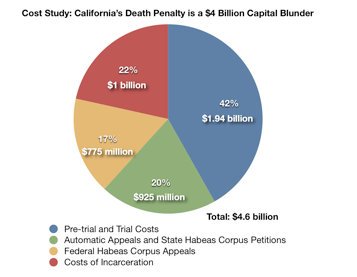
We did not come to this decision lightly, and NO, we are not soft on crime. Just the opposite. SAFE California replaces the death penalty with a sentence of life in prison with absolutely no chance of parole as the maximum punishment for murder. This means convicted killers will remain behind bars forever – but without the exorbitant price tag, terrible toll on the family members of victims, or the risk of executing an innocent person. At over 720 inmates and with a $4 billion price tag, our state runs the nation’s costliest and most populous death row. Nonetheless California has carried out just 13 executions since 1978.

We were intimately involved in writing and promoting our current death penalty law in 1978. We believe that public safety is one of the primary purposes of a government predicated on the rule of law. Justice should be swift and certain. The structure that we helped create is legally sound, having withstood multiple appeals to the U.S. Supreme Court. But, fiscallyspeaking, it has been disastrous. We never contemplated the staggering cost of implementing the death penalty: more than $4 billion to date and approximately $185 million projected per year in ongoing costs.

Source: ExecutingtheWilloftheVoters?” by Judge Arthur Alarcon and Paula Mitchell, 2011

We thought we would bring California savings and safety in dealing with convicted murderers. Instead, we contributed to a nightmarish system that coddles murderers and enriches lawyers. Like Senator Anderson, our effort was intended to bring about greater justice for murder victims. Never did we envision a multi-billion dollar industry that packs murderers onto death row for decades of extremely expensive incarceration. We thought we would empty death row, not triple its population.

Having 34 years of firsthand experiences in this matter we feel the bill proposed by Sen. Anderson will not fix these problems. First and foremost, shortcutting the appeals process means risking innocent lives. Appeals are the safety net that keeps us from executing innocent people. States that shortchange the justice process have executed innocent people, like CameronToddWillingham in Texas.

Beyond the risk of executing the innocent, SB 1514 would simply move appeals from one court to another. That doesn’t alleviate the delay or the expense, it will just move it to a different courthouse.

It won’t eliminate the $1 million each county pays per death penalty trial, or the extra housing costs on death row over the general population – on average $100,000 per inmate per year – and it won’t change the fact that 99% of death row inmates in California die of old age rather than execution. History tells us any change to the death penalty has only added life to criminals, enhanced lawyers paychecks costing taxpayers more and more while appellate dates or new trials continue to torture victims’ families and survivors.

We believe that life without parole protects victims’ families and survivors at a greater savings to taxpayers. California’s best path for safety and savings is life without the possibility of parole.

Please join us in supporting theSAFECaliforniaAct with a “YES” this November. California has another chance at real justice. We should embrace it.

Freed death row inmate will speak at Penn State Beaver


march, 26, 2012 source :http://www.br.psu.edu


the public is invited to attend a free presentation by Juan Melendez at 6 p.m., Wednesday, March 28 in the auditorium of the Penn State Beaver Student Union Building.

Melendez was imprisoned on death row in Florida for almost 18 years until his conviction was overturned and he was released in 2002. Upon his release, Melendez became the United States’ 99th death row inmate to be exonerated and released since 1973. 

In his presentation, Melendez will discuss his story of injustice and wrongful imprisonment on death row as one of many problems pervasive throughout the nation’s legal system and will describe the high rate of wrongful convictions based on poverty, race, and ethnicity.

Melendez will also share how he survived his experiences while imprisoned and how he maintained his spirit while he and others worked to free him.

Since his release, he has spoken here and abroad about the crisis of wrongful imprisonment, especially on death row, and his story has been reported in French, Spanish, Italian, and Arabic.

The administration of justice program and the Beaver campus Student Activity Fee are sponsoring the presentation as part of the Unique Perspectives for Selecting Your Career Path Speaker Series.

For information, contact Larissa Ciuca, student personal and career counselor, at lbm12@psu.edu or 724-773-3961 or LaVarr McBride, instructor in administration of justice at Beaver, Penn State New Kensington, and Penn State Shenango, atlwm13@psu.edu or 724-773-3866.

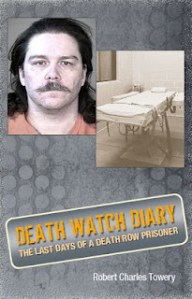
Death Watch Diary: The Last Days of a Death-Row Prisoner


Robert Towery was denied clemency by the state of Arizona on Friday March 2, 2012 and was executed on Thursday March 8th in Florence, Arizona. He was 47 years old.
The last 35 days of his life, Robert was placed on “Death Watch” where his every move was recorded and chronicled by prison officials. Robert kept a diary and he sent his writings to his attorneys. Robert authorized his lawyers to release his diary after his execution.
“Death Watch Diary” is available now as a FREE PDF version at www.deathwatchdiary.com.
A $.99 ebook download on amazon at http://www.amazon.com/dp/B007JD3LUM is available in Kindle format.
In his narrative, Robert picks at the ironies and absurdities of life in prison. He revels in simple pleasures, such as a good meal or a sports event on television. He yearns for the human contact from his last visitors, and he touchingly tries to comfort his pod-mate, who doesn’t really understand that he is going to his death.
As often happens, the man who was executed was not the same man who had committed the crime. Robert had 20 years to think about his crime and once he was free of the drugs and the torment, he became a thoughtful man. Robert apologized to the family of his victim and to his own family both in his clemency hearing and in his last words before his execution.

The barbarity of life on America’s death row Werner Herzog and Hank Skinner


march 23, 2012 source : http://www.thisiscornwall.co.uk

They have the death penalty in 34 American states – 16 of which currently perform executions with lethal injections. Until only recently, you could elect to die by firing squad in Utah.

German filmmaker Werner Herzog laid out his cards when he interviewed Hank Skinner, a man who has spent 17 years on death row in Texas.

“I’m not an advocate of the death penalty,” said Werner.

“Neither am I,” quipped Hank.

What emerged from this compelling documentary was a grim story of life on death row. The treatment of inmates seemed barbaric. Time doesn’t just drag here, it’s all over the place.

They don’t wash the windows of the cells so prisoners end up cocooned in a world of their own.

There’s activity and noise 24 hours a day. They serve breakfast at 3am, lunch at 10am and supper at 4pm.

The food is awful, says Hank, until you get to the execution unit, where you get a good last meal. He’s been so close to execution that he’s been given the last rites and had a final meal – fried chicken, catfish fillets, salad, a bacon cheeseburger, fries and chocolate milkshake.

It was delicious – because it’s prepared by the prisoners and they get to eat what the condemned man couldn’t face. Hank says, with a wry smile, that his last-minute reprieve gave him his appetite back and the prisoners had to go without their treat.

Hank says he’s innocent of the murder of his girlfriend and her two mentally disabled sons in 1995 – I guess a lot of death row men say they’re not guilty – but it seems unjust that he had to go to the Supreme Court to get the District Attorney to release DNA evidence which he says could prove his innocence.

On the face of it, he might have a point. There was another man’s jacket at the scene covered in the victim’s blood. His fingerprints were on a knife because he used it every day to make sandwiches.

Whatever the rights and wrongs of the case, it throws the spotlight on the use of the death penalty. Being proved innocent after death makes no sense at all.

Alabama – Carey Dale Grayson – execution – april 12, 2012 DELAYED


source : Court of criminal appeals of alabama  november 1999

The trial court made the following findings of fact concerning the crime and the appellant’s participation in it:

“On the night of [February 21, 1994,] Vickie Deblieux, age 37, was dropped off by a friend on I-59 near Chattanooga, Tennessee, to hitchhike to her mother’s home in Louisiana.

Four teenagers, the defendant ( Carey Dale Grayson), Kenny Loggins, Trace Duncan, and Louis Mangione, all who had been drinking alcohol and using drugs, saw her hitchhiking on I-59 at the Trussville exit in Jefferson County, Alabama. They offered to take her to Louisiana;  instead they took her to a wooded area, on the pretense of picking up another vehicle.“After arriving in this area, they all got out of the vehicle, and began to drink. The defendant, along with the others threw bottles at Ms. Deblieux, who began to run from them. They tackled her to the ground and began to kick her repeatedly all over her body. When they noticed that she was still alive, one of them stood on her throat, supported by the Defendant, until she gurgled blood and said ‘Okay, I’ll party,’ then died.

They then put her body in the back of a pickup truck and took her and her luggage to Bald Rock Mountain, after removing her clothing and a ring, and they played with her body and then threw her off a cliff.

They then went to a car wash in Pell City to wash the blood out of the truck.  After rummaging through her luggage, they hid the luggage in the woods.

“On their return to Birmingham, they took Mangione home and then returned to Bald Rock Mountain, where they began to mutilate the body by stabbing and cutting her 180 times, removing part of a lung, and removing her fingers and thumbs.

“The next morning defendant’s girlfriend found the three of them in Birmingham asleep in the truck all covered in mud and blood.   The defendant told her they got blood on them from a dog.

“On [February 26, 1994,] three rock climbers found Ms. Deblieux’s body and called the police.  Her body was taken to the medical examiner’s office.

“The medical examiner found the following injuries;  almost every bone in her skull was fractured, every bone in her face was fractured at least once, lacerations on the face over these fractures, a missing tooth, left eye was collapsed, right eye was hemorrhaged, tongue discolored, 180 stab wounds (postmortem), two large incisions in her chest, her left lung had been removed and all her fingers and both thumbs were cut off.

“The medical examiner opined that the cause of death was blunt force trauma to the head and that she was alive during the beating.

“All defendants were later arrested after Mangione began showing one of Ms. Deblieux’s fingers to friends.

“Defendant’s Case:

Ralph Wiley, the defendant’s uncle testified that he was disabled because of a bipolar disorder, which is a prevalent disorder in the defendant’s family. That Defendant’s mother died when he was age three and his father has been married four or five times.  He had not been around defendant in many years.

“Dora Roper, the defendant’s second cousin testified that her mother had mental problems for which she had to be hospitalized.

“Jan Arnett, testified that she was defendant’s junior high school teacher when he was ages 13-16.   That he was hyperactive in class, not interested in school, and wouldn’t do classwork or homework․ She tried to get defendant’s father to help the defendant.   That defendant was not violent and knew right from wrong․

“Dr. Rebert, a forensic psychologist for the State of Alabama, Department of Mental Health, opined that the defendant at the time of the incident suffered from a mental disease or defect. She described this as a bipolar disorder and said he was in a manic state at the time of the incident;  however, he did know the difference between right and wrong and was able to appreciate the nature and quality or wrongfulness of his acts.

“Dr. Goff, a private psychologist who opined that at the time of the incident the defendant suffered from a mental disease or defect, bipolar I disorder, which involves extreme mood swings. However, the defendant did know right from wrong but would not be able to respond to the rightness or wrongness of his acts.

“Jan Deblieux, the victim’s mother testified that she was not involved in a lawsuit filed by her daughter’s estranged husband.”

The record further indicates that, although the investigation originally involved suspects in Chattanooga because the victim was from that area, the investigation eventually led the police to the Jefferson County jail, where the appellant was incarcerated. He was interviewed by the police at the jail where he agreed to give a statement, indicating that “they were not hanging this case on him and [he wanted] to tell his side of the story.” The appellant then gave the following statement which was admitted at trial:

“Kenny, T.R., Louis and myself were all drinking very heavily when T.R. and Louis suggested that we get into a fight.  We left and went riding around and found a hitchhiker at I-59 exit in Trussville, Alabama. We picked her up and took her to the pipeline․  Medical Center East. We were all talking when she made a remark about killing us all when I threw a beer bottle at her, then Kenny hit her with his bottle, Louis hit her with his and T.R. with his.  After that she began to run when Kenny got her in the back of the head with another bottle, causing her to fall. We all ran over and began to kick her and hit her. When she stopped moving, Kenny saw she was still alive and stood on her throat [until] she died. Then we took her to Pell City and left the body. We then went to the car wash and washed out the bed of Kenny’s truck and we took Louis home. When we got back to my car, T.R. and Kenny asked me to show them the way to the body and I did.  When we got there, T.R. and Kenny began to mutilate the body by cutting off the fingers and cutting open the stomach. T.R. had found a bottle and shoved it into the [vagina] while Kenny took out her eyes. After this we dumped the body and left for T.R.’s house. Kenny and I returned to my car and we went ․ to Hardee’s in Chalkville and all three of us fell asleep in the truck, where Kenny’s girlfriend woke us up later that morning.”

Upon further questioning, by the authorities, the appellant made other statements concerning the details of the offense.  The appellant stated that while T.R. was standing on the victim’s throat, he placed his hands on the appellant for balance.  He further indicated that, when they dumped the victim’s clothes over the cliff, T.R. took some of the clothing and Kenny took a ring from the victim. The appellant indicated that he took nothing from her. The appellant was then asked why he and his accomplices had killed the victim;  the appellant responded that he did not know why they had killed her, “but it was not his problem.” The officer who took the appellant’s statement noted that he was very cooperative and that his attitude was “almost one of humor. He had a smile during the entire time we were speaking with him.”

The appellant argues that the trial court committed reversible error by refusing to allow the defense to question a State’s witness concerning a civil suit involving the appellant, because, he says, this questioning would have tended to show the bias of the witness. Specifically, the appellant argues that he was improperly prevented from questioning the victim’s mother, Jan Deblieux, concerning a wrongful-death action that had been filed by the victim’s estranged husband against the Miller Brewing Company. The appellant argues that the suit was being brought by the decedent’s estate and that the decedent’s mother clearly had a financial interest in the civil suit, and allowing him to question her about it would prove her bias in seeing that the appellant was convicted.

The record indicates that the victim’s mother had testified during the State’s case-in-chief to establish that the victim was her daughter, and had also testified that, just before the offense, the victim had telephoned her, stating that she would be traveling home to Louisiana very shortly, by bus or by plane. The witness further testified that she never heard from her daughter after that conversation.  There after, during the appellant’s presentation of his defense, the victim’s mother was called as a witness. She was asked whether she knew an attorney who had been hired by her daughter’s estranged husband.  She stated that she had not met with the attorney, nor had she participated in hiring him. More over, when asked if she was “familiar with the nature of the lawsuit filed on behalf on the decedent,” the victim’s mother responded that she had received “a pack like this,” indicating a large stack of materials, but that she had “no idea what it means.”  The prosecutor objected to the questioning on the grounds of relevance and defense counsel asked to make a proffer as to what he expected the evidence to show.  The trial court then allowed defense counsel to make his statement outside the presence of the jury. Defense counsel stated that they sought to admit a certified copy of the complaint and other papers in the lawsuit as well as testimony concerning it, because the lawsuit sought to hold Miller Brewing Company responsible for the victim’s death, because the appellant and his accomplices were drinking Ice House beer to the point of intoxication which caused the death.   Thus, defense counsel argued that the lawsuit, filed by the ex-husband, portrayed the death as caused by intoxication rather than by the appellant’s “meanness” or as part of a satanic ritual, both of which were suggested as causes by the State’s evidence. Defense counsel stated that convicting the appellant would further the victim’s mother’s cause in her lawsuit and therefore affected her bias and credibility, because she had a financial interest in the outcome of the criminal case.

full article click here

april 09, 2012  source : http://www.therepublic.com

The scheduled Thursday execution of Alabama death row inmate Cary Dale Grayson has been delayed by the Alabama Supreme Court.

The Alabama Department of Corrections said the Supreme Court had stopped the execution Monday. Officials with the AlabamaAttorney General’s office could not be reached for comment on whether the state would appeal the decision. Last month the 11th U.S. Circuit Court of Appeals stopped the scheduled execution of death row inmate Tommy Arthur after his attorneys challenged a change that had been made to the drugs used in Alabamaexecutions.

Grayson was one of four teenagers convicted for the 1994 torture and murder of Vicki Lynn DeBlieux, who was hitchhiking on Interstate 59. She was beaten and her body was thrown off a cliff and later mutilated.

feb.24, 2012  sourcehttp://www.dailyhome.com

A Birmingham man convicted of a 1994 murder that was discovered in St. Clair County received his execution date from the Alabama Supreme Court on Thursday.The court ordered that Carey Dale Grayson, now 37 years old, be executed by lethal injection on April 12 at Holman Prison in Atmore. Grayson is on death row for the Feb. 21, 1994, kidnapping and murder of Vicki Lynn Deblieux. Grayson was one of four men charged with torturing and killing Deblieux and throwing her body off Bald Rock Mountain, between Odenville and Pell City.

St. Clair County chief investigator Joe Sweatt said he remembers the case as “one of the most horrific murders” to ever occur in the area.

It’s one I’ll always remember,” Sweatt said. “She was hitchhiking on I-59 back to Louisiana, back to her mother’s house.

The murder actually happened in Jefferson County, and they dumped her body in St. Clair County. They actually mutilated the body … trying to make it hard to identify.”

Sweatt said he recalled that all four of the men involved were teenagers, and all were from the Birmingham area. Grayson, the oldest, was 19 at the time.

The truck they hauled her body in, they went to Pell City to the car wash across from the high school and pressure washed the back of the truck and threw some of her belongings in the woods back there,” Sweatt said. “We signed petitions on them here in St. Clair, but we actually had to transfer them in Jefferson County. We had to certify them as adults and went through four separate trials.”

According to Sweatt, the three others involved in the crime were initially sentenced to death, but received life in prison without the possibility of parole.

Iowa – Angela Johnson spared from death row


march, 24  source : http://www.omaha.com

IOWA CITY (AP) — A judge removed one of two women from federal death row on Friday, saying lawyers for the Iowa woman convicted in the 1993 execution-style murders of five people failed to present evidence about her troubled mental state that could have spared her from execution.

In a 448-page ruling, U.S. District Judge Mark Bennett threw out Angela Johnson’s death sentence, saying her defense lawyers were “alarmingly dysfunctional” during the 2005 trial that made her the first woman to be sentenced to death in the federal system since the U.S. Supreme Court reinstated the punishment in 1976.

Attorney General Eric Holder and aides must determine within 60 days whether to appeal or continue seeking the death penalty for Johnson, said Assistant U.S. Attorney C.J. Williams, who prosecuted the case.

If they do not appeal, there will be a trial to determine whether Johnson, 48, will be sentenced to death. In that trial, her lawyers would be allowed to present evidence about her mental health that was omitted in 2005. If they decline to seek the death penalty, Bennett could sentence Johnson to life in prison without parole.

Bennett’s ruling doesn’t throw out her convictions; he said evidence of her guilt was overwhelming. Johnson and boyfriend Dustin Honken committed the murders to thwart a federal investigation that threatened to end Honken’s reign as one of the Midwest’s largest methamphetamine kingpins, and buried the bodies to cover them up.

After separate trials, jurors sentenced Honken to death for the murders of two children while Johnson was sentenced to death on four counts. Both were to die by lethal injection.

The bodies of the victims — drug dealers-turned-government witnesses Terry DeGeus and Greg Nicholson; Nicholson’s girlfriend, Lori Duncan; and Duncan’s daughters, Kandi, 10, and Amber, 6 — were found in shallow graves near Mason City in 2000. They were discovered after Johnson, serving time on drug charges, sketched out a locator map to a jailhouse informant.

Prosecutors said Johnson posed as a saleswoman to gain access to Duncan’s home in 1993, days before Honken was to plead guilty to drug charges. Honken and Johnson forced Nicholson to make a videotaped statement exonerating Honken. Afterward, they took him, Duncan and her children to a field and shot each of them in the back of the head at close range.

A month later, Johnson lured DeGeus, a former boyfriend, to a secluded location where Honken shot him several times and beat him with a baseball bat.

Bennett said that he understands his ruling will upset victims’ families, but Johnson’s defense was so riddled with missteps that her rights were violated.

“I believe that I have done my duty, in light of what is required by the Constitution — the foundational document of our nation’s enduring freedoms, including the right not to be put to death when trial counsel’s performance was so grossly constitutionally inadequate,” he wrote.

During the penalty phase of Johnson’s trial, Bennett said defense lawyers failed to present expert testimony about her mental health at the time of the murders that could have helped explain her involvement to jurors. He said they should have presented evidence about the impact of serious brain impairments, personality disorders and her prior methamphetamine use.

Bennett said defense lawyers also failed to present evidence that could have undercut the prosecution’s claim that she participated in DeGeus’ killing out of revenge, because of their prior relationship’s abusive nature. He said they should have had experts argue she was suffering from battered woman’s syndrome and wouldn’t have wanted him dead.

At trial, her attorneys argued the government’s case was built entirely on circumstantial evidence and that Johnson was ignorant of Honken’s intent to kill. They urged jurors to sentence her to life in prison, not death.

Iowa does not have the death penalty, and Bennett said few lawyers in the state had expertise in capital punishment. He said he tried to assemble a “dream team” of lawyers for Johnson — including Alfred Willett of Cedar Rapids; Patrick Berrigan of Kansas City, Mo.; and Dean Stowers of Des Moines — but they performed poorly.

Willett and Berrigan didn’t return messages Friday. Stowers agreed the defense team was dysfunctional.

“I’m happy she’s going to get a new shot at things because she deserves it,” he said.

Bennett, appointed to the bench by President Bill Clinton, has acknowledged his personal opposition to the death penalty. In a 2006 speech about the two capital murder cases, he said he set aside his personal beliefs in the interest of fairness. But he added he had “grave concerns” that the death penalty could be applied unfairly.

William Mitchell asks US Supreme Court to stop his execution scheduled for Thursday


march, 20 source : http://www.therepublic.com

JACKSON, Miss. — William Mitchell has asked the U.S. Supreme Court to stop his execution now scheduled for Thursday at the state prison in Parchman.

In documents filed Tuesday, the death row inmate said his previous attorneys didn’t do a good job and the Mississippi courts have refused to give him a hearing and an expert to prove his “intellectual disability.”

The Supreme Court had not ruled on his motion Tuesday.

Mitchell, now 61, had been out of prison on parole for less than a year for a 1975 murder when he was charged with raping and killing 38-year-old Patty Milliken.

In documents filed Tuesday with the court, Mitchell says his previous attorneys didn’t do a good job and the Mississippi courts have refused to give him a hearing and an expert to prove his “intellectual disability.”

Milliken disappeared on Nov. 21, 1995, after walking out of the Majik Mart convenience store where she worked in Biloxi to have a cigarette with Mitchell. Her body was found the next day under a bridge. She had been “strangled, beaten, sexually assaulted, and repeatedly run over by a vehicle,” according to court records.

Mitchell was convicted of capital murder in Harrison County in 1998.

Mitchell argues the Mississippi Supreme Court twice refused to consider his ineffective counsel claims stemming from actions by his lawyers during the penalty phase of his trial and during his post-conviction petitions.

He said at no time did his attorneys try to develop evidence of his “intellectual disability” when evidence was available or could be available if he was given a psychological evaluation.

In a post-conviction petition, an inmate argues he has found new evidence — or a possible constitutional issue — that could persuade a court to order a new trial.

Similar arguments from Mitchell were turned down in the federalcourts last year.


   Us. Surpeme Court
No. 11A882
Title:
William Gerald Mitchell, aka William Jerald Mitchell, Applicant
v.
Mississippi
Docketed:
Linked with 11-9373
Lower Ct: Supreme Court of Mississippi
  Case Nos.: (2012-DR-00277)
~~~Date~~~ ~~~~~~~Proceedings  and  Orders~~~~~~~~~~~~~~~~~~~~~
Mar 20 2012 Application (11A882) for a stay of execution of sentence of death, submitted to Justice Scalia.

~~Name~~~~~~~~~~~~~~~~~~~~~ ~~~~~~~Address~~~~~~~~~~~~~~~~~~ ~~Phone~~~
Attorneys for Petitioner:
J. Cliff Johnson II. Pigott & Johnson (601)-354-2121
775 N. Congress Street
P.O. Box 22725
Jackson, MS  39225-2725
Party name: William Gerald Mitchell, aka William Jerald Mitchell
Attorneys for Respondent:
Marvin L. White Jr. Assistant Attorney General (601) 359-3680
450 High Street
P.O. Box 220
Jackson, MS  39205
Party name: Mississippi