Amnesty International publishes its annual review of death sentences and executions


Amnesty International publishes its annual review of death sentences and executions worldwide, let’s begin with the good news: the death penalty is on the retreat.

Last year, only 20 out of 198 countries carried out executions ― a figure down by more than a third from a decade ago. And 90 percent of U.N. member states were execution-free, while 140 countries have now abolished the death penalty in law or practice.

march 27, 2012 source : http://www.koreatimes.co.kr

Each execution is one too many

By Salil Shetty

Working for an organization whose job is to stand up for justice and freedom, and to expose abuses and injustices, I am often forced to highlight problems rather than progress.

So, as Amnesty International publishes its annual review of death sentences and executions worldwide, let’s begin with the good news: the death penalty is on the retreat.

Last year, only 20 out of 198 countries carried out executions ― a figure down by more than a third from a decade ago. And 90 percent of U.N. member states were execution-free, while 140 countries have now abolished the death penalty in law or practice.

It is worth pausing to consider these figures. When Amnesty International began its global campaign against the death penalty 35 years ago ― opposing it in all cases, regardless of the crime, offender, or method of execution ― the world’s 16 abolitionist countries were then the minority. Today, the poles are reversed and instead those states clinging to capital punishment are the exception.

In 2011, execution-free areas included all of Europe and the former Soviet Union, except Belarus; and all of the Americas, except the U.S. The Pacific region was death penalty free apart from five new sentences in Papua New Guinea.

This sea-change is testament to human rights campaigners with the courage to stand up to repression; to politicians and decision-makers with the courage to go against the political or popular grain; and to lawyers, journalists and academics with the courage to expose the truth.

They have shown that not only is the death penalty wrong ― a violation of the right to life ― but that once examined in any detail, the case for state-sanctioned murder collapses.

Does it deter violent crime? There is no convincing evidence for this. Countries that have abolished the death penalty often have lower murder rates than those that have not. State sanctioned killing endorses the use of force and can fuel cycles of violence and retribution.

What about popular support for executions? Such support is usually a mile wide and an inch deep. Once expedient reactions or a calculated desire by leaders and commentators to be “tough” on crime is replaced by considered discussion, and once alternative options are suggested, public support for execution recedes.

Don’t victims of crime deserve justice and closure? Yes, people who have suffered awful crimes deserve justice, but justice cannot be rooted in revenge. Murder is wrong, whether perpetrated by a person or by the state.

Some may find closure, but this is not self-evident ― sometimes victims of violent crimes oppose their attackers’ execution. In the U.S., Bangladeshi immigrant Rais Bhuiyan campaigned unsuccessfully for clemency for Mark Stroman, who had shot him during a series of violent crimes committed in reaction to the 9/11 attacks. Rais said: “My religion teaches that forgiveness is always better than vengeance.”

And of course there is no appeal from the grave. The U.S. state of Illinois abandoned the death penalty in 2011 following several wrongful convictions.

No wonder some argue that the true test of support for the death penalty isn’t a willingness to execute, but a willingness to accept the possibility of killing the innocent.

Others justify capital punishment for regional, religious or cultural reasons. But the abolitionist majority includes states from all major world regions, religions and cultures.

Yet a few states persist with capital punishment, and here we must address the bad news. A small group of isolated countries executed at an alarming rate last year. Whether by beheading, hanging, lethal injection or shooting, globally at least 676 people were executed and at least 18,750 people remained under sentence of death at the year’s end.

These figures exclude thousands of executions believed to have taken place in China, the world’s leading executioner. We no longer publish figures we collect from public sources on this country, as these are likely to grossly underestimate the true number. So far China has not accepted our challenge to publish the real figures, in order to confirm their claims that there has been a significant reduction in the use of the death penalty in the country over the last four years.

Neither do our figures include credible reports of large numbers of additional executions in Iran, which are not officially acknowledged. These would almost double the official tally there.

China and Iran were joined in their willingness to execute by Saudi Arabia, Iraq, and ― alone in the Americas and in the G8 group of leading economies ― the U.S. Along with North Korea, Somalia and Yemen, these states are consistently among the highest executioners every year.

Regionally, the Middle East saw a sharp rise in recorded executions, up almost 50 percent on 2010. Iraq, Iran, Saudi Arabia and Yemen accounted for 99 percent of these cases.

We should also note that in most countries where people were sentenced to death or executed, it was after unfair legal proceedings. And in Belarus, China, Iran, Iraq, North Korea and Saudi Arabia death sentences sometimes followed “confessions” extracted through duress or even torture. As so often throughout history, capital punishment was used by repressive states to remove the troublesome or unwanted.

So there is no room for complacency. Each execution is one too many. But 2011 reinforced the overall trend firmly toward abolition, and it is clear that this cruel and irrevocable punishment, which makes victims of us all, is heading inevitably toward the history books.

Salil Shetty is secretary general of Amnesty International.

Amid tragedy, activists promote ‘Better Days Ahead’


march, 26, 2012  source : http://www.roosevelttorch.com

Last year, the execution of Troy Davis execution sparked outrage around the world. Davis, who was wrongfully convicted of killing a police officer in 1989, became a symbol of worldwide artistic and political movements against racial injustice and wrongful convictions.

At the Wicker Park Arts Center Friday, Occupy Chicago Rebel Arts Collective (OCRAC) hosted a tribute event called “Better DaysAhead.” The event was to pay remembrance to Davis and his sister, Martina Correia. Correia, who passed six months after Davis, was an advocate on Davis’ behalf and fought against the death penalty.

“We’ve learned quite a bit of how the legal system fails in the last few decades,” said Paul Cates, Innocence Project communications director. He explained that 25 percent of wrongfully convicted cases are due to misidentification. False confessions account for another 25 percent and 50 percent is attributed to invalidated forensic science. In Davis’ case, there was no DNA evidence, according to Cates.

OCRAC, a project of Occupy Chicago’s Arts & Recreation, hosts events like the Davis tribute to connect local artists and to highlight the human effect of unchanging laws and wrongful convictions.

“OCRAC exists for the purpose of connecting with artists of all stripes…and mobilizing the power of art in the name of a more just and equal world,” according to the OCRAC website.

Artists and attendees reflected on the tragedies and celebrated Davis’ and Correia’s lives at the “Better Days Ahead” event. Speakers from various local anti-racism organizations like Amnesty International, Occupy 4 Prisoners, and Campaign to End the Death Penalty attended the tribute.

FM Supreme, ‘Two-time Louder than A Bomb’ city-wide high school poetry competition winners, performed at the event. The group wrote a song last year, dedicated to Davis and Correia.

“FM Supreme in particular was active in trying to save Troy,” Alex Billet said, an OCRAC artist and Rebel Frequencies founder, a journalism website focused on political activism through music. “Word is that Supreme had the chance to perform the song for her (Correia) before she passed away.”

An additional memorial was held for Trayvon Martin, in which a local artist set up a framed photo of Martin along with candles, and placed iced tea and Skittles, which Martin was carrying in his pockets at the time of the shooting.

Billet felt the impromptu memorial was important.

“Troy Davis and Trayvon Martin are both victims of the same sick, violent and virulently racist system,” Billet said in an email statement.

Ed Yohnka, director of communications and public policy at ACLU Illinois, believes tributes like “Better Days Ahead” help to spread awareness about injustices in the legal system and inspire people to right those injustices in various ways.

“I think stories like Davis’ have a powerful impact on how people relate to policy issues, and how it could affect them,” said Yohnka. “For example, President Obama’s statement in regards to relating to Trayvon Martin as a son. Comments like that connect people to issues. It’s very, very powerful.”

OCRAC hosts several events a month to promote activism through art. The next

OCRAC-sponsored event is Chicago Spring, at the Chicago Board of Trade on April 7 at noon.


Freed death row inmate will speak at Penn State Beaver


march, 26, 2012 source :http://www.br.psu.edu


the public is invited to attend a free presentation by Juan Melendez at 6 p.m., Wednesday, March 28 in the auditorium of the Penn State Beaver Student Union Building.

Melendez was imprisoned on death row in Florida for almost 18 years until his conviction was overturned and he was released in 2002. Upon his release, Melendez became the United States’ 99th death row inmate to be exonerated and released since 1973. 

In his presentation, Melendez will discuss his story of injustice and wrongful imprisonment on death row as one of many problems pervasive throughout the nation’s legal system and will describe the high rate of wrongful convictions based on poverty, race, and ethnicity.

Melendez will also share how he survived his experiences while imprisoned and how he maintained his spirit while he and others worked to free him.

Since his release, he has spoken here and abroad about the crisis of wrongful imprisonment, especially on death row, and his story has been reported in French, Spanish, Italian, and Arabic.

The administration of justice program and the Beaver campus Student Activity Fee are sponsoring the presentation as part of the Unique Perspectives for Selecting Your Career Path Speaker Series.

For information, contact Larissa Ciuca, student personal and career counselor, at lbm12@psu.edu or 724-773-3961 or LaVarr McBride, instructor in administration of justice at Beaver, Penn State New Kensington, and Penn State Shenango, atlwm13@psu.edu or 724-773-3866.

John Lotter, ‘Boys Don’t Cry’ Killer And Death Row Inmate, Denied Appeal By U.S. Supreme Court


march, 27  source : http://www.huffingtonpost.com

OMAHA, Neb. — The U.S. Supreme Court has denied the appeal of a Nebraska death row inmate whose murder case inspired the 1999 film “Boys Don‘t Cry.”

John Lotter and a co-defendant were convicted in the 1993 slaying of Teena Brandon, a 21-year-old woman who lived briefly as a man, and two witnesses to her killing. Lotter has maintained his innocence.

In August, a three-judge panel of the 8th U.S. Circuit Court of Appeals rejected Lotter’s attempt to appeal his conviction, and his request for the full court to consider his appeal was denied.

Lotter then appealed to the U.S. Supreme Court which last week denied Lotter’s request without comment.

Lotter’s attorney, Andre Barry of Lincoln, declined to comment on Tuesday. Lotter can petition the U.S. Supreme Court for a rehearing of the appeal.

Along with Brandon’s death, Lotter and Nissen were convicted of killing Lisa Lambert, 24, and Philip DeVine, 22, who witnessed Brandon’s death in the farmhouse near Humboldt, about 80 miles southeast of Lincoln.

Brandon had reported being raped by the two men. A former Richardson County sheriff was later criticized for his handling of the rape charges and for failing to offer Brandon protective custody.

In a deal with prosecutors to avoid the death penalty, Nissen testified that he stabbed Brandon, but Lotter fired the shots that killed the three. Nissen was sentenced to life in prison.

But in July 2007, he changed his story and said he, not Lotter, shot all three.

true story  of brandon Teena

No. 11-8458      *** CAPITAL CASE ***
Title:
John L. Lotter, Petitioner
v.
Robert Houston, Warden
Docketed: January 24, 2012
Lower Ct: United States Court of Appeals for the Eighth Circuit
  Case Nos.: (11-2223)
  Decision Date: August 23, 2011
  Rehearing Denied: October 31, 2011
~~~Date~~~ ~~~~~~~Proceedings  and  Orders~~~~~~~~~~~~~~~~~~~~~
Jan 20 2012 Petition for a writ of certiorari and motion for leave to proceed in forma pauperis filed. (Response due February 23, 2012)
Feb 17 2012 Brief of respondent Robert Houston, Warden in opposition filed.
Feb 28 2012 Reply of petitioner John L. Lotter filed. (Distributed)
Mar 1 2012 DISTRIBUTED for Conference of March 16, 2012.
Mar 19 2012 Petition DENIED.

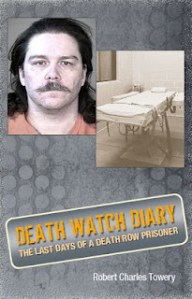
Death Watch Diary: The Last Days of a Death-Row Prisoner


Robert Towery was denied clemency by the state of Arizona on Friday March 2, 2012 and was executed on Thursday March 8th in Florence, Arizona. He was 47 years old.
The last 35 days of his life, Robert was placed on “Death Watch” where his every move was recorded and chronicled by prison officials. Robert kept a diary and he sent his writings to his attorneys. Robert authorized his lawyers to release his diary after his execution.
“Death Watch Diary” is available now as a FREE PDF version at www.deathwatchdiary.com.
A $.99 ebook download on amazon at http://www.amazon.com/dp/B007JD3LUM is available in Kindle format.
In his narrative, Robert picks at the ironies and absurdities of life in prison. He revels in simple pleasures, such as a good meal or a sports event on television. He yearns for the human contact from his last visitors, and he touchingly tries to comfort his pod-mate, who doesn’t really understand that he is going to his death.
As often happens, the man who was executed was not the same man who had committed the crime. Robert had 20 years to think about his crime and once he was free of the drugs and the torment, he became a thoughtful man. Robert apologized to the family of his victim and to his own family both in his clemency hearing and in his last words before his execution.

Clive Stafford Smith – How the US judicial process convicts the wrong people


very interesting

CNN interview of the wrong conviction of Alan Northrop !


march, 25, 2012

Woodland, Washington (CNN) — Alan Northrop was playing pool in 1993 when his life changed forever. He was lining up a bank shot when he felt something on his wrist: a handcuff.

Northrop was arrested for the rape and kidnapping of a housekeeper. “I instantly said, ‘No, you’ve got the wrong guy,'” Northrop recalls telling detectives. But detectives believed the victim’s testimony, although she was blindfolded for most of the attack. A jury agreed, sentencing Northrop, a father of three children under age 6, to 23 years in prison.

From behind bars, Northrop tried to prove police had the wrong guy. In 2000, he contacted the Innocence Project Northwest at the University of Washington School of Law in Seattle.

For years, prosecutors denied the project’s requests to use more advanced DNA testing on the evidence in Northrop’s case. In 2005, a new state law gave judges the power to order additional testing. But it took five more years for Northrop’s testing to be completed and for a court to consider the results that conclusively showed another man’s DNA was on the victim.

In 2010, Northrop, still sitting in prison, got a letter with news he thought he might never get.

“I was jumping around the day room saying, ‘I’m out of here! I’m out of here!'” Northrop said.

read full interview on CNN

The barbarity of life on America’s death row Werner Herzog and Hank Skinner


march 23, 2012 source : http://www.thisiscornwall.co.uk

They have the death penalty in 34 American states – 16 of which currently perform executions with lethal injections. Until only recently, you could elect to die by firing squad in Utah.

German filmmaker Werner Herzog laid out his cards when he interviewed Hank Skinner, a man who has spent 17 years on death row in Texas.

“I’m not an advocate of the death penalty,” said Werner.

“Neither am I,” quipped Hank.

What emerged from this compelling documentary was a grim story of life on death row. The treatment of inmates seemed barbaric. Time doesn’t just drag here, it’s all over the place.

They don’t wash the windows of the cells so prisoners end up cocooned in a world of their own.

There’s activity and noise 24 hours a day. They serve breakfast at 3am, lunch at 10am and supper at 4pm.

The food is awful, says Hank, until you get to the execution unit, where you get a good last meal. He’s been so close to execution that he’s been given the last rites and had a final meal – fried chicken, catfish fillets, salad, a bacon cheeseburger, fries and chocolate milkshake.

It was delicious – because it’s prepared by the prisoners and they get to eat what the condemned man couldn’t face. Hank says, with a wry smile, that his last-minute reprieve gave him his appetite back and the prisoners had to go without their treat.

Hank says he’s innocent of the murder of his girlfriend and her two mentally disabled sons in 1995 – I guess a lot of death row men say they’re not guilty – but it seems unjust that he had to go to the Supreme Court to get the District Attorney to release DNA evidence which he says could prove his innocence.

On the face of it, he might have a point. There was another man’s jacket at the scene covered in the victim’s blood. His fingerprints were on a knife because he used it every day to make sandwiches.

Whatever the rights and wrongs of the case, it throws the spotlight on the use of the death penalty. Being proved innocent after death makes no sense at all.

kill a man…


kill a man, wiImagell not bring back the person you lost. kill an innocent man, will not bring back the person you lost, but two innocent people will have died for nothing. when justice will understand that the death sentence is not the solution to reducing crime, and when I read after an execution, we won! what have you gained ? society that has she won? and you?