USA NEWS

TEXAS : Remembrance – Dominique Green “A Saint on Death Row “


On October 26, 2004, Dominique Green, thirty, was executed by lethal injection in Huntsville, Texas. Arrested at the age of eighteen in the fatal shooting of a man during a robbery outside a Houston convenience store, Green may have taken part in the robbery but always insisted that he did not pull the trigger. The jury, which had no African Americans on it, sentenced him to death. Despite obvious errors in the legal procedures and the protests of the victims family, he spent the last twelve years of his life on Death Row.

Werner Herzog’s ‘On Death Row’ Subject Executed


Having delved into the deep end of the prison system, interviewing a man awaiting execution and the family members of his victims in his outstanding 2011 doc “Into The Abyss.” Werner Herzog is set to continue the conversation about the death penalty and those to whom it’s been given in “On Death Row,” a four-part companion series to last year’s film that premieres on the Investigation Discovery channel on March 9th at 10pm. 

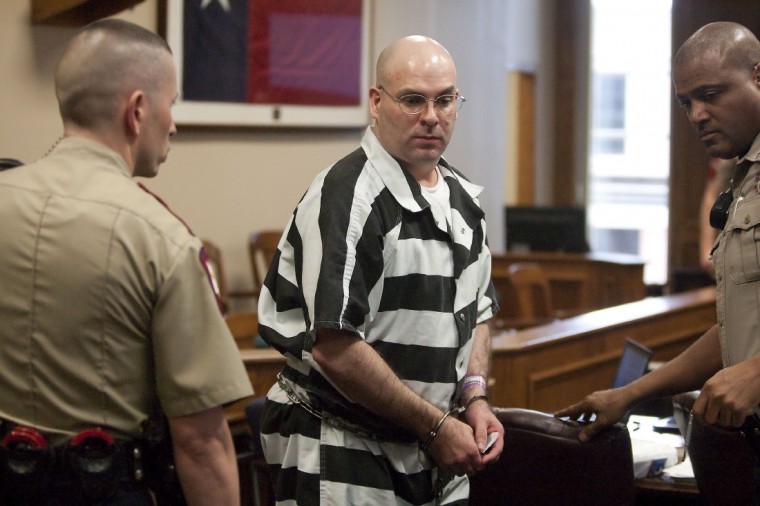
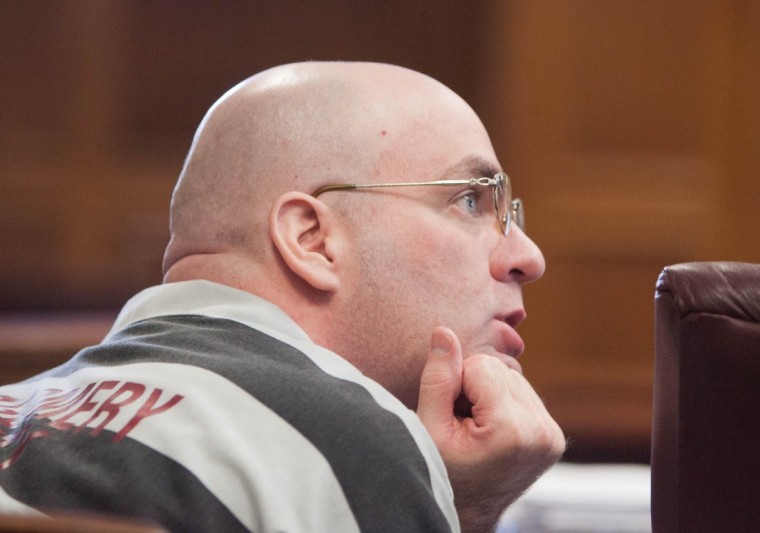
In an unfortunate instance of timeliness, one of the five inmates he interviews in the series has just been executed. George Rivas, 41, was the leader of the Texas 7, a gang that escaped from a maximum-security prison and went on a crime spree that left one policeman dead, ultimately getting caught after someone spotted them on “America’s Most Wanted.” He was serving multiple life sentences for kidnapping, robbery and burglary charges at the time of the breakout. In the clip from “On Death Row” below, he tells Herzog “I had more time than all mass murderers in the prison system that I know of. They took away all hope for me. When you do that to a person, anything is possible.”

Rivas died by lethal injection on Wednesday. According to the AP, he offered a statement to the family of Aubrey Hawkins, the slain officer: “I do apologize for everything that happened. Not because I’m here, but for closure in your hearts. I really do believe you deserve that.”

The episode featuring Rivas and fellow gang member Joseph Garcia is scheduled to air March 23. Herzog doesn’t support the death penalty, but during “Into The Abyss” demonstrated his ability to highlight its ugliness and find empathy for those awaiting execution while never softening his portrayal of the crimes committed, telling Michael Perry “I don’t have to like you, but you are a human being.”

TEXAS – Larry Swearingen back in court


                                                   http://www.myfoxhouston.com/video/videoplayer.swf?dppversion=11212

Swearingen official website 

        Swearingen Legal documents (pdf)

A defense expert in the hearing of convicted killer Larry Ray Swearingen reluctantly agreed with prosecutors Thursday that histology – the study of microscopic cell tissue – isn’t an accepted method to determine the time of death in a body.

Meanwhile, defense attorney Stephen Jackson accused the state of asking a “trick question” and stressed the science is valid.

“If the (science) was not well-based, it would have been excluded by now (by state District Court Judge Fred Edwards). And that hasn’t happened,” Jackson said.

The hearing, which began Monday in Edwards’ 9th state District Court, was ordered by the Texas Court of Criminal Appeals in July 2011 to hear Swearingen’s claim of innocence.

Like the first three days, the fourth day of the hearing focused on the condition of Trotter’s body when it was found. The defense argued the condition of the body and, more important, microscopic slides of Trotter’s heart and liver, prove she could not have died 22-25 days prior to discovery.

However, during cross-examination of Galveston County Medical Examiner Stephen Pustilnik, the prosecution challenged the validity of histology in determining the postmortem interval – the time from death to when a body is found.

On more than one occasion, Special Prosecutor Lyn McClelland asked Pustilnik to examine several books on forensic pathology and see if Pustilnik could locate “any reference in any book” that connects the use of histology to determine PMI.

“They don’t exist,” Pustilnik said.

“The defense’s position is not valid science,” Assistant District Attorney Warren Diepraam said.

The hearing resumes Monday with the prosecution to present its experts.

Swearingen’s Claim

Larry Ray Swearingen, 40, was sentenced in 2000 to die by lethal injection for the murder of 19-year-old Melissa Trotter of Willis. Since then, he has received three stays from execution. He claims he couldn’t have killed Trotter because he was in jail on Dec. 11, 1998. Trotter disappeared on Dec. 8, 1998 and her body was found on Jan. 2, 1999 in the Sam Houston National Forest.

…………………………………………………………………………………………………………………………………………………………………………………….
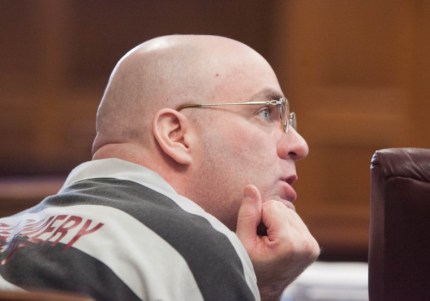
March 9 2012

 photo by Eric S. Swist

The canopy of trees so prevalent in the Sam Houston National Forest played a role in the condition of Melissa Trotter’s body when found 25 days after her disappearance, a meteorological expert testified Thursday.

Richard Grant, a professor at Purdue University, said the temperature at tree-top level is not dissimilar to the temperature in an open field.

However, Grant, an expert on microclimate, said the solar heat is diffused as it works its way to the forest floor.

Approximately 20 percent of the solar energy reaches the bottom of the forest, he said.

Questioned by prosecutor Warren Diepraam, Grant testified the temperatures on a forest floor tend to be more consistent than in a more open environment.

“The heat transfer is lower,” Grant said. “The temperature of the (forest) can’t be the same as an open field.”

Testimony in the hearing is expected to conclude today. Edwards may issue a ruling or send all evidence and testimony to the TTCA. Either way, a determination is not expected before a couple of months.

Source : http://www.yourhoustonnews.com

————————————————————————————————————————————————————————————————————–

March 8 2012

The battle of the experts continued Wednesday at the hearing of convicted killer Larry Ray Swearingen.

Forensic Entomologist Neal Haskell testified under cross-examination that he could extract a time of death based on DNA, weather data and autopsy photographs.

Prosecutor Warren Diepraam asked Haskell if the forensic evidence he was shown Wednesday was consistent with the condition of Trotter’s body found 25 days after her disappearance.

Haskell agreed.

Later in the day, Sibyl Bucheli, of Sam Houston State University, was called to the stand to testify about the decomposition of the human body.

Bucheli said data obtained at SHSU proved to be “entirely” consistent with the decomposition of Trotter’s body, Diepraam said.

“She (Bucheli) showed (Trotter’s) internal organs didn’t turn to mush as the defense alleged,” he said.

Defense attorney Stephen Jackson challenged Bucheli’s qualifications.

“She just received a PhD in Philosophy from Ohio State,” Jackson said. “She cherry-picked a body (at SHSU) that is not consistent with 17 days of 20-degree weather when the temperature was up in the 70s. It’s apples to oranges.”

The hearing is expected to conclude today.

source : http://www.yourhoustonnews.com

March 6 2012

The former Harris County medical examiner who conducted the autopsy in the Larry Swearingen murder case testified on Tuesday that his attorney misrepresented her opinion.

Dr. Joye M. Carter said during an evidentiary hearing that she did not reverse her opinion concerning how long Melissa Trotter‘s body had been in the Sam Houston National Forest, as Swearingen’s attorneyJames Rytting claimed in a 2007 affidavit.

Swearingen received a stay of execution after Rytting cited the affidavit in an appeal. He is on death row for the strangulation and sexual assault of Trotter, 19, who went missing on Dec. 8, 1998, from Lone Star College-Montgomery. Her body was discovered 25 days later.

During the 2000 trial, Carter testified the body had been in the woods for 25 days or so, placing the time of death on Dec. 8.

But Rytting tried to get Carter to say the wording in the affidavit indicated that the body was in the woods a maximum of 14 days, placing the time of death on or after Dec. 12.

Swearingen contends he could not have killed Trotter because he was in jail on Dec. 11 on an unrelated charge.

The hearing will determine whether Swearingen should receive a new trial.

http://www.larry-swearingen.com/attachments/File/Affidavit_of_Jerald_Crow_(2007).pdf

MISSOURI – Death penalty procedures rife with problem . ABA report


An American Bar Association analysis of Missouri’s death penalty procedures finds much room for improvement.

The report, to be formally announced today, faults the state for:

* not holding on to DNA evidence for as long as a person is incarcerated;

* not having clear requirements for recording depositions;

* not providing two attorneys and an investigator for defendants in death-penalty cases and appeals;

* not paying public defenders in capital cases fairly;

* not tracking racial statistics in death-penalty cases;

* and requiring that a defendant’s mental disability be documented — as opposed to just manifested — before they reach 18.

The report, “Evaluating Fairness and Accuracy in State Death Penalty Systems: The Missouri Death Penalty Assessment Report,” was conducted by a team of eight Missouri law professors, attorneys and judges with varying views on the death penalty. It looked at a dozen key areas that affect who is executed by the state and how fairly such punishment is meted out.

“The ABA doesn’t take a position on the death penalty itself but calls for states to impose a moratorium if certain problems have not been corrected,” said Virginia Sloan, chair of the ABA Death Penalty Moratorium Project.

The Missouri report is part of a second wave of such reports that have looked at the death penalty in Alabama, Arizona, Florida, Georgia, Indiana, Kentucky, Ohio, Pennsylvania and Tennessee since 2003. Funding for all the reports came from the European Union, which strongly opposes the death penalty.

The report said the state’s “areas of strength” were its accreditation of crime labs, provision of defense services, trial instructions to jurors in capital cases, the independence of its judiciary and its treatment of “mentally retarded” offenders.

Reform, however, was called for in six areas: aggravating circumstances, at the pretrial stage, at the trial stage, at the post-trial stage, data collection and funding issues. It says that the state allows too broad of a range of aggravating circumstances to result in a penalty of death.

Legislation in Missouri was introduced at the beginning of this year by Rep. Mike Colona, D-St. Louis, to hold off on executions in Missouri until a statewide report can be completed.

Source : http://molawyersmedia.com/

U.S.A News about Death penalty


Every day, you find the latest news on the death penalty, I will group the most important news I have read in the media.

TEXAS – Last hour of George Rivas- execution February 29, 2012 – EXECUTED 6.22 p.m


Last statement

Yes, I do. First of all for the Aubrey Hawkins family, I do apologize for everything that happened. Not because I am here, but for closure in your hearts. I really believe that you deserve that. To my wife, Cheri, I am so grateful you’re in my life. I love you so dearly. Thank you to my sister and dear friend Katherine Cox, my son and family, friends and family. I love you so dearly. To my friends, all the guys on the row, you have my courtesy and respect. Thank you to the people involved and to the courtesy of the officers. I am grateful for everything in my life. To my wife, take care of yourself. I will be waiting for you. I love you. God Bless. I am ready to go

Aubrey Hawkins, the police officer killed by t...

Aubrey Hawkins, the police officer killed by the Texas Seven (Photo credit: Wikipedia)

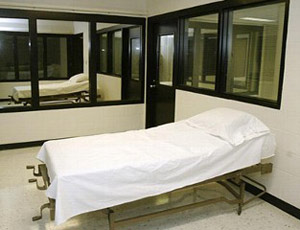
5:59p George Rivas will be strapped to a gurney, arms extended, and an IV for the lethal injection will be inserted in both arms. Once He’s strapped down, the warden will call for witnesses to enter the two observation rooms.

5:58p Once witnesses are in place, guards will ask George Rivas if he wants to make a final statement. He said he did.

5:48p Guards move George Rivas from his holding cell, 15 feet to the execution chamber. The lethal injection procedure is scheduled to begin a few minutes after six o’clock.

5:22p One of George Rivas’ four witnesses did not appear for his execution. Dallas County District Attorney Craig Watkins will attend instead.

5:03p Three drugs are used in the lethal injection cocktail. That used to cost about $86, but the price has recently skyrocketed to more than $1,300 because the state has been forced to resort to a more expensive substitute for one of the drugs being used.

5:01p “I met with him a few minutes ago along with the warden and the chaplain, and Rivas stated that he’s… all these years he’s made it clear that he’s ready to go,” said Jason Clark, a spokesman for the Texas Department of Criminal Justice. “He did say that he was going to make a last statement.” Rivas is said to have made several personal calls from a phone provided by the prison, He asked five friends to witness his lethal injection.

4:50p More than 15 Irving police officers are standing outside the Walls Unit where George Rivas will soon be executed for killing Irving Officer Aubrey Hawkins on Christmas Eve 2000.

4:42p The widow of Irving police Officer Aubrey Hawkins, who was killed by George Rivas, will not attend the execution. She told News 8 that she felt no closure after being present at the last execution of a Texas 7 gang member in 2009.

4:40p George Rivas was served barbequeue chicken for his final meal, just like the other inmates at the Walls Unit.

4:30p George Rivas’ appeals have all been denied. Clemency is denied. The state says attorneys for the convicted killer do not plan a last-minute challenge to the scheduled 6 o’clock execution.

ARIZONA – Robert H. Moorman – Execution – February 29, 2012 EXECUTED 10.23 a.m


The Arizona Department of Corrections has scheduled a Feb. 29 execution for a death row inmate convicted of killing his adoptive mother while on a three-day prison release in 1984.Corrections officials announced the execution date Wednesday for 63-year-old Robert Henry Moorman at the state prison complex in Florence.Moorman recently lost an appeal in the 9th U.S. Circuit Court of Appeals, and the U.S. Supreme Court declined to consider his case.Moorman was serving a nine-year prison term for kidnapping in 1984 when the state let him out on three-day release to visit his adoptive mother at a nearby hotel.Moorman beat, stabbed and strangled the woman, then dismembered her body and threw the pieces away in various trash bins and sewers in Florence before he was captured.

Arizona inmate facing execution hospitalized over illness Arizona death-row inmate Robert Moormann, who is scheduled to be executed Feb.29, was transported to an unnamed hospital Thursday after falling ill at the state prison in Florence, his attorney confirmed.The Arizona Department of Corrections would not provide information — even to Moormann’s attorneys — about Moormann’s condition, but a department spokesman said Thursday afternoon that Moormann was still alive.Moormann, 63, was sentenced to death for the 1984 murder of his adoptive mother.He has a history of health problems and was hospitalized twice last fall, first for an appendectomy and later for a quintuple heart bypass.Arizona prison policy requires death-row inmates facing execution to be kept alive until the last minute before execution by lethal injection.The execution protocol requires that a cardiac defibrillator “be readily available on site in the event that the inmate goes into cardiac arrest at any time prior to dispensing the chemicals; trained medical staff shall make every effort to revive the inmate should this occur.”In 1984, Moormannwas already imprisoned in Florence when he was granted a “compassionate furlough” to visit with his mother at a motel near the prison. During the visit, he killed her and dismembered her, dumping her body in garbage cans.In January, his attorneys argued that Moormann’s deteriorating health had lessened his intellectual functioning to the point where he could not be legally executed.
Arizona Supreme Court asked to stay executionLawyers for death row inmate Robert Henry Moormann have asked the Arizona Supreme Court to stay his scheduled Feb. 29 execution.In a 21-page motion filed Tuesday, Moormann’s attorneys say he was diagnosed in early childhood as being mentally retarded and the state can’t execute him because of that fact.The 63-year-old Moormann was sentenced to death for the 1984 death of his adoptive mother while on a prison furlough.Moormann was serving a prison term of nine years to life for kidnapping when the state let him out on three-day “compassionate furlough” to visit his adoptive mother at a Florence motel.Authorities say Moormann beat, stabbed and suffocated the woman before meticulously dismembering her body.Moormann’s attorneys used an insanity defense, but a jury convicted him of first-degree murder.
Families, others find closure in executionAt 10:23 a.m. on Feb. 29, convicted felon Robert H. Moorman was declared dead following his execution at the Arizona State Prison – 27 years after receiving his sentence.For Tom Rankin this particular order of execution offered a different kind of closure than that for relatives of the victims. He was the police chief in Florence 28 years ago when Moorman committed one of the most heinous crimes in the town’s history.“That was my third execution to observe, but this one was a bit more personal,” Rankin, one of the witnesses, said. “It provided closure for me, not only on that case, but for my law enforcement career. It was the last case that I had pending that I was involved in.“It’s like saying, ‘You’ve done your career. It’s over with now.’”Ironically, the Blue Mist Motel is within sight from the ASP visitors’ parking area. It was at the Blue Mist where, on Jan. 13, 1984, Moorman beat, stabbed and suffocated his adoptive mother, 74-year-old Roberta Moorman, who, according to defense attorneys, sexually abused him into his adult years.Moorman then dismembered Roberta’s body, cutting off her head, legs and arms, halved her torso, and flushed her fingers down the toilet. Most of her remains were found in trash bins around town after asking various businesses if he could “dispose of spoiled meat and animal guts.”Shortly after Moorman asked a corrections employee to dispose of “dog bones,” he was captured. The incident took place during a a three-day “compassionate furlough” from ASP, where Moorman was already serving nine years to life for kidnapping and molesting an 8-year-old girl in 1972.Moorman, 63, was sentenced to death on May 7, 1985. Appeals to overturn his warrant of execution were denied in 1986, 1987 and 1992. A motion to issue a warrant of execution was filed by the attorney general on Oct. 12, 2011 and granted on Nov. 29.Moorman was served his last meal between 7 p.m. and 7:30 p.m. on Feb. 28. It consisted of one double hamburger (two quarter-pound patties prepared “medium”) with two slices of onion, three leaves of lettuce, three tomato slices and a bun; plus French fries (with four ounces of ketchup), two three-ounce beef burritos, three Royal Crown colas, and two 14-ounce containers of Rocky Road ice cream.

A light breakfast was an option, but there was no word on whether or not Moorman accepted it.

From the reporter’s notebook, here’s the sequence of events:

8 a.m. – The media witnesses are greeted and informed that no cameras, pens or outside note pads are allowed – a pencil and note pad is furnished by the prison.

8:38 a.m. – Arizona Department of Corrections Director Charles L. Ryan came to the media room and announced that there were no further stays of execution and no pending motions from the Superior Court.

9:39 a.m. – The media leaves its holding area to another room upstairs. There, a DOC employee offered a briefing on the execution itinerary.

9:45 a.m. – After the briefing, media names were drawn at random to determine the order of entering the viewing gallery. My name was drawn first.

10 a.m. – There’s a delay in the process, as Moorman is having a final meeting with his legal counsel.

10:12 a.m. – The media is led to Housing Unit No. 9, enters the gallery area, and is positioned next to a partition, separate from other witnesses.

10:19 a.m. – Approximately 22 witnesses, other than the media and DOC staff, enter the gallery. An undetermined number of witnesses are on the other side of the partition.

10:21 a.m. – The curtain opens, and Moorman is seen strapped to a gurney, wearing his orange prison apparel. He appears calm as his execution order is being read.

10:23 a.m. – Moorman is asked if he has any final words. Looking up at the ceiling with a slight smile, he responds with an apology to the families involved, adding, “I’m sorry for the pain I caused. I hope this brings closure and they can start healing now. I just hope that they can forgive me in time.”

With that, the process of execution began.

10:24 a.m. – Moorman turns his head to his right and looks at the gallery. One minute later, he begins breathing hard, short of gasping for air, as the lethal injection of pentobarbital began to take effect.

10:27 a.m. – A physician enters the execution room to administer sedation.

10:29 a.m. – Moorman’s eyes are half-closed, looking peaceful, with little, if any, movement.

10:33 a.m. – The DOC announces, “The execution is completed.” The curtain is closed.

10:34 a.m. – The witnesses are excused.

10:40 a.m. – The media gives its witness account to six television stations and various print and radio reporters who did not see the execution.

“Death is never pretty,” Rankin said. “When I was standing there, I was wondering about (Roberta Moorman’s) family and wondering if any of her family was there. I didn’t know because I’ve lost contact with most of them. I didn’t recognize any of the other witnesses.

“For the family’s sake, I hope it’s over. It’s a period I hope they’ll never have to live through again.”

Deacon Ed Sheffer of St. Thomas The Apostle Parish in Tucson, who performs ministry work on death row, has been Moorman’s spiritual advisor for the last 10 years. After the execution, Sheffer said, “At the end, Robert was at a peaceful place and for some time had come to terms with what he had done and his fate. You could hear it in his last words, his thoughts and concerns were for others, not himself.”

Sheffer said Moorman received last rites from Bishop Gerald Kicanas of Tucson on Feb. 21, and had his final communion prior to the execution at approximately 6 a.m.

“He received his communion and was very grateful for our years of working together as he found his relationship with the Lord,” Sheffer said. “He moved from shame to guilt, to asking for mercy and reconciliation.

“His soul is now in God’s hands.”

Rankin noted it was the only case from his days as police chief that resulted in the death penalty, saying, “It’s too bad about the way the death penalty is scheduled, with the long delays and the years it takes to fulfill the sentence. I understand the process, but for the family of the victim, closure should come sooner.

“As for Robert Moorman, he got what he deserved,” Rankin concluded. “There’s no need to talk about him anymore. In law enforcement, we say, ‘case closed.’”

TEXAS – George’s Case – EXECUTED


 Execution day click here
George Rivas, 30, is, without question, a career criminal. Highly intelligent with a larger than life ego, it is little wonder that he plotted the Connally Unit breakout and appointed himself ringleader of the Texas 7. When it comes time for him to leave this world, an appropriate epitaph might read, “Guilty of crimes against humanity, and guilty of a wasted life.”Born in El Paso, Texas, on May 6, 1970, the six foot, 231 pound brown-haired, brown-eyed criminal with rugged good looks and a soft-spoken voice, could have been just about anything he wanted to make of himself had it not been for his lust for cash.Rivas, described by a former classmate as a “Beavis and Butthead kind of guy,” had aspirations of becoming a policeman before he turned to a life of crime, and spoke of his dream often. But he would never become a cop. Raised by his grandmother and grandfather after his parents divorced when he was 6, Rivas cruised through high school without attracting a lot of attention. Having a fascination with guns, he named his two dogs Ruger and Baretta, and began thinking about a life of crime.Characterized as intelligent, well spoken and friendly, Rivas did not get into trouble with the law until shortly after graduating from Ysleta High School in 1988 where, according to a high school spokesman, he was identified as a quiet guy who did not participate in any school activities. He committed his first robbery and burglary the following year, but since he had no prior criminal record he was sentenced to probation for 10 years.While on probation, Rivas enrolled at the University of Texas at El Paso where he signed up as a general studies major in the fall of 1992. After three semesters, unable to shake his criminal bent and lust for cash, he dropped out in the spring of 1993 and embarked on a short-lived criminal career that would land him in prison. There were striking similarities to his crimes that tied him to a string of robberies in El Paso that could be seen in his modus operandi of the prison breakout and the robbery of the Radio Shack in Pearland, as well as to a string of holdups, at least a dozen, that he was suspected of committing in Texas, New Mexico, and Arizona.One of the robberies he was suspected of committing occurred on October 3, 1992, at a Radio Shack in El Paso. According to a police report, he was suspected of handcuffing a salesman and then robbing the store of cash, two-way radios, as well as other merchandise.Less than three weeks later, on October 23, he was suspected of entering a Checker Auto Parts store under the guise of buying a car battery when he pulled a gun on a salesman. He was accused of forcing the salesman to remove his uniform shirt, after which he handcuffed him and forced him into the restroom. He then put on the uniform shirt and forced the store’s assistant manager to open the safe, of which he cleaned out all the cash on hand.Barely two weeks after the auto parts store robbery, Rivas walked into an El Paso Oshman’s sporting goods store near closing time under the guise of looking at ski boots. He went so far as to ask the assistant manager to keep the store open a bit longer so that he could purchase a pair of the boots, and explained that he was waiting for a friend to bring his wallet to him. When he was satisfied that he had the assistant manager’s cooperation, he pulled out a gun and ordered him to call all of the employees together.”I’m with store security,” Rivas told the employees as they arrived one by one. After he had gathered everyone together, he pulled out his gun and announced, “This is a robbery.” He then called an accomplice on a two-way radio, took a uniform shirt from an employee and put it on so that he wouldn’t unduly stand out just in case someone unexpectedly came in, such as the police, and he and his accomplice handcuffed all of the employees except one to a heavy ski grinding machine. Afterward, Rivas forced the store’s manager to empty the safe for him. He took all of the cash, $5095, as well as 58 guns. He didn’t touch anything during the robbery, but instead forced the employee to pick up and pack the items that he wanted to steal.”I’ve written down all of your license plate numbers and can find out where you live if anyone tries to identify us,” Rivas said as he and his accomplice left the store. He also said that he would return and kill them if anyone called the police.The employees waited about twenty minutes after Rivas and his accomplice left the store. They then dragged the ski grinding machine to a phone and called the police, after which they dragged the machine back to its original location out of fear that Rivas might return and find out what they had done.Rivas’s next known robbery occurred on May 12, 1993, when Rivas, donning a blond wig and brandishing a gun, went inside a Furr’s grocery store in El Paso and forced all of the employees into a back room. He took all of the cash that he could locate.On May 25, 1993, Rivas and an accomplice disguised themselves as security guards and walked into a Toys ‘R’ Us store. After rounding up eight employees, Rivas and his accomplice robbed the store. Although his previous robberies had been carried out with military-like precision, in this case he somehow missed one of the employees who escaped and called the police. When the police arrived, Rivas and his accomplice held them at bay for more than three hours by using the employees as hostages. However, a SWAT team was called in when the police officers realized that they weren’t going to get anywhere. The SWAT team stormed the store and found Rivas, wearing a blond wig, hiding in an air conditioning duct. They also recovered some of the guns that had been stolen from the Oshman’s sporting goods store robbery earlier. Although his arrest ended the string of local robberies, he was still suspected of committing the numerous robberies in other parts of Texas, Arizona and New Mexico.

Following his arrest, numerous employees from the various stores that he had robbed positively identified Rivas as the perpetrator. At his trial, he claimed that he was having dinner with his wife during the Oshman’s robbery and had been mistakenly identified. The jury didn’t buy his claims of mistaken identity in that case, or any of the others, and he was convicted of multiple counts of aggravated armed robbery, aggravated kidnapping, and burglary under various theories of law.

Dr. Richard Coons, a court-appointed Austin psychiatrist, examined Rivas prior to his trial. Despite the fact that nobody had been injured during the commission of any of Rivas’s crimes, Coons opinion was that had only been a matter of luck and not because of Rivas’s kindness.

“He demonstrates an unusual degree of interest, creativity and intensity in his craft,” Coons said. “He is confident and arrogant. He is a mastermind and a leader. He has no conscience, and he does not speak the truth.”

Rivas was sentenced to 18 life terms in prison, 17 of which were ordered to run consecutively. The judge wanted to make certain that he never left prison, alive.

Following Rivas’s escape from the Connally Unit, Dr. Coons was contacted by members of the news media and related that when Rivas and his cohorts were found and confronted by the police, the confrontation would likely turn deadly.

source : trutv
Supreme court of united states
No. 11-6812      *** CAPITAL CASE ***
Title:
George Rivas, Petitioner
v.
Rick Thaler, Director, Texas Department of Criminal Justice, Correctional Institutions Division
Docketed: October 12, 2011
Lower Ct: United States Court of Appeals for the Fifth Circuit
  Case Nos.: (10-70007)
  Decision Date: July 14, 2011
~~~Date~~~ ~~~~~~~Proceedings  and  Orders~~~~~~~~~~~~~~~~~~~~~
Oct 10 2011 Petition for a writ of certiorari and motion for leave to proceed in forma pauperis filed. (Response due November 14, 2011)
Nov 9 2011 Brief of respondent Rick Thaler, Director, Texas Department of Criminal Justice, Correctional Institutions Division in opposition filed.
Nov 23 2011 DISTRIBUTED for Conference of December 9, 2011.
Dec 12 2011 Petition DENIED.

~~Name~~~~~~~~~~~~~~~~~~~~~ ~~~~~~~Address~~~~~~~~~~~~~~~~~~ ~~Phone~~~
Attorneys for Petitioner:
Franklyn Mickelsen Broden & Mickelsen (214) 720-9552
2600 State Street
Dallas, TX  75204
Party name: George Rivas
Attorneys for Respondent:
Edward L. Marshall Chief, Post Conviction Litigation Division (512) 936-1400
    Counsel of Record Office of the Attorney General
P.O. Box 12548
Capitol Station
Austin, TX  78711-2548
edward.marshall@oag.state.tx.us
Party name: Rick Thaler, Director, Texas Department of Criminal Justice, Correctional Institutions Division