News

Georgia Sets March 20 Execution Date for Willie Pye Despite Strong Evidence of Intellectual Disability and Previous Finding of Ineffective Representation by Attorney with History of Racial Bias EXECUTED 11.03 PM


UDPATE march 22. 2024

he state of Georgia on Wednesday executed death row inmate Willie Pye, who was convicted and sentenced to die for the 1993 murder of Alicia Lynn Yarbrough.

The execution – Georgia’s first in more than four years – was carried out by lethal injection at 11:03 p.m. at a prison in Jackson, about 50 miles south of Atlanta, the Georgia Department of Corrections said in a news release. Pye did not make a final statement, it said.

Pye, 59, was put to death after the US Supreme Court denied his final appeals late Wednesday. In a clemency petition and various court filings, Pye and his attorneys had argued for his life to be spared, citing an intellectual disability, a troubled upbringing and ineffective assistance of counsel.

“The State of Georgia obtained Willie’s death sentence only after providing him a racist and incompetent defense attorney. And the State has insisted on standing by that death sentence in spite of his lifelong intellectual disability and the fact that he presents a danger to no one in prison,” his attorney, Nathan Potek, said after the execution.

“The people of Georgia deserve better,” he added, describing Pye as a loving son, brother and uncle who “will be dearly missed by his friends, family, and his legal team.”

March 7, 2024

The Georgia Attorney General has announced that Willie James Pye, who previously had his death sentence reversed due to his attorney’s failure to investigate his background, only to see the death sentence reinstated on appeal, is set to be executed on March 20. Mr. Pye’s court-appointed trial attorney, Johnny Mostiler, has been accused of ineffective representation or racial bias in at least four cases involving Black defendants and reportedly called one of his own clients a “little n****r.” Mr. Pye has also exhibited “undisputed” signs of intellectual disability, with an IQ of 68 and a history of learning difficulties. Georgia has not conducted an execution in over four years, and Mr. Pye is the state’s first scheduled execution date in about two years.

Mr. Pye was convicted and sentenced to death in 1996 for the kidnapping, robbery, rape, and murder of his ex-girlfriend Alicia Yarbrough. At the time, Mr. Mostiler had a lump-sum deal with Spalding County to represent the entire indigent criminal caseload, which numbered some 800 felony and five capital cases. He also had an active private civil practice. Mr. Mostiler only spent about 150 hours on Mr. Pye’s case, including the trial itself, while studies have found that thousands of hours are typically required for effective capital defense representation. He also spent less than five hours preparing the case for a life sentence, most of it on the day of the penalty phase and the day before. Due to his limited investigation, he did not uncover evidence of Mr. Pye’s traumatic upbringing and intellectual disability. Mr. Pye grew up experiencing “near-constant physical and emotional abuse, extreme parental neglect, endangerment, and abject poverty.” He battled severe depressive episodes and reported hearing voices prior to the killing. However, Mr. Mostiler relied on Mr. Pye’s sister to recruit family members as witnesses and told them only to testify to Mr. Pye’s good character, without delving into the difficulties of Mr. Pye’s childhood. He did not request an evaluation of Mr. Pye’s intellectual functioning or develop evidence regarding the claim even after the state expert tested Mr. Pye’s IQ at 68, in the impairment range. 

At least three of Mr. Mostiler’s clients have been executed, including Kenneth Fults and Curtis Osborne; Mr. Mostiler infamously slept through portions of Mr. Fults’ trial, and he told a white client that he would spend much more money on his case than on Mr. Osborne’s because “that little n****r deserves the chair.” In Frederick Whatley’s case, Mr. Mostiler allowed the prosecution to force Mr. Whatley to reenact the murder while shackled in manacles and leg irons. Justice Sonia Sotomayor later wrote that it was “hard to imagine a more prejudicial example of needless shackling.” A 2001 profile of Mr. Mostiler following his death found that he had handled “more than seven times the number of indigent cases the American Bar Association (ABA) believes is manageable…turning over one case every 100 minutes, less time than a private attorney might devote to a simple traffic violation.” The profile called him the “archetype” of “meet ’em, greet ’em, and plead ’em” lawyers. 

In 2021, the U.S. Court of Appeals for the Eleventh Circuit overturned Mr. Pye’s death sentence, unanimously finding that Mr. Mostiler failed to investigate and present a broad range of available mitigating and rebuttal evidence. The panel did not reach the merits of Mr. Pye’s intellectual disability claim, writing that the ineffective assistance claim was sufficient to require a new sentencing trial, but highlighted substantial evidence of Mr. Pye’s low cognitive functioning. However, on the state’s motion, the Eleventh Circuit reconvened en banc (with the full court) and reinstated Mr. Pye’s death sentence. The court acknowledged that Mr. Mostiler’s performance was deficient, but held that it was required under the Anti-Terrorism and Effective Death Penalty Act (AEDPA) to defer to the state court’s finding that Mr. Mostiler’s performance did not prejudice Mr. Pye. The majority interpreted AEDPA and Supreme Court precedent to conclude that even if the state court’s decision rests on clear errors, federal courts must defer to that decision if there are “additional rationales” that support it. In other words, the federal reviewing court may theorize reasons for the state court’s outcome and adopt those reasons to justify a state court decision that is otherwise wrong on the facts or the law.

Willie James Pye v. Warden, Georgia Diagnostic and Classification Prison (US COURT OF APPEALS) 2021

wo judges dissented in full, while two additional judges joined the dissent in part but concurred in the judgment. Dissenting Judge Jill Pryor wrote that the majority had directly violated Supreme Court precedent by “turning to justifications the state never even hinted at” and relying on “a half-baked textual analysis” in support. She further argued that the holding “creates a practically impossible path to relief for habeas petitioners…[i]f federal courts can bury unreasonable findings under an avalanche of new reasons the state court never gave, then unreasonable findings will virtually never be important enough to satisfy the majority’s test.” 

Judge Pryor also noted the “undisputed evidence” of Mr. Pye’s low intellectual functioning. Supreme Court jurisprudence and scientific research recognize IQ scores below 70 as a strong, often definitive indicator of intellectual disability. Georgia has one of the lowest appellate success rates of intellectual disability claims by capital defendants, with an 11% success rate compared to 82% in neighboring North Carolina. Georgia is also the only state that requires defendants to prove their intellectual disability “beyond a reasonable doubt” at trial, and a 2017 study found that only one defendant had ever been found exempt from the death penalty on these grounds in three decades. Research shows that states that significantly deviate from accepted clinical standards, including Georgia, are much less likely to exempt defendants from the death penalty based on intellectual disability.

Judge Pryor concluded that under the majority’s ruling, the “writ of habeas corpus is illusory—impossible, even, to obtain.” She wrote that as the author of the panel opinion, reading the full court’s opinion made her feel like she had “stepped through the looking glass.” However, “what happened during Alice’s time through the looking glass was a dream…This case, unfortunately, is not.”  

All 58 Louisiana death row inmates with no execution date wait as bill proposes death by nitrogen gas


Subscribe to continue reading

Subscribe to get access to the rest of this post and other subscriber-only content.

‘I saw Alabama killer’s eyes bulge as he took 22 minutes to die in first nitrogen execution’, Reverend Dr, Jeff Hood witnessed


January 28, 2024

The spiritual advisor for convicted hitman Kenneth Eugene Smith accompanied him into the chamber, where he witnessed what he called ‘the most horrific thing’ he’d ever seen done to another human

Smith – who survived a botched lethal injection attempt in 2022 – was accompanied to the gas chamber by his spiritual advisor, Reverend Dr Jeff Hood. Rev Hood described how he watched the 58-year-old killer writhe around like a “fish out of water” while his eyes bulged.

Here, in the reverend’s own words, he tells of his haunting, traumatising experience as he watched Smith die after anointing his head with holy oil.

I go into the execution chamber, and one of the first things that I realize was what the oxygen meters were saying. The oxygen meters, when I went in for orientation the other day, were at 22%, which makes sense because air is like 78% nitrogen. When I was going into the chamber, it was 25.4%, which means that they were pumping extra oxygen into the chamber — so that was kind of how they managed that.

“I immediately notice that Kenny has on a mask that extended from the top of his forehead to underneath his chin. It looked like a firefighter’s mask, and it was super tight. There were sorts of straps everywhere. It felt like I was looking at Bane from Batman. That’s what it felt like — it was a super gnarly, intense mask. There were strings going from the mask to the gurney.

“There were two corrections officers and a woman by the name of Cynthia Stewart Reilly, who is in charge of male prisons in Alabama. They were all sort of nonchalant-looking when all of this was happening.

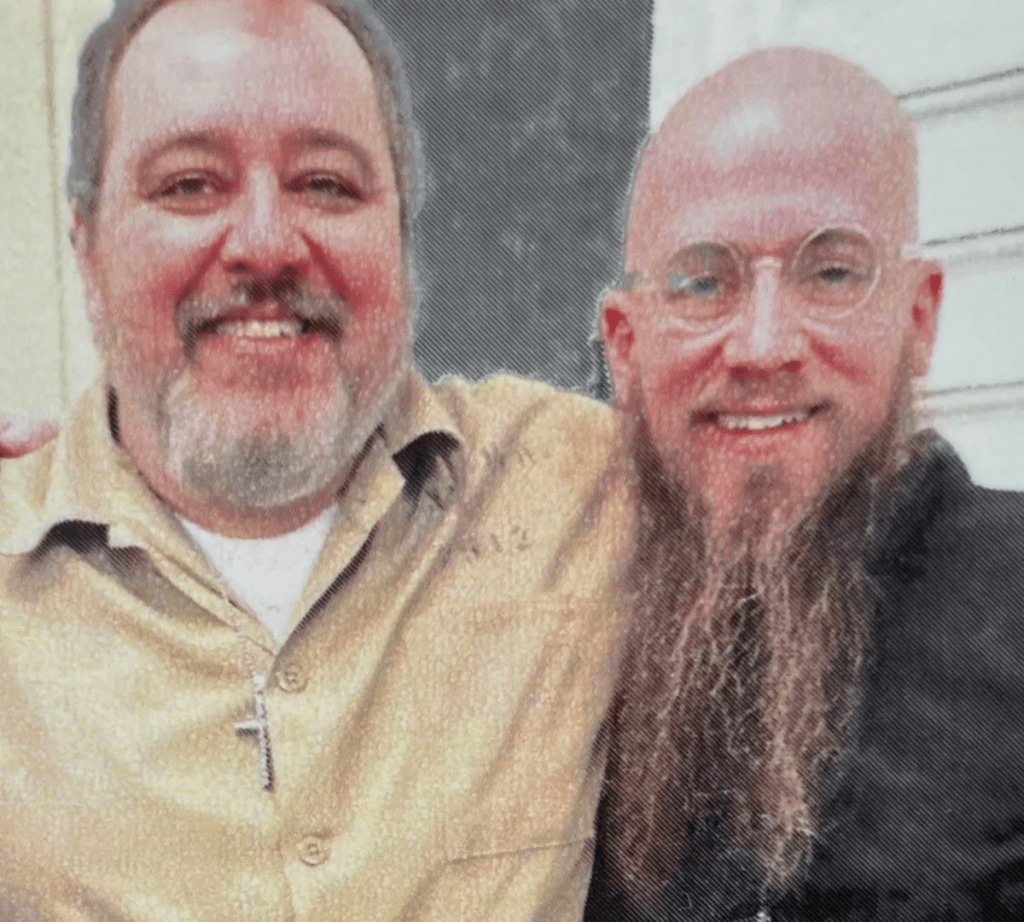
Hood stands with Smith as the two pose for a final picture together before his execution

(Image: Courtesy o Rev. Dr. Jeff Hood)

“Kenny, of course, gave his last words. I was, the whole time, going back and forth with Kenny. I put my hand over my heart to let him know that I loved him. He was talking to me, letting me know that he loved me. It was really powerful.
“At this point, the curtains were still shut, so the witnesses can’t see anything. As the curtains were opened, I was allowed to go up and make the sign of the cross on his leg. I did that, and he, again, repeatedly telling me how much he loved me and how thankful he was that I was there. Obviously, that was incredibly touching to me.
“Then, he looked at the room where his family was. He kept telling them how much he loved them. He gave his last words, and then the execution started.
“When the execution started, based on what the state said, I was expecting him to go unconscious in seconds. Well, as soon as the nitrogen hit, he began to convulse, and he didn’t stop convulsing for minutes. I know that by some accounts, it was two or three minutes.

He said the entire procedure lasted 22 minutes. That’s Lee Hedgepeth, who spoke at the press conference last night.

“It looked like a fish out of water. He kept heaving back and forth, back and forth. And the mask was tied to the gurney, and so every time he heaved forward, his face was hitting the front of the mask and pressing into the mask.

“His eyes started to bulge. He began to turn colors. He was spitting, and mucus was coming out of his mouth and his face. He kept almost hitting his face on the front of the mask.

“The mucus and saliva was hitting the front of the mask, and it was drizzling down the front of the mask. His whole body was seizing. It was absolutely, positively a horror show.

“It was so intense that the expressions of the corrections officers and Ms. Stewart Reilly dramatically changed from the nonchalant facial expressions that they had to real looks of concern.

Hood described the mask as being a tight fit, uncomfortably tight, and then said mucus and saliva from Smith coated the insides as he died

(Image: Getty Images)

“One of the reasons why I feel very comfortable calling Mr. Hamm [Alabama Department of Corrections Commissioner John Hamm] a liar, calling the attorney general [Steve Marshall] a liar, is because they know, based on the reactions in that room, that this was not a success, this was not what they thought it would be, this is not something that happened in seconds. This was something that was torture, cruel and unusual punishment, for minutes and minutes.

“Cynthia Stewart Reilly, she had on women’s dress shoes, and she kept on tapping her feet out of nervousness. It was almost as if she was tap dancing in the execution chamber. It was one of the noises that I kept hearing was her tapping her feet.

“It was just an unbelievably intense situation. I was crying my eyeballs out. I had my hand on the space behind me. The longer it went, I kept thinking in my head, ‘How long is this going to last? How long are we going to have to watch this s**t?’

“On a personal level, I felt an unbelievable sense of guilt that there was nothing I could do to stop it. I felt like I needed to tell Kenny that I was sorry that I couldn’t stop it. I think that comes from a couple of spaces, but … as an activist, I felt guilty that I couldn’t stop it beforehand. In the chamber, I felt just completely powerless.

“Witnessing a murder, a horror show like that, it’s horrible. The tears were running down my face.

“When it finally became apparent that he at least appeared to be deceased, they were waiting on a flatline from the EKG. My face went from just complete sadness and horror to absolute rage that the state of Alabama thought that it was morally appropriate to suffocate someone to death, to torture someone to death, in that manner.

“The tube that was coming out of the control center was a very thin tube. It actually looks like something that would have come out of plastic plumbing that kind of extends, except it was clear. The more he heaved, and the more he looked like a fish out of water, swinging back and forth, the more I was concerned that that tube was going to bust, or at least break, so there was that concern for my safety.

“I kept on wringing my hands. I couldn’t figure out what to do with my hands. You know when you rub your hands so hard you feel like you’re going to rub your hands off when something horrible is happening like you’re going to lose a finger at any moment? All of this happens, and I am eventually escorted out of the chamber.

“The state of Alabama does not send a doctor into the chamber to declare a time of death in front of the witnesses because they’re scared that the doctor will be revealed. In this circumstance, I was taken out of the chamber, and the reason that’s so important is nobody knows the exact time of death. We just have to trust the commissioner to come out and say the time of death.

“This is a state that says, ‘Trust us,’ but they are consistently not being honest and not telling the truth. I think it is very possible — I’m not saying this for certain — I think it is very possible that we could have left that room and Kenny [would] still be alive. We would have never known. We would have no idea.

“All we could tell was it didn’t look like he was breathing. It looked like he was unconscious. But there was no way for us to know that because there was no doctor in the space. There was no doctor who came out and declared a time of death.

Then, what happens is I am escorted down the hallway. On my right, as I was walking down the hallway, I saw the doctor, and he was very shocked and upset that I saw him because he was trying to hide. And the reason he was trying to hide is because he could lose his medical license for participating in that.

“It just shows that there are so many secrets and so many crimes and so many just horrific things that happened last night, and I hope that the state of Alabama is held accountable for the horror that they perpetuated.

“These state officials are obviously chicken hawks. They are all about executions. They’re hawks on executions, making those things happen. But they are too chicken to be present, to take any sort of responsibility, for what’s happening. They’re not in the execution chamber. They are not pushing the mechanisms.

“They’re cowards. They are all about talking about these executions and how they want them to continue and all this kind of fluster, but they are too chicken to participate in them themselves. They sit up in Montgomery, and they talk about how it was successful and this and that, but they’re never there.

They’re forcing the corrections officers to do this stuff, and there’s no doubt from what I saw last night that it has an unbelievable, detrimental effect on them.

“I was a trauma chaplain for a while, so I’ve seen people [who went through] car accidents and burn victims. I’ve seen, unfortunately, all sorts of horrific things — [including] four executions last year. This is the most horrific thing I’ve ever seen done to a human being, by far.

This was, again, a fish out of water. It was someone heaving over and over and over again, and in a viewing chamber where there were state officials, corrections officers, people who could have stopped it. And it just kept going. It wouldn’t stop.

“To say that this was successful… It’s just insane that they keep on saying that. Nobody that saw that would say that was a success, unless you consider a success to just be killing somebody.

“If a success is something that doesn’t violate the Eighth Amendment, if a success is something that’s moral — if this is a success, then they have a very different understanding of morality, any of these things.”

Texas Death Row inmate Ivan Cantu faces 3rd execution date, maintains innocence


January 11, 2024

Texas death row inmate Ivan Cantu is now facing his third scheduled execution date after the Texas Criminal Court of Appeals denied him a new trial following his filing of a petition to present new evidence in his case.

Cantu has been on death row for over two decades for murdering his cousin, James Mosqueda, a known drug dealer, and his cousin’s fiance, Amy Kitchen, in 2000. 

Since Cantu’s conviction in 2001, new information and holes in the state’s case raise questions of reasonable doubt, according to Matt Duff, a private investigator who has researched the case since 2019. The new developments in Cantu’s case included a trial witness recanting his testimony and a pair of jurors in his trial coming forward to express concerns about the conviction.

Duff documented his private investigation and created a lengthy, in-depth podcast titled “Cousins by Blood.” His work dives into Cantu’s case with first-hand interviews, including Cantu’s early jail tapes in 2000 and an interview with the state’s star witness that helped put him on death row. 

Ivan Cantu has been given two prior execution dates, but both have been halted. 

In 2022, after the DNA hearing concluded, Cantu received an execution date for April 2023. But Collin County District Judge Benjamin Smith withdrew that death warrant after Bunn filed her appeal outlining the new evidence.

Then, on August 23, a judge dismissed the new evidence for procedural reasons without considering the merit of her arguments. 

This month, Bunn filed a new request with the court to reexamine the ballistic evidence in the case since Duff and other investigators have conducted their own ballistics experiments that cast more doubt on some of the police’s original conclusions. 

To this day, Bunn doesn’t know if she has received everything related to Cantu’s case from the Collin County District Attorney’s Office and from the Dallas Police Department. Part of the issue is that 20 years have passed since the original trial, and many people currently working in those departments weren’t around then. Another issue was jurisdiction—Dallas police, then and now, don’t usually work with Collin County prosecutors—but the murders happened in a portion of North Dallas that extends into Collin County. 

Winning post-conviction relief is extremely difficult in Texas, though not impossible: 464 people have been exonerated of various crimes here since 1989, according to the National Registry of Exonerations. About a third of those cases were overturned due to perjury or false accusations, according to the registry. Nearly one in five was due to inadequate legal defense. 

Almost 70 exonerations were from Dallas County. But Cantu’s case was tried in Collin County, even though it was investigated by the Dallas Police Department. Since 1989, only four people sent to prison from Collin County have been exonerated.  

The judge who presided over Cantu’s trial, Charles Sandoval, has since been heralded “the worst judge in Collin County”. Known as “Hang Them All Sandoval,” he lost his seat in 2008 after developing a reputation for cruelty and for making decisions based not on law but on courtroom favorites. One of the four recent Collin County exonerations was of former Judge Suzanne Wooten, who was convicted of bribery after successfully challenging Sandoval in a judicial campaign. That accusation came directly from Sandoval, but the charges were later overturned and discredited as a baseless vendetta. 

On Valentine’s Day, Cantu will submit his paperwork to tell the prison system who he wants there on his execution day and what he wants the state to do with his body afterward. He’ll explain where he wants his few belongings and any money left in his account to go. 

Sister Helen Prejean, author of the book Dead Man Walking, is acting as Cantu’s spiritual adviser. She’ll be there with Cantu during his execution if his date holds. But in the meantime, she is a fierce advocate for the date to be withdrawn. 

“There’s no way I’m simply going to acquiesce, hold his hand, and pray him into eternity without doing every single thing I can to get the truth out so that Texas does not execute this man who very possibly might be innocent,” Prejean told

Prejean, along with Cantu’s other supporters, are calling on Collin County to again withdraw his death warrant. It’s one of many ongoing efforts to spare Cantu’s life—and to give him another day in court. Officials from the county did not respond to requests for comment for this story. 

“If you want to execute me, that’s fine,” Cantu said over the closed-circuit phone in the Polunsky Unit. “Just give me a fair trial.”

“The criminal court of appeals deemed the claims in Ivan’s application were procedural barred, meaning it should have been included in Ivan’s 2004 habeas filing,” Duff said. “If the claims raised were based on a 2009 law (ex. Parte Chabot) and 2022 recant of a state’s star witness, that information was clearly unavailable in 2004.”

“The court’s ruling is unjust and needs to be overturned,” Duff added. 

Cantu responded to the court’s decision on death row through the Texas Department of Criminal Justice email system.

“I’m disappointed with the Texas Court of Criminal Appeals for not reviewing my case on the merits,” Cantu writes. “I’m entitled to a new trial according to state law precedent and the constitution of the United States.”

“Where is State Rep. Jeff Leach?” Cantu added. “Leach advocates for other death row inmates such as Melissa Lucio and Jeffery Wood, who are not even from Collin County. Why isn’t he advocating for the injustice occurring in his own backyard?”

Texas State Rep. Jeff Leach was contacted for comment by phone and via email on Friday, Sept. 1, and again on Monday, Sept. 5, and has yet to reply as of noon on Wednesday, Sept. 6. 

Cantu’s execution date is scheduled for Feb. 28, 2024. 

Documentary

Claim your innocence World – News about the death penalty in the world


Hi everyone,

Just a little reminder, I created a blog about the death penalty in the world, you can read the news in all countries practicing the death penalty.

You find the blog here,  http://claimyourinnocenceworld.wordpress.com/

Thanks so much for your support.


Anabel

TEXAS – Jesse Joe Hernandez execution – march 28, EXECUTED 6.18 p.m


Jesse Joe Hernandez received lethal injection for the slaying of Karlos Borja (10 months old) 11 years ago.

“Tell my son I love him very much,” the 47-year-old Hernandez said before being put to death. “God bless everybody. Continue to walk with God.”

“Dile a mi hijo que  le quiero mucho”, dijo  Hernández de 47 años de edad, antes de ser condenado a muerte. “Dios bendiga a todo el mundo. Continúe caminando con Dios.”

As the drugs took effect, he repeated his appreciation for those he knew who had gathered to witness the execution. “Love y’all, man,” he said. “… Thank you. I can feel it, taste it. It’s not bad.”

He took about 10 deep breaths, which grew progressively weaker until he was no longer moving. Ten minutes later, at 6:18 p.m. CDT, he was pronounced dead.

———————————————————————-

The U.S. Supreme Court this afternoon rejected Jesse Hernandez’s request for a stay of execution, a court spokesman said.

(Los EE.UU. Corte Suprema de Justicia rechazó esta tarde, Jesse Hernández solicitud de suspensión de la ejecución, comento un portavoz del tribunal.)
The high court ruling came about two hours before the 47-year-old Hernandez, who previously was convicted of a child sex offense, could be taken to the Texas death chamber for lethal injection. The justices’ order was brief and did not include an explanation for their decision.

The Texas attorney general’s office opposed any delay, questioning whether the high court even had jurisdiction in the case because constitutional claims weren’t raised earlier in state courts.

Thomas Jones, an assistant attorney general, said jurors who sent Hernandez to death row probably would not have approved of a trial strategy that attempted to shift blame for the child’s death to the doctors treating him.

“Such an argument smacks of chutzpah,” Jones told the Supreme Court.

The decision clears the way for Texas to put Hernandez to death by injecting him with a series of drugs, including one often used to euthanize family pets. It will be the fourth execution of the year in Texas, the 12th in the United States.

march, 28, 2012 sourcehttp://abclocal.go.com

HUNTSVILLE, TX — The U.S. Supreme Court is considering whether to block the scheduled execution of a convicted child sex offender condemned in the beating death of a 10-month-old boy he was babysitting at a home in Dallas.

Related Content

Forty-seven-year-old Jesse Joe Hernandez is set for lethal injection Wednesday evening in Huntsville for the slaying of Karlos Borjas 11 years ago.

The child was brought to a Dallas hospital in April 2001 with a skull fracture and bruises to his head, thigh and abdomen. A week later, he was taken off life support and died. Hernandez’s DNA was found in Karlos’ blood on a pillowcase and on the child’s clothing.

Hernandez denied beating the children but later acknowledged to a detective he may have hit the boy with a flashlight.

case and court old post  click here

traducion para los hispanicos

Huntsville, Texas (AP) – La Corte Suprema de EE.UU. está considerando la posibilidad de bloquear la ejecución programada de un delincuente sexual sobre menores  condenado a muerte , por golpear  un niño de 10 meses de edad, cuando estaba de  niñera en una casa en Dallas.

Cuarenta y siete años de edad, Jesse Joe Hernández está listo para la inyección letal la noche del miércoles en Huntsville por el asesinato de Karlos Borjas, hace 11 años.

El niño fue llevado a un hospital de Dallas en abril de 2001 con una fractura de cráneo y contusiones en la cabeza, el muslo y el abdomen. Una semana más tarde, se le retirara el respirador artificial y murió. El ADN de Hernández se encuentra en la sangre Karlos ‘en una funda de almohada y en la ropa del niño.

Hernández negó a golpear a los niños, pero más tarde reconoció a un detective que pudo haber golpeado al muchacho con una linterna.

No. 11-9486

Jesse Joe Hernandez v. Texas

from the Court of Criminal Appeals of Texas

Docket Entries

on March 27, 2012

Reply of petitioner Jesse Joe Hernandez filed.

on March 27, 2012

Brief of respondent Texas in opposition filed.

on March 26, 2012

Application (11A904) for a stay of execution of sentence of death, submitted to Justice Scalia.

on March 26, 2012

Petition for a writ of certiorari and motion for leave to proceed in forma pauperis filed. (Response due April 25, 2012)

Parties

Jesse Joe Hernandez, Petitioner, represented by Brad D. Levenson

Texas, Respondent, represented by Thomas M. Jones

Texas, Respondent, represented byFredericka Sargent

Last updated: March 28, 2012

from Us supreme Court :

No. 11-9486      *** CAPITAL CASE ***
Title:
Jesse Joe Hernandez, Petitioner
v.
Texas
Docketed: March 26, 2012
Linked with 11A904
Lower Ct: Court of Criminal Appeals of Texas
  Case Nos.: (WR-62,840-02)
  Decision Date: March 21, 2012
~~~Date~~~ ~~~~~~~Proceedings  and  Orders~~~~~~~~~~~~~~~~~~~~~
Mar 26 2012 Petition for a writ of certiorari and motion for leave to proceed in forma pauperis filed. (Response due April 25, 2012)
Mar 26 2012 Application (11A904) for a stay of execution of sentence of death, submitted to Justice Scalia.
Mar 27 2012 Brief of respondent Texas in opposition filed.
Mar 27 2012 Reply of petitioner Jesse Joe Hernandez filed.

~~Name~~~~~~~~~~~~~~~~~~~~~ ~~~~~~~Address~~~~~~~~~~~~~~~~~~ ~~Phone~~~
Attorneys for Petitioner:
Brad D. Levenson Director (512) 463-8502
Office of Capital Writs
Stephen F. Austin Building
1700 N. Congress Avenue, Suite 460
Austin, TX  78711
Party name: Jesse Joe Hernandez
Attorneys for Respondent:
Thomas M. Jones Assistant Attorney General (512) 936-1400
Office of the Attorney General of Texas
Post Office Box 12548
Capitol Station
Austin, TX  78711-2548
Party name: Texas

Iowa – Angela Johnson spared from death row


march, 24  source : http://www.omaha.com

IOWA CITY (AP) — A judge removed one of two women from federal death row on Friday, saying lawyers for the Iowa woman convicted in the 1993 execution-style murders of five people failed to present evidence about her troubled mental state that could have spared her from execution.

In a 448-page ruling, U.S. District Judge Mark Bennett threw out Angela Johnson’s death sentence, saying her defense lawyers were “alarmingly dysfunctional” during the 2005 trial that made her the first woman to be sentenced to death in the federal system since the U.S. Supreme Court reinstated the punishment in 1976.

Attorney General Eric Holder and aides must determine within 60 days whether to appeal or continue seeking the death penalty for Johnson, said Assistant U.S. Attorney C.J. Williams, who prosecuted the case.

If they do not appeal, there will be a trial to determine whether Johnson, 48, will be sentenced to death. In that trial, her lawyers would be allowed to present evidence about her mental health that was omitted in 2005. If they decline to seek the death penalty, Bennett could sentence Johnson to life in prison without parole.

Bennett’s ruling doesn’t throw out her convictions; he said evidence of her guilt was overwhelming. Johnson and boyfriend Dustin Honken committed the murders to thwart a federal investigation that threatened to end Honken’s reign as one of the Midwest’s largest methamphetamine kingpins, and buried the bodies to cover them up.

After separate trials, jurors sentenced Honken to death for the murders of two children while Johnson was sentenced to death on four counts. Both were to die by lethal injection.

The bodies of the victims — drug dealers-turned-government witnesses Terry DeGeus and Greg Nicholson; Nicholson’s girlfriend, Lori Duncan; and Duncan’s daughters, Kandi, 10, and Amber, 6 — were found in shallow graves near Mason City in 2000. They were discovered after Johnson, serving time on drug charges, sketched out a locator map to a jailhouse informant.

Prosecutors said Johnson posed as a saleswoman to gain access to Duncan’s home in 1993, days before Honken was to plead guilty to drug charges. Honken and Johnson forced Nicholson to make a videotaped statement exonerating Honken. Afterward, they took him, Duncan and her children to a field and shot each of them in the back of the head at close range.

A month later, Johnson lured DeGeus, a former boyfriend, to a secluded location where Honken shot him several times and beat him with a baseball bat.

Bennett said that he understands his ruling will upset victims’ families, but Johnson’s defense was so riddled with missteps that her rights were violated.

“I believe that I have done my duty, in light of what is required by the Constitution — the foundational document of our nation’s enduring freedoms, including the right not to be put to death when trial counsel’s performance was so grossly constitutionally inadequate,” he wrote.

During the penalty phase of Johnson’s trial, Bennett said defense lawyers failed to present expert testimony about her mental health at the time of the murders that could have helped explain her involvement to jurors. He said they should have presented evidence about the impact of serious brain impairments, personality disorders and her prior methamphetamine use.

Bennett said defense lawyers also failed to present evidence that could have undercut the prosecution’s claim that she participated in DeGeus’ killing out of revenge, because of their prior relationship’s abusive nature. He said they should have had experts argue she was suffering from battered woman’s syndrome and wouldn’t have wanted him dead.

At trial, her attorneys argued the government’s case was built entirely on circumstantial evidence and that Johnson was ignorant of Honken’s intent to kill. They urged jurors to sentence her to life in prison, not death.

Iowa does not have the death penalty, and Bennett said few lawyers in the state had expertise in capital punishment. He said he tried to assemble a “dream team” of lawyers for Johnson — including Alfred Willett of Cedar Rapids; Patrick Berrigan of Kansas City, Mo.; and Dean Stowers of Des Moines — but they performed poorly.

Willett and Berrigan didn’t return messages Friday. Stowers agreed the defense team was dysfunctional.

“I’m happy she’s going to get a new shot at things because she deserves it,” he said.

Bennett, appointed to the bench by President Bill Clinton, has acknowledged his personal opposition to the death penalty. In a 2006 speech about the two capital murder cases, he said he set aside his personal beliefs in the interest of fairness. But he added he had “grave concerns” that the death penalty could be applied unfairly.

MISSOURI – Death penalty procedures rife with problem . ABA report


An American Bar Association analysis of Missouri’s death penalty procedures finds much room for improvement.

The report, to be formally announced today, faults the state for:

* not holding on to DNA evidence for as long as a person is incarcerated;

* not having clear requirements for recording depositions;

* not providing two attorneys and an investigator for defendants in death-penalty cases and appeals;

* not paying public defenders in capital cases fairly;

* not tracking racial statistics in death-penalty cases;

* and requiring that a defendant’s mental disability be documented — as opposed to just manifested — before they reach 18.

The report, “Evaluating Fairness and Accuracy in State Death Penalty Systems: The Missouri Death Penalty Assessment Report,” was conducted by a team of eight Missouri law professors, attorneys and judges with varying views on the death penalty. It looked at a dozen key areas that affect who is executed by the state and how fairly such punishment is meted out.

“The ABA doesn’t take a position on the death penalty itself but calls for states to impose a moratorium if certain problems have not been corrected,” said Virginia Sloan, chair of the ABA Death Penalty Moratorium Project.

The Missouri report is part of a second wave of such reports that have looked at the death penalty in Alabama, Arizona, Florida, Georgia, Indiana, Kentucky, Ohio, Pennsylvania and Tennessee since 2003. Funding for all the reports came from the European Union, which strongly opposes the death penalty.

The report said the state’s “areas of strength” were its accreditation of crime labs, provision of defense services, trial instructions to jurors in capital cases, the independence of its judiciary and its treatment of “mentally retarded” offenders.

Reform, however, was called for in six areas: aggravating circumstances, at the pretrial stage, at the trial stage, at the post-trial stage, data collection and funding issues. It says that the state allows too broad of a range of aggravating circumstances to result in a penalty of death.

Legislation in Missouri was introduced at the beginning of this year by Rep. Mike Colona, D-St. Louis, to hold off on executions in Missouri until a statewide report can be completed.

Source : http://molawyersmedia.com/

U.S.A News about Death penalty


Every day, you find the latest news on the death penalty, I will group the most important news I have read in the media.