
Subscribe to continue reading
Subscribe to get access to the rest of this post and other subscriber-only content.
Subscribe to get access to the rest of this post and other subscriber-only content.

Subscribe to get access to the rest of this post and other subscriber-only content.

January 28, 2024
Ivan Cantu was sentenced to death in 2001 for the murders of his cousin James Mosqueda and his cousin’s fiancée Amy Kitchen, but he has always maintained his innocence and now Kim Kardashian is fighting for his release
Kim Kardashian is fighting to save death row inmate Ivan Cantu after he was convicted for the murders of his cousin and his cousin’s fiancée.

Kim Kardashian has now become involved in the case ( Image: Getty Images)
Cantu has been on death row for more than two decades. He was sentenced to death in 2001 for the fatal shootings of James Mosqueda and Amy Kitchen, but has always maintained his innocence.
Amy and James were killed during a robbery at their home in North Dallas back in November 2000. Cantu has accused police officers of taking “witness statements and testimony at face value” and not properly investigating the claims. He alleges this led to “false and untruthful information” which culminated in his arrest.

Ivan Cantu was sentenced to death
(Image: Texas Department of Criminal Justice)
Investigators said they believed robbery was the motive for the killings. “Officers believe the crime occurred because robbery was the motive, the murders occurred during a robbery attempt, the car was taken, and some other items were also missing,” police told FOX 4 at the time.
At Cantu’s trial, prosecutors presented evidence of his fingerprints on the gun used in the murders, as well as bloody clothing seized from Cantu which had the victims’ DNA on it. However, true crime podcaster Matt Duff claims Cantu’s fiancée and the state’s star witness Amy Boettcher, who is now deceased, lied on the stand.
“Amy said Ivan had stolen James’s watch and then tossed it out the window,” Matt said during an episode of the Cousins by Blood podcast. The private investigator added: “Early in my investigation I discovered the Rolex. Although it was reported missing, it was later recovered at the house and given back to the family. So the family had that Rolex all along, but no one figured that out until 2019 when I started this case.”
Amy also claimed Cantu proposed to her using a diamond ring she alleges was taken from one of the victims. Witnesses have since come forward and said Amy and Cantu announced their engagement and shown off the ring a week before the murders.
Two jurors who originally voted to find Cantu murder have now come forward and said they don’t want him to be executed until new evidence can be reviewed. The Texas Criminal Court of Appeals could grant an evidentiary hearing, where Cantu’s lawyer could challenge the evidence presented in 2001.
The 50-year-old had been set for execution on April 26, 2023, but state District Judge Benjamin Smith in Collin County, where Cantu was convicted, withdrew the execution date and said more time was needed to review Cantu’s claims. However, his execution has now been rescheduled to February 28, 2024.
Kim Kardashian has now taken to Instagram to speak out about Cantu’s case. Posting on her Story, she wrote: “I heard about Ivan Cantu’s case from Sister Helen Prejean and was really moved by it. In 2001, Ivan was convicted of killing his cousin, James Mosqueda, and his fiancée, Amy Kitchen. Ivan has always maintained his innocence claiming that the rival drug dealer framed him for the murder.”
Explaining how her fans can help, the reality star added: “Texas now has a conviction integrity unity. The prosecutors offices are beginning to recognize that there are a lot of mistakes in convictions. They encourage you to write into their integrity units about specific cases, so I am encouraging everyone to write in about the case of Ivan Cantu. The time to act to save Ivan Cantu is now!”

January 25, 2024
Kenneth Eugene Smith was not provided with a full copy of the protocol for his execution by nitrogen hypoxia until November 2023, his lawyers have said, as they once again petitioned for a stay of execution.
In court documents filed on Thursday, lawyers said that Smith “did not endorse (and could not have endorsed) the procedures in the Protocol before he had seen them”.
“Mr Smith has not walked away from his allegation that nitrogen hypoxia is a feasible and available alternative method of execution to lethal injection. When he made the argument he had not seen ADOC’s Protocol for executing condemned people by nitrogen hypoxia,” the filing stated.
“He was only provided with a heavily redacted copy of the Protocol in late August, at the same time that the State informed him that he would be the first person subject to it and moved in the Alabama Supreme Court for authority to execute him under its procedures.
“Mr Smith did not receive an unredacted copy of the Protocol until late November when the district court ordered Respondents to produce it. Mr Smith did not endorse (and could not have endorsed) the procedures in the Protocol before he had seen them.”
The filing continued: “And, of course, the ‘devil is in the details’ of the Protocol, so his current challenge is to the procedures in the Protocol—specifically to the use of a mask to deliver nitrogen instead of other feasible and available alternatives, including a hood or a closed chamber—not to nitrogen hypoxia per se.
“When the State permitted condemned people in Alabama to elect nitrogen hypoxia as the method of their execution, ADOC adopted an election form that expressly provided that those condemned people so electing did not ‘waive [their] right to challenge the constitutionality of any protocol adopted for carrying out execution by nitrogen hypoxia.’
“Neither did Mr. Smith when he alleged that nitrogen hypoxia was a feasible and available alternative method of execution in the Lethal Injection Action.”
Alabama Governor Kay Ivey said that the method of execution for Kenneth Eugene Smith had been “thoroughly vetted” and she was “confident” that they were ready to proceed.
“Nitrogen hypoxia is the method previously requested by the inmate as an alternative to lethal injection,” Governor Ivey said in a statement.
“This method has been thoroughly vetted, and both the Alabama Department of Corrections and the Attorney General’s Office have indicated it is ready to go. The Legislature passed this law in 2018, and it is our job to implement it. I am confident we are ready to move forward.”
It comes amid ongoing debate about the method – which is previously untested.
Execution timeline
Kenneth Eugene Smith scheduled to be put to death with nitrogen gas on Thursday
Accordingly, Governor Ivey has set a 30-hour time frame for the execution to occur beginning at 12:00 a.m. on Thursday, January 25, 2024, and expiring at 6:00 a.m. on Friday, January 26, 2024. The execution will take place at the William C. Holman Correctional Facility (CF) in Atmore, Alabama.
The tentative start time will be 6:00 p.m. on the 25th. This, of course, may change based on the conclusion of the required legal proceedings.
Alabama death row inmate Kenneth Eugene Smith says he is not prepared to become the first person ever put to death by nitrogen gas.
Smith, 58, told The Guardian he has now been moved to the “death cell” in an Alabama Department of Corrections (ADOC) facility ahead of his Thursday execution, but that he is not ready to be executed using the untested method.
Smith’s attorneys have filed a request with the 11th US Circuit Court of Appeals to stop the execution because the nitrogen gas method carries the risk of prolonged death and suffering.
Additionally, his attorneys have asked the US Supreme Court to review whether the execution will violate the US Constitution. Officials previously tried to execute Smith in 2022 but failed after they were not able to insert IV lines into his system.
Now, his attorneys argue that the state might not have the right to try and put him to death a second time.
“It is uncontroverted that ADOC inflicted actual physical and psychological pain on Smith by repeatedly trying (and failing) to establish IV access through his arms, hands, and by a central line as he was strapped to a gurney for hours,” the filing said.
“Mr Smith’s was the third consecutive execution that ADOC botched or aborted for that same reason. ADOC’s failed attempt to execute Mr Smith caused him severe physical pain and psychological torment, including posttraumatic stress disorder.”
Smith said he’s not ready to be put to death with an untested treatment, given how a botched first execution attempt went.
“I am not ready for that. Not in no kind of way. I’m just not ready, brother,” Smith told the newspaper. He admitted that he’s had a recurring nightmare since the first execution attempt of being escorted back into the death chamber.
“All I had to do was walk into the room in the dream for it to be overwhelming. I was absolutely terrified,” he said. “It kept coming up.”
Discussing his upcoming execution date, he said he has dreams that “they’re coming to get me.” He currently spends most of his days being “sick in his stomach” and frequently suffers from nausea and stress.
“They haven’t given me a chance to heal,” Smith said. “I’m still suffering from the first execution and now we’re doing this again. They won’t let me even have post-traumatic stress disorder — you know, this is ongoing stress disorder.”
The inmate then presented a scenario in which a victim of abuse was forced back into an abusive situation, explaining that that’s how the new execution attempt makes him feel.
“A person who did that would probably be seen as a monster,” he said. “But when the government does it, you know, that’s something else.”
In April 1996, Smith was convicted of capital murder for his role in the death of 45-year-old Elizabeth Sennett, a pastor’s wife in Colbert County. Officials discovered that she’d been stabbed multiple times inside her home.
Smith was part of a two-person murder-for-hire scheme, which appeared to be put together by the woman’s husband. The jury voted 11 to 1 to put Smith away for life. However, the judge presiding over the case overrode the jury’s verdict and sentenced him to death.
Speaking of the crime, he said he wishes he “had done things differently.”
He added: “One second, one moment in a man’s life and that’s been the only incident — I’ve not had any incident with officers, not a single fight with inmates, in 35 years. Violence is not who I am.
“I’ve been in prison for 35 years, how have I not been punished,” he continued. “Thirty-five years. I have not gone unpunished for 35 years. I have suffered doing this. So has my family.”
Supreme court
January 18, 2024 Application (23A664) for stay of execution of sentence of death, submitted to Justice Thomas Stay of Execution
January 22, 2024 Response to application from respondent Alabama filed. Main document
January 23, 2024 Reply of Kenneth Eugene Smith in support of application submitted. Reply
January 24, 2024 Application (23A664) referred to the Court. Application (23A664) for stay of execution of sentence of death submitted to Justice Thomas and by him referred to the Court is denied. The petition for a writ of certiorari is denied.
Independent News (video)

January 11, 2024

Texas death row inmate Ivan Cantu is now facing his third scheduled execution date after the Texas Criminal Court of Appeals denied him a new trial following his filing of a petition to present new evidence in his case.
Cantu has been on death row for over two decades for murdering his cousin, James Mosqueda, a known drug dealer, and his cousin’s fiance, Amy Kitchen, in 2000.
Since Cantu’s conviction in 2001, new information and holes in the state’s case raise questions of reasonable doubt, according to Matt Duff, a private investigator who has researched the case since 2019. The new developments in Cantu’s case included a trial witness recanting his testimony and a pair of jurors in his trial coming forward to express concerns about the conviction.
Duff documented his private investigation and created a lengthy, in-depth podcast titled “Cousins by Blood.” His work dives into Cantu’s case with first-hand interviews, including Cantu’s early jail tapes in 2000 and an interview with the state’s star witness that helped put him on death row.
Ivan Cantu has been given two prior execution dates, but both have been halted.
In 2022, after the DNA hearing concluded, Cantu received an execution date for April 2023. But Collin County District Judge Benjamin Smith withdrew that death warrant after Bunn filed her appeal outlining the new evidence.
Then, on August 23, a judge dismissed the new evidence for procedural reasons without considering the merit of her arguments.
This month, Bunn filed a new request with the court to reexamine the ballistic evidence in the case since Duff and other investigators have conducted their own ballistics experiments that cast more doubt on some of the police’s original conclusions.
To this day, Bunn doesn’t know if she has received everything related to Cantu’s case from the Collin County District Attorney’s Office and from the Dallas Police Department. Part of the issue is that 20 years have passed since the original trial, and many people currently working in those departments weren’t around then. Another issue was jurisdiction—Dallas police, then and now, don’t usually work with Collin County prosecutors—but the murders happened in a portion of North Dallas that extends into Collin County.
Winning post-conviction relief is extremely difficult in Texas, though not impossible: 464 people have been exonerated of various crimes here since 1989, according to the National Registry of Exonerations. About a third of those cases were overturned due to perjury or false accusations, according to the registry. Nearly one in five was due to inadequate legal defense.
Almost 70 exonerations were from Dallas County. But Cantu’s case was tried in Collin County, even though it was investigated by the Dallas Police Department. Since 1989, only four people sent to prison from Collin County have been exonerated.
The judge who presided over Cantu’s trial, Charles Sandoval, has since been heralded “the worst judge in Collin County”. Known as “Hang Them All Sandoval,” he lost his seat in 2008 after developing a reputation for cruelty and for making decisions based not on law but on courtroom favorites. One of the four recent Collin County exonerations was of former Judge Suzanne Wooten, who was convicted of bribery after successfully challenging Sandoval in a judicial campaign. That accusation came directly from Sandoval, but the charges were later overturned and discredited as a baseless vendetta.
On Valentine’s Day, Cantu will submit his paperwork to tell the prison system who he wants there on his execution day and what he wants the state to do with his body afterward. He’ll explain where he wants his few belongings and any money left in his account to go.
Sister Helen Prejean, author of the book Dead Man Walking, is acting as Cantu’s spiritual adviser. She’ll be there with Cantu during his execution if his date holds. But in the meantime, she is a fierce advocate for the date to be withdrawn.
“There’s no way I’m simply going to acquiesce, hold his hand, and pray him into eternity without doing every single thing I can to get the truth out so that Texas does not execute this man who very possibly might be innocent,” Prejean told
Prejean, along with Cantu’s other supporters, are calling on Collin County to again withdraw his death warrant. It’s one of many ongoing efforts to spare Cantu’s life—and to give him another day in court. Officials from the county did not respond to requests for comment for this story.
“If you want to execute me, that’s fine,” Cantu said over the closed-circuit phone in the Polunsky Unit. “Just give me a fair trial.”
“The criminal court of appeals deemed the claims in Ivan’s application were procedural barred, meaning it should have been included in Ivan’s 2004 habeas filing,” Duff said. “If the claims raised were based on a 2009 law (ex. Parte Chabot) and 2022 recant of a state’s star witness, that information was clearly unavailable in 2004.”
“The court’s ruling is unjust and needs to be overturned,” Duff added.
Cantu responded to the court’s decision on death row through the Texas Department of Criminal Justice email system.
“I’m disappointed with the Texas Court of Criminal Appeals for not reviewing my case on the merits,” Cantu writes. “I’m entitled to a new trial according to state law precedent and the constitution of the United States.”
“Where is State Rep. Jeff Leach?” Cantu added. “Leach advocates for other death row inmates such as Melissa Lucio and Jeffery Wood, who are not even from Collin County. Why isn’t he advocating for the injustice occurring in his own backyard?”
Texas State Rep. Jeff Leach was contacted for comment by phone and via email on Friday, Sept. 1, and again on Monday, Sept. 5, and has yet to reply as of noon on Wednesday, Sept. 6.
Cantu’s execution date is scheduled for Feb. 28, 2024.
Documentary

Oklahoma executes man who claimed he killed two in self-defense
Phillip Dean Hancock killed by lethal injection after Republican governor declines to commute sentence despite recommendation

Oklahoma executed a man on Thursday who claimed he acted in self-defense when he shot and killed two men in Oklahoma City in 2001.
Phillip Dean Hancock, 59, received a three-drug lethal injection at the Oklahoma state penitentiary and was declared dead at 11.29am.
He requested a bucket of Kentucky Fried Chicken, dark meat only with no sides, as his final meal which he had with a root beer he bought on his own from commissary, according to a prison spokesman.
His execution went forward once the Republican governor, Kevin Stitt, declined to commute his sentence, despite a clemency recommendation from the state’s pardon and parole board.
“By unnecessarily stringing out his decision-making process for weeks, he has left the families of the victims in this case, all of Phil’s advocates and loved ones, the prison workers, and Phil himself, waiting for the news,” Abraham Bonowitz, executive director of the anti-death penalty group Death Penalty Action, said in a statement.
A spokeswoman for Stitt did not immediately respond to a message seeking comment on the governor’s decision to deny clemency or why it was delayed until shortly after the execution was originally scheduled.
Hancock had long claimed he shot and killed Robert Jett Jr, 37, and James Lynch, 58, in self-defense after the two men attacked him inside Jett’s home in south Oklahoma City. Hancock’s attorneys claimed at a clemency hearing this month that Jett and Lynch were members of outlaw motorcycle gangs and that Jett lured Hancock, who was unarmed, to Jett’s home.
A female witness said Jett ordered Hancock to get inside a large cage before swinging a metal bar at him. After Jett and Lynch attacked him, his attorneys said, Hancock managed to take Jett’s pistol from him and shoot them both, claiming to the parole board that “they forced me to fight for my life.”
Hancock’s lawyers also have said his trial attorneys have acknowledged they were struggling with substance abuse during the case and failed to present important evidence.
But attorneys for the state argued that Hancock gave shifting accounts of what exactly happened and that his testimony did not align with physical evidence.
Hancock is the fourth incarcerated person in Oklahoma to be executed this year and the 11th since Oklahoma resumed executions in October 2021 following a nearly six-year hiatus resulting from problems with lethal injections in 2014 and 2015. Oklahoma has executed more people per capita than any other state since the 1976 reinstatement of the death penalty.
Phillip Hancock says he wants his case to be remembered in last words before execution

HUNTSVILLE, Texas − David Santiago Renteria spoke his last words Thursday night, strapped to a gurney at the Huntsville Unit, minutes before being executed in the 2001 abduction and killing of 5-year-old Alexandra Flores.
Renteria, 53, was injected with a lethal dose of pentobarbital Thursday, Nov. 16, on a dark, cold and rainy evening at the Texas Department of Criminal Justice’s prison. His time of death was 7:11 p.m. CST, prison officials said.
With his family and Alexandra’s family present, Renteria gave his final statements.
Killer’s final words
Renteria prayed before singing a hymn in English and another in Spanish after witnesses, including relatives of his victim, entered the death chamber and watched through a window a few feet from him during his execution.
Looking at his victim’s relatives, Renteria also said: “There is not a day that goes by that I do not think about the fateful events of that day and what transpired.
“There are no words to describe what you’re going through, and I understand that.”
He told his sister and a friend, watching through another window, that he was “good… strong”.
“I love you all, I truly do. I’ll see you in the next life,” Renteria added.
He then began reciting The Lord’s Prayer as the drugs began flowing. “Our father, who art in heaven” is as far as he got.
“I taste it,” he said of the drug, before mumbling something and all movement stopped.
The Renteria family watched the execution from a different room from Alexandra’s family. Glass windows separated the witnesses from Renteria.
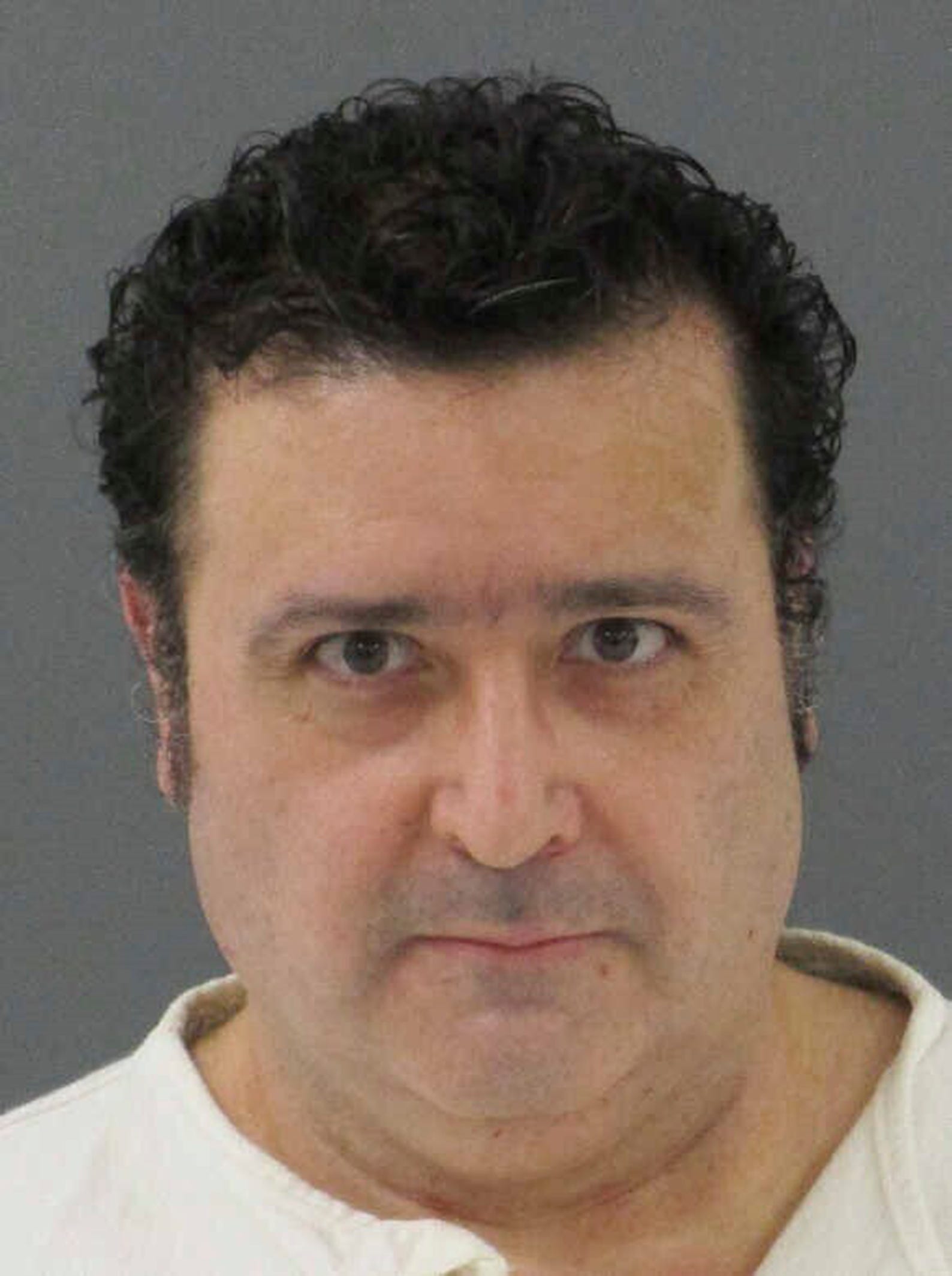
This photo released by the Texas Department of Criminal Justice shows death row inmate David Renteria. Renteria, a Texas inmate convicted of strangling a 5-year-old girl taken from an El Paso store and then burning her body nearly 22 years ago is facing execution. (Texas Department of Criminal Justice)
Alexandra’s sister, Sandra Frausto, and brother, Ignacio Frausto, attended the execution.
Renteria’s sister Cecilia Esparza and a friend also were present.
Esparza collapsed when she walked into the viewing room, and prison officials brought her a chair and she cried. Renteria told his sister through the glass, “I love you.”
Renteria spent his final days meeting with visitors, laying in bed, watching TV through a cell door and sleeping, a Death Watch report states. The times listed below are in Central time zone.
On his execution day, starting at 12:15 a.m., he sat on his bed and began writing. The report does not state what he wrote.
He began packing up his property about 2:30 a.m., before sitting on the floor and reading a book around 4 a.m., the report states. He then continued packing up his property and cleaning the floor between 5 to 7:30 a.m.
Renteria was allowed to talk to fellow inmates at 7:30 a.m., before meeting with visitors from 8 to 11:30 a.m., the death watch states.
He was then transferred from the Texas Department of Criminal Justice’s Polunsky Unit in Livingston, Texas, to the Huntsville Unit to await his execution.
A victim of Renteria’s from a different criminal incident and her mother also attended the execution. Renteria was previously convicted and sentenced to 20 years in prison for indecency with a child in El Paso.
The execution was also attended by 14 state law enforcement and governmental officials.
Renteria grew up in the Lower Valley and was a tribal member of the Ysleta del Sur Pueblo, according to the Texas Coalition to Abolish the Death Penalty.
While in prison, he rededicated himself to his Roman Catholic faith, the coalition reported.
Renteria’s execution ends a nearly 22-year legal battle waged in what has been described as one of the most heinous crimes committed in El Paso.
“I’ve always been a supporter of the death penalty and from a law enforcement perspective, I just think some people are too dangerous to be in our society and that is certainly one individual who I think that that the death penalty is absolutely appropriate,” El Paso County Sheriff Richard Wiles said. “It’s a long time coming. I think it’s been what? Twenty-one years. I was actually the assistant (El Paso police) chief, (Carlos) Leon was the chief when that horrific crime occurred. It was really tough on everybody. I can’t even imagine what that family went through and what they’re still going through today.
“Hopefully, this will give them a little bit of relief to help them in their recovery that is going to take the rest of their lives, Wiles said. “I can’t even imagine losing my 5-year-old daughter to such a horrific crime.”
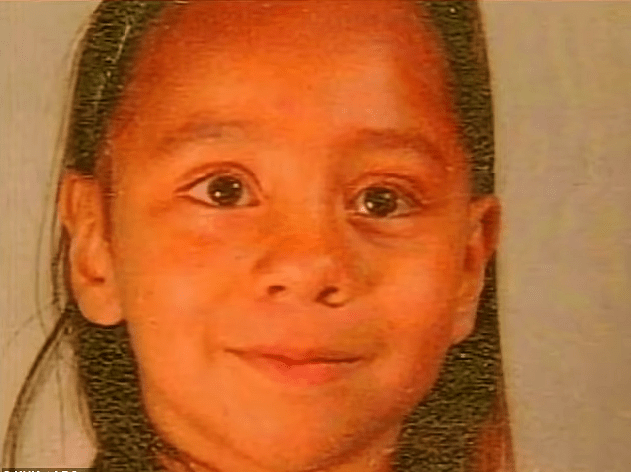
Renteria’s execution came two days before the 22nd anniversary of the day he kidnapped 5-year-old Alexandra Flores from an El Paso Walmart, strangled her to death and then burned her body. It also comes six days before his 54th birthday.
Renteria abducted Alexandra Nov. 18, 2001, as she was Christmas shopping with her parents at an El Paso Lower Valley Walmart.
Her parents realized she was missing and searched the store but could not find her. Alexandra was seen on store surveillance video exiting the store about 5:15 p.m. with Renteria.
Alexandra’s body was found about 7:10 a.m. the next day in an alley 16 miles (25km) away.. She was naked and partially burned in a carport near Downtown El Paso.
An autopsy revealed Alexandra was strangled to death and then set ablaze, court documents state. Investigators later revealed there were no signs of sexual assault.
A palm print on a plastic bag found over Alexandra’s head was determined to be from Renteria, court documents state.
El Paso Police Department investigators discovered that a vehicle registered to Renteria was at 9441 Alameda Ave. at the time and date of Alexandra’s disappearance. Renteria also told police he was at the location at the time and date of her disappearance, court documents state.
Renteria went to trial for the death of Alexandra in September 2003. He claimed in his trial that Barrio Azteca gang members forced him to kidnap the girl and someone else was the person who killed her, court records show.
A jury convicted him of capital murder and he was sentenced to death.
Appeals court justices heard the case in 2006 and upheld the conviction. However, the justices ordered a new sentencing phase of the trial.
The resentencing was ordered because of “exclusion of evidence showing the defendant’s remorse violated due process by preventing defendant from rebutting the State’s case when the State left jury with false impression and emphasized it,” the justices wrote in their opinion.
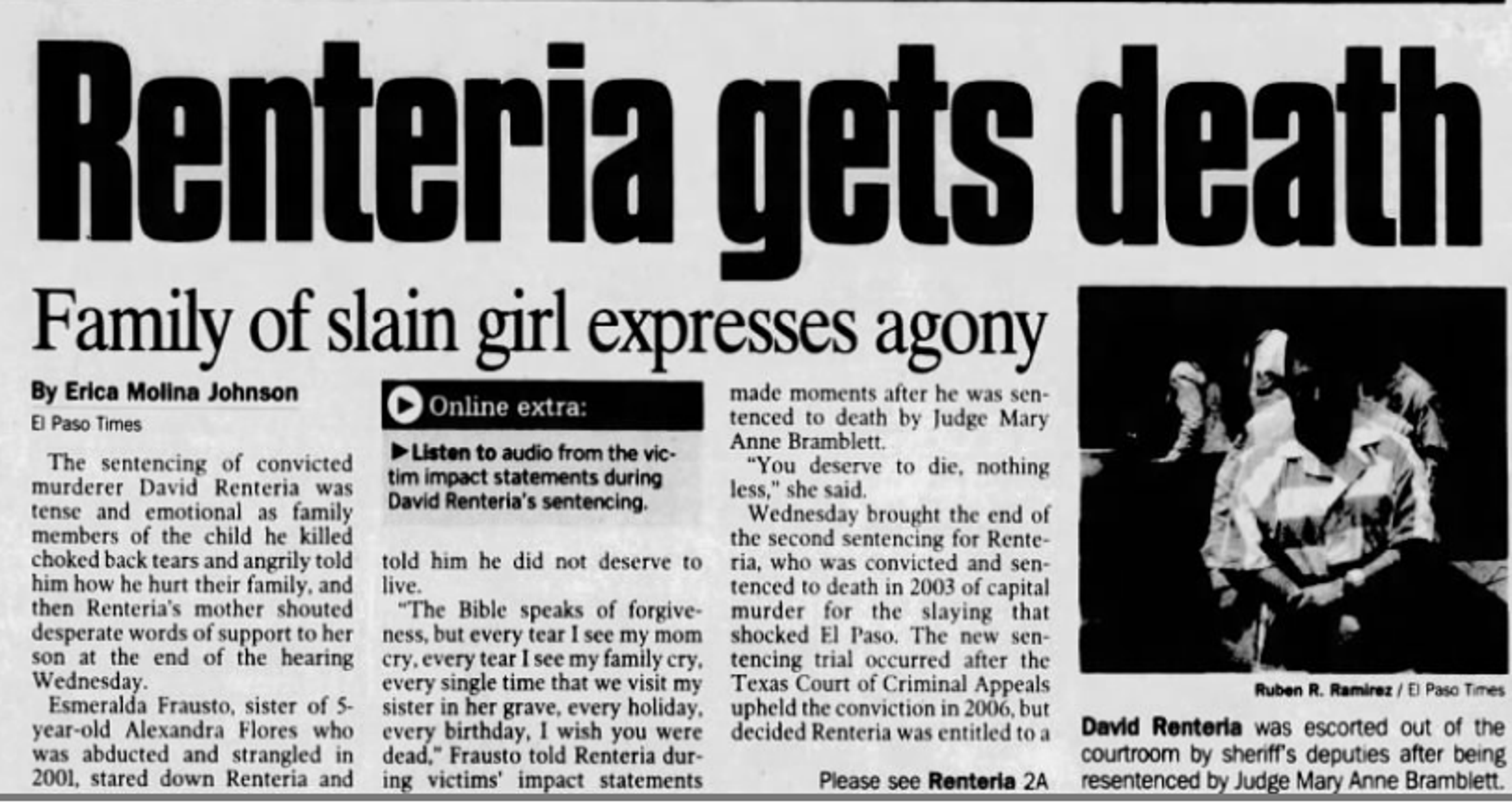
A May 15, 2008, El Paso Times article reporting David Santiago Renteria was given the death penalty during his resentencing hearing.
DAVID SANTIAGO RENTERIA v. THE STATE OF TEXAS (Original)
El Paso Sheriff Deputy Peter Herrera’s family speaks after death penalty sentence


Casey McWhorter (ALABAMA DEPARTMENT OF CORRECTIONS)
An Alabama man who shot and killed his friend’s father in a premeditated robbery in 1993 has been put to death, killed by lethal injection on Thursday — over 30 years after the initial crime. Before he died, however, he had a dire message for other youth who were going through a tough mental time like he was.
Casey McWhorter was convicted of first-degree murder and sentenced to death after slaughtering 34-year-old Edward Lee Williams, 34, at the age of 18. He and two other teens, Williams’ 15-year-old son, conspired to steal money from his home and kill him. He went to the home to commit the crime but didn’t have the intention of actually following through with the killing, he said in a recent interview.
But the situation escalated after the older Williams came home during the robbery and surprised the teens. He said they had been in the home grabbing various items when he came in and began fighting with his son over the gun he had. That’s when McWhorter came out of one of the back rooms. Williams immediately noticed him and started swinging at him, and so he did the only thing he could think to do — he shot the other gun that was in his hand at that point, and it hit Williams in the abdomen despite McWhorter saying he had aimed for the legs.
Casey A. McWhorter spent most of his adult life on Alabama’s death row. Thursday night he died there.
The state of Alabama executed McWhorter, 49, by lethal injection in the death chamber of the William C. Holman Correctional Facility in Atmore. He was convicted of capital murder in 1994 in connection with a 1993 Marshall County robbery and homicide. He went to death row when he was 19. He had been 18 three months earlier, when the murder was committed.
The drapes of the media witness room opened at 6:30 p.m. McWhorter was lying in a bed partially covered by a tightly drawn white sheet. His head and torso were slightly elevated. He was lying cruciform, with both arms facing palm up. Restraints for his body were on top of the sheet. Two IV lines came from a small window in the back wall of the death chamber. One appeared to enter his right arm near the inside of his elbow, and the other appeared to enter his left arm at the inside of his left elbow.
Warden Terry Raybon read the death warrant and governor’s order of execution. McWhorter was given the opportunity to say last words.
His final words were: “I would like to say I love my mother and family. I would like to say to the victim’s family I’m sorry. I hope you found peace.” He then also took a jab at his executioner, the prison warden, who faced many accusations of domestic violence accusations decades ago, calling him a “habitual abuser of women.””
At 6:33 p.m. McWhorter closed his eyes. A minute later he shifted his legs, clenched his fists and moved his fingers.
He was approached by his spiritual advisor.
At 6:35 p.m. he was moving his fingers. And at 6:37 p.m. he raised his head, made a yawning motion, appeared to gasp and his eyes rolled into the back of his head. At 6:39 p.m. he appeared to stop breathing.
His spiritual advisor made the sign of the cross.
A few minutes after a corrections officer inside the death chamber bent to McWhorter’s ear and loudly called his name, the officer then touched his face and pinched the inside of his right arm.
At 6:47 p.m. the drapes to the media witness room were drawn.
McWhorter’s official time of death was given as 6:56 p.m.
McWhorter’s final meal consisted of Turtles candy, and he had visits with his mother, stepdad and a spiritual advisor, a prison spokesperson said. He also spoke with his attorney and his friends by phone. His death was the second execution in Alabama this year.
After the execution, a news conference was held inside the media center.
It took two “sticks” to access McWhorter’s veins, one to his right arm and one to his left arm, said John Hamm, commissioner of the Alabama Department of Corrections. He read a lengthy letter from April Williams, the daughter of Edward Lee Williams, the victim of the homicide.
She was 16 when her father was murdered.
“My Dad was only 33 years old. He should still be here,” the letter read, in part. “He should be ready to retire.”
Gilbert “Bert” Williams, Edward Lee Williams’ brother, addressed the media.
“It took 30 years for this to occur. It’s a kind of unfortunate that we had to wait this long, but justice has been served,” he said.
Gilbert Williams compared McWhorter’s execution to “…the peaceful death to a murderous dog.”
There are three witness rooms in the death chamber, which is attached to the building that houses death row. One witness room is for the victim’s family, one is for the media and the inmate‘s witnesses, and one is for state officials. McWhorter had no witnesses.

JAN. 18, 2018
In his final statement, Shore, 55, was apologetic and his voice cracked with emotion.
“No amount of words or apology could ever undo what I’ve done,” Shore said. “I wish I could undo the past, but it is what it is.”
He was pronounced dead at 6:28 p.m. CST.
Texas’ “Tourniquet Killer” is set for execution Thursday. It would be the first execution under Harris County District Attorney Kim Ogg, a Democrat who oversaw the first year without an execution in the county for more than 30 years.
/https://static.texastribune.org/media/images/2017/10/16/Shore-Anthony.jpg)
The first execution of 2018 in Texas and the nation is expected to take place Thursday evening for Houston’s “Tourniquet Killer.”
Anthony Shore, 55, is a confessed serial rapist and strangler whose murders went unsolved in the 1980s and 1990s for more than a decade. With no pending appeals, his execution is expected to be the first under Harris County District Attorney Kim Ogg, a Democrat who took office last January and has said she doesn’t see the death penalty as a deterrent to crime.
Still, she has said the punishment is appropriate for Shore, deeming him “the worst of the worst.”
“Anytime a person is subject to government’s greatest sanction, it merits thoughtful review,” Ogg said through a spokesman Wednesday. “We have proceeded as the law directs and satisfied all doubts.”
Shore wasn’t arrested in the murders until 2003, when his DNA was matched to the 1992 murder of 21-year-old Maria Del Carmen Estrada, according to court documents. His DNA had been on file since 1998, when he pleaded no-contest to charges of sexually molesting his two daughters. After his arrest, he confessed to the murders of four young women and girls, including Estrada.
Between 1986 and 1995, Shore sexually assaulted and killed 14-year-old Laurie Tremblay, Estrada, 9-year-old Diana Rebollar and 16-year-old Dana Sanchez, the court documents said. He also admitted to the rape of another 14-year-old girl, but she managed to escape after he began choking her. The murder victims’ bodies were all found in various states of undress behind buildings or in a field with rope or cord tied around their necks like tourniquets.
Though he doesn’t argue that his client is innocent or undeserving of punishment, Shore’s lawyer, Knox Nunnally, said Wednesday that he was surprised Ogg continued to pursue the death penalty for Shore based on her previous statements on capital punishment. Ogg’s first year in office also coincided with the first year Harris County didn’t carry out an execution in more than 30 years.
“Many people in the death penalty community were expecting other things from her,” Nunnally said.
Though she has said the death penalty is “pure retribution,” Ogg told the Texas Observer last year that she still believes in it. But in two major death penalty cases that made their way to the U.S. Supreme Court, Ogg opted for reduced punishments.
After the high court ruled death row inmate Duane Buck should receive a new trial because an expert witness claimed he was more likely to be a future danger to society because he was black, Ogg offered a plea agreement in October to a sentence of life in prison rather than holding a new death penalty trial. The next month, Ogg asked the Texas Court of Criminal Appeals to reduce the death sentence of Bobby Moore, whose case had earlier prompted the Supreme Court to invalidate Texas’ outdated method of determining intellectual disability in death-sentenced inmates.
But for a “true serial killer” such as Shore, Ogg said in a July statement that he was “a person deserving of the ultimate punishment.”
Shore’s execution was originally set for October, but Ogg postponed it after Montgomery County District Attorney Brett Ligon requested a delay from her and Gov. Greg Abbott. Ligon was concerned that Shore might falsely confess to the Montgomery County murder of Melissa Trotter, potentially disrupting the existing death sentence for the man already convicted in Trotter’s murder.
“We knew that was not true, but, that said, we knew that if we didn’t investigate it, it would look like we ignored potential evidence,” Ligon said.
Ligon said that after Shore talked to Texas Rangers and his office, investigators were convinced that Shore was not responsible for Trotter’s death or any other open murder cases. Nunnally said Shore never confessed to Trotter’s murder.
Now, Nunnally says he thinks he’s done everything he can for Shore. He had hoped to ask for a delay if the U.S. Supreme Court elected to hear a case out of Arizona that questions the constitutionality of the death penalty as a whole, but the justices have yet to make a decision and don’t meet again until Friday — the day after his scheduled execution.
Shore’s execution will the be the first in 2018, following a years-long trend of fewer executions in Texas and across the country. Four other executions are scheduled in Texas through March.

December 5, 2017
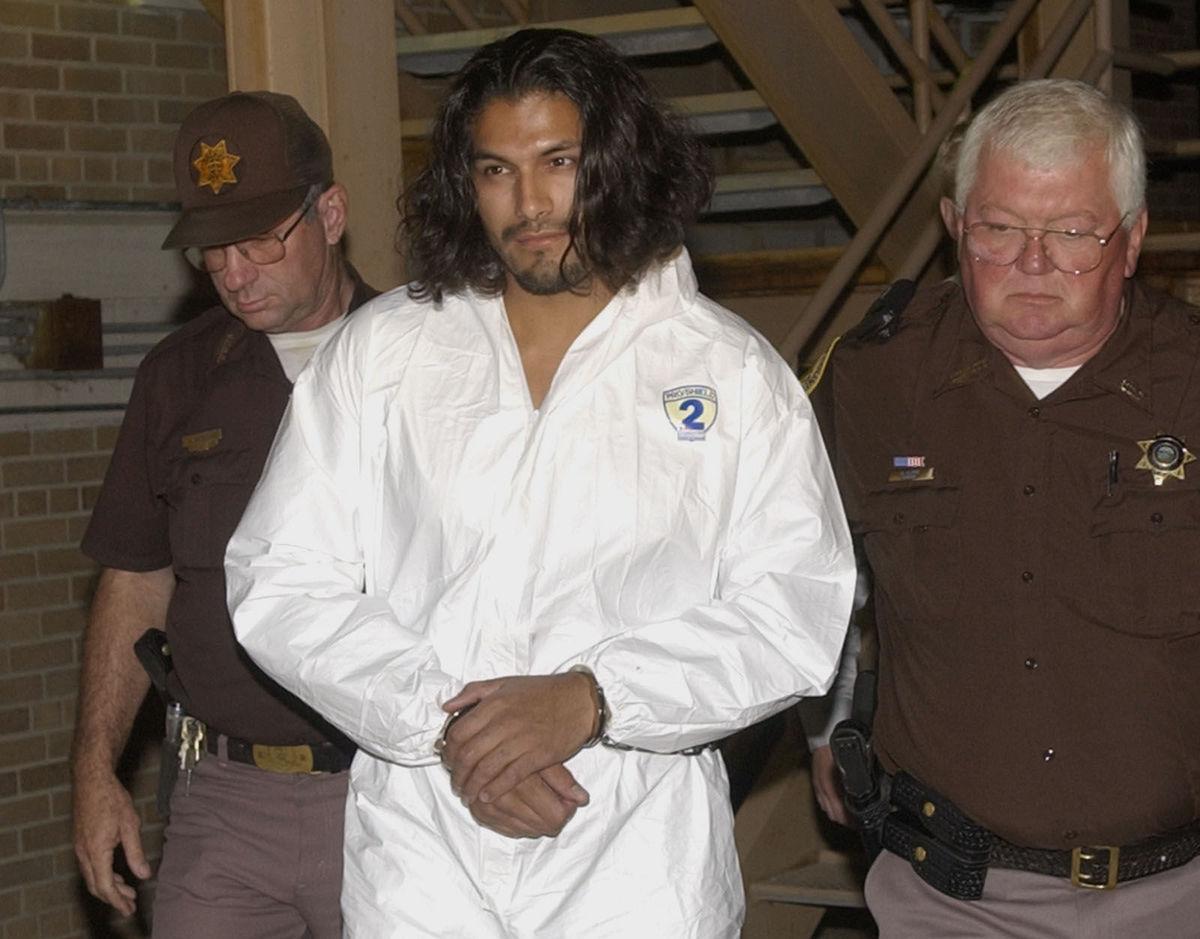
ACLU of Nebraska filed a lawsuit Monday on behalf of death row inmates that claims the ballot initiative that stopped the state Legislature’s 2015 repeal was illegal.
The complaint is an attempt to stop any executions, or even steps toward an execution, of the men on Nebraska’s death row.
Death row inmate Jose Sandoval said last week he intends to fight the execution. At that time, he had no ongoing legal actions or appeals in federal or state courts.
“My reaction to the notice (of lethal injection drugs) was not a surprise. I’ve been expecting it for a year now,” Sandoval said. “I intend to fight with the help of my attorneys — Amy Miller and company.”
The ACLU confirmed Sunday that Miller, its legal director, has been in contact with Sandoval, who was notified Nov. 9 of the state’s intention to execute him with four specified lethal injection drugs. The organization is preparing to announce the scope of its representation of Sandoval early this week, it said.
The four drugs in combination that would be used in Sandoval’s execution, if it takes place, have never been used to execute a person.
The complaint charged the ballot initiative violated the Nebraska Constitution’s separation of powers. It said Gov. Pete Ricketts was the driving force behind the 2016 referendum, exploiting government staff, resources and his own elected position to raise money for the ballot initiative and to persuade voters to support it.
“In Nebraska, our state Constitution … establishes a strong tradition with a clear separation of powers,” ACLU Executive Director Danielle Conrad said Sunday. “The governor can’t have it both ways and serve both as a member of the executive and legislative branches.”
The petition drive got underway in 2015 and the sponsoring group, Nebraskans for the Death Penalty, gathered 167,000 signatures, enough to stop the repeal from being in effect until a vote in November 2016.
The Legislature had voted to repeal Nebraska’s death penalty with a bill (LB268) that passed on a 32-15 vote. Ricketts vetoed the bill and then the Legislature voted to override the veto on a 30-19 vote that cut across party lines.
Shortly after that, Nebraskans for the Death Penalty was formed and raised just over $913,000, a third of it contributed by Ricketts and his father, Joe Ricketts.
The governor’s actions pose important legal questions with grave consequences, Conrad said.
She said the end result of those actions was the restoration of a “broken” death penalty that is racially biased, risks execution of innocent people and raises constitutional concerns about the Eighth Amendment’s prohibition against cruel and unusual punishments.
Ricketts’ office responded in a statement issued Sunday evening.
“The Governor’s Office holds itself to a high standard and follows state law regarding the use of taxpayer resources,” said Taylor Gage, the governor’s spokesman. “This liberal advocacy group has repeatedly worked to overturn the clear voice of the Nebraska people on the issue of capital punishment and waste taxpayer dollars with frivolous litigation. The administration remains committed to protecting public safety and creating a safe environment for our Corrections officers.”
The ACLU lawsuit — filed on behalf of death row inmates against Ricketts, Treasurer Don Stenberg, founders of Nebraskans for the Death Penalty, Attorney General Doug Peterson, the Department of Correctional Services and Director Scott Frakes — asked the court to immediately stop all preparations for executing Sandoval and the other 10 men on death row.
Peterson plans to ask the Nebraska Supreme Court for a death warrant after 60 days following the notification of drugs that would be used.
That ACLU complaint said that as the governor, Ricketts’ power over the repeal bill ended when the Legislature overrode his veto.
It claimed the subsequent ballot initiative should not stand, as it was the result of repeated, extensive and illegal abuses of the governor’s power. The state’s constitution reserves ballot initiatives as a legislative power for the people to use as a check on the legislature, and it further prohibits anyone in one branch of government from exercising powers over another branch, the ACLU said.
Ricketts encouraged or ordered members of the executive branch and his allies in the Legislature and local governments to work for the referendum campaign or to express public support for it, the complaint said.
For example, Stenberg was simultaneously a leader of the campaign in the first few months, serving as co-chairman with Sen. Beau McCoy, the ACLU charged. In the middle of the campaign, Ricketts rewarded Jessica Flanagain, the campaign manager and coordinator, with a publicly paid position in the government as special adviser to the governor for external affairs, with a salary of $130,000, the complaint alleges.
The lawsuit also noted that Nebraskans for the Death Penalty made an error that invalidated the referendum by failing to submit sworn statements from its sponsors, as required by law to assure the sponsors’ names aren’t fraudulent and assure transparency in the working of ballot campaigns.
Previous litigation more narrowly alleged the referendum petition was not legally sufficient because a list of sponsors filed with the petition did not include the name of Ricketts, who it claimed engaged in activities that established that he was a sponsor of the referendum. The district court dismissed the complaint. The Supreme Court affirmed, holding Ricketts’ alleged financial or other support of the referendum did not make him a person “sponsoring the petition.”

 Claim your Innocence