January 10, 2024
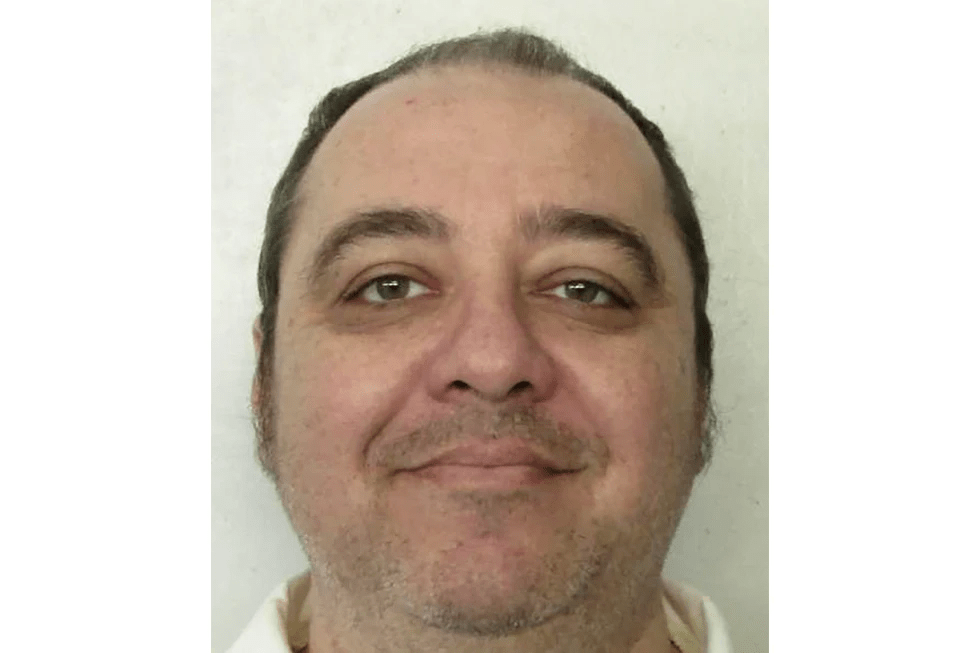
Alabama will be allowed to put an inmate to death with nitrogen gas later this month, a federal judge ruled Wednesday, clearing the way for what would be the nation’s first execution using a new method the inmate’s lawyers criticize as cruel and experimental.
U.S. District Judge R. Austin Huffaker rejected inmate Kenneth Eugene Smith’s request for a preliminary injunction to stop his scheduled Jan. 25 execution by nitrogen hypoxia. Smith’s attorneys have said Alabama is trying to make Smith the “test subject” for an untried execution method after he survived the state’s previous attempt to put him to death by lethal injection.
Why it matters: This untested hypoxia execution method, the first of its kind in the U.S., could prove to be “painful and humiliating,” human rights experts said.
- “Hypoxia is a state in which oxygen is not available in sufficient amounts at the tissue level to maintain adequate homeostasis,” per research in the National Institutes of Health.
Smith’s attorney, Robert Grass, said he will appeal the decision but declined further comment. The question of whether the execution can ultimately proceed could end up before the U.S. Supreme Court.
Smith, now 58, was one of two men convicted of the murder-for-hire of a preacher’s wife that rocked Alabama in 1988. Prosecutors said Smith and the other man were each paid $1,000 to kill Elizabeth Sennett on behalf of her husband, who was deeply in debt and wanted to collect on insurance.
Alabama Attorney General Steve Marshall praised Wednesday’s decision, saying it moves the state closer to “holding Kenneth Smith accountable for the heinous murder-for-hire slaying” he was convicted of committing.
“Smith has avoided his lawful death sentence for over 35 years, but the court’s rejection today of Smith’s speculative claims removes an obstacle to finally seeing justice done,” his statement added.
The state’s plans call for placing a respirator-type face mask over Smith’s nose and mouth to replace breathable air with nitrogen, causing him to die from lack of oxygen. Three states — Alabama, Mississippi and Oklahoma — have authorized nitrogen hypoxia as an execution method, but none has used it so far.
Smith’s attorneys argued the new protocol is riddled with unknowns and potential problems and violates a constitutional ban on cruel and unusual punishment.
Huffaker acknowledged that execution by nitrogen hypoxia is a new method but noted that lethal injection — now the most common execution method in the country — once was also new. He said while Smith had shown the theoretical risks of pain and suffering under Alabama’s protocol, those risks don’t rise to an unconstitutional violation.
“Smith is not guaranteed a painless death. On this record, Smith has not shown, and the court cannot conclude, the Protocol inflicts both cruel and unusual punishment rendering it constitutionally infirm under the prevailing legal framework,” Huffaker wrote in the 48-page ruling.
Huffaker also wrote that there wasn’t enough evidence to find the method “is substantially likely to cause Smith superadded pain short of death or a prolonged death.”
Smith survived a prior attempt to execute him. The Alabama Department of Corrections tried to give Smith a lethal injection in 2022 but called it off when authorities couldn’t connect two intravenous lines.
The Rev. Dr. Jeff Hood, Smith’s spiritual adviser who plans to be with Smith during the execution, said he was troubled by the ruling. “Horror is an understatement. The State of Alabama now has the permission of a federal court to suffocate its citizens,” Hood said.
Experts appointed by the United Nations Human Rights Council earlier this month cautioned that, in their view, the execution method would violate the prohibition on torture and other cruel, inhuman or degrading punishment.
Wednesday’s ruling followed a December court hearing and legal filings in which attorneys for Smith and Alabama gave diverging descriptions of the risks and humaneness of death from nitrogen gas exposure.
The state attorney general’s office had argued that the deprivation of oxygen would “cause unconsciousness within seconds, and cause death within minutes.” Its court filings compared the new execution method to industrial accidents in which people passed out quickly and died after exposure to nitrogen gas.
But Smith’s attorneys noted in court filings that the American Veterinary Medical Association wrote in 2020 euthanasia guidelines that nitrogen hypoxia is an acceptable method of euthanasia for pigs but not for other mammals because it could create an “anoxic environment that is distressing for some species.”
Smith’s attorneys also argued that the gas mask, which sits over the nose and mouth, would interfere with Smith’s ability to pray aloud or make a final death chamber statement.
The attorney general’s office called those concerns speculative.
Alabama’s prison system agreed to minor changes to settle concerns that Smith’s spiritual adviser would be unable to minister to him before the execution. The state wrote in a court filing that the adviser could enter the execution chamber before the mask was placed on Smith’s face to pray with him and anoint him with oil.
The murder victim Sennett was found dead on March 18, 1988, in the home she shared with her husband Charles Sennett Sr. in Alabama’s northern Colbert County. The coroner testified the 45-year-old woman had been stabbed repeatedly. Her husband, then the pastor of the Westside Church of Christ, killed himself when the murder investigation focused on him as a suspect, according to court documents.

Smith’s initial 1989 conviction was overturned on appeal. He was retried and convicted again in 1996. The jury recommended a life sentence by a vote of 11-1, but a judge overrode the recommendation and sentenced Smith to death. Alabama no longer allows a judge to override a jury’s decision on death penalty decisions.
John Forrest Parker, the other man convicted in the case, was executed in 2010.
Supreme Court Opinion (pdf)
Alabama Appellate courts Case View Kenneth Eugene Smith v. State of Alabama


 Survivor on Death Row, a new e-book co-authored by death row inmate Romell Broom and Clare Nonhebel, tells the story of Ohio‘s botched attempt to execute Broom by lethal injection in 2009. In September of that year, Broom was readied for execution and placed on the gurney, but the procedure was terminated after corrections officials spent over two hours attempting to find a suitable vein for the lethal injection. Broom was removed from the death chamber and has remained on death row ever since. In the book, Broom discusses his troubled childhood and his life of over 25 years on death row, including his repeated requests for new DNA testing and a new legal team. Broom has always maintained his innocence. Jon Snow, a reporter for Channel 4 News in England, called the book “A horrifying story embracing all the evils of the death penalty. Bad forensics, dodgy DNA, awful lawyers, render this a must-read.”
 A new book by Larry Koch, Colin Wark and John Galliher discusses the status of the death penalty in the U.S. in light of recent legislative activity and court decisions. In The Death of the American Death Penalty, the authors examine the impact of factors such as economic conditions, public sentiment, the role of elites, the media, and population diversity on the death penalty debate. The book highlights the recent abolition decisions in New York, New Jersey, New Mexico, and Illinois, and the surprising decline of the death penalty even in the deep South. James R. Acker, Distinguished Teaching Professor in Criminal Justice at the University at Albany, said, “Support for capital punishment in this country, as measured by the laws authorizing it, prosecutors’ enthusiasm for seeking it, jury verdicts that dispatch it, and executioners’ final deliverance, has eroded rapidly in recent years. A decade after the publication of its predecessor and carrying on in that volume’s fine tradition, The Death of the American Death Penalty provides detailed explanations—the where, how, and why—of these dramatic developments in death penalty laws and practices.”
 Long-time death penalty scholar Hugo Adam Bedau died on August 13, 2012 . Dr. Bedau had been the Austin B. Fletcher Professor of Philosophy at Tufts University, and is best known for his work on capital punishment. Dr. Bedau frequently testified about the death penalty before the U.S. Congress and many state legislatures. He authored several books about the death penalty, including The Death Penalty in America (1964; 4th edition, 1997), The Courts, the Constitution, and Capital Punishment (1977), Death is Different (1987), and Killing as Punishment (2004), and co-authored In Spite of Innocence (1992). This last book, written with Prof. Michael Radelet of the University of Colorado and Constance Putnam (Dr. Bedau’s wife), contained one of the best early collections of people who had been wrongly convicted in death penalty cases. In 1997, Bedau received the August Vollmer Award of the American Society of Criminology, and in 2003 he received the Roger Baldwin Award from the ACLU of Massachusetts. Dr. Bedau was a founding member of the National Coalition to Abolish the Death Penalty.
 A new book by Professors Saundra Westervelt and Kimberly Cook looks at the lives of eighteen people who had been wrongfully sentenced to death and who were later freed from death row. In Life After Death Row: Exonerees’ Search for Community and Identity, the authors focus on three central areas affecting those who had to begin a new life after leaving years of severe confinement: the seeming invisibility of these individuals after their release; the complicity of the justice system in allowing that invisibility; and the need for each of them to confront their personal trauma. C. Ronald Huff, a professor at the University of California, Irvine, noted, “The authors skillfully conduct a journey inside the minds of exonerees, allowing readers to see the world from their unique perspectives.”
 A new electronic book by former journalist Peter Rooney offers an in-depth look at the case of Joseph Burrows, who was exonerated fromIllinois’s death row in 1996. In Die Free: A True Story of Murder, Betrayal and Miscarried Justice, Rooney explains how Burrows was sentenced to death for the murder of William Dulin based on snitch testimony. He was convicted primarily on the word of Gayle Potter, who recanted her testimony eight years later and admitted to committing the crime herself. According to one review, “Rooney makes it clear his book Die Free isn’t an argument against the death penalty, but simply another example of why such an extreme punishment should be re-evaluated. His points are made clearly and with merit as he details obvious evidence withholding by an over-aggressive district attorney, threats and intimidation of a borderline mentally challenged man, and the old school thoughts of little women versus big, burly men.” Rooney is a former staff writer for the Champaign-Urbana News-Gazette and is currently the director of public affairs at Amherst College. Joe Burrows died at age 56 in 2009. This case, and similar exonerations, led to the abolition of the death penalty in Illinois in 2011. The book is available for
  A new book by Clive Stafford Smith, a British lawyer who has defended death row inmates in the U.S., offers an in-depth view of capital punishment in America. In Injustice: Life and Death in the Courtrooms of America, Stafford Smith examines the case of Kris Maharaj, a British citizen who was sentenced to death in Florida for a double murder, to expose problems in the justice system. The book reveals disturbing details of Maharaj’s case, including anomalies in the prosecution files–witnesses with exculpatory testimony who were never called, falsified and suppressed evidence, and reports that a witness to the shootings failed a lie detector test. Maharaj’s death sentence was later commuted to life without parole. Stafford Smith is the Legal Director of Reprieve, which provides legal assistance in death penalty cases. In 2005 he received the Gandhi International Peace Award. He was a founder of the Louisiana Crisis Assistance Center, defending death row inmates in that state.
 American Bar Association recently published The State of Criminal Justice 2012, an annual report that examines major issues, trends and significant changes in America’s criminal justice system. This publication serves as a valuable resource for academics, students, and policy-makers in the area of criminal justice, and contains 24 chapters focusing on specific areas of the criminal justice field. The chapter devoted to capital punishment was written by Ronald Tabak, special counsel and pro bono coordinator at Skadden Arps. Tabak addresses the decline in the use of the death penalty, the geographic, racial and economic disparities in implementing capital punishment, important Supreme Court decisions, and other issues such as the continuing risk of wrongful executions. In concluding, he writes, “Ultimately, our society must decide whether to continue with a system that has been found in study after study, and has been recognized by a growing number of leading judges, to be far more expensive than the actual alternative – in which life without parole is the most serious punishment. In view of the lack of persuasive evidence of societal benefits from capital punishment, this is one ineffectual, wasteful government program whose elimination deserves serious consideration.”


 Claim your Innocence