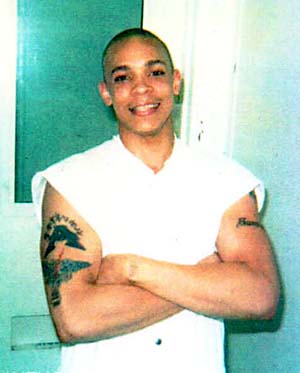
Anthony Cardell Haynes
Anthony Haynes claimed he didn’t know that Kent Kincaid was a Houston police sergeant when he shot him in the head back in 1998. Kincaid was off-duty and driving his personal vehicle when Haynes drove by; something cracked Kincaid’s windshield, and he reportedly thought Haynes had thrown something at him. He followed Haynes, and when the 19-year-old stopped his car, Kincaid approached him. Kincaid said he was a police officer, but Haynes later said he didn’t know whether to believe him. When Kincaid reached behind his back, presumably for a badge, Haynes pulled out a .25-caliber gun and shot him.

Anthony Haynes
Haynes blamed the tragedy in part on drugs and falling in with a bad crowd of people who reportedly made a game out of shooting at the windshields of passing cars and then robbing the drivers after they stopped. As it happened, the crack in Kincaid’s windshield was made by a bullet. Jurors in Haynes’ case deliberated for three days before sentencing the teen to death.
That sentence was overturned, however, after the 5th U.S. Circuit Court of Appeals agreed with Haynes’ defense that an unusual jury-selection setup in Haynes’ case had denied his right to equal protection under law. Indeed, two different judges presided over Haynes’ jury selection; one heard prosecutors interview individual jurors, and a second heard the lawyers’ arguments for striking from service the potential jurors. As it turned out, the state used its power to strike all but one of the black potential jurors, arguing that it was not their race that excluded them (which would be illegal), but their “demeanor.” But Haynes’ appeal attorney argued that the judge who allowed those strikes had not actually witnessed the jurors’ questioning and thus could not actually have seen whether their demeanor would be a basis on which to have them struck. The U.S. Supreme Court ultimately disagreed with the 5th Circuit, ruling that there was no rule that would require a judge to “personally observe” the juror questioning when deciding whether a juror is lawfully struck from service.
Haynes is scheduled for execution today, Oct. 18. STAYED
Bobby Lee Hines

Hines
Bobby Lee Hines was also just 19 when he was sentenced to death for the robbery and strangling of 26-year-old Michelle Haupt in her Dallas apartment. Now, 20 years later, he’s scheduled to die for that crime on Oct. 24. But his attorney, Lydia Brandt, argues that Hines’ execution should, once again, be stayed while the courts consider whether his lawyers have done enough to save his life.
Hines was convicted of the 1991 murder of Haupt, who was stabbed repeatedly with an ice pick and strangled with a cord inside her apartment. Hines had been staying next door with the apartment complex’s maintenance man. Police found items from Haupt’s apartment, including packs of cigarettes and a bowl of pennies, under a couch where Hines had been sleeping.
Hines’ first date with death was stayed in 2003, while the courts considered a claim that he was mentally retarded and thus ineligible for execution. Although Hines had a diagnosed learning disability and was considered emotionally disturbed, the courts ruled that he didn’t meet the criteria for relief. His execution date was reset for June 2012, but was stayed again so that further DNA testing could be performed. The DNA evidence confirmed Hines’ guilt and once again his execution was back on.
Now, Brandt is again seeking a stay, arguing that Hines’ case has been plagued by ineffective assistance of counsel. Brandt’s latest appeal, filed Oct. 10 with the Court of Criminal Appeals, argues that none of Hines’ defense attorneys ever investigated his background for mitigating evidence that could have swayed a jury to sentence him to life in prison. Hines had a “nightmarish” childhood that featured chronic abuse by his racist, alcoholic father, and later by foster parents, and was profoundly affected by his mother’s decision to abandon him as a young child. But the jury never heard anything of Hines’ troubled background. The question now before the CCA is whether the prior counsel’s failings can create an avenue for reconsidering Hines’ punishment. Brandt believes it should: “Fundamental rules of equity will not suffer a right to be without a remedy,” reads the appeal



 Claim your Innocence