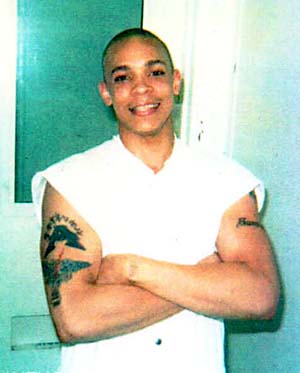
execution

TEXAS – SUZANNE BASSO TO BE EXECUTED TODAY at 6 p.m EXECUTED 6.26 pm


Basso went quietly enough. When asked for a final statement, she said “No, sir,” with a tearful look in her eyes. She reportedly looked to a couple of friends positioned behind a window and “mouthed a brief word to them and nodded.” As the drug began to take hold, she began to snore deeply; the snoring slowed and eventually halted and, eleven minutes after the injection, she was declared dead.

*Last Meal: Last meal requests no longer allowed.

Execution Watch with Ray Hill
can be heard on KPFT 90.1 FM,
in Galveston at 89.5 and Livingston at 90.3,
as well as on the net here
from 6:00 PM CT to 7:00 PM CT
on any day Texas executes a prisoner.

filed  february 4 : 5th circuit appeal  pdf

February 5, 2014

HUNTSVILLE, Texas (AP) — A woman convicted of torturing and killing a mentally impaired man she lured to Texas with the promise of marriage was scheduled to be executed Wednesday in a rare case of a female death-row inmate.

If 59-year-old Suzanne Basso is lethally injected as scheduled, the New York native would be only the 14th woman executed in the U.S. since the Supreme Court allowed capital punishment to resume in 1976. By comparison, almost 1,400 men have been put to death.

Texas, the nation’s busiest death-penalty state, has executed four women and 505 men.

Basso was sentenced to death for the 1998 slaying of 59-year-old Louis “Buddy” Musso, whose battered and lacerated body, washed with bleach and scoured with a wire brush, was found in a ditch outside Houston. Prosecutors said Basso had made herself the beneficiary of Musso’s insurance policies and took over his Social Security benefits after luring him from New Jersey.

The 5th U.S. Circuit Court of Appeals refused to halt the execution in a ruling Tuesday, meaning the U.S. Supreme Court is likely her last hope. A state judge ruled last month that Basso had a history of fabricating stories about herself, seeking attention and manipulating psychological tests.

Leading up to her trial, Basso’s court appearances were marked by claims of blindness and paralysis, and speech mimicking a little girl.

LOUSIANA – Upcoming execution Christopher Sepulvado-February 5,2014 STAYED


UPDATE FEBRUARY 3. 2014  from Helen Prejean
We’ve just received the news that Christopher Sepulvado’s execution will not proceed on Wednesday. Instead, a trial on the constitutionality of Louisiana’s hastily change execution protocol will take place on April 7. The vigil scheduled for tomorrow has also been cancelled. This is good news, at least for the moment, and more great work by the lawyers.
SUPREME COURT OF LOUISIANA

NO. 93-KA-2692
FACTS
On Thursday, March 5, 1992, defendant married the victim’s mother, Yvonne. The next day,Friday, the victim came home from school, having defecated in his pants. Yvonne spanked him and refused to give him supper. Defendant returned home from work at approximately 9:00 p.m. That night, the victim was not allowed to change his clothes and was made to sleep on a trunk at the foot of his bed. On Saturday, the victim was not allowed to eat and was again made to sleep on the trunk in his soiled clothes.
At around 10:00 a.m. on Sunday, defendant and the victim were in the bathroom, preparing to attend church services. Defendant instructed the victim to wash out his soiled underwear in the toilet and then take a bath. When the victim hesitated to do so,defendant hit him over the head with the handle of a screwdriver several times with enough force to render him unconscious.
There after, the victim was immersed in the bathtub which was filled with scalding hot water.
Approximately three hours later, at around 1:50 p.m.,defendant and his wife brought the victim to the emergency room at the hospital. At that time the victim was not breathing, had no pulse, and probably had been dead for approximately thirty to sixty minutes. All attempts to revive the victim were futile. The cause of death was attributed to the scald burns covering 60% of the victim’s body, primarily on his backside. There were third degree burns over 58% of the body and second degree burns on the remaining 2%.
The scalding was so severe that the victim’s skin had been burned away. In addition to the burns, medical examination revealed that the victim had been severely beaten. The victim’s
scalp had separated from his skull due to hemorrhaging and bruising. Also, there were deep bruises on the victim’s buttocks.
full opinion click here

Skirting the Constitution: Texas rules Basso competent for execution


Texas set to execute woman for ‘horrible, horrible, horrible’ torture killing

UPDATE : february 4, 2014 (AP)

Texas: 2 courts won’t block woman’s execution

A federal judge has joined Texas’ top criminal court in refusing to stop this week’s scheduled execution of a woman condemned for the torture slaying of a mentally impaired man more than 15 years ago outside Houston.

U.S. District Judge Sim Lake on Monday turned down an appeal from 59-year-old Suzanne Basso hours after Texas Court of Criminal Appeals rejected a similar appeal. She’s set for lethal injection Wednesday evening in Huntsville.

Basso’s attorney contends she is mentally incompetent for execution for the slaying of 59-year-old Louis “Buddy” Musso.

Additional appeals to delay her punishment are likely headed into the federal appeals courts.

Basso would be the 14th woman executed in the U.S. and the 5th in Texas since the Supreme Court in 1976 allowed capital punishment to resume.
Basso’s attorney asked the court to reverse a ruling last month that Basso is competent to be executed for the slaying of 59-year-old Louis “Buddy” Musso at a home in Jacinto City, just east of Houston.
The Texas Court of Criminal Appeals Monday rejected an appeal from 59-year-old Suzanne Basso. She’s set for lethal injection Wednesday evening in Huntsville.

30 january 2014

If the state of Texas goes through with the planned execution on Feb. 5 of Suzanne Basso, it will be executing a delusional woman with scant understanding of why she’s to be put to death, attorney Winston Cochran Jr. argues in a request for sentence commutation filed this month with the Texas Board of Pardons and Paroles.

Indeed, Cochran argues that evidence of Basso’s mental health issues was never provided to the jurors who sentenced her to die in 1999 – because no mitigation investigation was ever done and no mitigation evidence was provided to jurors. “Executing Basso would bring discredit upon the Texas judicial system by demonstrating that constitutional protections necessary in death penalty cases are not protected,” he wrote in the BPP filing.

Given the BPP’s history, it is not a stretch to imagine that Basso will be denied clemency or a reprieve in order to allow Cochran to pursue additional appeals – since 2007, the BPP has recommended clemency just 4 times out of the 129 death cases it has considered.

Basso was condemned for the gruesome beating death in 1998 of Louis “Buddy” Musso. According to the state, Basso lured Musso, a 59-year-old intellectually disabled man, to Texas from New Jersey by promising to marry him and then, with 5 other people – including her son – abused Musso, beatings that left his body covered in bruises from head to toe, before he was finally killed by a series of brutal blows to the head, as part of a scheme to collect insurance money and Musso’s other assets.

Cochran has argued that there is no evidence that Basso was the one who actually killed Musso and that because the jury was not asked to find that she was a party to the crime – a theory under which all actors share culpability – her conviction is invalid. Several courts have denied Basso’s appeals, including a district court ruling Jan. 15 in Houston, which found that Basso is competent to be executed.

Basso will be the 8th woman put to death in Texas since the mid-1800s, the 2nd inmate executed this year, and the 510th executed since reinstatement of the death penalty.

(source: Austin Chronicle)

RELATED ARTICLE  SUZANNE BASSO

VAUGHN ROSS HAS BEEN EXECUTED BY TEXAS 6:38 pm


HUNTSVILLE, TX — A former Texas Tech graduate student convicted of a double slaying a dozen years ago has been executed.

Vaughn Ross received lethal injection Thursday evening for the January 2001 fatal shootings of an 18-year-old woman with whom he had been feuding and an associate dean at the university in Lubbock who was with her. He was pronounced dead at 6:38 p.m. CT.

Ross, from St. Louis, came to Texas Tech for graduate work in architecture. Ross was found guilty in the January 2001 fatal shootings of an 18-year-old woman with whom he had been feuding an associate dean at the university who was with her at the time. In his appeal to the high court, Ross argued his previous appeals attorneys neglected to note that his trial lawyers didn’t present evidence that may have convinced jurors to sentence him to life in prison.

A bicyclist spotted the bodies of Douglas Birdsall, 53, the associate dean of libraries at Texas Tech University, and Viola Ross McVade in a car in a gully at a Lubbock park. McVade was the sister of Ross’ girlfriend and was not related to the convicted killer.

Court documents said Birdsall had been looking for a prostitute and that a friend of McVade introduced him to her that evening. Prosecutors contend McVade was the intended target, and that Birdsall was at the wrong place at the wrong time.

Both victims were shot multiple times. Detectives said they linked Ross to the deaths after finding his and Birdsall’s DNA on part of a latex glove in the car. DNA tests on Ross’ sweatshirt also detected blood from both victims.

Ross, from St. Louis, came to Texas Tech for graduate work in architecture. When questioned by detectives, he acknowledged arguing and threatening McVade. He also acknowledged wearing latex gloves but said they were to protect his hands while he was doing some cleaning with bleach.

While in jail, Ross phoned his mother, who asked if he had any involvement in the slayings. He replied he “might have,” according to the tape-recorded call.

“I’ve always said a guy could never lie to his mama,” Matt Powell, the Lubbock County district attorney who prosecuted the case, said last week. “It was the closest thing we had to a confession.”

Authorities believed Bridsall and McVade were ambushed in an alley behind Ross’ apartment after Ross had ordered McVade’s sister to leave. Birdsall’s blood and glass from shattered windows of his car were found in the alley, as well as a shell casing matching casings inside Birdsall’s car.

Prosecutors believed the latex glove was torn when Ross moved Birdsall’s body from the front to the back seat so he could drive the car to the gully.

At least six other Texas prisoners have execution dates set for the coming months, including one later this month.

Source: AP, June 18, 2013

Execution date moved for El Paso man convicted of killing boy -Rigoberto “Robert” Avila Jr.


June 24, 2013 elpasotimes.com


The execution date for an El Paso man convicted in the 2000 death of his then-girlfriend’s 19-month-old son has been rescheduled again.

The request was made by his attorneys who wanted more time to explore the possibility he may be innocent.

Rigoberto “Robert” Avila Jr., 40, has been on Texas’ death row since 2001 after his capital murder conviction in the Feb. 29, 2000, death of Nicolas Macias.

In 2001, a state district court jury sentenced Avila to death after convicting him in Nicolas’ death. Prosecutors had alleged Avila fatally beat Nicolas while Avila was baby-sitting Nicolas and his sibling.

At the time, Avila was dating the children’s mother, who was attending classes when Nicolas was injured. Nicolas’ mother, Marcelina Macias, has declined interview requests from the El Paso Times.

Avila was initially scheduled to be executed on Dec. 12 — which happened to be the Catholic Church’s feast day for Our Lady of Guadalupe — but was rescheduled for April 10. After defense attorneys asked for more time to explore scientific evidence in the case, Avila‘s execution was rescheduled again for July 10.

Cathryn Crawford and Kathryn Kase, attorneys with the Texas Defender Service who are representing Avila in his appeals, requested that Avila’s July 10 execution date be withdrawn to allow them to explore the possibility Avila may be innocent, based on a scientific study that Nicolas was injured by a sibling.

District Attorney Jaime


Esparza did not oppose the request, which was granted by 41st District Judge Anna Perez last week. Perez also scheduled a new execution date in January 2014.

Avila’s attorneys commended Esparza for not opposing their request for more time. Esparza declined to comment on the request, but said he allowed prosecutors to seek the death penalty against Avila based on Nicolas’ brutal death. At the time, jurors did not have the option of sentencing Avila to life in prison without parole.

According to testimony by two medical experts at Avila’s trial, Nicolas had severe internal injuries, including a severed pancreas, that were caused by the same amount of force seen in high-speed traffic crashes. They also testified Nicolas’ injuries could not have been caused by an accident.

One witness, pediatric surgeon Dr. George Raschbaum, testified the only way a 4-year-old child could have caused Nicolas’ injuries was if he had jumped on Nicolas from a height of 20 feet.

During an El Paso Times editorial board meeting last week, Crawford said testing by their defense expert indicates Nicolas’ injuries could have been caused by a 4-year-old child jumping from a height of 16 to 24 inches. The bed in the bedroom Nicolas and his sibling were playing in was 18 inches high.

“It is very clear that physically, this is a very possible scenario,” Crawford said. “We’re hoping to present the evidence to the court to determine if the jury had heard this, would they have possibly found him not guilty. That’s all we’re asking for.”

Crawford and Kase stopped short of saying Avila is innocent, but said they are exploring the possibility Nicolas was fatally injured by his 4-year-old sibling, who was mimicking wrestling moves both had seen on pay-per-view a few days earlier.

According to preliminary biomechanical testing conducted by a defense expert, Crawford and Kase said, it is possible Nicolas could have suffered his injuries after his sibling leaped from a bed onto the boy, who was lying on the floor.

However, the biomechanical testing was not available to Avila’s defense attorneys at the time of his 2001 trial, and according to Senate Bill 344, a state law that will take effect Sept. 1, a defendant is entitled to a court hearing based on “relevant scientific evidence” not available at the time of the defendant’s trial.

Crawford said she and Kase are also looking into the possibility that Avila unknowingly signed a confession where he admitted to hitting Nicolas.

Avila had initially told then-El Paso police homicide Detective Tony Tabullo that Nicolas and his sibling were playing in a bedroom while Avila was watching television in a different room when Nicolas’ sibling told Avila the boy was not breathing.

Crawford said in the first statement, Avila initialed each paragraph indicating he had read them. She said Avila’s first statement was consistent with what he told police and paramedics at the scene and what Nicolas’ sibling described during an initial interview with a police investigator.

During the early morning hours of March 1, 2000, while Avila was still at police headquarters, Tabullo learned of a bruise on Nicolas’ abdomen that paramedics interpreted as a shoe mark, Crawford said.

Crawford said Tabullo, who retired from the police department in 2003, had Avila sign a second statement that said Avila confessed to beating Nicolas. Avila signed the second statement because he trusted it was the same as the first.

Kase and Crawford also noted Avila had no previous criminal or violent history and was a Navy veteran.

Crawford and Kase said they expect to file more extensive documents once the new law becomes effective in September. Kase said Avila’s case will very likely be the first case heard under the new law.


Texas Defender Service (TDS)


June 20,2013
The July 10 execution date for our client, Rigoberto Avila, Jr., has been withdrawn by 41st District Court Judge Annabell Perez to give Mr. Avila time to litigate new scientific evidence relevant to the merots of hos case. El Paso DA Jaime Esparza did not oppose Mr. Avila’s motion to withdraw the July 10 execution date.

FLORIDA – mentally ill death row inmate gets stay of execution – FERGUSON


october 21,2012 http://www.globalpost.com

John Errol Ferguson will add another week to the 34 years he has been on death row in Florida. The convicted mass killer was granted a stay of execution by a federal judge on Saturday. 

Defense attorneys have argued for decades that Ferguson is mentally ill and that putting him to death would be “cruel and unusual punishment”.

He execution was originally scheduled for Tuesday

“The issues raised merit full, reflective consideration,” the court said when US. District Judge Daniel T. K. Hurley granted the motion for a stay.

Ferguson’s attorneys told AP that the court will hear three hours of arguments on his habeas corpus petition on Friday. His lawyers are arguing that Ferguson is unfairly on death row because the court used an old and outdated definition of competency.

They contend that Ferguson is insane and that a 2007 US Supreme Court ruling prohibits the state from executing him, reports AP. 

“In order for the state to execute him, Mr. Ferguson must have a rational understanding of the reason for, and effect of, his execution,” Chris Handman, an attorney for Ferguson, told AP in an emailed statement.

“A man who thinks he is the immortal Prince of God and who believes he is incarcerated because of a Communist plot quite clearly has no rational understanding of the effect of his looming execution and the reason for it.”

Ferguson was convicted of the July 1977 murders of six people during a home-invasion robbery, reports the Miami Herald.  He was convicted separately of posing as a police officer and murdering two teenagers in January 1978.

Ferguson has had a long history with mental illness and crime. In 1971, he was declared psychotic and incompetent by a court-appointed doctor years before his first murder, reports the Tampa Bay Tribune.

“He is completely paranoid. A schizophrenic,” Handman, whose law firm, Hogan Lovells, has represented Ferguson pro bono for more than 30 years, told the Miami Herald.

“When you meet him, he is deeply suspicious of your motives. He has a very tenuous grasp on reality.”


TEXAS – EXECUTION TODAY- ANTHONY HAYNES – 6 p.m STAYED


October 18, 2012 

Anthony Haynes, 33, would be the 11th inmate executed this year in Texas and the 33rd in the United States, according to the Death Penalty Information Center. The execution is scheduled for after 6 p.m. (2300 GMT) in Huntsville.

Haynes fired a shot from his truck at a Jeep Cherokee carrying off-duty Houston police officer Kent Kincaid and his wife, Nancy, according to an account of the case from the Texas attorney general’s office.

The officer got out of his Jeep and approached Haynes‘ truck, telling him that he was a police officer and asking to see his driver’s license, the account said.

Nancy Kincaid said during Haynes’ trial that her husband was reaching for his badge when the driver shot him in the head, according to a Houston Chronicle account at the time.

“(The driver) pulled his hand up and I saw the flash and I heard the pop,” Nancy Kincaid testified. “That was the end. He then went down.”

Kent Kincaid was declared brain-dead at the hospital.

That same night, Haynes had committed several armed robberies, Texas officials say.

“I’m not a vicious psychopath who goes around wanting to take people’s lives,” Haynes told the Houston Chronicle in a 2001 death row interview. “There was no intent to kill a cop. He did not ID himself until a second before I shot him.”

Haynes has appealed to the U.S. Supreme Court, raising questions about whether his trial lawyers were effective.

These two men were both 19 when they were sentenced to death


Anthony Cardell Haynes

Anthony Haynes claimed he didn’t know that Kent Kincaid was a Houston police sergeant when he shot him in the head back in 1998. Kincaid was off-duty and driving his personal vehicle when Haynes drove by; something cracked Kincaid’s windshield, and he reportedly thought Haynes had thrown something at him. He followed Haynes, and when the 19-year-old stopped his car, Kincaid approached him. Kincaid said he was a police officer, but Haynes later said he didn’t know whether to believe him. When Kincaid reached behind his back, presumably for a badge, Haynes pulled out a .25-caliber gun and shot him.

Anthony Haynes

Anthony Haynes

Haynes blamed the tragedy in part on drugs and falling in with a bad crowd of people who reportedly made a game out of shooting at the windshields of passing cars and then robbing the drivers after they stopped. As it happened, the crack in Kincaid’s windshield was made by a bullet. Jurors in Haynes’ case deliberated for three days before sentencing the teen to death.

That sentence was overturned, however, after the 5th U.S. Circuit Court of Appeals agreed with Haynes’ defense that an unusual jury-selection setup in Haynes’ case had denied his right to equal protection under law. Indeed, two different judges presided over Haynes’ jury selection; one heard prosecutors interview individual jurors, and a second heard the lawyers’ arguments for striking from service the potential jurors. As it turned out, the state used its power to strike all but one of the black potential jurors, arguing that it was not their race that excluded them (which would be illegal), but their “demeanor.” But Haynes’ appeal attorney argued that the judge who allowed those strikes had not actually witnessed the jurors’ questioning and thus could not actually have seen whether their demeanor would be a basis on which to have them struck. The U.S. Supreme Court ultimately disagreed with the 5th Circuit, ruling that there was no rule that would require a judge to “personally observe” the juror questioning when deciding whether a juror is lawfully struck from service.

Haynes is scheduled for execution today, Oct. 18. STAYED

Bobby Lee Hines

Hines

Hines

Bobby Lee Hines was also just 19 when he was sentenced to death for the robbery and strangling of 26-year-old Michelle Haupt in her Dallas apartment. Now, 20 years later, he’s scheduled to die for that crime on Oct. 24. But his attorney, Lydia Brandt, argues that Hines’ execution should, once again, be stayed while the courts consider whether his lawyers have done enough to save his life.

Hines was convicted of the 1991 murder of Haupt, who was stabbed repeatedly with an ice pick and strangled with a cord inside her apartment. Hines had been staying next door with the apartment complex’s maintenance man. Police found items from Haupt’s apartment, including packs of cigarettes and a bowl of pennies, under a couch where Hines had been sleeping.

Hines’ first date with death was stayed in 2003, while the courts considered a claim that he was mentally retarded and thus ineligible for execution. Although Hines had a diagnosed learning disability and was considered emotionally disturbed, the courts ruled that he didn’t meet the criteria for relief. His execution date was reset for June 2012, but was stayed again so that further DNA testing could be performed. The DNA evidence confirmed Hines’ guilt and once again his execution was back on.

Now, Brandt is again seeking a stay, arguing that Hines’ case has been plagued by ineffective assistance of counsel. Brandt’s latest appeal, filed Oct. 10 with the Court of Criminal Appeals, argues that none of Hines’ defense attorneys ever investigated his background for mitigating evidence that could have swayed a jury to sentence him to life in prison. Hines had a “nightmarish” childhood that featured chronic abuse by his racist, alcoholic father, and later by foster parents, and was profoundly affected by his mother’s decision to abandon him as a young child. But the jury never heard anything of Hines’ troubled background. The question now before the CCA is whether the prior counsel’s failings can create an avenue for reconsidering Hines’ punishment. Brandt believes it should: “Fundamental rules of equity will not suffer a right to be without a remedy,” reads the appeal

South Dakota set to execute two on death row – Robert due next week; Moeller wants his lawyers dismissed


October 9, 2012 http://www.argusleader.com

State Department of Corrections officials gave media representatives a tour Tuesday of the execution chamber and holding cell where death row inmates Eric Robert and Donald Moeller will live out the last minutes of their lives later this month.

Robert, 50, has pleaded guilty to the 2011 murder of corrections officer Ron Johnson and is scheduled to die by lethal injection sometime next week. Moeller, 60, was twice convicted of rape and murder in the 1990 death of Becky O’Connell and is scheduled to be executed the week of Oct. 28-Nov. 3.

Though Moeller’s execution date has been set, U.S. District Judge Larry Piersol still has to decide on Moeller’s request to cease any further action on a constitutional challenge to the state’s execution method by injection. The judge’s decision on the matter is expected any day.

Arkansas lawyers appointed at the federal level to represent Moeller want to continue with the challenge and have asked Piersol to find that Moeller isn’t competent to make decisions in his case. On Tuesday, Moeller sent a letter to Piersol reiterating that he wants the Arkansas lawyers removed as his counsel.

Also Tuesday, media representatives shot photographs and video in what inmates call the old hospital section of the state penitentiary.

The death chamber is a square room with a table in the middle that sits on a cylindrical metal pedestal.

A white mattress rests on the table with armrests to each side. Four leather straps are draped across the mattress for now, and there are leather straps on the armrests and at the foot of the mattress.

There are two windows on each of the west and north walls with blinds closed over them Tuesday. There are four separate offices on the other sides of the windows from which witnesses will watch the execution. Red letters above each window designate them as “A,” “B,” “C” and “D.”

A one-way mirrored window on the east wall hides what prison officials call “the chemical room” on the other side. There are four digital clocks in the execution chamber — each gives the time, the date and the temperature in the room. A long, black rod hangs down from the ceiling over the mattress with a microphone attached to it.

Just east of the execution chamber are three holding cells where Robert and Moeller will be housed before their executions.

Each cell has a toilet, a sink and a bed, as well as a white cabinet with three, open shelves that sits just to the right as you enter.

State statute allows the court to set the week of a scheduled execution, then leaves it to the warden to set a specific day and time depending on the needs of the institution and execution requirements, said Corrections spokesman Michael Winder.

The last inmate to be executed in South Dakota, Elijah Page, was put to death July 11, 2007, at the state penitentiary in Sioux Falls