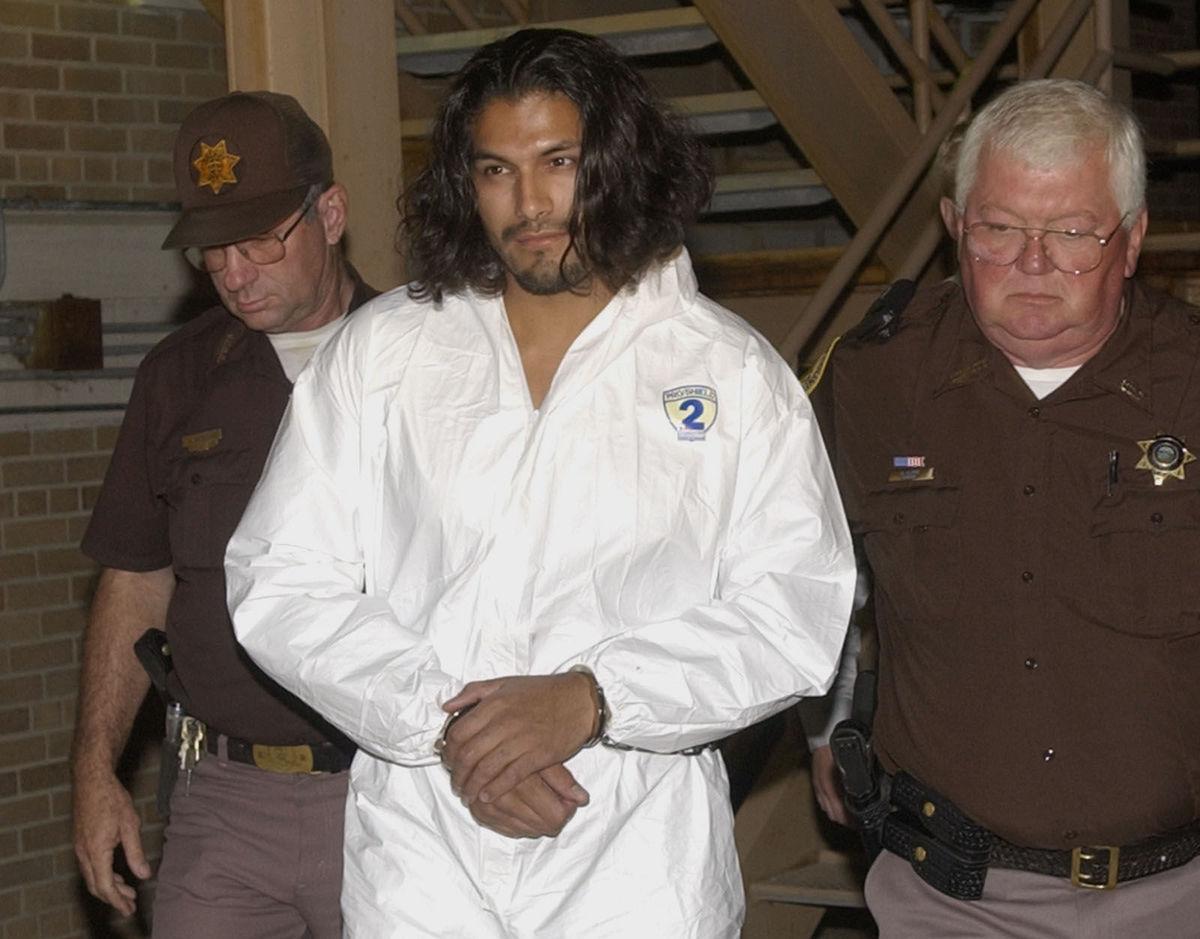
death row

FLORIDA – Prison inmate who beat, killed his cellmate sentenced to death


A Santa Rosa Correctional Institution inmate who viciously beat and killed his cellmate in an apparent racial attack was sentenced to death Monday.

Shawn Rogers, 37, will be placed on death row for the murder and kidnapping of Ricky Dean Martin in 2012.

Rogers, who is a black man, and Martin, a white man, shared a cell in the prison. When word of unarmed black teenager Trayvon Martin’s death made it to the prison, Rogers carried out the racially motivated attack on Ricky Dean Martin that left him tied at the hands and feet, bruised, cut and in a coma that eventually killed him.

The court heard during Rogers’ trial that blood was smeared on the cell’s walls, and Rogers covered Martin’s body with a prayer rug before guards arrived. Martin’s face was covered with a pair of bloody boxer shorts.

A civil lawsuit filed by Martin’s family against the prison further claims Martin had filed grievances in the days before his death, saying he feared for his life and wanted to be moved from Rogers’ cell.

The same suit claims Rogers also raped Martin, though that claim was not presented by the state in Rogers’ criminal case.

Circuit Judge John Simon read a portion of Rogers’ sentencing document during court Monday, finding that the court agrees with the 12-person jury’s unanimous death recommendation.

“Mindful that a human life is at stake … the aggravating factors far outweigh the mitigating factors,” Simon said during sentencing, adding that not only did Rogers murder Martin, but he humiliated him in the process.

Rogers remained stoic as Simon read the document, not making any gestures or saying anything to his attorney, Kenneth Brooks. Rogers will join 349 other Florida prisoners on death row.

Neither Brooks nor prosecutor Jack Schlechter made any motions or arguments before Simon handed down the sentence. Both sides were allowed to present mitigating and aggravating factors in the case at a separate hearing in November, during which Simon heard about Rogers’ troubled past, with one doctor having called his upbringing a “perfect storm” for trouble.

At that same hearing, prosecutors pointed out Rogers had been functional to represent himself at trial, and was capable of premeditation because he voiced to others he would carry out an attack on a white person in the wake of Trayvon Martin’s death.

In addition to the death sentence for the murder charge, Simon sentenced Rogers to life in prison for the kidnapping to inflict terror charge.

Simon told Rogers he is entitled to an appeals process and per state law his death sentence will be automatically reviewed by the Supreme Court.

The civil lawsuit is still ongoing in Federal Court.

Officials urging mercy for death row inmate convicted under ‘law of parties’ now include prosecutor


December 14.2017

There is no dispute over whether Jeffery Lee Wood ever killed anyone.

He did not. He didn’t pull a trigger, didn’t wield a knife, didn’t take any direct action that caused another person’s death.

But twice now, Wood, 44, has come within only a few days of being executed by the state of Texas. He was convicted under Texas’ felony murder statute, informally called the “law of parties,” after he waited outside in a truck while an accomplice robbed a Kerrville convenience store in 1996 — and ended up killing a clerk named Kriss Keeran.

A growing bipartisan chorus agrees that, while Wood was complicit in a crime, he does not belong on death row.

One of those voices belongs to the prosecutor who put him there. Last week, The Texas Tribune reported that Kerr County District Attorney Lucy Wilkehas joined a long list of Texas officials who want to see Wood’s death sentence reduced to life in prison.

In a letter co-signed by the Kerrville police chief and the district judge overseeing Wood’s appeal, Wilke — a young, relatively inexperienced prosecutor at the time of Wood’s 1998 trial — says life imprisonment is the appropriate punishment in this case.

Wilke’s change of heart is not based solely on misgivings over the law of parties used in Texas murder trials. She has also expressed concern over testimony supplied by forensic psychiatrist James Grigson — “Dr. Death” — whose methods and credentials were later called into question.

But her letter urging the Texas Board of Pardons and Paroles to recommend that Gov. Greg Abbott reduce Wood’s sentence to life in prison specifies that “the offender was not actually the person who shot the victim” as a factor in her request.Wilke’s letter reflects a fair and candid evolution of thought about appropriate use of the death penalty in Texas, an evolution she shares with many others.

Honest disagreement remains over capital punishment in this state. This editorial board has urged its discontinuance; many others believe just as strongly that it should be preserved.

But all thoughtful people can agree that the death penalty, if used, should be applied carefully, sparingly, and reserved for the “worst of the worst” offenders — a standard that Wood, while culpable, does not meet.

“At the time of the jury trial in this case, I was a newly licensed attorney with 13 months of experience … the decision to seek the death penalty was mine,” Wilke wrote. “Again, I now respectfully request that this offender’s death sentence be commuted to a capital murder life sentence.”

Unfortunately, in spite of strong bipartisan efforts, state lawmakers passedon an opportunity to reform the Texas statute regarding the law of parties’ use in capital cases during their most recent session. It’s an issue that must be revisited.

In the meantime, a growing number of voices that bridge the political spectrum is calling on Abbott to intervene in this case.

Abbott, sensitive to protecting his red-state bona fides, has not reduced a capital sentence to life since he took office in 2015. But the case of Jeff Wood would be a sensible and honorable place to start.

Shreveport man freed from death row files suit in hopes ‘injustice never happens again’


December 5, 2017

SHREVEPORT — The lawsuit filed by former death row inmate Rodricus Crawford is about more than justice for Crawford; it’s about getting Caddo Parish officials to change their death-penalty-dealing ways, one of the now-freed man’s attorneys said during a recent interview.

“Rodricus seeks justice not only for himself and for all that he lost, but also for people who might – God forbid – face similar circumstances,” Crawford’s attorney David J. Utter, counsel with The Claiborne Firm in Savannah, Georgia, said during a Louisiana Record email interview. “This lawsuit provides parish and city officials do the right thing by examining what went wrong in Rodricus’ case, and instituting checks and balances to ensure such an injustice never happens again.”

Those checks and balances were severely lacking when a Caddo District Court jury handed down the capital punishment sentence the following year against the Shreveport man in the 2012 death of his 1-year-old son Roderius “Bobo” Lott, according to Crawford’s lawsuit.

“Mr. Crawford was convicted and sentenced to death based upon false evidence as a result of the failure of Defendants to conduct an unbiased autopsy based on professional standards of practice, and to properly train and supervise prosecutors in Caddo Parish,” said the lawsuit filed Nov. 16 in U.S. District Court for Louisiana’s Western District.

“Because of the lack of training and supervision and adherence to professional standards, the prosecution was illegally based upon both race and religion, and a complete indifference to the evidence. In addition, Mr. Crawford raises state law negligence and intentional infliction of emotional distress claims; but for the reckless and willful conduct of defendants, Mr. Crawford would not have been prosecuted let alone convicted of capital murder.”

In his lawsuit filed on behalf of himself and his minor daughter, Crawford claims he did not receive his constitutionally guaranteed right to a fair trial. Named defendants in the case include Caddo Parish Coroner’s Office, Caddo Parish District Attorney’s Office, Caddo Parish District Attorney James Stewart, former Caddo Parish District Attorney Dale Cox, Shreveport Fire Department and Coroner James Traylor. Crawford’s lawsuit asks for a jury trial.

The Caddo Parish District Attorney’s office did not respond to a Louisiana Record request for comment.

“Defendants knowingly participated in the investigation, arrest and capital prosecution driven by Caddo Parish, Louisiana’s well-known history of racism and the arbitrary application of the death penalty,” Crawford’s lawsuit said. “But for Defendants’ actions, no prosecution and conviction of Mr. Crawford would have occurred.”

Crawford was taken into custody after bruises and other injuries were discovered on the child’s body. Crawford reportedly told police his son had fallen in the bathroom and Crawford consistently maintained that he had never harmed his son.

His attorneys also consistently maintained that the jury relied on bad forensic science, and pointed to strong medical evidence that the child was suffering from pneumonia and died of sepsis.

“The conduct of the officials in this case, particularly the coroner Dr. Traylor and the prosecutor, were particularly egregious, outside the norm of a mistake or error,” Utter said. “There was intentional misconduct.”

By the time Crawford’s conviction was overturned by the Louisiana Supreme Court in November 2016, Caddo Parish juries were widely noted for having sentenced five people to death in six years, 38 percent of the state’s total death sentences.

The state’s highest court ordered a new trial for Crawford after finding serious issues with the case, including unconstitutional exclusion of black jurors. Louisiana prosecutors dropped charges against Crawford this past April and he was freed soon after that.

“As the result of Defendants’ unconstitutional, negligent and intentional acts, Mr. Crawford spent 4 years, 9 months, and 6 days illegally in custody,” Crawford’s lawsuit said.

Utter credited Baton Rouge lawyer Cecilia Trenticosta Kappel, his co-counsel in Crawford’s lawsuit who is active with the Capital Appeals Project and the Promise of Justice Initiative, for much of the work done to exonerate Crawford.

“Cecelia is the real hero amongst the lawyers on the case,” Utter said.

Crawford’s lawsuit is necessary to get defendants and others to do the right thing, Utter said.

“Unfortunately, many innocent people who spent time in jail or prison have to file a lawsuit before officials will do what is right,” Utter said, referring to the overturned murder conviction of Sabein Burgess in Maryland.

“Rodricus only filed because the officials responsible for this miscarriage of justice failed to apologize and offer to discuss a settlement that provided justice to him, his family and ensure something like this never happens again in Shreveport,” Utter said.

ACLU files lawsuit on behalf of death row inmates against Ricketts, Corrections Department


December 5, 2017

Sandoval

ACLU of Nebraska filed a lawsuit Monday on behalf of death row inmates that claims the ballot initiative that stopped the state Legislature’s 2015 repeal was illegal.

The complaint is an attempt to stop any executions, or even steps toward an execution, of the men on Nebraska’s death row.

Death row inmate Jose Sandoval said last week he intends to fight the execution. At that time, he had no ongoing legal actions or appeals in federal or state courts.

“My reaction to the notice (of lethal injection drugs) was not a surprise. I’ve been expecting it for a year now,” Sandoval said. “I intend to fight with the help of my attorneys — Amy Miller and company.”

The ACLU confirmed Sunday that Miller, its legal director, has been in contact with Sandoval, who was notified Nov. 9 of the state’s intention to execute him with four specified lethal injection drugs. The organization is preparing to announce the scope of its representation of Sandoval early this week, it said.

The four drugs in combination that would be used in Sandoval’s execution, if it takes place, have never been used to execute a person.

The complaint charged the ballot initiative violated the Nebraska Constitution’s separation of powers. It said Gov. Pete Ricketts was the driving force behind the 2016 referendum, exploiting government staff, resources and his own elected position to raise money for the ballot initiative and to persuade voters to support it.

“In Nebraska, our state Constitution … establishes a strong tradition with a clear separation of powers,” ACLU Executive Director Danielle Conrad said Sunday. “The governor can’t have it both ways and serve both as a member of the executive and legislative branches.”

The petition drive got underway in 2015 and the sponsoring group, Nebraskans for the Death Penalty, gathered 167,000 signatures, enough to stop the repeal from being in effect until a vote in November 2016.

The Legislature had voted to repeal Nebraska’s death penalty with a bill (LB268) that passed on a 32-15 vote. Ricketts vetoed the bill and then the Legislature voted to override the veto on a 30-19 vote that cut across party lines.

Shortly after that, Nebraskans for the Death Penalty was formed and raised just over $913,000, a third of it contributed by Ricketts and his father, Joe Ricketts.

The governor’s actions pose important legal questions with grave consequences, Conrad said.

She said the end result of those actions was the restoration of a “broken” death penalty that is racially biased, risks execution of innocent people and raises constitutional concerns about the Eighth Amendment’s prohibition against cruel and unusual punishments.

Ricketts’ office responded in a statement issued Sunday evening.

“The Governor’s Office holds itself to a high standard and follows state law regarding the use of taxpayer resources,” said Taylor Gage, the governor’s spokesman. “This liberal advocacy group has repeatedly worked to overturn the clear voice of the Nebraska people on the issue of capital punishment and waste taxpayer dollars with frivolous litigation. The administration remains committed to protecting public safety and creating a safe environment for our Corrections officers.”

The ACLU lawsuit — filed on behalf of death row inmates against Ricketts, Treasurer Don Stenberg, founders of Nebraskans for the Death Penalty, Attorney General Doug Peterson, the Department of Correctional Services and Director Scott Frakes — asked the court to immediately stop all preparations for executing Sandoval and the other 10 men on death row.

Peterson plans to ask the Nebraska Supreme Court for a death warrant after 60 days following the notification of drugs that would be used.

That ACLU complaint said that as the governor, Ricketts’ power over the repeal bill ended when the Legislature overrode his veto.

It claimed the subsequent ballot initiative should not stand, as it was the result of repeated, extensive and illegal abuses of the governor’s power. The state’s constitution reserves ballot initiatives as a legislative power for the people to use as a check on the legislature, and it further prohibits anyone in one branch of government from exercising powers over another branch, the ACLU said.

Ricketts encouraged or ordered members of the executive branch and his allies in the Legislature and local governments to work for the referendum campaign or to express public support for it, the complaint said.

For example, Stenberg was simultaneously a leader of the campaign in the first few months, serving as co-chairman with Sen. Beau McCoy, the ACLU charged. In the middle of the campaign, Ricketts rewarded Jessica Flanagain, the campaign manager and coordinator, with a publicly paid position in the government as special adviser to the governor for external affairs, with a salary of $130,000, the complaint alleges.

The lawsuit also noted that Nebraskans for the Death Penalty made an error that invalidated the referendum by failing to submit sworn statements from its sponsors, as required by law to assure the sponsors’ names aren’t fraudulent and assure transparency in the working of ballot campaigns.

Previous litigation more narrowly alleged the referendum petition was not legally sufficient because a list of sponsors filed with the petition did not include the name of Ricketts, who it claimed engaged in activities that established that he was a sponsor of the referendum. The district court dismissed the complaint. The Supreme Court affirmed, holding Ricketts’ alleged financial or other support of the referendum did not make him a person “sponsoring the petition.”

After 22 years, Ernesto Martinez convicted of Blythe murder during deadly road trip


December 4, 2017

Twenty two years ago, a desperate man stepped into the Day & Nite Mini Mart in Blythe, pulled a gun, demanded money and shot the clerk behind the counter. Then he grabbed the cash and fled.

That killer, a jury said, was Ernesto Salgado Martinez.

Martinez, 42, was convicted Monday of murdering Randip Singh, a shopkeeper who was gunned down during a deadly road trip to Arizona and back in 1995. The verdict, which took three-and-a-half days to reach, brings closure to one of the longest and most convoluted prosecutions in the recent history of Riverside County. Martinez’s verdict was confirmed by John Hall, a spokesman for the District Attorney’s Office.

Martinez, who was only 19 at the time, drove from Indio to Arizona to visit his family members, then was pulled over by a highway patrol officer along the Beeline Highway. Martinez shot that officer, Bob Martin, then fled back to California, where he crossed the state line and ran out of gas in Blythe. Prosecutors say Martinez then robbed the mini-mart, shooting Singh when he refused to empty the register.

During closing arguments last week, Deputy District Attorney Chris Cook said there was “overwhelming” evidence that Martinez was fleeing from one murder and killed again to keep running.

“The thing standing between him and getting home to Indio – a place of safety, family and familiarity – was Randip,” Cook said. “He was out of options and out of gas. He had just killed a police officer, he had to get home.”

“And he had a gun.”

Martinez, who taught himself law during two decades behind bars, acted as his own attorney during a six-week trial. In his own closing arguments, he accused witnesses of changing their stories and implied that a key piece of the evidence – a bullet casing – had been planted. He told jurors the prosecution’s case had “insulted their intelligence.”

“They are not asking you to decide this case based on the evidence. They are asking you to decide this case based on prejudice,” Martinez said.Martinez was also on trial for attempted murder, accused of stabbing his cell mate, Leroy Gutierrez, 50 times in 2011. Martinez argued that the stabbing was self defense, and jury acquitted him of the attempted murder charge on Monday.

The murder case will now proceed to the sentencing phase, at which prosecutors plan to seek the death penalty. However, regardless of how Martinez is sentenced, once the decision is made he will be returned to Arizona, where he has already received the death penalty for killing Martin, the highway patrol officer. Even if Martinez is sentenced to death in California, Arizona will still get to kill him first.

After the Blythe shooting, police captured Martinez during a standoff in Indio. Martinez was prosecuted in Arizona first, where he was convicted of killing Martin in 1998. Twelve years later, in 2010, local prosecutors had Martinez pulled off of Arizona Death Row and brought to Riverside County to be tried for Singh’s death. Now back in California, Martinez fired his public defender and became his own attorney. His case then took seven years to get to trial, in part because of Martinez’s talent for filing and arguing pre-trial motions.

“He is incredibly dangerous because he is so bright,” District Attorney Mike Hestrin said of Martinez in 2015. “I would like to get him out of our system and out of our jail. And one of the ways to do that is to get this case to trial as quickly as possible.”

Miami mom is on trial a third time for the torture and murder of ‘Baby Lollipops’


December  4,2017

For the third time, a jury heard about Baby Lollipops’ short and tragic life — and the details remained just as ghastly now as they did in 1990, when his body was discovered in the bushes of a Miami Beach home.

The skeletal, malnourished 3-year-old weighed just 18 pounds. His soiled diaper was duct-taped onto his filthy body. His cheek bore a burn mark, likely from a cigarette.

Two teeth were knocked out, taking out a portion of his jaw. Blow after blow, inflicted month after month, eventually left his tiny body battered. He was unable to walk, his skull was fractured, his brain stem severed.

“His left arm was so badly injured that the muscle from the elbow to the shoulder had fused into the bone making it impossible for this young child to extend his arm,” Miami-Dade prosecutor Christine Hernandez told jurors on Monday.

Lazaro Figueroa died an unimaginably horrible death. And to blame, prosecutors allege, was his own mother, Ana Maria Cardona, who beat and abused her youngest child over months.

“This young baby was the subject of her hatred, this baby was the target of her rage,” Hernandez told jurors.

The start of the trial Monday marks the third time Cardona has faced a jury for the November 1990 murder of little Lazaro, whose corpse was discovered dumped outside a home in Miami Beach.

As detectives hunted for his killer and identity in a case that captivated South Florida, they dubbed him “Baby Lollipops” for the design on his shirt. Homicide detectives soon arrested Cardona, a cocaine addict who had lived in a Miami efficiency with her two other children and lover, Olivia Gonzalez.

Cardona’s defense team on Monday shifted the blame.

“We’re going to bring you testimony that while Olivia Gonzalez was serving time in prison, she bragged that she was the one who hit the child over the head with a baseball bat and killed him,” Miami-Dade Assistant Public Defender Manuel Alvarez said.

Jurors will not hear that twice before, Cardona was sent to Death Row after convictions for first-degree murder and aggravated child abuse.

Lazaro Figueroa died an unimaginably horrible death. And to blame, prosecutors allege, was his own mother, Ana Maria Cardona, who beat and abused her youngest child over months.

“This young baby was the subject of her hatred, this baby was the target of her rage,” Hernandez told jurors.

Ohio Supreme Court to hear local man’s death penalty appeal


December  4,  2017


COLUMBUS, Ohio — On Tuesday, the Ohio Supreme Court is to preside over a legal debate over whether the death penalty should be executed on a young Clayton man – the second youngest on Ohio’s Death Row – for the murder of an even younger Warren County man at his home outside Waynesville in January 2014, according to the Journal-News.

Warren County Prosecutor David Fornshell will personally argue for the state to continue forward toward the execution of Austin Myers, now 22, of Clayton, although another Clayton man, Timothy Mosley – like Myers 19 years old at the time – actually stabbed to death Justin Back, 18, a 2013 Waynesville High School graduate about to enter the U.S. Navy.

“Austin Myers killed Justin. Tim was his weapon of choice,” Fornshell said last week, quoting Back’s stepfather, Mark Cates, a local prison guard.

It will be Fornshell’s first appearance before the high court on behalf of Warren County.

Lawyers appointed to appeal Myers’ death sentence have identified 18 violations of law they claim should convince the state’s high court to set aside his death sentence, including his age and the lesser sentence – life in prison without paroleMosley received in exchange for his testimony.

Three years later, Myers is still the second youngest of 140 Ohio prisoners facing the death penalty. Damantae Graham, 20, convicted of killing a Kent State University student, is the only one younger.

Myers’ lawyers also claim errors or misconduct by the judge, prosecutors and defense lawyers in the case, decided more than three years ago in Warren County Common Pleas Court, should convince the high court, including appointed Judge Cynthia Westcott Rice of Ohio’s 11th District Court of Appeals, to spare his life.

“Mr. Myers’s rights under the Constitution of the United States and the Ohio Constitution were violated and he was denied a fair trial and sentencing proceeding. Accordingly, this Court should reverse and discharge the defendant or grant a new trial. In the alternative, this Court should vacate the death sentence, remand for a resentencing hearing, and order the life sentence imposed,” lawyer Timothy McKenna said in his brief to the high court.

The appeal, pending since Oct. 27, 2014, was set for oral arguments on Oct. 20, after a second Ohio Death Row inmate was executed. These came after the postponement of scheduled executions starting in January 2014 following problems during the execution of Dennis McGuire, a Preble County man.

Rice was appointed to the high court on Nov. 6, replacing Justice Bill O’Neill, who recused himself after announcing he was running for governor.

The case

Myers and Mosley were arrested in July 2014 after Back’s mutilated body was found in Preble County, in a wooded area outside Versailles known as Crybaby Bridge. They both gave statements during interrogation at the Clayton Police Department used by investigators in reconstructing the crime, according to police and court records.

According to their statements, Mosely’s testimony and other evidence, after a day of preparation and planning, Myers and Mosley went to Back’s home in a small neighborhood along the Little Miami River, east of Waynesvile. With a garrote – fashioned by a friend who was not charged – Mosley came up behind Back and began choking him, while Myers restrained Back. When the garrote caught on Back’s chin, Mosley pulled out a knife and stabbed Back to death.

After cleaning the home and stealing Back’s iPod and wallet, as well as a gun and safe belonging to Cates, Mosley and Myers removed Back’s body, dumping it in Preble County after dousing it with chemicals to quicken decomposition. Before leaving the body, Myers shot it twice with Cates’ gun.

At trial, prosecutors convinced the jury that Myers was the mastermind of the crime and he was sentenced to die. Mosley, in exchange for his testimony, was sentenced in a plea bargain to life without parole.

The issues

Mosley was represented by Dennis Lieberman, a lawyer hired by Mosley’s family. Myers was represented by Greg Howard and John Kaspar, appointed by the court.

But Fornshell said Mosley got the deal because – unlike Myers- he offered to cooperate. Prosecutors needed one or the other to “put in the back story,” Fornshell said.

In addition, Fornshell said Mosley accepted responsibility and Myers was “exponentially more dangerous,” pointing to evidence indicating Myers handled the bulk of the planning and wanted to go back and kill Cates.

He’s a serial killer who got caught the first time,” Fornshell added.“There is absolutely no doubt in my mind.”

McKenna and co-counsel Roger Kirk did not respond to requests for interviews.

But their 110-page brief indicates they will emphasize Myers “was a 19 year-old immature adolescent with behavioral issues” who should be spared the death penalty, in part because Mosley’s sentence spared his life, although he wielded the murder weapon.

In addition, they claim prosecutors rendered Myers’ lawyers “admittedly ineffective” by withholding evidence until “on the Friday eve before the Monday trial,”as well as the fact that Mosley was to be a witness.

The appeal

The appeal is to be the first of a series of cases heard on Tuesday and Wednesday.

All arguments are streamed live online at sc.ohio.gov and broadcast live and archived on the Ohio Channel, according a release from the high court.

The court typically issues opinions within six months, but it was unclear when a decision would be issued in this case.

Death row inmate who survived his own execution really doesn’t want a do-over


November  2017

An Ohio man who became the third U.S. death row inmate in seven decades to survive his own execution filed a new appeal for mercy Tuesday, arguing that Ohio’s lethal injection protocol constitutes cruel and unusual punishment because one of its drugs may not work properly.

Alva Campbell, a 69-year-old man sentenced to death in 1998 for killing 18-year-old Charles Dial in a robbery, had his execution halted about 25 minutes after it was scheduled to start, according to the Associated Press. The execution team, it turned out, couldn’t pinpoint a vein that they could use to inject Campbell with a dosage of lethal drugs.

In court documents filed before the execution, Campbell’s lawyers warned that this was a possibility, as Campbell has a history of chronic heart and lung problems that can make finding a vein tricky. In fact, the prison was so worried that Campbell’s lungs would give out and he would stop breathing, while lying on the execution gurney, that the team gave him a wedge pillow to help him stay calm and alive until they could execute him.

Campbell’s lawyers also cited Ohio’s bad track record when it came to successfully carrying out executions. Though the first failed execution in modern U.S. history took place in 1946, when Louisiana’s attempt to execute Willie Francis using the electric chair failed, the second was much more recent: In 2009, an Ohio execution team made 18 attempts over the course of two hours to find a vein to inject Romell Broom with lethal injection drugs. Then-Gov. Ted Strickland ultimately ordered them to give up. Broom remains on death row, locked in a court battle where he argues that trying to execute him a second time would be unconstitutional.

Alva Campbell, 69 (Ohio Department of Rehabilitation and Correction )

Campbell’s new appeal to the U.S. Court of Appeals for the Sixth Circuit Court, however, technically centers around a different issue: the use of midazolam, a sedative that’s meant to render an inmate unconscious.

Midazolam has been used in several recent botched executions, including in Ohio. In 2014, the state executed convicted killer and rapist Dennis McGuire, even though McGuire reportedly gasped, snorted, and snored minutes after he should have been knocked unconscious. A judge ended up declare Ohio’s lethal injection procedure unconstitutional, leading the state to halt executions for years.

As drug manufacturers and distributors become more and more reluctant to allow their wares to be used in executions, however, states are scrambling to find drugs they can use in lethal injections. That’s led midazolam’s popularity to skyrocket.

Evidence “from recent executions demonstrates the disturbing signs that prisoners remain sensate to severe pain, aware, and conscious following injection of 500 mg. of midazolam or more are ‘the rule,’ not ‘the exception,’” Campbell’s lawyers write in his latest appeal.

Campbell’s new execution date is June 6, 2019.

Death row inmate Lotter’s attorneys ask U.S. Supreme Court to hear case


December 1,  2017

A Nebraska death row inmate has asked the U.S. Supreme Court to take his case and review decisions by a federal district court and appellate court to deny his latest challenge to his sentence.

John Lotter, who was convicted in the killing that inspired the 1999 movie “Boys Don’t Cry,” specifically is seeking review of an 8th Circuit Court of Appeals order July 31 denying him permission to go forward with an appeal in U.S. District Court in Nebraska.

Rebecca Woodman and Jessica Sutton, of the Death Penalty Litigation Clinic in Kansas City, Missouri, had sought to challenge Nebraska’s sentencing method, which relies on judges and not juries to determine if someone gets the ultimate punishment.

They started the challenge in U.S. District Court in Lincoln.

But in February, Senior U.S. District Judge Richard Kopf refused and denied Lotter’s habeas corpus petition, in part because the attorneys hadn’t gotten permission from the 8th Circuit Court to file it.

He likened the filing to a Hail Mary pass.

Lotter, who is raising the same challenge in state court based on a U.S. Supreme Court decision in a Florida case last year, appealed.

In a one-page judgment July 31, a three-judge 8th Circuit panel said after carefully reviewing the district court file it was denying Lotter’s application for a certificate of appealability.

The court’s permission is required for him to go forward in federal court because he has had at least one prior habeas corpus petition.

Lotter also is appealing a Richardson County District judge’s decision to deny him an evidentiary hearing.

Lotter was sentenced to death for his role in the 1993 killings of Brandon Teena and two witnesses, Lisa Lambert and Philip DeVine, at a rural Humboldt farmhouse.

Prosecutor: Why Arizona still needs the death penalty


November 27, 2017

County attorney: As long as there are horrific murders, there will be a role for the death penalty as a just and proportionate punishment.

n a coordinated campaign, death penalty opponents submitted nearly identical op-eds in major publications across the U.S. seeking to persuade the United States Supreme Court to review the case of Arizona vs. Hidalgo and abolish the death penalty.

Understanding how a decision is made to pursue the death penalty, the facts of this case and about the death penalty in Arizona undermines their arguments.

Few murders become death penalty cases

My office follows a thorough and deliberative process for reviewing all death penalty eligible cases under tight deadlines. Arizona law requires us to make an initial decision within 60 days of the murderer’s arraignment.

During this period, we request any and all information the defense team can offer to assess whether the death penalty can be supported by the evidence and is an appropriate punishment.

If more time is needed to gather information, we regularly work with the defense to extend deadlines. After receiving input from victims, reviewing everything provided by the defense, and considering the facts and circumstances of the case, an experienced team makes a recommendation to me.

MORE: Maricopa County runs out of death penalty attorneys

I consider the recommendation carefully before making any decision. Approving the filing of a “notice of intent to seek the death penalty” is the most consequential decision I make as county attorney.

Should more information be provided later on, we regularly review it and, where appropriate, we revisit our initial decision and resolve cases accordingly.

Lastly, not all murder cases are death penalty cases. In fact, Maricopa County has averaged 203 murders each year from 2012 through 2016, and a death notice has been filed in an average of 14 cases each year – less than 8 percent of the murders.

Why Hidalgo was sentenced to die

As for the op-eds, they fail to acknowledge the extensive protections provided to capital defendants to safeguard constitutional rights and ensure a fair and just process.

In Hidalgo’s case, every constitutional right was protected. Hidalgo had a qualified capital defense team that included experienced investigators and mitigation specialists. The trial judge that presided over the case had presided over numerous death penalty cases and had represented several capital defendants before becoming a judge.

A jury unanimously imposed a death sentence on Hidalgo for good reason.

Hidalgo agreed to kill the victim on behalf of a street gang for $1,000. When Hidalgo went to kill the victim, the victim was not alone.

Hidalgo murdered this second victim to eliminate a potential witness. He shot one victim in the back of the head and the other in the forehead. Even though both victims were certainly dead, Hidalgo shot each victim an additional five times.

Before determining death was an appropriate punishment, the jurors found that Hildalgo had actually killed four people, the two Arizona victims and two Idaho women.

Like other death penalty cases in Maricopa County, the question was not who did it.  Hidalgo actually pleaded guilty to the charged offenses. The only contested issue was what the penalty should be.

A just system needs the death penalty

Next, death penalty opponents assert that the death penalty in Arizona is racially disparate. But this does not match the facts. Currently, there are 69 Caucasians, 25 Mexican Americans, 17 African Americans, four Native Americans, three Asians and two classified as “other” awaiting justice on Arizona’s death row.

Continuing complaints about the cost and time to impose the death penalty neglect the costs associated with constitutional protections and thorough appellate review caused by the very people complaining about costs and the time involved.

For Arizona, this has led to excessive litigation in the U.S. Ninth Circuit Court of Appeals and unnecessary delays averaging more than 20 years with associated costs. Other federal circuits in the United States routinely and thoroughly review death penalty appeals within 10 years. This tolerance for endless litigation is an area ripe for criminal justice reform.

Recent polls continue to reflect that a majority of Americans support the death penalty, and 31 states have determined there is a place for the death penalty in a just and proportionate system of punishment.

One year ago, voters in Nebraska reinstated the death penalty abolished the year before by their legislature. Voters in California recently rejected an initiative to abolish the death penalty and passed Proposition 66, which seeks to speed up the process for final review of capital sentences.

As long as there are horrific murders reflecting the worst of crimes, there will be a role for the death penalty as a just and proportionate punishment.

Bill Montgomery is Maricopa County attorney.