Capital punishment

Werner Herzog’s ‘On Death Row’ Subject Executed


Having delved into the deep end of the prison system, interviewing a man awaiting execution and the family members of his victims in his outstanding 2011 doc “Into The Abyss.” Werner Herzog is set to continue the conversation about the death penalty and those to whom it’s been given in “On Death Row,” a four-part companion series to last year’s film that premieres on the Investigation Discovery channel on March 9th at 10pm. 

In an unfortunate instance of timeliness, one of the five inmates he interviews in the series has just been executed. George Rivas, 41, was the leader of the Texas 7, a gang that escaped from a maximum-security prison and went on a crime spree that left one policeman dead, ultimately getting caught after someone spotted them on “America’s Most Wanted.” He was serving multiple life sentences for kidnapping, robbery and burglary charges at the time of the breakout. In the clip from “On Death Row” below, he tells Herzog “I had more time than all mass murderers in the prison system that I know of. They took away all hope for me. When you do that to a person, anything is possible.”

Rivas died by lethal injection on Wednesday. According to the AP, he offered a statement to the family of Aubrey Hawkins, the slain officer: “I do apologize for everything that happened. Not because I’m here, but for closure in your hearts. I really do believe you deserve that.”

The episode featuring Rivas and fellow gang member Joseph Garcia is scheduled to air March 23. Herzog doesn’t support the death penalty, but during “Into The Abyss” demonstrated his ability to highlight its ugliness and find empathy for those awaiting execution while never softening his portrayal of the crimes committed, telling Michael Perry “I don’t have to like you, but you are a human being.”

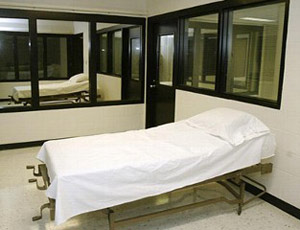
MISSOURI – Death penalty procedures rife with problem . ABA report


An American Bar Association analysis of Missouri’s death penalty procedures finds much room for improvement.

The report, to be formally announced today, faults the state for:

* not holding on to DNA evidence for as long as a person is incarcerated;

* not having clear requirements for recording depositions;

* not providing two attorneys and an investigator for defendants in death-penalty cases and appeals;

* not paying public defenders in capital cases fairly;

* not tracking racial statistics in death-penalty cases;

* and requiring that a defendant’s mental disability be documented — as opposed to just manifested — before they reach 18.

The report, “Evaluating Fairness and Accuracy in State Death Penalty Systems: The Missouri Death Penalty Assessment Report,” was conducted by a team of eight Missouri law professors, attorneys and judges with varying views on the death penalty. It looked at a dozen key areas that affect who is executed by the state and how fairly such punishment is meted out.

“The ABA doesn’t take a position on the death penalty itself but calls for states to impose a moratorium if certain problems have not been corrected,” said Virginia Sloan, chair of the ABA Death Penalty Moratorium Project.

The Missouri report is part of a second wave of such reports that have looked at the death penalty in Alabama, Arizona, Florida, Georgia, Indiana, Kentucky, Ohio, Pennsylvania and Tennessee since 2003. Funding for all the reports came from the European Union, which strongly opposes the death penalty.

The report said the state’s “areas of strength” were its accreditation of crime labs, provision of defense services, trial instructions to jurors in capital cases, the independence of its judiciary and its treatment of “mentally retarded” offenders.

Reform, however, was called for in six areas: aggravating circumstances, at the pretrial stage, at the trial stage, at the post-trial stage, data collection and funding issues. It says that the state allows too broad of a range of aggravating circumstances to result in a penalty of death.

Legislation in Missouri was introduced at the beginning of this year by Rep. Mike Colona, D-St. Louis, to hold off on executions in Missouri until a statewide report can be completed.

Source : http://molawyersmedia.com/

U.S.A News about Death penalty


Every day, you find the latest news on the death penalty, I will group the most important news I have read in the media.

Death Penalty Methods, State by State


The death penalty laws in each state and the District of Columbia. Six states with the death penalty have not had an execution since 1976: Connecticut, Kansas, New Hampshire, New Jersey, NewYork and South Dakota.
ALABAMA – Lethal injection unless inmate requests electrocution
ALASKA – No death penalty
ARIZONA – Lethal injection for those sentenced after Nov. 15, 1992; others may select injection or lethal gas.
ARKANSAS – Lethal injection for those whose offense occurred after July 4, 1983; others may select injection or electrocution.
CALIFORNIA – Lethal injection unless inmate requests gas.

COLORADO – Lethal injection.

CONNECTICUT – Lethal injection.

DELAWARE – Lethal injection.

DISTRICT OF COLUMBIA – No death penalty.

FLORIDA – Inmate may select lethal injection or electrocution.

GEORGIA – Lethal injection.

HAWAII – No death penalty.

IDAHO – Firing squad if lethal injection is”impractical.”

ILLINOIS – Lethal injection; electrocution authorized if injection is ever held to be unconstitutional.

INDIANA – Lethal injection.

IOWA – No death penalty.

KANSAS – Lethal injection.

KENTUCKY – Lethal injection for those convicted after March 31, 1998; others may select lethal injection or electrocution.

LOUISIANA – Lethal injection.

MAINE – No death penalty.

MARYLAND – Lethal injection for those whose offense occurred on or after March 25, 1994; others may select injection or gas.

MASSACHUSETTS – No death penalty.

MICHIGAN – No death penalty.

MINNESOTA – No death penalty.

MISSISSIPPI – Lethal injection.

MISSOURI – Lethal injection or lethal gas; statute leaves unclear whether decision to be made by inmate or director of state Department of Corrections.

MONTANA – Lethal injection.

NEBRASKA – Electrocution.

NEVADA – Lethal injection.

NEW HAMPSHIRE – Hanging only if lethal injection cannot be given.

NEW JERSEY – Lethal injection.

NEW MEXICO – Lethal injection.

NEW YORK – Lethal injection.

NORTH CAROLINA – Lethal injection.

NORTH DAKOTA – No death penalty.

OHIO – Lethal injection.

OKLAHOMA – Electrocution if lethal injection is ever held to beunconstitutional; firing squad if both injection and electrocution are
held unconstitutional.

OREGON – Lethal injection.

PENNSYLVANIA – Lethal injection.

RHODE ISLAND – No death penalty.

SOUTH CAROLINA – Inmate may select lethal injection or electrocution.

SOUTH DAKOTA – Lethal injection.

TENNESSEE – Lethal injection for those sentenced after Jan. 1, 1999; others may select electric chair or injection.

TEXAS – Lethal injection.

UTAH – Lethal injection; firing squad available to inmates who chose it prior to passage of legislation this year banning the
practice.

VERMONT – No death penalty.

VIRGINIA – Inmate may select lethal injection or
electrocution.

WASHINGTON – Lethal injection unless inmate requests
hanging.

WEST VIRGINIA – No death penalty.

WISCONSIN – No death penalty.

WYOMING – Lethal gas if lethal injection is ever held to be unconstitutional.