Filmmaker Werner Herzog’s segment on Hank Skinner, who is on Texas death row and fighting to prove his innocence with more DNA testing.
official website : http://www.hankskinner.org/
Filmmaker Werner Herzog’s segment on Hank Skinner, who is on Texas death row and fighting to prove his innocence with more DNA testing.
official website : http://www.hankskinner.org/

march 29, source :http://arkansasnews.com
LITTLE ROCK — A man sentenced to die for a 1997 double homicide in Little River County did not receive a fair trial because prosecutors withheld crucial evidence from the defense, an attorney for the man argued today before the state Supreme Court.
An attorney for the state said the outcome of the case would have been the same even if the state had provided the evidence.
The court heard oral arguments but did not immediately issue a ruling in an appeal by Timothy Lamont Howard, 42, who was convicted of two counts of capital murder in the deaths of Brian and Shanon Day. The three were friends and were all involved in using and selling illegal drugs, mainly methamphetamine, according to court filings.
Brian Day’s body was found in a U-Haul trailer in Ogden on Dec. 13, 1997, and his wife’s body was found in the closet of the couple’s home in Ashdown later the same day.
At Howard’s trial in December 1999, jurors heard a forensics expert testify that boots found 2 1/2 miles from the murder scene contained hairs that were a likely match with Howard, and that blood on the boots was a likely match with Brian Day.
Howard’s trial lawyer argued that Howard was in Texarkana when the murders occurred and that the boots had been used to frame Howard.
The state Supreme Court upheld Howard’s conviction in 2002, but federal public defender Scott Braden argued before the high court today that it should order a new trial, or in the alternative send the case back to Little River County Circuit Court for a new evidentiary hearing, because the defense has learned that the state withheld evidence that could have changed the outcome of the trial.
That evidence includes notes showing that errors occurred during the testing of DNA from the boots and that samples may have been contaminated. Braden said the state had those notes but did not provide them to the defense before the trial.
“There is no question here that there is a reasonable probability that the jury would have done something different” if the defense had been able to use those notes to try to impeach the DNA evidence, Braden argued.
Assistant Attorney General Lauren Heil argued that other evidence established that the boots were Howard’s, including testimony by Howard’s ex-wife that the boots looked like his.
Justice Robert Brown asked Heil if she thought that testimony was equivalent to testimony of a DNA match. She said she believed it was, in combination with Howard’s defense that the boots were used to frame him — a defense that she said required conceding that the boots were his.
Braden also argued that the state did not provide the defense with a police report detailing an incident of abuse that Howard suffered as a child. He said the defense could have used the report as evidence of Howard’s violent childhood during the penalty phase of the trial, and the jury could have considered Howard’s past a mitigating factor that weighed against imposing the death penalty.
Heil argued that Howard could have brought up the incident himself at his trial, but he did not.
“The defendant has an obligation to raise things within his own unique knowledge,” she said.
Heil also argued that the defense did not assert its claims in a timely manner, a charge that Braden denied.
The Supreme Court split on Howard’s previous appeal in 2002, ruling 4-3 to uphold his conviction. Only two of the justices who took part in that decision are still on the court: Chief Justice Jim Hannah and Justice Robert Brown, both of whom said then in dissenting opinions they would have overturned the conviction because of problems with the state’s case.
Justice Donald Corbin recused from hearing both appeals. Filling in for him today as a special appointed justice was Little Rock lawyer Ronald Hope.
| Name | Date | Duration | |||
|---|---|---|---|---|---|
 CR 00-803 Timothy Lamont Howard v. State of Arkansas, from Little River Circuit CR 00-803 Timothy Lamont Howard v. State of Arkansas, from Little River Circuit |
Mar 29, 2012 | 00h 53m | Oral Argument |
Case Caption:
TIMOTHY LAMONT HOWARD
V
STATE OF ARKANSAS
Timothy Lamont Howard (ACTIVE) Appellant’s counsel:
Dorcy Kyle Corbin – LEAD
Janice Wegener Vaughn – LEAD
Mac John Carder Jr – LEAD
Julie Brain – LEAD
Scott W. Braden – LEAD
Joshua R. Lee – LEAD
Conviction Information:
Convicted of: Capital Murder
Sentence: 000-00-000 (yyy-mm-ddd)
Sentence Type DEATH
State Of Arkansas (ACTIVE) Appellee’s counsel:
Attorney General – LEAD
Trial Court: Little River
Little River Circuit
Trial Court Number: CR-97-105
Trial Judge: Charles A. Yeargan
——- EVENT LISTING ——–
03/29/2012 Case Submitted – Orally Argued
03/29/2012 Supreme Court Votesheet Issued
03/29/2012 Supreme Court Oral Argument Issued for
REGULAR DOCKET scheduled for 03/29/12 at A.M. – ORAL Argument.
2/27/12 – Scott Braden and Josh Lee confirmed
2/27/12 – Lauren Heil confirmed
| No. 02-6564 | Status: | DECIDED |
| Title: | Timothy Lamont Howard, Petitioner | |
| v. | ||
| Arkansas | ||
| Docketed: | Lower Ct: | Supreme Court of Arkansas |
| September 26, 2002 | (CR00-803) |
| ~~Date~~~~~~ | ~~~~~~~Proceedings and Orders~~~~~~~~~~~~~~~~~~~~~~~~~~~~~~ |
| Sep 25 2002 | Petition for writ of certiorari and motion for leave to proceed in |
| forma pauperis filed. (Response due October 26, 2002) | |
| Oct 28 2002 | Brief of respondent Arkansas in opposition filed. |
| Nov 7 2002 | DISTRIBUTED for Conference of November 27, 2002 |
| Dec 2 2002 | Petition DENIED. |
| ******************************************************** | |
| ~~Name~~~~~~~~~~~~~~~~~~~~~ | ~~~~~~~Address~~~~~~~~~~~~~~~~~~ | ~~Phone~~~ |
| Attorneys for Petitioner: | ||
| Jeffrey M. Rosenzweig | 300 Spring Street | 5013725247 |
| Suite 310 | ||
| Little Rock, AR 72201 | ||
| Party name: Timothy L. Howard | ||
| Attorneys for Respondent: | ||
| Lauren E. Heil | AG’s Ofc., 200 Tower Building | 5016821309 |
| 323 Center Street | ||
| Little Rock, AR 72201 | ||
| Party name: Arkansas | ||

march 29, 2012 source : http://www.myfoxal.com
A new execution date has been set for death row inmate Thomas Douglas Arthur.
Officials with the Alabama Department of Corrections say Arthur will be put to death on Thursday, March 29th at 6 pm. That will happen at Holman Correctional Facility in Atmore.
Arthur has served more than 24 years on Alabama’s death row. He was convicted in the contract killing of businessman Troy Wicker in 1982.
Thomas Douglas had challenged his scheduled execution by lethal injection, claiming the state’s use of a new anesthesia did not completely sedate inmates before the lethal drugs were administered. He said the practice was cruel and unusual.
The court on Wednesday declined a request by Alabama’s attorney general’s office to reconsider a March 21 decision allowing Arthur to go forward with his challenge.
Spokeswoman Joy Patterson said the Alabama attorney general’s office was not going to appeal the court decision Wednesday.
State attorneys have pointed to successful executions where the drug — pentobarbital — was used.
The court last week decided to put Arthur’s execution on hold while the challenge was heard. It marked the fifth time that Arthur — who has maintained his innocence for more than 29 years while on death row — was spared execution.
According to court documents filed by the State of Alabama, Troy Wicker’s wife, Judy, testified that she had a sexual relationship with Arthur and paid him $10,000 to kill her husband.
11th court read the docket click here
Thomas Douglas Arthur Website
case and old post click here

march, 27, 2012 source : http://www.foxandhoundsdaily.com
by Donald H. Heller, former Assistant U.S. Attorney & Ron Briggs, El Dorado County Supervisor
As two staunch conservatives, we write in response to Sen. JoelAnderson’s attempt to “fix the death penalty” with Senate Bill 1514. Together, the two of us supported California’s current death penalty law and helped enact it in 1978. Today, we agree with Sen. Anderson that the system we helped create is hopelessly broken. But far from tinkering with that system, we have both concluded the solution is to replace it with life without parole by passing the SAFECaliforniaAct on this November’s ballot.
We did not come to this decision lightly, and NO, we are not soft on crime. Just the opposite. SAFE California replaces the death penalty with a sentence of life in prison with absolutely no chance of parole as the maximum punishment for murder. This means convicted killers will remain behind bars forever – but without the exorbitant price tag, terrible toll on the family members of victims, or the risk of executing an innocent person. At over 720 inmates and with a $4 billion price tag, our state runs the nation’s costliest and most populous death row. Nonetheless California has carried out just 13 executions since 1978.
We were intimately involved in writing and promoting our current death penalty law in 1978. We believe that public safety is one of the primary purposes of a government predicated on the rule of law. Justice should be swift and certain. The structure that we helped create is legally sound, having withstood multiple appeals to the U.S. Supreme Court. But, fiscallyspeaking, it has been disastrous. We never contemplated the staggering cost of implementing the death penalty: more than $4 billion to date and approximately $185 million projected per year in ongoing costs.
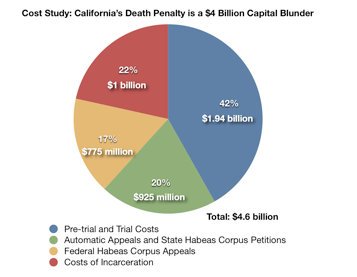
Source: “ExecutingtheWilloftheVoters?” by Judge Arthur Alarcon and Paula Mitchell, 2011
We thought we would bring California savings and safety in dealing with convicted murderers. Instead, we contributed to a nightmarish system that coddles murderers and enriches lawyers. Like Senator Anderson, our effort was intended to bring about greater justice for murder victims. Never did we envision a multi-billion dollar industry that packs murderers onto death row for decades of extremely expensive incarceration. We thought we would empty death row, not triple its population.
Having 34 years of firsthand experiences in this matter we feel the bill proposed by Sen. Anderson will not fix these problems. First and foremost, shortcutting the appeals process means risking innocent lives. Appeals are the safety net that keeps us from executing innocent people. States that shortchange the justice process have executed innocent people, like CameronToddWillingham in Texas.
Beyond the risk of executing the innocent, SB 1514 would simply move appeals from one court to another. That doesn’t alleviate the delay or the expense, it will just move it to a different courthouse.
It won’t eliminate the $1 million each county pays per death penalty trial, or the extra housing costs on death row over the general population – on average $100,000 per inmate per year – and it won’t change the fact that 99% of death row inmates in California die of old age rather than execution. History tells us any change to the death penalty has only added life to criminals, enhanced lawyers paychecks costing taxpayers more and more while appellate dates or new trials continue to torture victims’ families and survivors.
We believe that life without parole protects victims’ families and survivors at a greater savings to taxpayers. California’s best path for safety and savings is life without the possibility of parole.
Please join us in supporting theSAFECaliforniaAct with a “YES” this November. California has another chance at real justice. We should embrace it.

Amnesty International publishes its annual review of death sentences and executions worldwide, let’s begin with the good news: the death penalty is on the retreat.
Last year, only 20 out of 198 countries carried out executions ― a figure down by more than a third from a decade ago. And 90 percent of U.N. member states were execution-free, while 140 countries have now abolished the death penalty in law or practice.
march 27, 2012 source : http://www.koreatimes.co.kr
|
|
By Salil Shetty Working for an organization whose job is to stand up for justice and freedom, and to expose abuses and injustices, I am often forced to highlight problems rather than progress. So, as Amnesty International publishes its annual review of death sentences and executions worldwide, let’s begin with the good news: the death penalty is on the retreat. Last year, only 20 out of 198 countries carried out executions ― a figure down by more than a third from a decade ago. And 90 percent of U.N. member states were execution-free, while 140 countries have now abolished the death penalty in law or practice. It is worth pausing to consider these figures. When Amnesty International began its global campaign against the death penalty 35 years ago ― opposing it in all cases, regardless of the crime, offender, or method of execution ― the world’s 16 abolitionist countries were then the minority. Today, the poles are reversed and instead those states clinging to capital punishment are the exception. In 2011, execution-free areas included all of Europe and the former Soviet Union, except Belarus; and all of the Americas, except the U.S. The Pacific region was death penalty free apart from five new sentences in Papua New Guinea. This sea-change is testament to human rights campaigners with the courage to stand up to repression; to politicians and decision-makers with the courage to go against the political or popular grain; and to lawyers, journalists and academics with the courage to expose the truth. They have shown that not only is the death penalty wrong ― a violation of the right to life ― but that once examined in any detail, the case for state-sanctioned murder collapses. Does it deter violent crime? There is no convincing evidence for this. Countries that have abolished the death penalty often have lower murder rates than those that have not. State sanctioned killing endorses the use of force and can fuel cycles of violence and retribution. What about popular support for executions? Such support is usually a mile wide and an inch deep. Once expedient reactions or a calculated desire by leaders and commentators to be “tough” on crime is replaced by considered discussion, and once alternative options are suggested, public support for execution recedes. Don’t victims of crime deserve justice and closure? Yes, people who have suffered awful crimes deserve justice, but justice cannot be rooted in revenge. Murder is wrong, whether perpetrated by a person or by the state. Some may find closure, but this is not self-evident ― sometimes victims of violent crimes oppose their attackers’ execution. In the U.S., Bangladeshi immigrant Rais Bhuiyan campaigned unsuccessfully for clemency for Mark Stroman, who had shot him during a series of violent crimes committed in reaction to the 9/11 attacks. Rais said: “My religion teaches that forgiveness is always better than vengeance.” And of course there is no appeal from the grave. The U.S. state of Illinois abandoned the death penalty in 2011 following several wrongful convictions. No wonder some argue that the true test of support for the death penalty isn’t a willingness to execute, but a willingness to accept the possibility of killing the innocent. Others justify capital punishment for regional, religious or cultural reasons. But the abolitionist majority includes states from all major world regions, religions and cultures. Yet a few states persist with capital punishment, and here we must address the bad news. A small group of isolated countries executed at an alarming rate last year. Whether by beheading, hanging, lethal injection or shooting, globally at least 676 people were executed and at least 18,750 people remained under sentence of death at the year’s end. These figures exclude thousands of executions believed to have taken place in China, the world’s leading executioner. We no longer publish figures we collect from public sources on this country, as these are likely to grossly underestimate the true number. So far China has not accepted our challenge to publish the real figures, in order to confirm their claims that there has been a significant reduction in the use of the death penalty in the country over the last four years. Neither do our figures include credible reports of large numbers of additional executions in Iran, which are not officially acknowledged. These would almost double the official tally there. China and Iran were joined in their willingness to execute by Saudi Arabia, Iraq, and ― alone in the Americas and in the G8 group of leading economies ― the U.S. Along with North Korea, Somalia and Yemen, these states are consistently among the highest executioners every year. Regionally, the Middle East saw a sharp rise in recorded executions, up almost 50 percent on 2010. Iraq, Iran, Saudi Arabia and Yemen accounted for 99 percent of these cases. We should also note that in most countries where people were sentenced to death or executed, it was after unfair legal proceedings. And in Belarus, China, Iran, Iraq, North Korea and Saudi Arabia death sentences sometimes followed “confessions” extracted through duress or even torture. As so often throughout history, capital punishment was used by repressive states to remove the troublesome or unwanted. So there is no room for complacency. Each execution is one too many. But 2011 reinforced the overall trend firmly toward abolition, and it is clear that this cruel and irrevocable punishment, which makes victims of us all, is heading inevitably toward the history books. Salil Shetty is secretary general of Amnesty International. |

march, 26, 2012 source :http://www.br.psu.edu
the public is invited to attend a free presentation by Juan Melendez at 6 p.m., Wednesday, March 28 in the auditorium of the Penn State Beaver Student Union Building.
Melendez was imprisoned on death row in Florida for almost 18 years until his conviction was overturned and he was released in 2002. Upon his release, Melendez became the United States’ 99th death row inmate to be exonerated and released since 1973.
In his presentation, Melendez will discuss his story of injustice and wrongful imprisonment on death row as one of many problems pervasive throughout the nation’s legal system and will describe the high rate of wrongful convictions based on poverty, race, and ethnicity.
Melendez will also share how he survived his experiences while imprisoned and how he maintained his spirit while he and others worked to free him.
Since his release, he has spoken here and abroad about the crisis of wrongful imprisonment, especially on death row, and his story has been reported in French, Spanish, Italian, and Arabic.
The administration of justice program and the Beaver campus Student Activity Fee are sponsoring the presentation as part of the Unique Perspectives for Selecting Your Career Path Speaker Series.
For information, contact Larissa Ciuca, student personal and career counselor, at lbm12@psu.edu or 724-773-3961 or LaVarr McBride, instructor in administration of justice at Beaver, Penn State New Kensington, and Penn State Shenango, atlwm13@psu.edu or 724-773-3866.


march 23, 2012 source : http://www.thisiscornwall.co.uk
They have the death penalty in 34 American states – 16 of which currently perform executions with lethal injections. Until only recently, you could elect to die by firing squad in Utah.
German filmmaker Werner Herzog laid out his cards when he interviewed Hank Skinner, a man who has spent 17 years on death row in Texas.
“I’m not an advocate of the death penalty,” said Werner.
“Neither am I,” quipped Hank.
What emerged from this compelling documentary was a grim story of life on death row. The treatment of inmates seemed barbaric. Time doesn’t just drag here, it’s all over the place.
They don’t wash the windows of the cells so prisoners end up cocooned in a world of their own.
There’s activity and noise 24 hours a day. They serve breakfast at 3am, lunch at 10am and supper at 4pm.
The food is awful, says Hank, until you get to the execution unit, where you get a good last meal. He’s been so close to execution that he’s been given the last rites and had a final meal – fried chicken, catfish fillets, salad, a bacon cheeseburger, fries and chocolate milkshake.
It was delicious – because it’s prepared by the prisoners and they get to eat what the condemned man couldn’t face. Hank says, with a wry smile, that his last-minute reprieve gave him his appetite back and the prisoners had to go without their treat.
Hank says he’s innocent of the murder of his girlfriend and her two mentally disabled sons in 1995 – I guess a lot of death row men say they’re not guilty – but it seems unjust that he had to go to the Supreme Court to get the District Attorney to release DNA evidence which he says could prove his innocence.
On the face of it, he might have a point. There was another man’s jacket at the scene covered in the victim’s blood. His fingerprints were on a knife because he used it every day to make sandwiches.
Whatever the rights and wrongs of the case, it throws the spotlight on the use of the death penalty. Being proved innocent after death makes no sense at all.

 Beunka Adams official website click here
Case from his official website
Beunka Adams is 29 years old today and is awaiting his execution at the Polunsky Unit, Livingston,Texas.
He has three children that he loves deeply.
Beunka Adams spends his days writing poetry or letters to his friend, creating artwork, working out and reading.
Beunka Adams also published a poetry book, named Delirium – A mind at death row.
In the beginning of October 2011 Beunka Adams’ final appeal was rejected by the US Supreme Court, even though there are obvious flaws in Mr. Adams’ legal procedure, doubts about the fairness of his trial and also doubts about what really happened that unfortunate day of a robbery back in 2002 in Rusk, Texas, USA.
Beunka Adams has repeatedly expressed his deepest regrets for taking part in the robbery. Mr. Adams is the father of three children and a healthy young man that can be a great asset to society in the future.
Resume of the events:
Richard Cobb and Beunka Adams robbed a store and took three hostages, two women and one man. They drove the hostages to a field where one woman and one man were shot. The man tragically died from his injuries. The women survived.
Beunka Adams has never denied his involvement in the robbery which led to the murder of a man by his accomplice.
The crime: Beunka Adams tells his story
It was an extremely transitional point in my life (more than I knew) at the time when thismost unfortunate incident occurred. Not long before I had been kicked out of Job Corps and lost every stitch of clothing I owned. I had reunited with my children’s mother after a
little over a month separation and was preparing what would have been our third homesince I was 14 or 15 years old. I was out of work and in the coming two weeks were my step-son and my daughters birthdays… (I tell you this not to trivialize the events that
followed but to show you what motivated me to involve myself in this situation.)So when my friend/co-defendant showed up while I was working on the house and asked me to help him rob a store – I agreed.
It was not planned but I didn’t assume there would be any real physical violence. I didnot even carry my own gun. I was suppose to just follow his lead and be a pair of eyes, but shit went bad from the moment we entered the store and it became obvious my friend had
not planned anything out. He mostly stopped talking and nearly froze at the register.It was noticed there was a customer in the store and my friend whispered that one of the cashiers was his neighbor and he believed she recognized him…At that point I knew we were caught and really my only concern was getting the money where it needed to be. My friend was not talking and I had no idea what to do, so it was decided to take everyone from the store to buy some time to think. Now this is when some of the first lies start to occur. At trial one of the victims said she told me: “I know you, don’t I?” and I said: “yes” and took of my mask. This is not exactly true. She said: “I know you, don’t I? Your girlfriend used to work at Brookshines.”. At the time I had long hair and realized she was mistaken me for a friend of mine, but we did know each other and well, so to calm the situation a bit I took off my mask. The other girlknew my co-defendant so we where caught anyway. I was not known to hurt people for no reason, Nicky and Kenneth knew that.
If you read the transcripts it is said that there was laughter and conversation in the car though Nicky contends she was laughing to keep herself from crying. “Fast forward time” we wound up in an open field outside town. I really did not know what to do next because my friend was not really talking to me and acting weird. First idea was to put all three into the trunk and leave the car in a parking lot to be found in a few hours but all three of them would not fit. Two got in and I along with Nicky left walking (with no weapon). Now it has never been revealed what we spoke about by her nor me and I will not do so in this missive… We wound up having sex. I admit when I later gave a statement I conceded to rape but it was because I knew Nicky was engaged to be married and she would say that and if I did not, those officers would not believe one word that came out my mouth! I will be more than willing to take a lie detector test on the fact I never threatened or forced her to have sex with me, that or any other facts I present.
The others were let back out and it was decided they would take off in one direction and we would go the other. I stopped them because the direction they were headed led deep into the woods and they’d never come to a house, road or anything. It is decided they stay put. I turned and started walking towards the car assuming my friend was doing the same but after a few steps I heard the first blast!
read the whole story (download pdf) click here
Legal documents click here
Take Action
1. [sign petition]
Sign our petition to show your support for Beunka Adams and others wrongfully convicted. Read more.
2. [write officials]
Send e-mails and letters to those in power. Let them know what you think. Read more.
sign the petition click here
HUNTSVILLE (April 23, 2012)—Death row inmate Beunka Adams, 29, who was scheduled to receive a lethal injection this week for killing an East Texas man after robbing a convenience store, won a reprieve Monday from a federal judge.
april 13, 2012
| Petitioner: | Beunka Adams |
|---|---|
| Respondent: | Rick Thaler, Director TDCJ-CID |
| Case Number: | 5:2012cv00036 |
| Filed: | April 13, 2012 |
| Court: | Texas Eastern District Court |
| Office: | Texarkana Office |
| County: | Cherokee |
| Nature of Suit: | P. Petitions – Death Penalty |
| Cause: | 28:2254 |
| Jurisdiction: | Federal Question |
| Jury Demanded By: | None |
december 2010, source: various
Beunka Adams is imprisoned on the Polunsky Unit of Texas death row for a crime that another man confessed to committing. He was convicted and sentenced to death at the age of 21. Beunka was involved in a robbery in which store employee, Kenneth Vandever, was shot and killed.
Beunka’s co-defendant, Richard Cobb, admitted to the killing in his trial. This information was suppressed at Beunka’s trial. His jury were told that he was the gunman and he was given the death penalty.
Beunka does not deny his guilt in participating in the robbery and he suffers huge remorse for what happened that night, but he is not a murderer and does not deserve to die for his crime!
His supporters say; “Beunka is indigent – he has no money to pay for a defence and his state-appointed defence attorney is overworked and unable to help him. We need to raise $150,000 to pay for a private lawyer and investigator to help save Beunka’s life”.
In 2007 Beunka’s attorney at appeal, Stephen Evans, presented ten points of error in his client’s criminal case. The court voted 9 to 0 that the objections held no merit. The court affirmed both the trial court’s judgment and the sentence of death.
Evidence presented in the court hearings alledged that on the night of the murder the men entered BDJ’s convenience store wearing masks and demanding money. One of them was armed with a shotgun.
Prosecutors say that after taking the money from the cash register it was said that they demanded the keys to a Cadillac parked outside. Two women employees of the store and Kenneth Vandever were forced the three into the car. After arriving at the secluded field, one female and Mr. Vandever were told to get into the trunk of the car. The prosecution says that the other female was taken away and sexually assaulted. Both women were wounded.
A supporter of Beunka Adams said; “criminals are punished in the name of justice. This sense of justice seems to have abandoned the scene of capital punishment. Even in the USA people who committed murder as a minor are put on death row, those without money cannot afford decent legal aid which almost immediately condemns them, and prisoners spend years and years on death row sometimes getting their execution postponed several times.
“People on death row go through years of isolation and uncertainty. This is when justice becomes torture”.
12/05/2007 source :http://www.tdcaa.com
An East Texas man condemned for a fatal shooting during an abduction and robbery at a convenience store lost an appeal Wednesday at the Texas Court of Criminal Appeals.
Richard Aaron Cobb was 18 when he was arrested along with a companion for the slaying of Kenneth Vandever in 2004. Vandever and two women were abducted from a store in Rusk. The three were taken to a field about 10 miles away near Alto, where one of the women was raped and all three were shot with a 20-gauge shotgun.
Vandever, 37, died of his injuries but the two women survived and testified against Cobb and his partner, Beunka Adams.
Both Cobb and Adams were convicted and sentenced to die. Records showed Cobb was on probation at the time for auto theft.
Vandever was described as mentally challenged after injuries in an auto accident left him with the mental capacity of a child.
Cobb’s conviction and sentence were upheld in January by the Court of Criminal Appeals. A subsequent appeal reviewed by the Austin-based court was rejected Wednesday.
The brief five-paragraph ruling from the appeals court upheld the recommendation of the trial court in Cherokee County, where a judge denied Cobb any legal relief after an evidentiary hearing.
Testimony showed Cobb fired the shot that killed Vandever, who frequented the store and would do things like take out the trash. Adams, then 20, was accused of shooting the two women who worked at the store. Adams’ conviction and sentence were affirmed by the court in June.
The men left the scene after believing the two women were dead, but the women were able to get up and run to houses nearby to get help. Adams and Cobb were arrested a few hours later in Jacksonville, about 25 miles to the north.
Both men still have appeals to pursue in the federal courts, and neither has an execution date.
Defense lawyers had argued at his trial that Cobb suffered abuse as a child and from fetal alcohol syndrome, the result of his mother drinking liquor while she was pregnant with him. Prosecutors presented witnesses who testified Cobb was able to tell the difference between right and wrong.
Executions in Texas, the nation’s most active death penalty state, and other states with capital punishment are on hold pending the outcome of a U.S. Supreme Court review of lethal injection procedures. Arguments in that case, initiated by two death row inmates in Kentucky, are set for early next year and a decision is expected before summer.
from the Court of Criminal Appeals of Texas
Petition for a writ of certiorari and motion for leave to proceed in forma pauperis filed. (Response due April 18, 2012)
Beunka Adams, Petitioner, represented byThomas Scott Smith


Shannon M. Johnson
DOB: 11/18/1983
Race: Black Gender: Male
Offense: Murder 1st
Sentenced to Death: 09/05/2008
Date of Offense: 09/24/2006
Update april 17, source : http://www.wboc.com
WILMINGTON, The attorney for a Delaware death row inmate facing execution this week is asking a federal judge to reject an attempt by the convicted killer’s estranged sister to stop the execution.
Shannon M. Johnson has waived his right to further appeals of his conviction and death sentence and faces death by lethal injection early Friday.
But federal public defenders are trying for the second time to intervene in the case without Johnson’s consent.
They are arguing on behalf of Johnson’s sister that he is mentally incompetent and should not be executed.
But Johnson’s lawyer says in a letter to the court that she spoke with Johnson on Monday, and that he remains committed to proceeding with his execution.
Johnson was sentenced to death in 2008 for the September 2006 murder of a man who he found sitting in a car with Johnson’s former girlfriend. Johnson later shot the former girlfriend, but she survived.
march 14, 2012 source : http://www.necn.com
Superior Court Judge M. Jane Brady ordered the April execution of Shannon Johnson after Johnson waived his right to a requirement that an execution be held no sooner than 90 days from the sentencing date.
Johnson was sentenced to death for the 2006 murder of Cameron Hamlin, 25, who was shot after Johnson found him sitting in a car with Johnson’s ex-girlfriend near downtown Wilmington. Johnson later shot the former girlfriend, but she survived.
After the state Supreme Court upheld his conviction and death sentence in 2009, Johnson said he did not want to pursue any further appeals.
“The court system has prevailed here and we can start having closure here in the Hamlin family,” Vandrick Hamlin, the victim’s father, said after Wednesday’s brief sentencing hearing.
“I think the judge sent a message out to the thugs and killers that you will not get away with murder here in the city of Wilmington.”
After Johnson sought to waive all further appeals following the state Supreme Court’s decision, federal public defenders tried to intervene in his case without his consent, arguing that Johnson was incompetent because he was mentally disabled. After Brady refused to allow them to participate in a state court competency hearing, they defied her order to turn over their files on Johnson to state prosecutors and Johnson’s state court attorneys.
Chief U.S. District Court Judge Gregory Sleet last year ordered the federal public defenders to turn over their files to state prosecutors and defense attorneys. He also voided their appointments to represent Johnson, declaring that they had misled the federal court into believing that they were acting with his knowledge and consent.
In a ruling last month in which she cited reports from several mental health experts, Brady declared that Johnson was not mentally disabled, was mentally competent to waive his right to further appeals, and that he understood the legal consequences of that decision.
Johnson’s defense attorney, Jennifer-Kate Aaronson, said after Wednesday’s hearing that he has been “steadfast” in his opposition to all further appeals.
“He fervently hopes no zealot files state or federal proceedings to override his competent decision,” she said.
The Facts source : sentencing decision court (pdf)
Shannon Johnson, had a relationship with Lakeisha Truitt, from which was born a son. Ms. Truitt attempted to end the relationship on multiple occasions, because the Defendant was violent and unfaithful, and testified that she had not had a steady relationship with the Defendant for several years preceding the events that give rise to the charges in this matter. She did, however, continue to see the Defendant on some basis, including, but not limited to, effecting visitation with his son. From all appearances, Ms. Truitt had tried to move on with her life. She was a single mom, was employed, had purchased a home, and just prior to the initial incident in this case, began seeing another young man, Cameron Hamlin. By all accounts, Mr. Hamlin was a solid and sober individual, who had an interest in music, and was caring and thoughtful of his family. On September 24, 2006, Mr. Hamlin spent the night at Ms. Truitt’s home, and in the morning, was in the process of taking Ms. Truitt to her grandmother’s, where her son spent the night, and then was going to take his mother to church. The Defendant accosted the couple at a stop sign in his vehicle, and after some words were spoken, took out a gun and fired into Mr. Hamlin’s vehicle, killing him. Truitt was not injured in this incident. She ran to her grandmother’s, where she called the police, and reported the incident. Due to concern for her safety, she was advised not to go to her home until the Defendant was apprehended, but on November 10, 2006, she decided to go to her home and retrieve clothes for her son. On the way, she encountered one Rima Stewart, and had a brief conversation with her. As she was leaving her home, after having been there only a short time, the Defendant ran toward her car, brandishing a firearm, and fired several times, striking Ms. Truitt. To this day, a portion of one bullet remains lodged in her chest. The Defendant was later apprehended, and has been incarcerated since his arrest.
Statutory Aggravating Circumstance
The State alleged that the Defendant was previously convicted of a felony involving the use of, or threat of, force or violence upon another person, in this case, Rape in the Fourth Degree. To prove the Defendant’s prior conviction of the offense of Rape in the Fourth Degree, the State called the victim of that offense, Quana Thomas.Ms. Thomas testified that she had known the Defendant since she was of elementary school age, and that she saw him one day in the neighborhood and began talking with him regarding an incident involving a mutual friend, entering the Defendant’s car at some point in the conversation. During the conversation, the Defendant started the car, locked the doors and began to drive away. Ms. Thomas asked him where he was going, and asked to be let out of the car. The Defendant told her he had to take care of something and it would not take that long. He drove to an area near the Wilmington Hospital, at which time he stopped the car and began trying to kiss Ms. Thomas, who pushed him off her. She was 18, and seven to eight months pregnant at the time. Eventually he was able to pull her pants down and engage in vaginal intercourse with her. He told her the baby she was carrying should have been his. He then took her back to the neighborhood, and left her there. The Defendant was charged with Rape in the Second Degree and later entered a plea of guilty to a charge of Rape in the Fourth Degree. A certified copy of the
plea agreement was introduced as an exhibit.
September 5, 2008 Sentenced to death read here
Convicted Killer Shannon Johnson Sentenced to Death Wilmington, DE – Today, Attorney General Beau Biden announced that Shannon M. Johnson, age 24 of Wilmington, was sentenced today by Judge M. Jane Brady to death by lethal injection plus 95 years
in prison.“Shannon Johnson is a threat to society. His conviction and today’s sentence ensures that justice will be served,” stated Attorney General Joseph R. Biden, III. “Victim and witness testimony was critically important to securing this conviction and I want to thank them for having the courage to come forward. Without their testimony a very dangerous person could be on the street.”
On September 24, 2006, Johnson shot and killed Cameron Hamlin in the City of Wilmington. On November 10, 2006, Johnson approached a car in Wilmington, driven by Lakeisha Truitt. He fired a gun at the car, smashed the driver’s side window, dragged her from the car, shot her, and fled the scene. Truitt was taken to the hospital, where she recovered. Johnson was arrested by Wilmington
Police on November 15, 2006. Johnson was convicted in New Castle County Superior Cour.
Feb 26, 2010 source : http://www.delawareonline.com/article/20100226/NEWS01/2260348
WILMINGTON — Death row inmate Shannon M. Johnson appeared in court Thursday to demand an end to all his appeals to speed his execution date.
This follows a pattern that Johnson, 26, set after his 2008 trial when he told the judge, after he was convicted of the murder of
Cameron Hamlin, that he was not seeking mercy and wanted to be sentenced immediately — without a penalty hearing — even if that
meant the death penalty.Dressed in an orange prison jumpsuit Thursday, Johnson told Superior Court Judge M. Jane Brady in a calm and cool tone that he wanted to waive any further appeals. He also wanted Brady to instruct the Delaware Federal Public Defender’s Office to drop the appeals it filed on his behalf in U.S. District Court and with the U.S. Supreme Court.
Johnson said attorneys with that office ignored his explicit instructions against filing appeals and asked Brady to prevent attorneys from that office from contacting him again.
Johnson said he told federal defenders, “I’d rather not waste your time” and that they should instead work on other cases. But he said
the attorney “then did everything I asked her not to do.”
Julie Brain, Johnson’s federal defender, declined to comment Thursday.
Johnson was not asked and did not explain why he was ending his appeals.
His attorney, Jennifer-Kate Aaronson, declined to comment on Johnson’s reasons, stating that to do so would violate attorney-
client privilege.
At that same hearing, Johnson’s other appellate attorney, James J. Haley Jr., asked Brady for permission to withdraw from the case,
stating in a motion that Johnson’s desire “to be executed as soon as possible” conflicted with his beliefs as a practicing Catholic.
Johnson said he did not object to Haley’s departure, and Brady dismissed him from the case.
Johnson, however, said he wanted Aaronson to continue to represent him, although he acknowledged that Aaronson too had advised him against ending his appeals.
Brady told Johnson that before she can accept his waiver, she must have him evaluated by a psychologist to make sure he is competent and that he fully understands the ramifications of his decision.
She said it will take about 60 days for a doctor to perform the evaluation and file a report, followed by an additional 30 days for
state prosecutors to respond to that report.
While this process could speed up Johnson’s execution by as much as a decade, Brady told Johnson the court would not act hastily.
“This will not be a fast process,” she said, and will not result in an execution being set next week or next month. “This is to make sure
you have time to reflect and that you are certain about your decision.”
Johnson was convicted two years ago of the Sept. 24, 2006, slaying of Cameron Hamlin. According to police and testimony, Johnson shot Hamlin after he found him sitting in a car in Wilmington with Johnson’s ex-girlfriend, who was also the mother of a child with
Johnson.
The ex-girlfriend escaped and was the only witness against Johnson in the homicide. Several weeks later, in November, Johnson tried to kill her by shooting her as she was getting into a car. She survived, and Johnson also was convicted of that shooting.
After the jury returned guilty verdicts, Johnson told the judge he wanted to be sentenced immediately, didn’t want to go through a
penalty hearing and would no longer cooperate with his attorneys. “I don’t need your mercy, the court’s mercy, none of that,” he told
Brady in March 2008. “If you want to sentence me to death … then let that be the case. All that other stuff, like, all that’s irrelevant.”
Deputy Attorney General Paul Wallace said after Thursday’s hearing that this is not the first time a death row inmate has waived his
appeals to hasten his date with the executioner.
|
|||||||||||||||||||||||||||||
| ~~Name~~~~~~~~~~~~~~~~~~~~~ | ~~~~~~~Address~~~~~~~~~~~~~~~~~~ | ~~Phone~~~ |
| Attorneys for Petitioner: | ||
| Julie Brain | Chief, Capital Habeas Unit | (302) 442-6545 |
| Delaware Federal Public Defender | ||
| 800 King Street | ||
| Suite 200 | ||
| Wilmington, DE 19801 | ||
| Julie Brain @fd.org | ||
| Party name: Shannon Johnson | ||
| Attorneys for Respondent: | ||
| Paul R. Wallace | Chief of Appeals | (302) 577-8500 |
| Counsel of Record | Criminal Division | |
| Delaware Department of Justice | ||
| 820 N. French Street, 7th Floor | ||
| Wilmington, DE 19801 | ||
| Paul.Wallace@state.de.us | ||
| Party name: Delaware | ||


 Claim your Innocence