arizona

Upcoming – Executions – June 2012


Update : June 20, 2012

Dates are subject to change due to stays and appeals

JUNE
05/06/2012

Henry Curtis Jackson

Mississippi EXECUTED 6:13 P.M
06.06.12

Bobby Hines

Texas STAYED
06/06/2012 Abdul Awkal Ohio Reprieve 2 weeks
12/06/2012 Jan Michael Brawner Mississippi  Executed  6:18 P.M.
12.06.12  Richard Leavitt Idaho Executed  10:25 A.M
20.06.12 Gary Carl Simmons Mississippi  Executed   6:16 p.m
27/6/2012 Samuel Villegas Lopez Arizona  


State pays for inmate bypass surgery, then executes him


May 15, source  : http://www.kpho.com

Watch the video : click here

Robert Henry Moorman received bypass surgery three months before he was executed.

Robert Henry Moorman received bypass surgery three months before he was executed.


Lynette Barrett’s eyes well up with tears when she talks about her husband, Murray, and his struggle to survive.

“Nine years ago last December,” Barrett said is when she discovered Murray had liver failure. “He needs a new liver,” she said.

Unable to work and with no health insurance, the Barretts found themselves under a mountain of debt and with an even larger bill on the horizon.

“He’s had three hospital stays in the last year and each of them has been over $50,000. Without insurance, we had to have $100,000 up front before they’d even consider a transplant,” said Barrett.

To raise money, the Barretts and other families in similar situations have had to become creative. They’ve heldpancake breakfasts, auctions, car washes and accept donations on their blog.

Since 2010, the state indigent healthcare system has purged more than 100,000 people from its rolls. Families like the Barretts no longer qualify for state aid.

State leaders say helping them is a luxury they just can’t afford. But a CBS 5 investigation found cases where state dollars have gone to lifesaving operations in one of the unlikeliest places.

That place is death row. 

Every inmate here is awaiting execution and in a strange quirk of the law, some of these condemned inmates are receiving the kind of state-funded medical care being denied to law-abiding citizens who don’t have health insurance.

In 1984, Robert Moorman murdered his adoptive mother and chopped her up into pieces. But in November of last year, Moorman received a quintuple heart bypass surgery at the taxpayers’ expense. He was executed three months later.

Why does the state pay for healthcare for prison inmates?

“Because there’s no choice,” said Daniel Pachoda, who is the legal director for the Phoenix office of the ACLU.

He said he can’t explain what happened to Robert Moorman, but the requirements of the death penalty may help explain it.

“That is a quirk in the law that people have to be medically and physically competent before they’re allowed to be executed,” said Pachoda.

But according to Pachoda, it would be a mistake to think that all inmates get the same treatment.

The ACLU recently sued the state, citing dozens of cases where basic medical treatment or antibiotics would have saved the lives of inmates or spared them from serious illness.

Lynette Barrett says the Moorman case does not make any sense to her. 

“It’s really hard to see somebody they’re going to execute in three months…what was the point of the bypass?” she asked.

Department of Corrections officials could not discuss any specific inmate medical questions, but they did say medical professionals are the ones who make the decisions about healthcare for inmates. And they insist that all inmates receive the same constitutionally required medical care.

ARIZONA – Arizona death-row inmate’s lawsuit heads to court – Samuel Villegas Lopez


May 14, 2012, Source : http://azcapitoltimes.com

Lawyers for an Arizona death-row inmate plan to argue the state’s clemency process is flawed as they make last-minute bids to stop his execution.

Attorneys for Samuel Villegas Lopez contend the execution should be delayed so new members of the state’s clemency board can be appointed. They are set to make their case Monday in Maricopa County Superior Court.

Separate proceedings will be held Monday before the U.S. 9th Circuit Court of Appeals in San Francisco, where lawyers for Lopez will challenge the state’s execution procedures and contend he was denied effective legal representation.

Lopez is scheduled to be executed Wednesday at a state prison in Florence for the 1986 murder of 59-year-old Estefana Holmes. The Phoenix woman was raped, robbed and stabbed in what court papers described as a “terrible and prolonged struggle.”

Lopez would be the fourth person executed by Arizona this year.

His lawyers say Lopez deserves clemency because the trial judge was never told he had brain damage and a difficult childhood.

The Board of Executive Clemency took no action during a May 7 hearing for Lopez when a lawyer for the inmate walked out after challenging the validity of the proceeding.

A lawsuit filed on behalf of Lopez two days later called the hearing a sham resulting from a revamping of the board’s makeup to avoid having clemency recommendations in high-profile cases land on the desk of Gov. Jan Brewer.

The lawsuit asked Superior Court Judge Joseph Kraemer to rule that Brewer’s recent appointments of three of the five members of the board were invalid. The suit cited alleged open meeting law violations by a committee that screen applicants.

“The three board members, rendered null and void by state statute, were equivalent to three empty chairs in the room,” Lopez’s attorneys wrote in a filing in the case.

As a result, Lopez has been denied his due-process right to have the board consider recommending that Brewer commute his death sentence to life in prison or grant him a reprieve delaying the execution, the lawsuit contends.

In court papers filed on behalf of Brewer and other state officials, state Solicitor General David Cole said clemency proceedings are legally a “matter of grace” that only entitle inmates to minimal due process.

On behalf of the state, Attorney General Kent Cattani also urged Kreamer to reject Lopez’s requests and said the inmate’s lawyers had an opportunity to present his case but chose not to do so.

Clemency is a political process decided by elected officials that is not subject to judicial review, Cattani said.

ARIZONA – Death-row inmate’s case before AZ clemency board


May 7, 2012 Source : http://www.myfoxphoenix.com

PHOENIX (AP) – Arizona’s largely new clemency board on Monday is expected to consider the case of a death-row inmate set for execution next week.

But the attorney for Samuel Villegas Lopez has asked the five-member board, which has three new members, to delay the execution and a decision in the matter.

Attorney Kelley Henry argues that the new board members should have additional training before considering Lopez’s request for mercy.

Gov. Jan Brewer overhauled the board last month, replacing two voting members and longtime Chairman Duane Belcher with three new people in what some defense attorneys and anti-death penalty advocates said was a political move.

Lopez is scheduled to be executed by lethal injection next Wednesday at the state prison in Florence in what would be the fourth execution in Arizona this year.

ARIZONA – Samuel Villegas Lopez – execution – May 16 RESCHEDULED


 Inmate 043833, Samuel V. Lopez

On October 29, 1986, Lopez broke into the apartment of 59-year-old Estafana Holmes. Lopez raped, beat, and stabbed Ms. Holmes. Her body was found nude from the waist down, with her pajama bottoms tied around her eyes. A lace scarf was crammed tightly into her mouth. She had been stabbed 23 times in the left breast and upper chest, three times in her lower abdomen, and her throat was cut. Lopez’ body fluids matched seminal fluids found in Ms. Holmes’ body.

PROCEEDINGS

Presiding Judge: Hon. Peter T. D’Angelo
Prosecutor:Paul Ahler
Defense Counsel: Joel Brown
Start of Trial: April 16, 1987
Verdict: April 27, 1987
Sentencing: June 25, 1987
Resentencing: August 3, 1990

Aggravating Circumstances
Especially heinous, cruel or depraved

PUBLISHED OPINIONS
State v. Lopez (Samuel V.), 163 Ariz. 108, 786 P.2d 959 (1990).
State v. Lopez (Samuel V.), 175 Ariz. 407, 857 P.2d 1261 (1993).

affidavit of Samuel villegas Lopez (us.court) pdf file

petition for post conviction relief (us court) pdf file

………………………………………………………

May 23, Source : http://www.kpho.com

The Arizona Supreme Court has denied a petition to review the case of a death row inmate set for execution next week.

Lawyers for Samuel Villegas Lopez had asked the state’s high court to review a lower court’s order dismissing his petition for post-conviction relief on March 30.

The state Supreme Court issued its ruling Wednesday without comment. There’s no immediate response from Lopez’s attorneys.

The 49-year-old Lopez is scheduled to be executed by lethal injection May 16 at the state prison in Florence in what would be the fourth execution in Arizona this year.

Lopez was convicted of raping, robbing and stabbing a 59-year-old woman to death in her Phoenix apartment on Oct. 29, 1986, after what court records described as a “terrible and prolonged struggle.”

————————————————–

PHOENIX (Reuters) – Arizona’s top court issued a stay of execution on Tuesday for death row inmate Samuel Villegas Lopez, a day before he was scheduled to die by lethal injection, to address claims that he had been denied a chance at a fair clemency hearing.

Villegas Lopez was sentenced to death for raping 59-year-old Estafana Holmes and stabbing her to death in a violent, drawn-out assault at her Phoenix apartment in 1986

The Arizona Supreme Court rescheduled his execution for June 27 so that attorneys could address claims that he was denied a fair clemency hearing because some members of the state clemency board had not received a mandated four-week training course.

“We conclude that the interests of justice are best served by staying the pending execution and forthwith issuing … a new warrant of execution, for June 27,” the court said in its ruling.

“The period between now and the new execution date will allow training of new board members and a clemency hearing to be subsequently held by the board,” it added.

He had been due to die by lethal injection at 10 a.m. on Wednesday morning, at the state prison in Florence, some 60 miles southeast of Phoenix.

—————————————————-

Update may 9, 2012 source : http://azcapitoltimes.com

The Arizona Supreme Court has denied a petition to review the case of a death row inmate set for execution next week.

Lawyers for Samuel Villegas Lopez had asked the state’s high court to review a lower court’s order dismissing his petition for post-conviction relief on March 30.

The state Supreme Court issued its ruling Wednesday without comment. There’s no immediate response from Lopez’s attorneys.

The 49-year-old Lopez is scheduled to be executed by lethal injection May 16 at the state prison in Florence in what would be the fourth execution in Arizona this year.

Lopez was convicted of raping, robbing and stabbing a 59-year-old woman to death in her Phoenix apartment on Oct. 29, 1986, after what court records described as a “terrible and prolonged struggle.”

……………………………………………………………………

Update may  7, 2012 source : http://www.azfamily.com

PHOENIX, ARIZ.– Lawyers for a death row inmate set to be executed next week will ask the courts to put a hold on the execution because of concerns about how new members were appointed to the Arizona’s Executive Clemency Board, and whether those new members have had adequate training.

Samuel Villegas Lopez is scheduled to be executed on Wednesday May 16 for the brutal rape and murder of Phoenix woman Estefana “Essie” Holmes in 1986. At his clemency hearing on Monday, his attorneys walked out, claiming the appointments of three new members to the board violated state law.

Kelley Henry, a federal public defender who has worked on Lopez’ case for more than a decade, said she believes there have been at least 16 violations of state statutes surrounding the appointments of the new members.

Among her allegations: that the state violated open meeting laws by failing to properly post information about board vacancies, that the new members have not had the four weeks of training required by statute, and that one of the board members has a clear conflict of interest voting on death penalty cases.

After Henry presented the board with her concerns, the members went into a closed-door executive session for close to an hour. When they re-opened the meeting to the public, they said they believed they could fairly continue the hearing, but Henry and her team disagreed and walked out.

“As we know it at this time, this board does not have the authority to conduct the hearing, or move forward,” Henry said.

After the meeting new board Chairman Jesse Hernandez accused Henry of “grasping at straws” and said he and the other two new members, Melvin Thomas and Brian Livingston, are “more than qualified to serve on the board.”

As for questions regarding the amount of training they’ve one, Hernandez said the training process has been started and that’s within the confines of the law.

Lopez’ attorneys plan to file a lawsuit in court Tuesday asking a judge to step in.

In the meantime, at least one board member, former Attorney General Jack LaSota, said he believed Governor Brewer should vacate the warrant for Lopez’ execution to allow time for the issues to be addressed.

“I think the man is entitled at this point to a hearing by a board that has been determined to be appropriate,” LaSota said, adding, “I think our board is appropriate.”

Matt Benson, a spokesman for the Governor, said the Executive Board of Clemency and the selection committee charged with selecting candidates for the vacant seats acted fully within the law.

Benson said the allegations were nothing more than an attempt to delay justice for the family of Lopez’ victim.

Lopez’ attorneys originally planned to argue before the board that their client’s sentence should be commuted to life without parole because of inadequate legal counsel during his trials and initial appeals.

May 3 , 2012

Us court appeals : pdf file

Update May 2, 2012  Source : http://ktar.com

PHOENIX — Lawyers for an Arizona death-row inmate are fighting his upcoming execution.

Samuel Villegas Lopez’s attorneys argued in one filing Tuesday that three newly appointed clemency board members are unprepared to consider his arguments for mercy.

In another filing Tuesday, they argued that the state Department of Corrections is violating Lopez’s constitutional rights by repeatedly violating its own execution protocol.

Lopez, 49, is scheduled to be executed by lethal injection May 16 in what would be the fourth execution in the state this year.

Lopez was convicted of raping, robbing and stabbing Estafana Holmes, 59, to death in her Phoenix apartment in October 1986, after what court records described as a “terrible and prolonged struggle.”

Petitioner – Appellant,: SAMUEL VILLEGAS LOPEZ
Respondent – Appellee,s: CHARLES L. RYAN and GEORGE HERMAN, Warden, Arizona State Prison – Eyman Complex
Case Number: 12-99001
Filed: May 1, 2012
Court: U.S. Court of Appeals, Ninth Circuit
Nature of Suit: P. Petitions – Death Penalty
Previous Case: Lopez, et al v. Stewart, et al (2:1998cv00072)

ARIZONA – Thomas Arnold Kemp – Execution -10:00 a.m – EXECUTED 10:08 am


april 25, source : various

Thomas Kemp, 63, was pronounced dead at 10:08 a.m. local time at the state prison in Florence, about 60 miles southeast of Phoenix, a state official said.

Kemp was defiant to the end.

“I regret nothing,” he said as his last words.

Then he trembled as the drugs coursed through his veins, took some deep breaths and went still.

Kemp’s last meal was cheeseburger, fries and root beer; boysenberry pie with strawberry ice cream

Thomas Arnold Kemp, 63, is scheduled to be given a lethal injection at 10 a.m. at the state prison in Florence. If it proceeds as planned, the execution will put Arizona on pace to match its busiest year for executions and make it one of the busiest death-penalty states in the nation.

He was, and remains, a hard case. At his sentencing, he saidKe his only regret was not killing an accomplice who turned him in. Kemp did admit to “a deep and abiding sense of remorse,” he said, that his friendship kept him from killing the accomplice.

But he had no remorse for killing Hector Juarez, whose naked body he left in the desert near Marana.

At his sentencing, Kemp noted that Juarez was not an American citizen and he offered up a diatribe against Mexican immigrants that made it clear he had no intention of seeking mercy for the killing, telling the court, “I spit on the law and all those who serve it.”

Kemp’s attorney at the time argued that Kemp had a personality disorder that made him perceive everyone else as dishonest and opportunistic, and therefore moved him to do anything he could to get something for himself.

He still refuses to ask for mercy. He chose not to appear before the Arizona Board of Executive Clemency earlier this month.

Kemp was sentenced to death for kidnapping Hector Soto Juarez from outside Juarez’s Tucson home on July 11, 1992, and robbing him before taking him into the desert near Marana, forcing him to undress and shooting him twice in the head.

Juarez, 25, had just left his apartment and fiancee to get food when Kemp and Jeffery Logan spotted him. They held him at gunpoint and used his debit card to withdraw $200 before driving him to the Silverbell Mine area, where Kemp killed Juarez.

The two men then went to Flagstaff, where they kidnapped a married couple traveling from California to Kansas and made them drive to Durango, Colo., where Kemp raped the man in a hotel room. Later, Kemp and Logan forced the couple to drive to Denver, where the couple escaped. Logan soon after separated from Kemp and called police about Juarez’s murder.

Logan led police to Juarez’s body, and Kemp was arrested. Logan was later sentenced to life in prison.

Kemp has argued that his conviction was unfair because then-prosecutor Kenneth Peasley repeatedly told jurors that Kemp’s homosexuality was behind Juarez’s kidnapping and murder, and that the jury hadn’t been properly vetted for their feelings about gay men.

Outside of wishing he had killed Logan when he had the chance, Kemp said at his sentencing that he had no regrets.

“I don’t show any mercy, and I am certainly not here to plead for mercy,” he said at the sentencing, a time when most defendants convicted of first-degree murder argue that they should be spared the death penalty.

“The so-called victim was not an American citizen and, therefore, was beneath my contempt,” Kemp said and then referred to Juarez using a racial slur. “If more of them ended up dead, the rest of them would soon learn to stay in Mexico where they belong.”

Kemp did not respond to a recent letter from The Associated Press asking whether he feels the same way after nearly 20 years on death row.

In a letter written March 29, Kemp said such a hearing “provides public humiliation of the prisoner without any chance that the board might actually recommend a commutation.”

The letter was provided to the AP through Kemp’s Tucson attorney, Tim Gabrielsen.

“In light of the board’s history of consistently denying requests for commutations, my impression is that a hearing in my case would be nothing short of a dog and pony show,” Kemp wrote.

ARIZONA – Death penalty upheld in Ariz. teen’s killing


april 13, 2012 source :http://www.trivalleycentral.com

The Arizona Supreme Court on Thursday upheld the conviction and death sentence of a man found guilty of fatally bludgeoning his 14-year-old niece whose semi-nude body was found while her mother was in the hospital.

Brad Lee Nelson of Golden Valley had appealed his sentence to the court, arguing that he didn’t have an impartial trial jury, that the killing wasn’t premeditated and that putting him to death would be cruel and unusual punishment.

The 41-year-old was convicted of first-degree murder in the June 2006 killing of 14-year-old Amber Graff.

Records show that Nelson was watching Graff and her 13-year-old brother Wade at a hotel in Kingman in western Arizona while their mother was in the hospital being treated for Crohn’s disease.

Prosecutors say that Nelson walked from the hotel to a Kmart, bought a rubber mallet, came back and hit Amber in the head with it multiple times as Wade slept.

Prosecutors say that after hitting her with the mallet, Nelson covered up her body and soon after spent the morning with Wade going to a couple of stores and hanging out by the pool. When they returned to the hotel room, Nelson told Amber to wake up and pulled the covers from her.

Her body was blue and naked from the waist down, her forehead was covered in blood, and blood and foam were coming out of her mouth. Semen later found on her groin area matched Nelson, although there was no evidence that Amber was raped.

The rubber mallet was found in a bloody black sock under the bed.

Amber’s stepfather later gave investigators a letter from Nelson to Amber that proclaimed his love for her and promised to never hurt her.

Defense attorneys had argued that Nelson didn’t mean to kill the girl while the prosecution argued that his trip to Kmart to buy the mallet and his efforts to cover up the crime proved it was premeditated murder.

Prosecutors also theorized at trial that Nelson came on to Amber and she denied him, provoking him enough to kill her.

“It was pretty clear it was sexually motivated,” Mohave County Attorney Matt Smith, who prosecuted the case against Nelson, said Thursday. “I don’t see anything accidental about any of it.”

In their ruling Thursday, the Arizona Supreme Court rejected multiple arguments from Nelson’s attorney that sought to have his death sentence overturned, including that the jury’s finding that Nelson was eligible for the death penalty because Amber was under the age of 15 is “arbitrary and capricious.”

Under Arizona law, a number of so-called aggravating factors make someone convicted of first-degree murder eligible to be executed, including that the murder victim is under the age of 15. Amber was two months away from turning 15 when she was killed.

Nelson’s attorney, David Goldberg, argued that the state doesn’t have a compelling or rational basis to execute someone who kills a child who is 14 years and 10 months old as opposed to someone who has turned 15.

The court ruled that the Arizona Legislature set the age at 15 after determining that the young are especially vulnerable, should be afforded more protection and that murders of the sort should carry more severe punishments.

Feds want more time to weigh death penalty


april 8, 2012 source : http://www.lasvegassun.com

Prosecutors want more time to decide whether to seek the death penalty for a legally dead Mississippi man charged with a kidnapping that resulted in the death of a 12-year-old Las Vegas girl whose body was found in Louisiana.

Thomas Steven Sanders was declared dead in Mississippi in 1994. He surfaced as a suspect in the death of Lexis Roberts, whose body was found in October 2010 in Catahoula Parish, La. The body of her mother, Suellen Roberts, was found the next month in Yavapai County, Ariz.

Sanders is charged with the child’s death in U.S. District Court in Alexandria, La.

Prosecutors have asked for a 30-day extension until Aug. 1 to decide on seeking the death penalty. The motion says defense attorneys agree with the request.

U.S. District Judge Dee Drell has not yet ruled.

Authorities have said in court records that Sanders confessed to killing the mother and daughter. His attorneys, however, have filed motions to prevent that information from being presented at trial. They argue Sanders asked for a lawyer, and questioning should have stopped.

At the request of Drell, U.S. Magistrate James Kirk investigated the confession issue and in March wrote a lengthy recommendation to allow the confession at trial. Kirk’s recommendation contained some of the most graphic details to become public about the killing.

According to the judge’s recommendation and other court documents, Sanders was living at a storage facility in Las Vegas when he met Roberts. A relationship developed and they planned to take her daughter on a trip to Bearizona, a wildlife park in Arizona near the Grand Canyon, for the Labor Day weekend in 2010.

They spent the night in a hotel and played in the swimming pool, court records said. On their way back to Nevada, Sanders pulled over in the desert “ostensibly so Suellen could shoot his .22 rifle” but instead he shot her in the head, Kirk wrote in his March filing, which drew upon the confession documents.

“Sanders then loaded Lexis, who was in hysterics over seeing her mother murdered, into the car and traveled to Louisiana. He took Lexis to a wooded area and shot her in the back of the head and, when she didn’t die, he shot her twice more in the head. When she still didn’t die, he tried to shoot her through the heart. When she still didn’t die, he cut her throat, killing her,” Kirk wrote.

Sanders‘ attorneys have been trying to get the confession thrown out based on the argument that questioning continued after he asked for a lawyer. Kirk disagreed, saying that Sanders only requested a lawyer to discuss certain questions: why he killed the mother and daughter, what he had been doing while in Nevada and whether he had worked for a mattress company.

Authorities in Louisiana and Arizona have said Sanders could face state charges.

Sanders walked away from his family in Mississippi in 1987 and they didn’t hear for him for years. His parents, brother and ex-wife petitioned a Pike County, Miss., court in July 1994 to have him declared dead. Despite the death certificate, Sanders was able to move about easily and undetected even though he was arrested over the years, including for drug paraphernalia and a number of traffic and motor vehicle incidents, all in Tennessee. He was sentenced to two years in jail in Georgia for simple battery.

He’s being held without bond. His trial is scheduled for January.

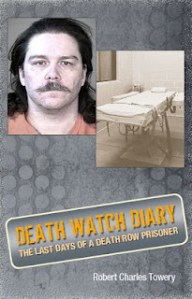
Death Watch Diary: The Last Days of a Death-Row Prisoner


Robert Towery was denied clemency by the state of Arizona on Friday March 2, 2012 and was executed on Thursday March 8th in Florence, Arizona. He was 47 years old.
The last 35 days of his life, Robert was placed on “Death Watch” where his every move was recorded and chronicled by prison officials. Robert kept a diary and he sent his writings to his attorneys. Robert authorized his lawyers to release his diary after his execution.
“Death Watch Diary” is available now as a FREE PDF version at www.deathwatchdiary.com.
A $.99 ebook download on amazon at http://www.amazon.com/dp/B007JD3LUM is available in Kindle format.
In his narrative, Robert picks at the ironies and absurdities of life in prison. He revels in simple pleasures, such as a good meal or a sports event on television. He yearns for the human contact from his last visitors, and he touchingly tries to comfort his pod-mate, who doesn’t really understand that he is going to his death.
As often happens, the man who was executed was not the same man who had committed the crime. Robert had 20 years to think about his crime and once he was free of the drugs and the torment, he became a thoughtful man. Robert apologized to the family of his victim and to his own family both in his clemency hearing and in his last words before his execution.

Upcoming – Executions – May 2012


Dates are subject to change due to stays and appeals

May

5/1/2012

Michael Selsor

Oklahoma

       Executed  6:06 p.m

5/2/2012

Anthony Bartee

Texas

           Stay

5/9/2012

Todd Wessinger

Louisiana

           Stay

5.13.2012

Eric Robert

South Dakota

           Stay

5/16/2012

Steven Staley

Texas

STAY

5/16/2012

Samuel Villegas Lopez

Arizona

            STAY  june 27