Para la gente de idioma hispanico les queria hacer una pregunta
Ustedes piensan y les gustaria que este blog este tambien disponible en idioma hispanico ?
gracias por sus respuestas
Para la gente de idioma hispanico les queria hacer una pregunta
Ustedes piensan y les gustaria que este blog este tambien disponible en idioma hispanico ?
gracias por sus respuestas

i share again with u all, a comment i got on the blog
from curi56 blog’link : http://faktensucher.wordpress.com/
Dear …… (don´t know Your name),
saw several reports about prisons in USA & Russia. Not needed to tell about my emotions.
I immediately started to get informations and look how I could get active.
In spite off my poor English I created blogs, wrote on Twitter & Facebook and: wrote to TV-stations in Germany, asking for send reports of prisons. And I crossposted all informations I got.
In spite off I am not able to create a blog-site like Your´s is, I am fighting for justice for inprisoned innocent people.
And now I come to the point: people are writing e-mails, asking for help.
Now there is a woman whose brother is in prison, innocent.
I experienced that prison-inmates would oft send around and their families couldn´t visit them.
It seems they broke them all connections to a world, outside of prison.
In this spec. case the prisoners name is: John Wesling. The family is destroyed, family-members died, it´s such a drama.
I am in contact with Alice Willison, his sister. Here is help needed, linfe-changing needed.
Excuse my many words, but…
Thank You so much:
Dr. Annamaria Grabowski (Psychologist), Germany

may 4, 2012, source : http://www.southbendtribune.com
If anyone personifies evil, it is Anders Breivik. The 33-year-old Norwegian violently disrupted his country’s usual peace on July 22, 2011, by gunning down 69 mostly young people at a summer camp. A bomb he planted in Oslo killed eight others. He did it all to defend Norway against multiculturalism, he later raved.
Yet, on one point, Breivik is not talking crazy. At his trial, which began April 16, he pronounced a the maximum penalty for his actions — 21 years in prison, or longer if the government meets certain conditions — “pathetic.” He “would have respected” the death penalty, Breivik said. Of course, he won’t get it; Norway abolished capital punishment long ago.
Norway has suffered deeply because of Breivik, and I don’t mean to add insult to injury. But this situation illustrates what’s wrong with banning the death penalty in all cases. If executing an innocent man is the worst-case scenario for proponents of the death penalty, then threatening Breivik with prison is the reductio ad absurdum of death-penalty abolitionism
Anti-death-penalty sentiment is hardly limited to Europe. Last week Connecticut Gov. Dan Malloy signed a bill abolishing capital punishment, which means that no future Anders Breivik need fear execution in that state. Sixteen other states have no death penalty; California voters will get a chance to join them in a November referendum.
In the United States, abolitionist arguments are gaining traction, especially claims about the high cost of lengthy death-penalty litigation and the risk of executing people by mistake. Malloy also cited a “moral component” to his decision.
Such practical and moral concerns are at their most understandable in run-of-the-mill convenience-store murder cases, where the risk of error seems relatively high compared with the benefits of punishing murder with death.
But Breivik’s was no ordinary crime. It presents the special case of a cold-blooded massacre of children by a political terrorist whose guilt is unquestionable and who remains utterly unrepentant; indeed, he told the court that he would kill again if given the opportunity.
What is morally worse: putting the author of this bloodbath to death or letting him live, with the accompanying risk — however small — that he might broadcast his message to receptive audiences from jail, or escape, or one day litigate his way to freedom?
There is no scientific answer. To oppose the death penalty regardless of the crime or the consequences of letting the perpetrator live is a consistent and principled position. If Norwegians consider doing so a point of pride, that’s their choice.
In Connecticut, 62 percent of registered voters support the death penalty for murder, according to aQuinnipiac University poll published last month — so it took some political courage for the legislature and governor to do what they did.
But note that the Connecticut law is not retroactive: It does not apply to the 11 men already on death row, including two sentenced to death for a 2007 home invasion in which they raped and strangled a mother, murdered her two daughters and then set the bodies ablaze.
This tells me that the Connecticut politicians who voted to ban future capital punishment still find it hard to argue against the death penalty in every specific case, no matter how ghastly.
The stubborn fact is that death-penalty abolitionism runs counter to one of humanity’s oldest and most persistent moral intuitions: that there should be condign retribution for the most monstrous transgressions.
Even in Norway, Breivik’s rampage caused some second thoughts. Immediately after his crimes last summer, a man named Thomas Indrebo observed online that “the death penalty is the only just sentence in this case!!!!!!“ Indrebo was later assigned as a lay judge in Breivik’s trial and had to be dismissed because of his comment.
That was the right call, legally. But I wonder if the Breivik case will cause more people in Europe to ask whether there really is no place in civilization for capital punishment.
Both abroad and at home, we need less polarized debate, less moralizing — and more honest legislative efforts to reconcile valid concerns about the death penalty with the public’s clear and consistent belief that it should remain available for the “worst of the worst” offenders.

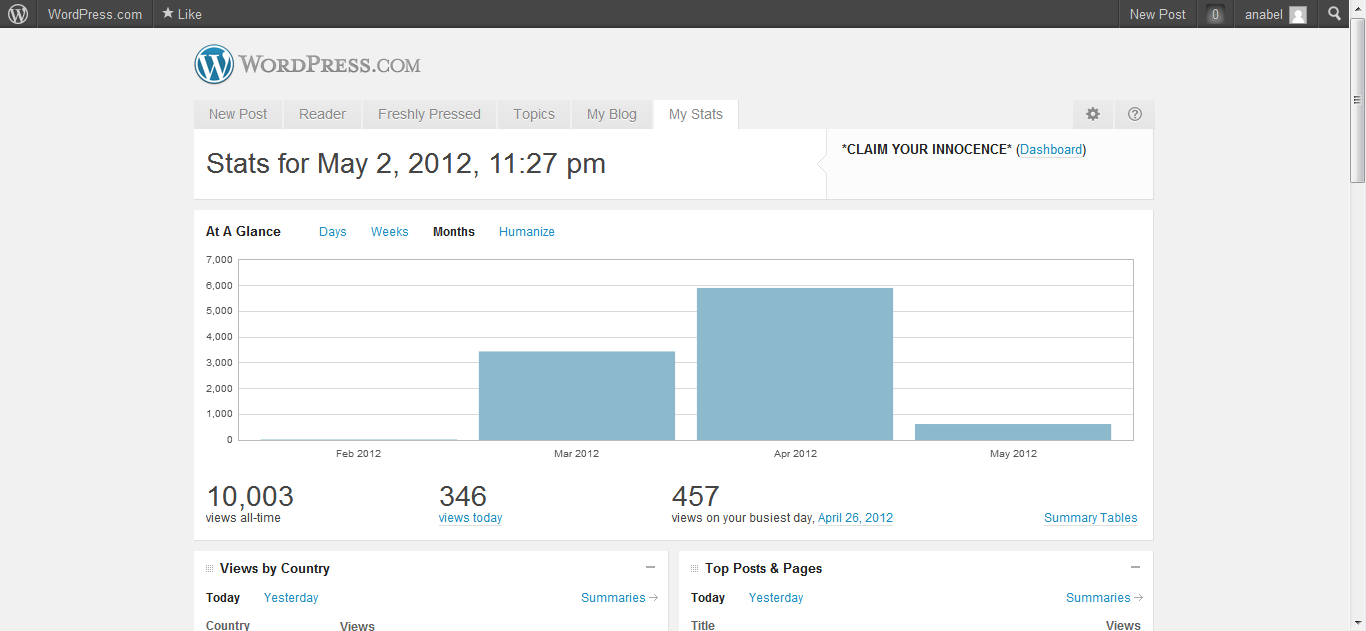
omg i cant believe it ! thx all for your support !

April, 25 source : http://www.huffingtonpost.com
The campaign to abolish the death penalty has been freshly invigorated this month in a series of actions that supporters say represents increasing evidence that America may be losing its taste for capital punishment.
As early as this week, Gov. Dannel Malloy, a Democrat, is poised to sign a bill repealing the death penalty in Connecticut. A separate proposal has qualified for the November ballot in California that would shut down the largest death row in the country and convert inmates’ sentences to life without parole.
Academics, too, have recently taken indirect aim: The National Research Council concluded last week that there have been no reliable studies to show that capital punishment is a deterrent to homicide.
That study, which does not take a position on capital punishment, follows a Gallup Poll last fall that found support for the death penalty had slipped to 61 percent nationally, the lowest level in 39 years.
Even in Texas, which has long projected the harshest face of the U.S. criminal justice system, there has been a marked shift. Last year, the state’s 13 executions marked the lowest number in 15 years. And this year, the state — the perennial national leader in executions — is scheduled to carry out just 10.
Capital punishment proponents say the general decline in death sentences and executions in recent years is merely a reflection of the sustained drop in violent crime, but some lawmakers and legal analysts say the numbers underscore a growing wariness of wrongful convictions.
In Texas, Dallas County alone has uncovered 30 wrongful convictions since 2001, the most of any county in the country. Former Texas Gov. Mark White, a Democrat, said he continues to support the death penalty “only in a select number of cases,” yet he says he believes that a “national reassessment” is now warranted given the stream of recent exonerations.
“I have been a proponent of the death penalty, but convicting people who didn’t commit the crime has to stop,” White said.
There is an inherent unfairness in the system,” said former Los Angeles County district attorney Gil Garcetti, a Democrat. He added that he was “especially troubled” by mounting numbers of wrongful convictions.
A recent convert to the California anti-death-penalty campaign, Garcetti said the current system has become “obscenely expensive” and forces victims to often wait years for death row appeals to run their course. In the past 34 years in California, just 13 people have been executed as part of a system that costs $184 million per year to maintain.
“Replacing capital punishment will give victims legal finality,” Garcetti said.
Richard Dieter, executive director of the Death Penalty Information Center, which opposes capital punishment, said California’s referendum marks a potentially “historic” moment in the anti-death-penalty movement in a state that houses 22 percent of the nation’s death row prisoners.
“Repeal in California would be a huge development,” Dieter said. “Just getting it on the ballot is big.”
Nationally, Dieter said, fading arguments for capital punishment as a deterrent to homicide and mounting numbers of wrongful convictions are “turning a corner” in the debate.
Democratic state Rep. Gary Holder-Winfield, a sponsor of the bill to repeal Connecticut’s death penalty, said capital punishment’s “promise to victims and taxpayers is hollow.” In Connecticut, only one person has been executed in the past 52 years.
Scott Burns, executive director of the National District Attorneys Association, said the country’s system of capital punishment is in need of change, but not elimination. He said there is “strong motivation,” though, to fix a system that can take 20 years for offenders to reach the death chamber following conviction.
“The vast majority of states (33, not counting Connecticut) still have the possibility of the death penalty,” Burns said.
“I don’t see a blowing wind that will dramatically change that,” he added.

april 23, source : http://www.suntimes.com
SANFORD, Fla. — George Zimmerman was released around midnight Sunday from a Florida county jail on $150,000 bail as he awaits his second-degree murder trial for fatally shooting Trayvon Martin.
The neighborhood watch volunteer was wearing a brown jacket and blue jeans and carrying a paper bag. He walked out staring straight ahead and following another man also carrying bags and didn’t look over at photographers gathered outside. He then followed the man into a white BMW vehicle and drove away.
His ultimate destination is being kept secret for his safety and it could be outside Florida.
Circuit Judge Kenneth Lester said at a hearing Friday he cannot have any guns and must observe a 7 p.m.-to-6 a.m. curfew. Zimmerman also surrendered his passport.
Zimmerman had to put up 10 percent, or $15,000, to make bail. His father had indicated he might take out a second mortgage.
Zimmerman worked at a mortgage risk-management company at the time of the shooting and his wife is in nursing school. A website was set up to collect donations for Zimmerman’s defense fund. It is unclear how much has been raised.
Bail is not unheard of in second-degree murder cases, and legal experts had predicted it would be granted for Zimmerman because of his ties to the community, because he turned himself in after he was charged last week, and because he has never been convicted of a serious crime.
Prosecutors had asked for $1 million bail, citing two previous scrapes Zimmerman had with the law, neither of which resulted in charges. In 2005, he had to take anger management courses after he was accused of attacking an undercover officer who was trying to arrest Zimmerman’s friend. In another incident, a girlfriend accused him of attacking her.
Zimmerman, 28, fatally shot Martin, 17, Feb. 26 inside the gated community where Zimmerman lived during an altercation. Martin was unarmed and was walking back to the home of his father’s fiancée when Zimmerman saw him, called 911 and began following him. A fight broke out — investigators say it is unknown who started it.
Zimmerman says Martin, who was visiting from Miami, attacked him. Zimmerman says he Martin in self-defense, citing Florida’s “stand your ground” law, which gives broad legal protection to anyone who says they used deadly force because they feared death or great bodily harm.
Zimmerman was not charged for over six weeks, sparking national protests led by Martin’s parents, civil rights groups and the Revs. Jesse Jackson and Al Sharpton. Martin was black; Zimmerman’s father is white and his mother is from Peru.
Earlier Sunday, Zimmerman’s attorney was working to secure the money for bail and a safe place for Zimmerman to stay. But residents in Sanford, where Martin was killed, didn’t expect a ruckus once Zimmerman was released.
City commissioners said they hadn’t received calls from nervous residents. Protesters didn’t show up outside the jail. And talk at one local coffee shop seldom focused on the case.
“It’s just kind of a non-issue now,” said Michele Church, a server at Mel’s Family Diner. “That’s pretty much all anybody in Sanford wanted, was an arrest, so it could be sorted out in the court system.”
On Friday, a Florida judge agreed to let Zimmerman out on $150,000 bail. Defense attorney Mark O’Mara has said there are several options for where Zimmerman should go, but would not disclose any of them. Lester on Friday indicated Zimmerman would be allowed to leave the state if arrangements with law enforcement could be made for him to be monitored. He will be fitted with an electronic device.
About a half-dozen photographers and cameramen camped outside the Sanford jail Sunday, focused on the door marked “Bonds Rooms,” where other people who had been arrested and released on bail exited. Zimmerman had entered the jail about a week earlier after more than a month of nationwide protests calling for his arrest.
“The mood in Sanford has calmed down tremendously,” said Sanford Commissioner Patty Mahany, whose district includes the neighborhood where Martin was killed. “I think now that people are able to see the justice system taking place, even though they understand it’s going to be quite slow, people are willing to just remain calm and really we’re all getting back to our daily routines.”
A spokeswoman for the Seminole County Sheriff’s Office declined to release any information about whether they were increasing patrols or security.
Defense attorneys for other high-profile clients who awaited trial on bail have said Zimmerman should leave Florida and refrain from going out in public. Sanford residents say they aren’t expecting to see him around the neighborhood anytime soon.
“They’ve already said they’re going to move him to a safe place,” Church said. “Everyone has calmed down. That’s all anyone in Sanford wanted, an arrest.”
Meanwhile, Martin’s parents published a “Card of Thanks” in The Miami Herald obituary page Sunday. The note says Sybrina Fulton and Tracy Martin express their appreciation for all the public’s support since their son’s death. The notice includes a photograph of Trayvon Martin dressed in a hooded sweatshirt, similar to one he was wearing the evening he was killed.
“Words will never express how your love, support and prayers lifted our spirits and continue to give us the strength to march on,” the letter says.

april 18 2012 source : http://www.gainesville.com
Wake up, Florida. We have been sold a pig in the poke. If what we got is not totally defective, it is redundant and far less satisfactory than a comparable product which is efficient and cost effective.
I am, of course, talking about the death penalty and why it should be abolished.
It should be acknowledged that we have two death sentences in Florida; death by execution and death by prison. Both accomplish the same purpose: the condemned will never leave prison alive. Further, it is far from certain which sentence will be carried out first.
This article is in opposition is to the death by execution alternative and is based on the law as it now is and will continue to be, and not on the law as it was in some bygone era when a death sentence was imposed within a reasonable time following the conviction. This article does not urge that we end the death penalty on either moral or religious grounds. Others can better speak to that. And although it is of great concern, and should concern all Floridians, this article does not urge the end the death penalty based on the fact that innocent people may be executed under out present system(we have had more people exonerated and released from our death row than any other state, 25.) That issue is beyond the scope of this article.
My opposition is based on more practical grounds: First, the death penalty is not needed since the legislature adopted the life in prison without parole alternative. This was a wise action taken by the legislature but it has rendered death by execution redundant and the amount we spend on it wasted. Second, death by execution is excessively expensive. Most people who support the death penalty believe it is more cost effective than life in prison. Perhaps at one time, when executions were swift and sure, this may have been the case. It is not now. Most people knowledgeable about the subject will agree that the delay now built into the system, more trial preparation, much longer time to get to trial, much longer jury selections and trials, much more complicated and far more frequent appeals, and continuous motions, have increased the cost of capital punishment so that it is now many times the cost of keeping a prisoner in prison for life.
One study have shown that it costs Florida $51 million per year more to support the death penalty than the costs of keeping our murderers in prison for life (Death Penalty Information Center). For example, it costs the state more than $10 million annually to fund the Capital Collateral lawyers who represent those who have been sentenced to death only after the sentence is entered, and this expense must be paid whether or not here is an execution.
The high cost of executions in California caused one of the sponsors who brought about reintroduction of the death penalty there and who is now leading the effort to end it to say: “Close your eyes for a moment. If there was a state program that was costing $185 million a year and only gave the money to lawyers and criminals, what would you do with it?” (New York Times, April 7, 2012).
Quite obviously, a large amount of the money spent on capital punishment goes for legal expenses. That should not be criticized. Proper legal representation of the accused, particularly those sentenced to death, is an essential element of due process. The only way to end the enormous expense is to end the unnecessary reason for it. The $51 million listed as the extra expense for the death penalty is the annual cost of retaining the death penalty apparatus whether or not we have any executions. If it costs that much just to be able to execute someone, what does each execution cost us? The Miami Herald published an article in 1988 stating that it cost $3.2 million to execute a condemned person but only $750,000 to house a prisoner in prison for life. Both of these figures, of course, have increased over the past twenty plus years as indicated by the study mentioned above.
We have averaged two executions per year over the past decade. If we take the $51 million we spend annually merely to be in a position to execute someone and divide it by the two executions we normally have each year, the cost would be about $25 million each.
What do we get for our money? If the death penalty is not a deterrent, and it is not, and if the death penalty does not make us safer, and it does not, then it is only high-cost revenge. There are those who look at Ted Bundy, DannyRolling and Aileen Wuornus and say that at least they won’t kill again. It is unlikely that they would have killed again in any event while confined forever to their 12-by-7 foot cell, but more importantly to the issue of the death penalty being a deterrent is the fact that although Florida has had the death penalty for many generations, these serial killers murdered almost a score of our citizens before they were caught. They were not deterred by the threat of death.
Law enforcement officers, or at least the chiefs of police, seems to realize the futility of the death penalty or at least believe that the money spent on it can be better spent. A recent survey of police chiefs found that a lack of resources and drug/alcohol abuse tied for what most interferes with effective law enforcement. Of the nine categories, insufficient use of the death penalty was a distant last.
Why would anyone ignore the death penalty while considering killing someone? The answer is that the potential killer, for good reason, does not think the death penalty will apply to him. As Justice Brennan said in his Furman concurring opinion: “Proponents of this argument (that the death penalty is a deterrent) necessarily admit that its validity depends upon the existence of a system in which the punishment of death is inevitably and swiftly imposed. Our system, of course, satisfies neither condition. A rational person contemplating a murder…is confronted, not with the certainty of a speedy death, but with the slightest possibility that he will be executed in the distant future.”

april 20, 2012 source :http://www.nytimes.com
A Florida judge on Friday set George Zimmerman’s bail at $150,000 in the shooting death of 17-year-old Trayvon Martin and imposed restrictions on Mr. Zimmerman’s release from jail.
During the bail hearing, Mr. Zimmerman, a neighborhood watch volunteer who has been charged with second-degree murder for shooting Mr. Martin to death, offered an apology to the victim’s parents, who were in the courtroom.
“I wanted to say I am sorry for the loss of your son. I did not know how old he was,” Mr. Zimmerman, 28, said, speaking publicly for the first time about the Feb. 26 shooting. “I thought he was a little bit younger than I am. I did not know if he was armed or not.”
Mr. Martin’s parents, Tracy Martin and Sybrina Fulton, showed no emotion during Mr. Zimmerman’s remarks. They left shortly before the hearing ended and were whisked by their lawyer across a parking lot to a waiting car.
In setting bail, the judge, Kenneth R. Lester Jr., said that Mr. Zimmerman could have no contact with Mr. Martin’s family and no access to alcohol or firearms and that his movements would be monitored electronically. Judge Lester also set a curfew that would require Mr. Zimmerman to remain at home from 7 p.m. until 6 a.m. and require him check in with the authorities every three days.
Mr. Zimmerman will not be released from jail on Friday. The judge said that he wanted to make sure that security measures were in place for Mr. Zimmerman, who has received death threats.
Mr. Zimmerman’s family members testified that they would assume responsibility for his whereabouts when he is released from jail.
Testifying by telephone, Mr. Zimmerman’s wife, Shellie Nichole Zimmerman, said that she would also notify the court and law enforcement officials if she lost contact with Mr. Zimmerman for any reason before his trial.
Judge Lester had agreed to allow Ms. Zimmerman and other members of the Zimmerman family, including his father, Robert, and his mother, Gladys, to testify at the hearing by telephone out of concern for their safety.
Mr. Zimmerman, 28, dressed in a white shirt, dark suit and gray tie, was shackled and wore a somber expression during the proceedings as he sat next to his lawyer, Mark O’Mara.
He showed no expression as his wife calmly answered questions from both Mr. O’Mara and Bernado De La Rionada, an assistant state attorney.
Ms. Zimmerman said she and her husband had been married for almost five years and that she did not believe that he posed a flight risk. She said she spoke with him every day by phone when he was in hiding in the weeks before his arrest.
Mr. De La Rionada asked her whether she believed her husband was a violent person. She replied, “No.”
Mr. Zimmerman has spent nine days in the Seminole County jail since his arrest, which came six weeks after he shot and killed Mr. Martin, 17, who was unarmed and walking through a small gated development in Sanford. Mr. Zimmerman told police he shot Mr. Martin in self-defense.
The case, which led to protests and marches around the country, raised questions about Florida’s expansive self-defense law and racial profiling after Mr. Zimmerman was not immediately arrested after the shooting on Feb. 26 and remained free for weeks. Widely criticized for not moving quickly enough on the case, both the Sanford police chief and the local prosecutor stepped aside.
Gov. Rick Scott appointed Angela B. Corey, a state attorney from the Jacksonville area, as a special prosecutor to manage the case. Ms. Corey brought the maximum possible charge against Mr. Zimmerman, outlining in court papers that he had profiled Mr. Martin based on his race before following him as he walked through the development.
If convicted of second-degree murder, Mr. Zimmerman, could face life in prison.

april19, 2012 source :http://www.sbs.com.au
Scientific research to date provides no useful conclusion on whether the death penalty reduces or boosts the murder rate, said US report.
Scientific research to date provides no useful conclusion on whether the death penalty reduces or boosts the murder rate, said a report by the US National Academy of Sciences on Wednesday.
A committee of scientists reviewed research done over the past 35 years and found it was “not informative about whether capital punishment decreases, increases, or has no effect on homicide rates,” said the report.
“Consequently, claims that research demonstrates that capital punishment decreases or increases the homicide rate by a specified amount or has no effect on the homicide rate should not influence policy judgments.”
The report was issued by the NAS’s National Research Council, which convened a Committee on Deterrence and the Death Penalty to look at available evidence on how the death penalty may affect murder rates.
A previous report by the NRC in 1978 found that “available studies provide no useful evidence on the deterrent effect of capital punishment.”
In the decades since that report, “a considerable number” of studies have attempted to judge how well it works, or does not, and have reached “widely varying conclusions,” the latest report said.
“Fundamental flaws in the research we reviewed make it of no use in answering the question of whether the death penalty affects homicide rates,” said Daniel Nagin, professor of public policy and statistics at Carnegie Mellon University and chair of the committee that wrote the report.
“We recognise that this conclusion may be controversial to some, but no one is well-served by un supportable claims about the effect of the death penalty, regardless of whether the claim is that the death penalty deters homicides, has no effect on homicide rates or actually increases homicides.”
Until now, a key flaw in the research has been the failure to account for how punishments such as life in prison without the possibility of parole may affect homicide rates.
Also, a number of assumptions have hobbled previous studies, particularly by assuming that potential murderers actually consider the risk of execution and respond accordingly.
Instead, researchers going forward must perform more rigorous studies that assess how potential criminals view the death penalty and its likely effect on their actions, the report said.
Better methods for future research include collecting data that consider both capital and non-capital punishments for murder and doing studies on how potential murderers perceive a range of punishments in homicide cases, it said.
Just 15 percent of people who have received the death sentence since 1976 have been executed, “and a large fraction of death sentences are reversed,” added the report.
The members did not examine the moral arguments for or against capital punishment, or the costs involved.

The attorney for George Zimmerman filed a motion late Monday asking the court to recuse the judge in the case over a possible conflict of interest.
Mark O’Mara, Zimmerman’s attorney, requested that Seminole Circuit Judge Jessica Recksiedler be removed after she revealed that her husband works with Mark NeJame, a CNN legal analyst. Last week, after O’Mara agreed to take Zimmerman as a client, NeJame revealed that he had been approached by Zimmerman—the 28-year-old neighbourhood watchman accused of second-degree murder in the killing of Trayvon Martin—about representing him. NeJame declined, but suggested five lawyers, including O’Mara, to Zimmerman, reports The Cutline.
On Friday, Recksiedler said she would consider stepping aside.
Meanwhile, several news organizations—including CNN, USA Today and the Miami Herald—petitioned the court to reverse an order sealing records in the case.
O’Mara told CNN Monday he wants them sealed to prevent the steady flow of leaks that have already marred the case.
“It’s an overall philosophy of trying to keep the information flow concentrated within the court system,” O’Mara said. “It’s much better handled there. And, again, if information like this, even a police report with names on it, gets out, then my concern is that they’re going to be spoken to. They’re going to be questioned. There’s going to be four or five different statements from this one witness, let’s say, and then we have to sift through all of that to try and get to what is the truth.”
O’Mara said he’s also concerned about the safety of the witnesses.

 Claim your Innocence