TEXAS EXECUTIONS

TEXAS – Execution – Donnie Lee Roberts – 31/10/2012 – EXECUTED 6.39 p.m


“I’m really sorry. I never meant to cause you all so much pain,” Roberts said to Bowen’s father, who was seated in a chair close to a glass window in the death chamber viewing area. “I hope you can go on with your life.

“I loved your daughter. I hope to God he lets me see her in heaven so I can apologize to her and see her and tell her.”

Roberts also asked two of his friends who watched through another window to tell his own daughter he loved her.

He repeated that he was sorry and took several deep breaths as the lethal dose of pentobarbital began taking effect. He snored briefly before slipping into unconsciousness, and was pronounced dead 23 minutes later.

Last Meal: Same shit salad being fed to every other thug on the row that day

October 30, 2012  http://www.beaumontenterprise.com

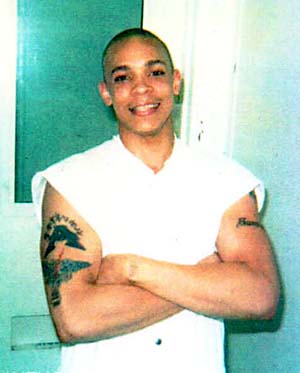
This handout photo provided by the Texas Department of Public Safety shows Donnie Roberts. Roberts, a Louisiana parole violator, is set to die Wednesday, Oct. 31, 2012, for killing his girlfriend Vicki Bowen at her home in Lake Livingston, Texas, in October 2003. Photo:  Texas Department Of Public Safety / AP

HUNTSVILLE, Texas  — Donnie Lee Roberts, convicted in his girlfriend’s 2003 slaying, was taken from his death row cell Wednesday and moved to the Texas prison where executions are carried out, one of the final steps before his scheduled lethal injection.

After the U.S. Supreme Court refused to review Roberts’ case earlier this week, no additional appeals were filed to try to block his execution, which will be the 12th this year in the nation’s most active capital punishment state.

Roberts, now 41, is being put to death for fatally shooting Vicki Bowen and taking items from her East Texas home to sell or trade to support his drug habit. At the time of his arrest for the October 2003 killing, Roberts had violated his probation for a robbery conviction in Louisiana by fleeing to Texas after dropping out of a drug treatment program.

Authorities said he apparently met Bowen, 44, a dental assistant, at a bar and moved in with her at her home on Lake Livingston, about 75 miles northeast of Houston. Their relationship soured because Roberts wasn’t working and was abusing drugs and alcohol, investigators said, and he shot Bowen after she refused his demand for money.

Roberts was arrested at a suspected crack house in Livingston when a truck missing from Bowen’s home was spotted there the same day Bowen’s body was discovered.

“He was cooperative and confessed several times,” District Attorney Lee Hon said. “He was saying he wanted the death penalty.”

Roberts told authorities he made several trips from the house where Bowen was shot, collecting property that he took into town to sell and trade for crack.

He also surprised detectives by confessing to the shotgun death of a man a decade earlier in Natchitoches Parish, La. Louisiana authorities initially believed the victim, Al Crow, had died of asphyxiation in a fire at the camper trailer where he was living but reopened the case following Roberts’ disclosure, found shotgun pellets and determined it was a homicide.

Roberts was charged with murder but not tried for Crow’s death.

Stephen Taylor, one of Roberts’ lawyers at his Texas capital murder trial, said the confessions complicated his trial defense.

“It’s almost like somebody saying he was a serial killer, that he’s killed before and he killed again,” Taylor said. “It’s one thing to say you have the right to remain silent. Use it!

“It’s always sad for someone to lose his life, especially for something so stupid.”

Bowen didn’t show up for work on Oct. 16, 2003, and a co-worker who went to check on her found her body wrapped in a blanket and lying in a pool of blood. A medical examiner determined Bowen was killed with two gunshots to her head.

Roberts took the witness stand and tried to blame Bowen for the gunfire, saying he was acting in self-defense by grabbing a .22-caliber rifle after seeing her reach down inside a couch to locate a pistol that was kept there.

“The jury obviously disagreed,” Hon said.

Evidence at trial showed Roberts had a record for battery while being held in jail in Fulton County, Ga., that he’d threatened his wife to give him money for drugs, and that he demanded a single-person cell in Polk County when he was jailed for Bowen’s murder or there would be another killing.

His robbery conviction in Louisiana was for a Mother’s Day 2001 convenience store holdup in Baton Rouge, La., where the knife-wielding Roberts threatened to slice the throat of the female clerk.

“He was a bad dude, pretty violent,” Hon said.

The Texas Department of Criminal Justice Polunsky Unit, where the state’s male death row is housed, has been Roberts’ home since his capital murder conviction in 2004. The unit is just outside Livingston and not far from where Bowen was killed.

On Wednesday, Roberts was moved about 45 miles west to the Huntsville Unit prison, where he is to be executed.

Three more Texas prisoners are set to die in November, including one next week.

TEXAS – A Death Row Struggle Between Advocates and Lawyers – Preston Hughes III


October 25, 2012 Texas Tribune

LIVINGSTON — Preston Hughes III, a death row inmate, is 46 but seems much older, with white hair, thick glasses and a quiet, slow voice that rises only when the subject of his lawyer comes up.

Mr. Hughes, convicted in 1989 of fatally stabbing two young people, has tried multiple times to dismiss his court-appointed lawyer, Patrick McCann. He said that Mr. McCann, who has been his lawyer for 14 years, had not raised his claims of innocence and is “helping the state cover this up.”

Mr. McCann says he cannot comment on why he will not pursue these claims, which were not introduced in Mr. Hughes’s original trial. But Texas and federal law set a high burden of proof for new claims of “actual innocence” so late in the judicial process, a bar that Mr. McCann said was “almost impossible” to meet.

Mr. Hughes, who says he did not commit the murders, is scheduled to be executed Nov. 15. He says all of his lawyers have failed him. “They just want to do things on their own,” he said recently from death row in Livingston.

While Mr. McCann is suing the state over lethal injection procedures, arguing that prison officials would be “experimenting” on his client, a handful of advocates are publicizing what they believe is new evidence of Mr. Hughes’s innocence.

The advocates, who do not have legal training, are campaigning for Mr. Hughes’s exoneration and supporting his efforts to have Mr. McCann fired.

The issue of advocates’ doubting the work of lawyers is common in death penalty cases, especially as an execution date nears.

“Once the lawyers do the spadework, a lot of people want to come in,” said Jeff Blackburn, a lawyer who runs the Innocence Project of Texas, “and they don’t understand that we’re limited with the art of the possible here.” He called Mr. McCann a “great lawyer.”

The official facts of the crime, on their face, pointed directly to Mr. Hughes. On the night of Sept. 26, 1988, Shandra Charles, 15, and her cousin Marcell Taylor, 3, were fatallystabbed in a Houston field. A police sergeant reported that before she died, Ms. Charles identified the name “Preston” and said, “He tried to rape me.”

Detectives located Mr. Hughes in a nearby apartment complex. Investigators found evidence of blood on his clothing and a knife in his apartment, as well as Ms. Charles’s eyeglasses on his couch. Mr. Hughes, who said the glasses were planted, confessed to the murder during the investigation but then denied involvement during the trial. No biological evidence tied him directly to the crime.

Convicted and sentenced to death in 1989, Mr. Hughes had multiple appeals rejected. Then, this year, several unlikely advocates became interested.

John Allen, 64, a retired engineer in California, writes a blog called The Skeptical Juror. With the help of Barbara Lunsford, an accountant in Corpus Christi, and Ward Larkin, an activist from Houston, he has spent nine months and more than 100,000 words delvinginto the forensic and legal details of Mr. Hughes’s case. None of the three are affiliated with an official organization, and while Mr. Allen has written about other convictions in the past, he said he had stopped looking at other cases for now.

After reviewing documents related to the trial, appeals and evidence, he deduced that Ms. Charles must have lost brain function within two minutes, and she could not have told the police the name of her attacker. “This is a seemingly overwhelming case” of innocence, Mr. Allen said, adding that he also believed that the victim’s glasses were planted in the apartment, based on his review of crime scene photographs.

In September, Mr. McCann said he had never heard of Mr. Allen’s investigation. This week, he said Mr. Allen “sounds like a very sincere man who is attempting to right a wrong.”

“Like in fantasy football,” he said, “I think lots of people are happy to offer thought without skin in the game.”

As for Mr. Hughes’s petitions to have him replaced, Mr. McCann said he thought they were the product of desperation. “When a person is drowning,” he said, “they sometimes try to fight the guy holding a life preserver.”

Mr. McCann agreed that Ms. Charles would have “been unconscious in a matter of seconds based on the blood loss,” and so she could not have said Mr. Hughes’s name to the police. Despite being troubled by this evidence, he is not filing a claim of innocence.

“I find myself in an odd position,” he said, “because I’m ethically bound not to advance a claim I think is false.”

Mr. Allen learned about the case while investigating the work of James Bolding, the head of blood analysis for the Houston Police Department’s crime lab at the time, who testified at Mr. Hughes’s 1989 trial. Mr. Bolding tested for blood on Mr. Hughes’s knife while he was in the courtroom. Mr. Hughes said the blood came from a rabbit he had killed months before.

Judge George Godwin said at the time that he found the “cavalier attitude and lackadaisical attitude of doing tests right while we’ve got a jury waiting to come in and hear testimony unacceptable.” He nevertheless ruled that the testimony was permissible.

Mr. Hughes said he trusted Mr. Allen more than his lawyer, Mr. McCann. In September, Mr. Hughes filed a petition to have Mr. McCann replaced, and a court rejected it.

Mr. McCann plans to follow the case to the end. In September, he sued the Texas prison system, saying that by using a single drug for the execution, as a result of a recent policy change, officials would be experimenting on his client. The Court of Criminal Appeals, Texas’ highest criminal court, has ordered the civil court overseeing the case not to stay Mr. Hughes’s execution.

Mr. McCann does not know when the court will rule. “The unfortunate timing of this is it’s before a contested election,” he said.

Murray Newman, a Houston defense lawyer, said he believed Mr. McCann was doing his best and cared about Mr. Hughes. “He works so hard on these cases. It’s like losing a family member,” Mr. Newman said.

From death row, Mr. Hughes sees it differently, as he plays basketball during his hour of recreation every day, eats food he calls “pitiful” and learns about court decisions from a small, black radio.


“We don’t like each other,” he said of Mr. McCann. “I don’t feel somebody who doesn’t like me is going to do anything for me.”


UPCOMING EXECUTIONS – NOVEMBER 2012


Dates are subject to change due to stays and appeals

Pennsylvania execution dates and stays are generally not listed because the state routinely sets execution dates before all appeals have been exhausted.

NOVEMBER 16 , 2012  

November    
11.06.12 Garry Allen Oklahoma  EXECUTED  6.10 p.m
11.08.12 Mario Swain Texas  EXECUTED  6.39 p.m
11/08.2012 Hubert Michael Pennsylvania STAY                                                                                                                      
11/13/2012 Brett Hartman Ohio EXECUTED  10.34 a.m 
11/14/2012 Ramon Hernandez Texas EXECUTED  6.38 p.m
11/15/2012 Preston hughes Texas  EXECUTED  7.52 p.m

TEXAS – High court stops execution of Houston cop killer Anthony Haynes


OCTOBER 18, 2012 http://abclocal.go.com

HUNTSVILLE, TX — The U.S. Supreme Court stopped the execution Thursday of a 33-year-old Texas prisoner for gunning down an off-duty Houston police sergeant 14 years ago.

Anthony Haynes had been set to die for the shooting death of Sgt. Kent Kincaid, 40, while the officer was with his wife driving in their own vehicle not far from home. Their SUV had been struck by an object from a pickup truck, cracking its windshield. When Kincaid got out to talk to the people in the truck and told them he was a police officer, he was shot in the head.

The high court ruling came about three hours before Haynes could have been taken to the death chamber.

Haynes confessed to the May 1998 slaying, was tried for capital murder the following year and sentenced to death.

His lethal injection would have been the 11th this year in Texas, the nation’s most-active death penalty state. Another is set for next week.

Evidence showed the object that hit the Kincaids’ SUV was a .25-caliber bullet from the same gun used to shoot him. Testimony at Haynes’ 1999 trial in Houston showed that same evening Haynes had committed a series of armed robberies.

Haynes’ trial lawyers showed “virtual abdication of their duty” by failing to more fully investigate and present evidence of Haynes’ good character to jurors who were deciding his punishment, his appeals attorney, A. Richard Ellis, told the high court in his appeal.

He also contended prosecutors unfairly painted Haynes, who was 19 at the time of the shooting, “as an out-of-control, violent and unpredictable individual who was subject to intermittent fits of rage.”

“This picture was totally at variance with his actual character,” Ellis said.

The appeal also faulted attorneys at earlier stages of Haynes’ appeals for not addressing the trial defense issues and contended lower court rulings and Texas appeals procedures unfairly kept Haynes from raising the claims now. Similar appeals in recent Texas death penalty cases have failed to win reprieves from the high court although at least one other did. That case, involving prisoner John Balentine, is set for conference before the justices for later this month.

The arguments center on a Supreme Court ruling favorable to an Arizona prisoner who couldn’t find a way to make an appeal under procedures in that state. Texas attorneys argued the statutes in Texas were different, did allow for appeals like the one Haynes wanted considered and that courts had determined the Arizona ruling had no effect in Texas.

State attorneys contesting Hayne’s appeal argued his previous attorneys didn’t abandon him and shouldn’t be considered ineffective because they chose issues different from those now being pursued by Ellis.

“Haynes does not now present any compelling reasons for this court to review his claims,” Jeremy Greenwell, an assistant Texas attorney general, told the justices.

Greenwell pointed out evidence of Haynes’ history of explosive temper outbursts, of police being summoned to deal with his threats against a school nurse and an ROTC instructor, that he assaulted his 3-year-old sister and tried to kill the family dog.

“He was no angel,” Mark Vinson, the Harris County district attorney who prosecuted Haynes, recalled last week.

Kincaid’s wife couldn’t describe the shooter and provided only a cursory description of the truck but said she was certain her husband identified himself as a police officer, a distinction important in that it allowed prosecutors to try Haynes for capital murder and make him death-penalty eligible. Haynes’ trial lawyers said he didn’t know the man who approached was an officer and feared for his own safety.

One of the robbery victims earlier the evening of the shooting identified a companion of Haynes as participating in the holdup, and that led detectives to Haynes. He took police to separate sites miles apart where he left the gun and ammunition clip.

TEXAS – EXECUTION TODAY- ANTHONY HAYNES – 6 p.m STAYED


October 18, 2012 

Anthony Haynes, 33, would be the 11th inmate executed this year in Texas and the 33rd in the United States, according to the Death Penalty Information Center. The execution is scheduled for after 6 p.m. (2300 GMT) in Huntsville.

Haynes fired a shot from his truck at a Jeep Cherokee carrying off-duty Houston police officer Kent Kincaid and his wife, Nancy, according to an account of the case from the Texas attorney general’s office.

The officer got out of his Jeep and approached Haynes‘ truck, telling him that he was a police officer and asking to see his driver’s license, the account said.

Nancy Kincaid said during Haynes’ trial that her husband was reaching for his badge when the driver shot him in the head, according to a Houston Chronicle account at the time.

“(The driver) pulled his hand up and I saw the flash and I heard the pop,” Nancy Kincaid testified. “That was the end. He then went down.”

Kent Kincaid was declared brain-dead at the hospital.

That same night, Haynes had committed several armed robberies, Texas officials say.

“I’m not a vicious psychopath who goes around wanting to take people’s lives,” Haynes told the Houston Chronicle in a 2001 death row interview. “There was no intent to kill a cop. He did not ID himself until a second before I shot him.”

Haynes has appealed to the U.S. Supreme Court, raising questions about whether his trial lawyers were effective.

These two men were both 19 when they were sentenced to death


Anthony Cardell Haynes

Anthony Haynes claimed he didn’t know that Kent Kincaid was a Houston police sergeant when he shot him in the head back in 1998. Kincaid was off-duty and driving his personal vehicle when Haynes drove by; something cracked Kincaid’s windshield, and he reportedly thought Haynes had thrown something at him. He followed Haynes, and when the 19-year-old stopped his car, Kincaid approached him. Kincaid said he was a police officer, but Haynes later said he didn’t know whether to believe him. When Kincaid reached behind his back, presumably for a badge, Haynes pulled out a .25-caliber gun and shot him.

Anthony Haynes

Anthony Haynes

Haynes blamed the tragedy in part on drugs and falling in with a bad crowd of people who reportedly made a game out of shooting at the windshields of passing cars and then robbing the drivers after they stopped. As it happened, the crack in Kincaid’s windshield was made by a bullet. Jurors in Haynes’ case deliberated for three days before sentencing the teen to death.

That sentence was overturned, however, after the 5th U.S. Circuit Court of Appeals agreed with Haynes’ defense that an unusual jury-selection setup in Haynes’ case had denied his right to equal protection under law. Indeed, two different judges presided over Haynes’ jury selection; one heard prosecutors interview individual jurors, and a second heard the lawyers’ arguments for striking from service the potential jurors. As it turned out, the state used its power to strike all but one of the black potential jurors, arguing that it was not their race that excluded them (which would be illegal), but their “demeanor.” But Haynes’ appeal attorney argued that the judge who allowed those strikes had not actually witnessed the jurors’ questioning and thus could not actually have seen whether their demeanor would be a basis on which to have them struck. The U.S. Supreme Court ultimately disagreed with the 5th Circuit, ruling that there was no rule that would require a judge to “personally observe” the juror questioning when deciding whether a juror is lawfully struck from service.

Haynes is scheduled for execution today, Oct. 18. STAYED

Bobby Lee Hines

Hines

Hines

Bobby Lee Hines was also just 19 when he was sentenced to death for the robbery and strangling of 26-year-old Michelle Haupt in her Dallas apartment. Now, 20 years later, he’s scheduled to die for that crime on Oct. 24. But his attorney, Lydia Brandt, argues that Hines’ execution should, once again, be stayed while the courts consider whether his lawyers have done enough to save his life.

Hines was convicted of the 1991 murder of Haupt, who was stabbed repeatedly with an ice pick and strangled with a cord inside her apartment. Hines had been staying next door with the apartment complex’s maintenance man. Police found items from Haupt’s apartment, including packs of cigarettes and a bowl of pennies, under a couch where Hines had been sleeping.

Hines’ first date with death was stayed in 2003, while the courts considered a claim that he was mentally retarded and thus ineligible for execution. Although Hines had a diagnosed learning disability and was considered emotionally disturbed, the courts ruled that he didn’t meet the criteria for relief. His execution date was reset for June 2012, but was stayed again so that further DNA testing could be performed. The DNA evidence confirmed Hines’ guilt and once again his execution was back on.

Now, Brandt is again seeking a stay, arguing that Hines’ case has been plagued by ineffective assistance of counsel. Brandt’s latest appeal, filed Oct. 10 with the Court of Criminal Appeals, argues that none of Hines’ defense attorneys ever investigated his background for mitigating evidence that could have swayed a jury to sentence him to life in prison. Hines had a “nightmarish” childhood that featured chronic abuse by his racist, alcoholic father, and later by foster parents, and was profoundly affected by his mother’s decision to abandon him as a young child. But the jury never heard anything of Hines’ troubled background. The question now before the CCA is whether the prior counsel’s failings can create an avenue for reconsidering Hines’ punishment. Brandt believes it should: “Fundamental rules of equity will not suffer a right to be without a remedy,” reads the appeal

Y’all are killing an innocent man’: Last words of ‘mentally ill’ Texas death row inmate executed for killing 12-year-old girl


October 11, 2012 http://www.dailymail.co.uk

Last Minute Appeal Denied For Texas Death Row Inmate

An inmate on death row used his last breath to protest his innocence of the murder of a 12-year-old girl as he was executed in Texas last night despite his legal team arguing he was mentally ill.

Jonathan Green, 44, was jailed for the abduction, rape and strangling of Christina Neal, 12, whose body was found at his home a month after she was reported missing in 2000.

Several last ditch appeals were made on the basis of his mental health in an attempt to save him from the death penalty but Green was given a lethal injection after the U.S. Supreme Court rejected the arguments to spare him.

Too mentally ill: Attorneys argued that Jonathan Green should be spared execution for the murder of 12 year old Christina Leann Neal

The 11th-hour appeals delayed the punishment nearly five hours past the initial 6pm execution time and as the midnight expiration of the death warrant neared.

Asked by the warden if he had a statement from the death chamber gurney, Green shook his head and replied: ‘No’

But seconds later he changed his mind, adding: ‘I’m an innocent man. I never killed anyone. Y’all are killing an innocent man.’

He then looked down at his left arm where one of the needles carrying the lethal drug was inserted, and said: ‘I’ts me hurting bad.’

But almost immediately he began snoring loudly. The sounds stopped after about six breaths.

Green was pronounced dead 18 minutes later at 10.45pm.


TEXAS – Green gets stay 2 days before execution EXECUTED 10:45 p.m


October 9, 2012 http://www.news-journal.com/

Two days before his scheduled execution, a Montgomery man on Texas’ Death Row for the 2000 abduction, rape and strangulation murder of a 12-year-old Dobbin girl received a stay because he wasn’t given due process to prove he is mentally incompetent for execution, a federal judge ruled Monday.

Judge Nancy Atlas, in the Southern District of Texas, ruled that Jonathan Marcus Green, 44, who was convicted in 2002 for the murder of Christina LeAnn Neal, did not receive a fair opportunity to demonstrate that he is incompetent, “and thus the State of Texas denied him due process.”

But the Texas Attorney General’s Office plans to file a motion today asking the U.S. Fifth Circuit Court of Appeals to vacate the stay.

Green is schizophrenic and “is not malingering,” said his appellate attorney, James Rytting.

“He is mentally ill … and he’s only gotten worse after being stuck in administrative segregation,” Rytting said.

In her written opinion, Atlas notes that 221st state District Court Judge Lisa Michalk, who denied Green a stay two days before he was to be executed on June 30, 2010, applied incorrect legal standards by seeking to determine if there was a change in Green’s mental capacity since his imprisonment in 2002.

“The correct question was whether Green was presently competent, regardless of his comparative mental capacity between 2002 and 2010,” Atlas wrote.

Green understood that he was convicted of killing Christina and was to be executed for that crime, the basis for Michalk’s finding that he understood why he was being executed, Atlas wrote.

But Green believed he was to be executed as a result of “spiritual warfare” between demons and God, Atlas found, and Michalk prevented Green from presenting relevant evidence, denied Green due process.

TEXAS – Convicted Cop Killer in Texas Exhausts Appeals – Anthony Cardell Haynes STAYED


October 5, 2012 http://www.courthousenews.com

Houston, Texas (CN) – A convicted cop killer who faces the death penalty for the 1998 murder of an off-duty police officer cannot have his appeal reopened and his Oct. 18 execution will move forward, a federal judge ruled. Anthony Cardell Haynes shot and killed Sgt. Kent Kinkaid following a night of crime where he committed a string of armed robberies before spotting the off-duty officer and firing at him.
A Harris county jury convicted Haynes in 1999 of capital murder and sentenced him to death. After failing to find relief in both state and federal courts for more than a decade, including a 456-page federal petition for a writ of habeas corpus filed in 2005, Haynes petitioned the court to reopen his federal habeas action citing an ineffective trial counsel. U.S. District Judge Sim Lake rejected that petition Wednesday and denied him a certificate of appealability.
Haynes claimed relief under the recent Supreme Court decision Martinez v. Ryan, which concluded that a deficient performance by a state habeas attorney may amount to some cause, but Lake said that decision does not apply to cases arising from Texas courts.
Lake also said even if it did apply, Haynes failed to show extraordinary circumstances under the law.
“Because the Martinez decision is simply a change in decisional law and is not the kind of extraordinary circumstance that warrants relief under Rule 60 (b) (6), Haynes‘ motion is without merit. Additional, the applicability of Martinez to Texas’s post-conviction process does not change the fact that the court has already adjudicated Haynes‘ Strickland claim. Haynes asks the court ‘to exercise its authority and grant him relief from its prior judgment…and grant federal review of this claim …'”
“The court has already reviewed the merits of Haynes‘ Strickland claim in the alternative and found it to be without merit.”
Lake also noted that the Texas Court of Criminal Appeals observed, on direct appeal, that Haynes confessed “to knowingly murdering a police officer after a violent crime spree.”
“Haynes admitted that he shot Sergeant Kincaid because he was a police officer and, showing no remorse, bragged to friends that he had killed a police officer. Haynes also told people that he should have killed Nancy Kincaid, so that there would have been no witness to the murder.”
According to the Texas Department of Criminal Justice, Haynes will be the 10th death row inmate to be executed this year, in the country’s most active death penalty state.

TEXAS – UPCOMING EXECUTION, Jonathan Marcus Green, 10/10/2012 – EXECUTED 10.45 P.M


Picture of Offender

Name Green, Jonathan Marcus
TDCJ Number 999421
Date of Birth 12/23/1967


Jonathan Marcus Green, is scheduled to be executed after 6 p.m. on October 10, 2012. Green was sentenced to death for the kidnapping, rape and murder of a 12-year-old girl in Montgomery County.
On the evening of June 21, 2000, 12-year-old Christina Neal disappeared after leaving a friend’s home in the small community of Dobbin, TX.
The girl’s family began looking for her the next day, after determining that she had not stayed overnight at a friend’s house. Christina’s glasses were found along a road near the Neal home. The glasses were “smashed and broken.”

On June 23, the girl’s father, Victor Neal, asked his sister to look for Christina while he was at work. Christina had run away before, so Victor told his sister to report her as a runaway if she could not find her. Later that day, having failed to locate Christina, the sister reported her missing to a Montgomery County Sheriff’s deputy. Officers then joined the family in searching for Christina.

On June 26, the FBI joined in the search. Christina’s panties were found at the edge of the woods across from the Neal home, and Christina’s bracelet and necklace were found along a pathway in the woods.

On June 28, investigators spoke with Jonathan Green, who also lived in Dobbin, because his wallet was discovered in the vicinity of Christina’s disappearance. Green said he had no information concerning Christina’s disappearance, and that he was either at home or at his neighbor’s house on the night she disappeared. He gave investigators permission to search his home and property, with the condition that he be present. Investigators performed a cursory search of the house and property, but they noticed nothing significant.

On July 19, a man who lived on the property behind Green’s, told investigators that Green had an unusually large fire in his burn pile the day after Christina disappeared. A few days later, investigators went to Green’s home and asked if they could search his property again, including his burn pile. Green again consented, but insisted that he be present during the search. An FBI agent smelled a distinct odor emanating from a disturbed section of ground which he identified as “some sort of decaying body.” The investigation team then began to dig up the disturbed area. Green, who had been cooperative up to that point, became angry and told the officers to get off his property.
The investigative team returned to Green’s property later that night with a search warrant. They discovered that part of the burn pile had been excavated, leaving what appeared to be a shallow grave. They also smelled the “extremely foul, fetid odor” of a “dead body in a decaying state.”
An officer then arrived with a “cadaver dog,” trained to detect human remains. The dog repeatedly went to the side of a recliner in the house. An FBI agent looked behind the recliner and found human remains in a bag that were identified as Christina’s. An autopsy concluded that Christina was sexually assaulted and then strangled.
During the course of the autopsy, various materials were recovered from Christina’s body.
DNA testing on black hairs found on Christina’s body indicated a higher probability the hairs came from Green.
A Texas Department of Public Safety crime lab criminalist testified that many of the fibers recovered from Christina’s body matched fiber samples seized from Green’s property and residence. On the panties that were recovered near the Neal home five days after Christina had disappeared and nearly a month before her body was found, investigators found a fiber that had characteristics identical to carpet in Green’s residence.

The Texas Court of Criminal Appeals affirmed Green’s conviction on Dec. 17, 2004.
On March 6, 2006, the U.S. Supreme Court denied certiorari review.
On March 23, 2005, the Texas Court of Criminal Appeals adopted the findings and conclusions of the trial court and denied Green’s application for state habeas relief.
On Feb, 15, 2008, a U.S. district court denied Green’s federal petition for a writ of habeas corpus.
On February 27, 2009, the United States Court of Appeals for the Fifth Circuit denied a certificate of appealability.
On October 5, 2009, the U.S. Supreme Court denied certiorari review of this decision.
No litigation is currently pending.
Green had a misdemeanor conviction for unlawfully carrying a weapon.
The State also presented evidence of Green’s history of violent behavior:
A woman testified that Green raped her about four years before he was tried for the capital murder of the 12-year-old girl.
Another woman testified that in July 1999, Green entered her home without permission, jumped on top of her, and demanded that she have sex with him. The woman said she tried to defend herself, but Green forced himself on her. The woman also testified about another time when Green tried to rape her. However, on that occasion, she was armed with a pocket knife and was able to fend him off.
Green was linked to the stabbing death of a pony that was stolen in January 2000 from a pasture in Dobbin. The pony was tied to a tree and stabbed to death. A bloody pair of shears and a bloody broken butcher knife were laying near the pony’s carcass. Green admitted that the shears were his but claimed that they had been stolen a few weeks earlier. However, the only print recovered from the shears matched Green’s left middle finger.
Green also displayed increasingly violent behavior while he was incarcerated in the Montgomery County Jail:
On the morning of September 9, 2000, Green threatened to assault an officer for taking a toothbrush and a bowl of food from him.
On February 5, 2001, Green threatened a fellow inmate asserting that he “would make his heart stop.”
On another occasion, Green threatened a deputy because he would not give him a second glass of juice.
On July 26, 2001, Green assaulted and robbed another inmate.
On March 13, 2002, Green assaulted an officer in the jail.