Lethal Injection

EXECUTION CARRIED OUT TEXAS DAVID RENTERIA 16/11/2023, 22 years after child abduction, killing


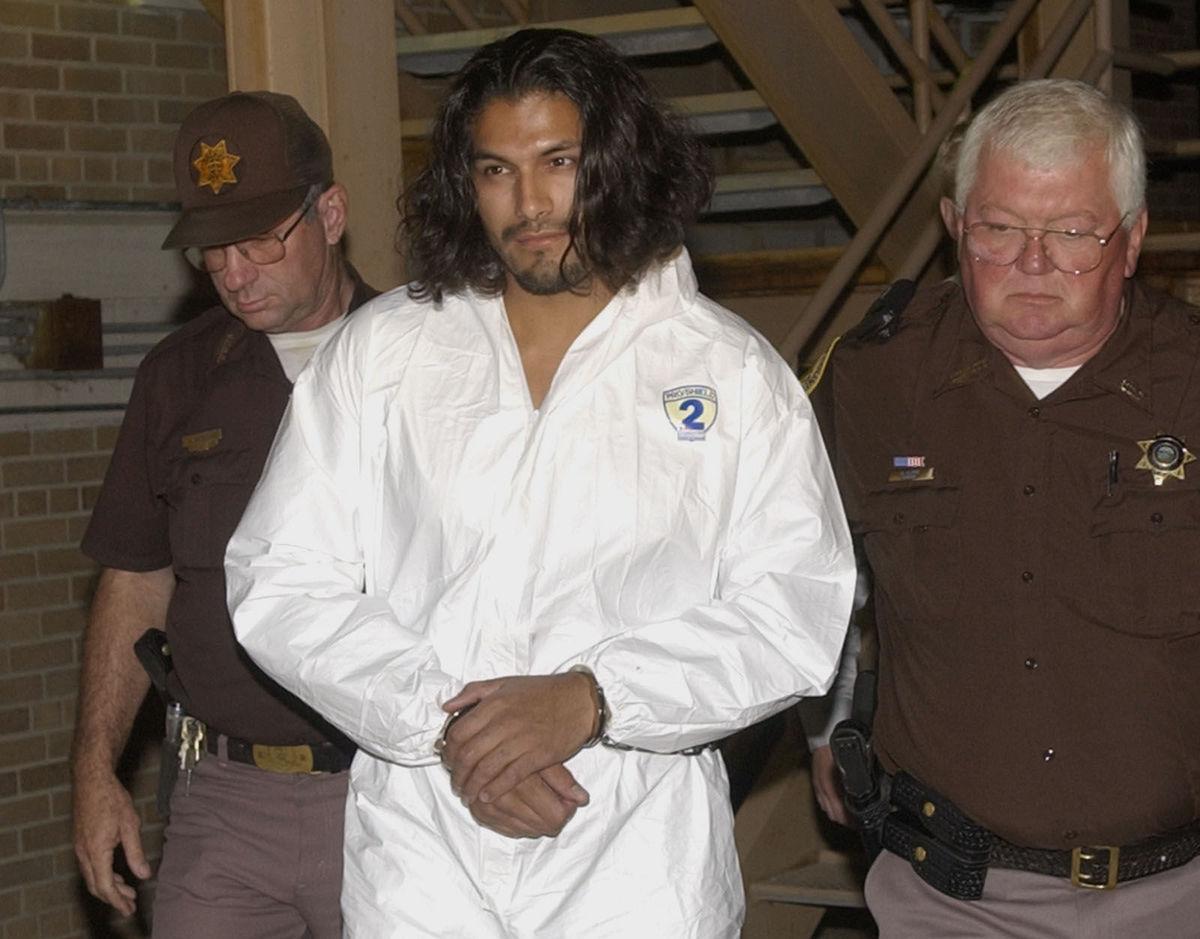
HUNTSVILLE, Texas − David Santiago Renteria spoke his last words Thursday night, strapped to a gurney at the Huntsville Unit, minutes before being executed in the 2001 abduction and killing of 5-year-old Alexandra Flores.

Renteria, 53, was injected with a lethal dose of pentobarbital Thursday, Nov. 16, on a dark, cold and rainy evening at the Texas Department of Criminal Justice’s prison. His time of death was 7:11 p.m. CST, prison officials said.

With his family and Alexandra’s family present, Renteria gave his final statements.

Killer’s final words

Renteria prayed before singing a hymn in English and another in Spanish after witnesses, including relatives of his victim, entered the death chamber and watched through a window a few feet from him during his execution.

Looking at his victim’s relatives, Renteria also said: “There is not a day that goes by that I do not think about the fateful events of that day and what transpired.

“There are no words to describe what you’re going through, and I understand that.”

He told his sister and a friend, watching through another window, that he was “good… strong”.

“I love you all, I truly do. I’ll see you in the next life,” Renteria added.

He then began reciting The Lord’s Prayer as the drugs began flowing. “Our father, who art in heaven” is as far as he got.

“I taste it,” he said of the drug, before mumbling something and all movement stopped.

The Renteria family watched the execution from a different room from Alexandra’s family. Glass windows separated the witnesses from Renteria.
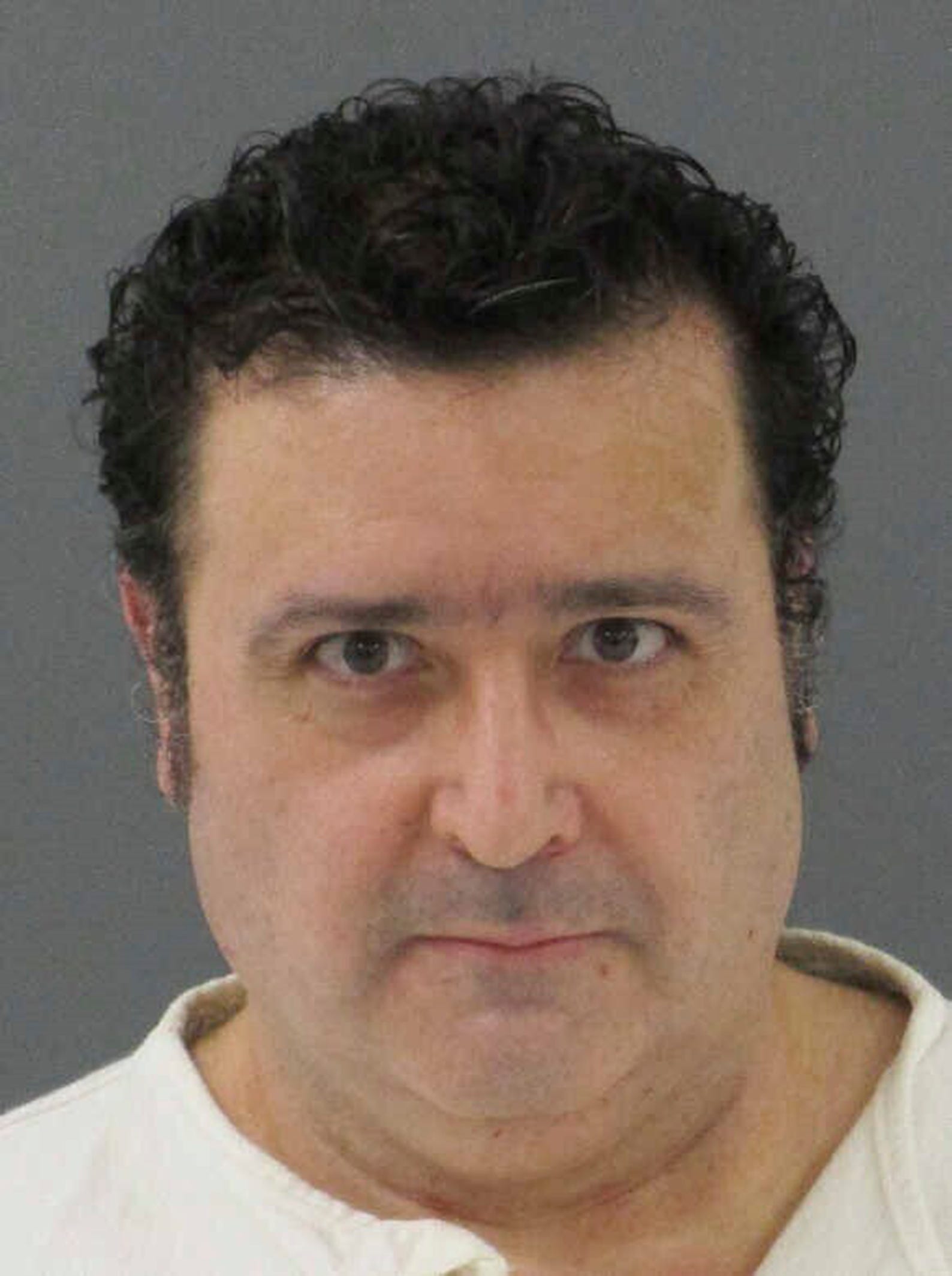
This photo released by the Texas Department of Criminal Justice shows death row inmate David Renteria. Renteria, a Texas inmate convicted of strangling a 5-year-old girl taken from an El Paso store and then burning her body nearly 22 years ago is facing execution. (Texas Department of Criminal Justice)

Alexandra’s sister, Sandra Frausto, and brother, Ignacio Frausto, attended the execution.

Renteria’s sister Cecilia Esparza and a friend also were present.

Esparza collapsed when she walked into the viewing room, and prison officials brought her a chair and she cried. Renteria told his sister through the glass, “I love you.”

Last days on Texas death row for one of El Paso’s most notorious killers

Renteria spent his final days meeting with visitors, laying in bed, watching TV through a cell door and sleeping, a Death Watch report states. The times listed below are in Central time zone.

On his execution day, starting at 12:15 a.m., he sat on his bed and began writing. The report does not state what he wrote.

He began packing up his property about 2:30 a.m., before sitting on the floor and reading a book around 4 a.m., the report states. He then continued packing up his property and cleaning the floor between 5 to 7:30 a.m.

Renteria was allowed to talk to fellow inmates at 7:30 a.m., before meeting with visitors from 8 to 11:30 a.m., the death watch states.

He was then transferred from the Texas Department of Criminal Justice’s Polunsky Unit in Livingston, Texas, to the Huntsville Unit to await his execution.

A victim of Renteria’s from a different criminal incident and her mother also attended the execution. Renteria was previously convicted and sentenced to 20 years in prison for indecency with a child in El Paso.

The execution was also attended by 14 state law enforcement and governmental officials.

Renteria grew up in the Lower Valley and was a tribal member of the Ysleta del Sur Pueblo, according to the Texas Coalition to Abolish the Death Penalty.

While in prison, he rededicated himself to his Roman Catholic faith, the coalition reported.

Renteria’s execution ends a nearly 22-year legal battle waged in what has been described as one of the most heinous crimes committed in El Paso.

“I’ve always been a supporter of the death penalty and from a law enforcement perspective, I just think some people are too dangerous to be in our society and that is certainly one individual who I think that that the death penalty is absolutely appropriate,” El Paso County Sheriff Richard Wiles said. “It’s a long time coming. I think it’s been what? Twenty-one years. I was actually the assistant (El Paso police) chief, (Carlos) Leon was the chief when that horrific crime occurred. It was really tough on everybody. I can’t even imagine what that family went through and what they’re still going through today.

“Hopefully, this will give them a little bit of relief to help them in their recovery that is going to take the rest of their lives, Wiles said. “I can’t even imagine losing my 5-year-old daughter to such a horrific crime.”

Justice served for Alexandra Flores in 2001 abduction nearly 22 years later
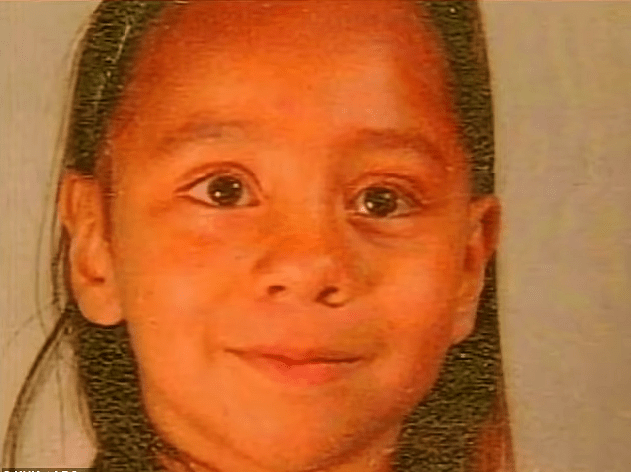
Renteria’s execution came two days before the 22nd anniversary of the day he kidnapped 5-year-old Alexandra Flores from an El Paso Walmart, strangled her to death and then burned her body. It also comes six days before his 54th birthday.

Renteria abducted Alexandra Nov. 18, 2001, as she was Christmas shopping with her parents at an El Paso Lower Valley Walmart.

Her parents realized she was missing and searched the store but could not find her. Alexandra was seen on store surveillance video exiting the store about 5:15 p.m. with Renteria.

Alexandra’s body was found about 7:10 a.m. the next day in an alley 16 miles (25km) away.. She was naked and partially burned in a carport near Downtown El Paso.

An autopsy revealed Alexandra was strangled to death and then set ablaze, court documents state. Investigators later revealed there were no signs of sexual assault.

A palm print on a plastic bag found over Alexandra’s head was determined to be from Renteria, court documents state.

El Paso Police Department investigators discovered that a vehicle registered to Renteria was at 9441 Alameda Ave. at the time and date of Alexandra’s disappearance. Renteria also told police he was at the location at the time and date of her disappearance, court documents state.

Renteria went to trial for the death of Alexandra in September 2003. He claimed in his trial that Barrio Azteca gang members forced him to kidnap the girl and someone else was the person who killed her, court records show.

A jury convicted him of capital murder and he was sentenced to death.

Appeals court justices heard the case in 2006 and upheld the conviction. However, the justices ordered a new sentencing phase of the trial.

The resentencing was ordered because of “exclusion of evidence showing the defendant’s remorse violated due process by preventing defendant from rebutting the State’s case when the State left jury with false impression and emphasized it,” the justices wrote in their opinion.
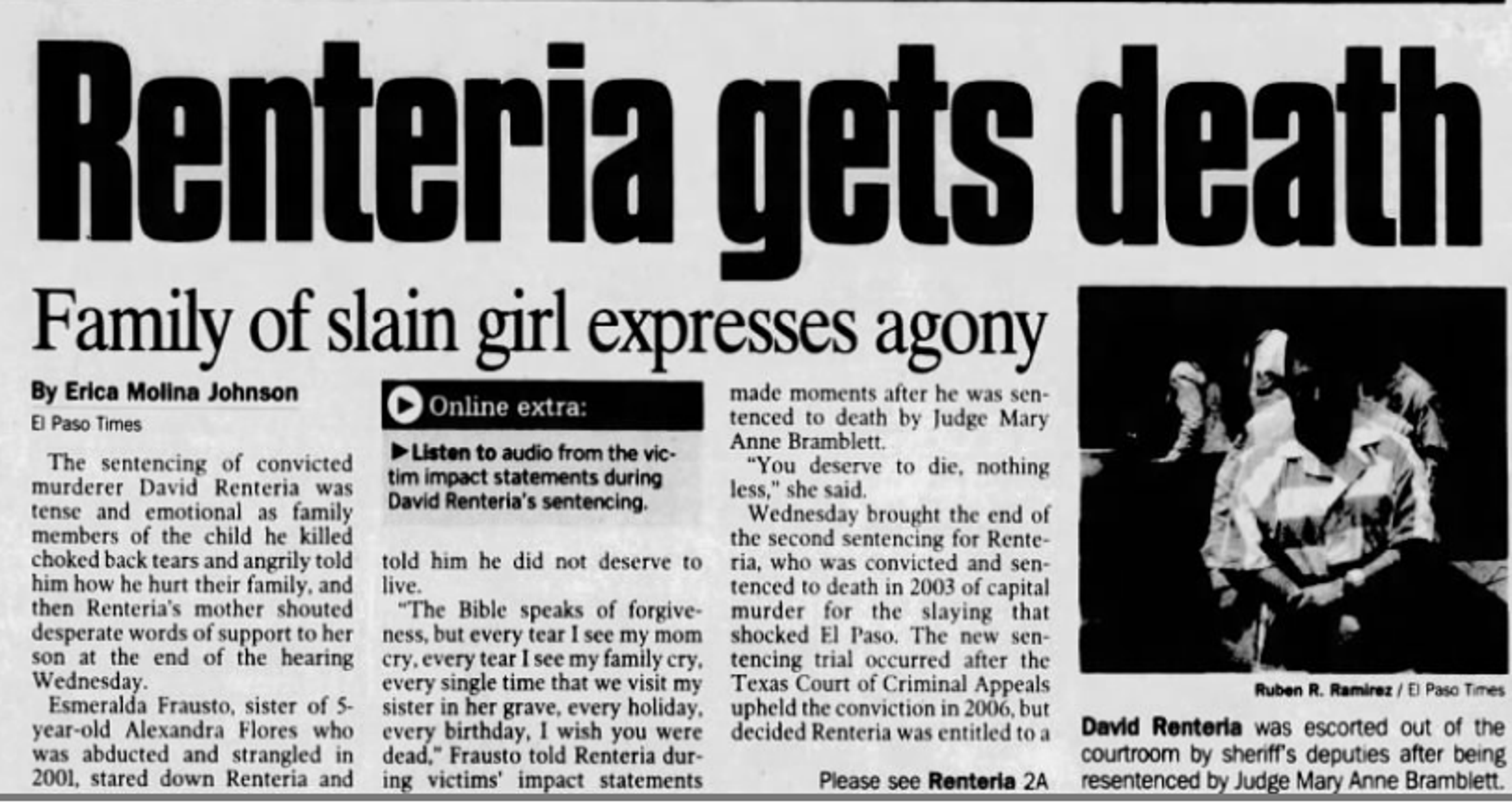
A May 15, 2008, El Paso Times article reporting David Santiago Renteria was given the death penalty during his resentencing hearing.

A May 15, 2008, El Paso Times article reporting David Santiago Renteria was given the death penalty during his resentencing hearing. 

KTSM 9 NEWS

DAVID SANTIAGO RENTERIA v. THE STATE OF TEXAS (Original)

El Paso Sheriff Deputy Peter Herrera’s family speaks after death penalty sentence

Questions Linger for Anthony Shore, Larry Swearingen


Update 2019.

Larry Swearingen, 48, was executed by lethal injection Wednesday evening for the December 1998 killing of Melissa Trotter. The 19-year-old was last seen leaving her community college in Conroe, and her body was found nearly a month later in a forest near Huntsville, about 70 miles north of Houston.

Swearingen was pronounced dead at 6:47 p.m. His last words were: “Lord forgive them. They don’t know what they are doing.”

Larry Swearingen, en 2009

January, 18 2018

Houston serial killer Anthony Shore faces another death date, this one Jan. 18. Shore was originally set for execution in October, but that got halted by the Harris County District Attorney’s Office amid rumors he was planning to confess to another murder: the 1998 killing of Melissa Trotter. Except Larry Swearingen had been convicted of kidnapping, raping, and strangling Trotter in 2000, and by then was preparing for his own execution in November.

Assistant District Attorney Tom Berg said his office revoked Shore’s execution warrant at the request of Montgomery County D.A. Brett Ligon, who believed Shore was colluding with Swearingen. (He says a folder was found in Shore’s cell with information relating to Trotter’s death.) Berg said the Texas Rangers have since interviewed Shore, who admitted he had “nothing to do” with Trotter’s murder. Shore alleged he and Swearingen once contemplated conspiring, but had since “parted ways.” Berg, who says his office and Ligon’s have reviewed the interview, said Shore decided not to “take the fall” for his fellow inmate. Shore has exhausted his appeals; Berg said he’s unaware of any new attempts to stay Shore’s execution, and concluded that his case will see its “inevitable end” next Thursday.

Shore’s execution is just the beginning of a busy month.

Swearingen, however, had his November execution stayed due to a filing error, and has since been granted additional DNA testing. Unlike Shore, who confessed to killing four girls between 1986 and 1995, Swearingen has maintained his innocence. His supporters, including his lawyer James Rytting, say he was in a county jail for outstanding traffic warrants at the time of Trotter’s murder. The 19-year-old was last seen on Dec. 8, 1998, with Swearingen (who wasn’t arrested until three days later), but her body wasn’t discovered until Jan. 2. Rytting said forensic evidence suggests her body could not have been dumped in the woods until “a week or 10 days” after Swearingen was arrested.

Included in the evidence sent out for testing is Trotter’s rape kit, which was never tested and could exonerate Swearingen should analysts uncover another DNA profile. Samples of hair particles found on Trot­ter’s undergarments and the alleged murder weapon (a torn pair of pantyhose) will also be tested. The evidence was shipped out in December and testing will likely take four weeks.

Rytting was alarmed that the state had reissued an execution date for Shore. “They shouldn’t be putting the guy into the ground with these questions still around,” he said. He says two witnesses, with no connection to Swearingen, told the D.A.’s Office that Shore suggested to them that he was connected to Trotter’s murder. The information, Rytting said, would “sure as hell” make Shore a suspect had it been provided prior to Swearingen’s conviction. “It’s a type of incriminating statement the prosecution seizes on all the time,” he said. “You don’t get to wiggle out of it with an ‘Aw shucks, I was kidding.'”

Shore will likely mark the first state-sanctioned killing of 2018, and his is just the beginning. William Rayford is scheduled for Jan. 30, and John Battaglia for Feb. 1.

EXECUTED – ‘Tourniquet Killer’ set to be executed in Texas – Anthony Shore 6:28 p.m


JAN. 18, 2018

In his final statement, Shore, 55, was apologetic and his voice cracked with emotion.

“No amount of words or apology could ever undo what I’ve done,” Shore said. “I wish I could undo the past, but it is what it is.”

He was pronounced dead at 6:28 p.m. CST.

Texas’ “Tourniquet Killer” is set for execution Thursday. It would be the first execution under Harris County District Attorney Kim Ogg, a Democrat who oversaw the first year without an execution in the county for more than 30 years.

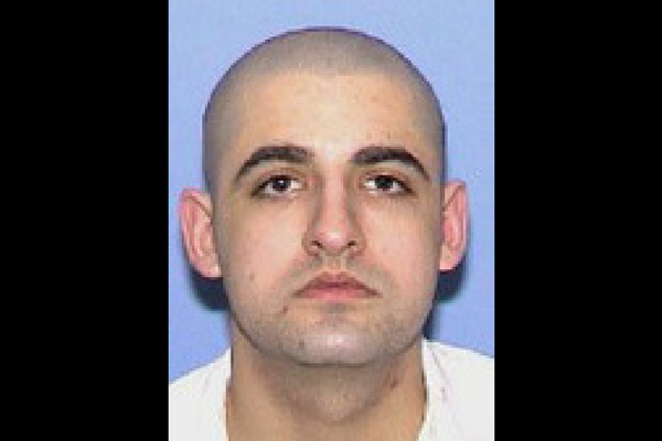
Death row inmate Anthony Shore.


The first execution of 2018 in Texas and the nation is expected to take place Thursday evening for Houston’s “Tourniquet Killer.”

Anthony Shore, 55, is a confessed serial rapist and strangler whose murders went unsolved in the 1980s and 1990s for more than a decade. With no pending appeals, his execution is expected to be the first under Harris County District Attorney Kim Ogg, a Democrat who took office last January and has said she doesn’t see the death penalty as a deterrent to crime.

Still, she has said the punishment is appropriate for Shore, deeming him “the worst of the worst.”

“Anytime a person is subject to government’s greatest sanction, it merits thoughtful review,” Ogg said through a spokesman Wednesday. “We have proceeded as the law directs and satisfied all doubts.”

Shore wasn’t arrested in the murders until 2003, when his DNA was matched to the 1992 murder of 21-year-old Maria Del Carmen Estrada, according to court documents. His DNA had been on file since 1998, when he pleaded no-contest to charges of sexually molesting his two daughters. After his arrest, he confessed to the murders of four young women and girls, including Estrada.

Between 1986 and 1995, Shore sexually assaulted and killed 14-year-old Laurie Tremblay, Estrada, 9-year-old Diana Rebollar and 16-year-old Dana Sanchez, the court documents said. He also admitted to the rape of another 14-year-old girl, but she managed to escape after he began choking her. The murder victims’ bodies were all found in various states of undress behind buildings or in a field with rope or cord tied around their necks like tourniquets.

Though he doesn’t argue that his client is innocent or undeserving of punishment, Shore’s lawyer, Knox Nunnally, said Wednesday that he was surprised Ogg continued to pursue the death penalty for Shore based on her previous statements on capital punishment. Ogg’s first year in office also coincided with the first year Harris County didn’t carry out an execution in more than 30 years.

“Many people in the death penalty community were expecting other things from her,” Nunnally said.

Though she has said the death penalty is “pure retribution,” Ogg told the Texas Observer last year that she still believes in it. But in two major death penalty cases that made their way to the U.S. Supreme Court, Ogg opted for reduced punishments.

After the high court ruled death row inmate Duane Buck should receive a new trial because an expert witness claimed he was more likely to be a future danger to society because he was black, Ogg offered a plea agreement in October to a sentence of life in prison rather than holding a new death penalty trial. The next month, Ogg asked the Texas Court of Criminal Appeals to reduce the death sentence of Bobby Moore, whose case had earlier prompted the Supreme Court to invalidate Texas’ outdated method of determining intellectual disability in death-sentenced inmates.

But for a “true serial killer” such as Shore, Ogg said in a July statement that he was “a person deserving of the ultimate punishment.”

Shore’s execution was originally set for October, but Ogg postponed it after Montgomery County District Attorney Brett Ligon requested a delay from her and Gov. Greg Abbott. Ligon was concerned that Shore might falsely confess to the Montgomery County murder of Melissa Trotter, potentially disrupting the existing death sentence for the man already convicted in Trotter’s murder.

“We knew that was not true, but, that said, we knew that if we didn’t investigate it, it would look like we ignored potential evidence,” Ligon said.

Ligon said that after Shore talked to Texas Rangers and his office, investigators were convinced that Shore was not responsible for Trotter’s death or any other open murder cases. Nunnally said Shore never confessed to Trotter’s murder.

Now, Nunnally says he thinks he’s done everything he can for Shore. He had hoped to ask for a delay if the U.S. Supreme Court elected to hear a case out of Arizona that questions the constitutionality of the death penalty as a whole, but the justices have yet to make a decision and don’t meet again until Friday — the day after his scheduled execution.

Shore’s execution will the be the first in 2018, following a years-long trend of fewer executions in Texas and across the country. Four other executions are scheduled in Texas through March.

States to try new ways of executing prisoners. Their latest idea? Opioids.


December 11, 2017

The synthetic painkiller fentanyl has been the driving force behind the nation’s opioid epidemic, killing tens of thousands of Americans last year in overdoses. Now two states want to use the drug’s powerful properties for a new purpose: to execute prisoners on death row.

As Nevada and Nebraska push for the country’s first fentanyl-assisted executions, doctors and death penalty opponents are fighting those plans. They have warned that such an untested use of fentanyl could lead to painful, botched executions, comparing the use of it and other new drugs proposed for lethal injection to human experimentation.

States are increasingly pressed for ways to carry out the death penalty because of problems obtaining the drugs they long have used, primarily because pharmaceutical companies are refusing to supply their drugs for executions.

The situation has led states such as Florida, Ohio and Oklahoma to turn to novel drug combinations for executions. Mississippi legalized nitrogen gas this spring as a backup method – something no state or country has tried. Officials have yet to say whether it would be delivered in a gas chamber or through a gas mask.

Other states have passed laws authorizing a return to older methods, such as the firing squad and the electric chair.

“We’re in a new era,” said Deborah Denno, a law professor at Fordham University. “States have now gone through all the drugs closest to the original ones for lethal injection. And the more they experiment, the more they’re forced to use new drugs that we know less about in terms of how they might work in an execution.”

Supporters of capital punishment blame critics for the crisis, which comes amid a sharp decline in the number of executions and decreasing public support for the death penalty. As of late November, 23 inmates had been put to death in 2017 – fewer than in all but one year since 1991. Nineteen states no longer have capital punishment, with a third of those banning it in the past decade.

“If death penalty opponents were really concerned about inmates’ pain, they would help reopen the supply,” said Kent Scheidegger of the Criminal Justice Legal Foundation, which advocates the rights of crime victims. Opponents “caused the problem we’re in now by forcing pharmaceuticals to cut off the supply to these drugs. That’s why states are turning to less-than-optimal choices.”

Prison officials in Nevada and Nebraska have declined to answer questions about why they chose to use fentanyl in their next executions, which could take place in early 2018. Many states shroud their procedures in secrecy to try to minimize legal challenges.

But fentanyl offers several advantages. The obvious one is potency. The synthetic drug is 50 times more powerful than heroin and up to 100 times more powerful than morphine.

“There’s cruel irony that at the same time these state governments are trying to figure out how to stop so many from dying from opioids, that they now want to turn and use them to deliberately kill someone,” said Austin Sarat, a law professor at Amherst College who has studied the death penalty for more than four decades.

Another plus with fentanyl: It is easy to obtain. Although the drug has rocketed into the news because of the opioid crisis, doctors frequently use it to anesthetize patients for major surgery or to treat severe pain in patients with advanced cancer.

Nevada officials say they had no problem buying fentanyl.

“We simply ordered it through our pharmaceutical distributor, just like every other medication we purchase, and it was delivered,” Brooke Keast, a spokeswoman for the Nevada Department of Corrections, said in an email. “Nothing out of the ordinary at all.”

The state, which last put someone to death in 2006, had planned its first fentanyl-assisted execution for November. The inmate involved, 47-year-old Scott Dozier, was convicted of killing a man in a Las Vegas hotel, cutting him into pieces and stealing his money.

According to documents obtained by The Washington Post, Nevada’s protocol calls for Dozier first to receive diazepam – a sedative better known as Valium – and then fentanyl to cause him to lose consciousness. Large doses of both would cause a person to stop breathing, according to three anesthesiologists interviewed for this report.

Yet Nevada also plans to inject Dozier with a third drug, cisatracurium, to paralyze his muscles – a step medical experts say makes the procedure riskier.

“If the first two drugs don’t work as planned or if they are administered incorrectly, which has already happened in so many cases . . . you would be awake and conscious, desperate to breathe and terrified but unable to move at all,” said Mark Heath, a professor of anesthesiology at Columbia University. “It would be an agonizing way to die, but the people witnessing wouldn’t know anything had gone wrong because you wouldn’t be able to move.”

John DiMuro, who helped create the fentanyl execution protocol when he was the state’s chief medical officer, said he based it on procedures common in open-heart surgery. He included cisatracurium because of worries that the Valium and fentanyl might not fully stop an inmate’s breathing, he said. “The paralytic hastens and ensures death. It would be less humane without it.”

A judge postponed Dozier’s execution last month over concerns about the paralytic, and the case is awaiting review by Nevada’s Supreme Court. In the meantime, Nebraska is looking toward a fentanyl-assisted execution as soon as January. Jose Sandoval, the leader of a bank robbery in which five people were killed, would be the first person put to death in that state since 1997.

Sandoval would be injected with the same three drugs proposed in Nevada, plus potassium chloride to stop his heart.

Even at much lower concentrations, intravenous potassium chloride often causes a burning sensation, according to Heath. “So if you weren’t properly sedated, a highly concentrated dose would feel like someone was taking a blowtorch to your arm and burning you alive,” he said.

Fentanyl is just the latest in a long line of approaches that have been considered for capital punishment in the United States. With each, things have often gone wrong.

When hangings fell out of favor in the 19th century – because of botched cases and the drunken, carnival-like crowds they attracted – states turned to electrocution. The first one in 1890 was a grisly disaster: Spectators noticed the inmate was still breathing after the electricity was turned off, and prison officials had to zap the man all over again.

Gas chambers were similarly sold as a modern scientific solution. But one of the country’s last cyanide gas executions, in 1992, went so badly that it left witnesses crying and the warden threatening to resign rather than attempt another one.

Lethal injection, developed in Oklahoma in 1977, was supposed to solve these problems. It triggered concerns from the start, especially because of the paralytic drug used. Even so, the three-drug injection soon became the country’s dominant method of execution.

In recent years, as access to those drugs has dried up, states have tried others. Before the interest in fentanyl, many states tested a sedative called midazolam – leading to what Supreme Court Justice Sonia Sotomayor called “horrifying deaths.”

Dennis McGuire, who raped and killed a pregnant newlywed in Ohio, became the first inmate on whom that state’s new protocol was tried. Soon after the 2014 execution began, his body writhed on the table as he gasped for air and made gurgling, snorting noises that sounded as though he was drowning, according to witnesses.

The same year, Oklahoma used midazolam on an inmate convicted of kidnapping and killing a teenager; authorities aborted the execution after Clayton Lockett kicked, writhed and grimaced for 20 minutes, but he died not long after. Three months later, Arizona used midazolam on Joseph Wood III, who was convicted of killing his ex-girlfriend and her father. Officials injected him more than a dozen times as he struggled for almost two hours.

Like officials in other states, Arizona officials argued that the inmate did not suffer and that the procedure was not botched. Later, they said they would never again use midazolam in an execution.

Joel Zivot, a professor of anesthesiology and surgery at Emory University, called the states’ approach ludicrous. “There’s no medical or scientific basis for any of it,” he said. “It’s just a series of attempts: obtain certain drugs, try them out on prisoners, and see if and how they die.”

The bad publicity and continuing problems with drug supply have sent some of the 31 states where capital punishment remains legal in search of options beyond lethal injection. Turning to nitrogen gas would solve at least one issue.

Nitrogen is literally in the air we breathe – you can’t cut off anyone’s supply to that,” said Scheidegger, who strongly supports the idea.

In addition to Mississippi, Oklahoma has authorized nitrogen gas as a backup to lethal injection. Corrections officials and legislators in Louisiana and Alabama have said they hope to do the same.

And yet, critics note, there is almost no scientific research to suggest that nitrogen would be more humane.

Zivot is among those skeptical that nitrogen would work as hoped.

“There’s a difference between accidental hypoxia, like with pilots passing out, and someone knowing you’re trying to kill him and fighting against it,” he said. “Have you ever seen someone struggle to breathe? They gasp until the end. It’s terrifying.”

Dozier, the inmate Nevada hopes to execute soon with fentanyl has said he would prefer death by firing squad over any other method. In more than a dozen interviews, experts on both sides of the issue expressed similar views.

Of all the lethal technology humans have invented, the gun has endured as one of the most efficient ways to kill, said Denno, who has studied the death penalty for a quarter-century.

“The reason we keep looking for something else,” she said, “is because it’s not really for the prisoner. It’s for the people who have to watch it happen. We don’t want to feel squeamish or uncomfortable. We don’t want executions to look like what they really are: killing someone.”

Attorneys seek to ensure Scott Dozier won’t be executed until 2018


December 5, 2017

A judge in Las Vegas kept a condemned prison inmate’s execution on hold Tuesday over concerns about a never-before-tried three-drug combination planned for use during Nevada‘s first execution in more than 11 years.

Clark County District Court Judge Jennifer Togliatti also said Tuesday that she wants to see written filings before she decides several other key issues.

With the Nevada Supreme Court expected to review the case and decide if Scott Raymond Dozier’s execution should go forward, Togliatti took no immediate action on a request by state and local prosecutors to reverse her Nov. 14 order halting the execution, which had been planned the same day.

State attorney general’s office lawyers say they’re drafting an appeal to the state high court of Togliatti’s order that the state Department of Corrections must remove a disputed paralytic, cisatracurium, as the third drug in a protocol using high doses of the sedative diazepam and the potent opioid fentanyl.

“You could have proceeded. He could be dead today,” the judge told attorney general solicitor Jordan Smith on Wednesday, noting that he said the state would appeal instead.

The judge added that she felt Supreme Court review of the three-drug cocktail will be important if the state wants to use it in future executions.

Togliatti canceled a Dec. 7 hearing, and made it clear that Dozier will have to wait at least several months for the execution he has said repeatedly he wants carried out.

She set a Jan. 17 hearing on a bid from the attorney general and Clark County district attorney’s offices to proceed using just diazepam and fentanyl. A medical expert witness called by federal public defenders challenging the case said those two drugs should be enough to kill the inmate.

She also is being asked to decide if federal public defenders should continue to represent Dozier in a review of the state’s proposed execution protocol.

Dozier, appearing by videoconference from Ely State Prison, did not say he wanted attorneys David Anthony and Lori Teicher to stop representing him.

Togliatti barely contained exasperation over what she termed “manipulation of the court process,” and asked the inmate if a flurry of filings in recent days meant he was asking for a “do-over” of the lengthy proceedings that began in July and required almost daily action in the run-up to the scheduled execution date.

Dozier called the months of hearings that made his case a topic of national interest “vital,” noted that they led to revisions of the protocol, and said he feels now “like I had to take a less-than-ideal option because that was the only option available.”

Dozier, 47, has been on death row since 2007 for convictions in separate murders in Phoenix and Las Vegas.

Jonathan VanBoskerck, a chief Clark County district attorney, has said that local prosecutors have an interest in seeing the penalty that Togliatti imposed 10 years ago carried out. He said Tuesday that other arguments are irrelevant since Dozier is not challenging his sentence or the process.

“The bottom line is it’s his choice,” VanBoskerck told the judge.


RELATED | Condemned inmate Scott Dozier complains of death penalty delay


ACLU files lawsuit on behalf of death row inmates against Ricketts, Corrections Department


December 5, 2017

Sandoval

ACLU of Nebraska filed a lawsuit Monday on behalf of death row inmates that claims the ballot initiative that stopped the state Legislature’s 2015 repeal was illegal.

The complaint is an attempt to stop any executions, or even steps toward an execution, of the men on Nebraska’s death row.

Death row inmate Jose Sandoval said last week he intends to fight the execution. At that time, he had no ongoing legal actions or appeals in federal or state courts.

“My reaction to the notice (of lethal injection drugs) was not a surprise. I’ve been expecting it for a year now,” Sandoval said. “I intend to fight with the help of my attorneys — Amy Miller and company.”

The ACLU confirmed Sunday that Miller, its legal director, has been in contact with Sandoval, who was notified Nov. 9 of the state’s intention to execute him with four specified lethal injection drugs. The organization is preparing to announce the scope of its representation of Sandoval early this week, it said.

The four drugs in combination that would be used in Sandoval’s execution, if it takes place, have never been used to execute a person.

The complaint charged the ballot initiative violated the Nebraska Constitution’s separation of powers. It said Gov. Pete Ricketts was the driving force behind the 2016 referendum, exploiting government staff, resources and his own elected position to raise money for the ballot initiative and to persuade voters to support it.

“In Nebraska, our state Constitution … establishes a strong tradition with a clear separation of powers,” ACLU Executive Director Danielle Conrad said Sunday. “The governor can’t have it both ways and serve both as a member of the executive and legislative branches.”

The petition drive got underway in 2015 and the sponsoring group, Nebraskans for the Death Penalty, gathered 167,000 signatures, enough to stop the repeal from being in effect until a vote in November 2016.

The Legislature had voted to repeal Nebraska’s death penalty with a bill (LB268) that passed on a 32-15 vote. Ricketts vetoed the bill and then the Legislature voted to override the veto on a 30-19 vote that cut across party lines.

Shortly after that, Nebraskans for the Death Penalty was formed and raised just over $913,000, a third of it contributed by Ricketts and his father, Joe Ricketts.

The governor’s actions pose important legal questions with grave consequences, Conrad said.

She said the end result of those actions was the restoration of a “broken” death penalty that is racially biased, risks execution of innocent people and raises constitutional concerns about the Eighth Amendment’s prohibition against cruel and unusual punishments.

Ricketts’ office responded in a statement issued Sunday evening.

“The Governor’s Office holds itself to a high standard and follows state law regarding the use of taxpayer resources,” said Taylor Gage, the governor’s spokesman. “This liberal advocacy group has repeatedly worked to overturn the clear voice of the Nebraska people on the issue of capital punishment and waste taxpayer dollars with frivolous litigation. The administration remains committed to protecting public safety and creating a safe environment for our Corrections officers.”

The ACLU lawsuit — filed on behalf of death row inmates against Ricketts, Treasurer Don Stenberg, founders of Nebraskans for the Death Penalty, Attorney General Doug Peterson, the Department of Correctional Services and Director Scott Frakes — asked the court to immediately stop all preparations for executing Sandoval and the other 10 men on death row.

Peterson plans to ask the Nebraska Supreme Court for a death warrant after 60 days following the notification of drugs that would be used.

That ACLU complaint said that as the governor, Ricketts’ power over the repeal bill ended when the Legislature overrode his veto.

It claimed the subsequent ballot initiative should not stand, as it was the result of repeated, extensive and illegal abuses of the governor’s power. The state’s constitution reserves ballot initiatives as a legislative power for the people to use as a check on the legislature, and it further prohibits anyone in one branch of government from exercising powers over another branch, the ACLU said.

Ricketts encouraged or ordered members of the executive branch and his allies in the Legislature and local governments to work for the referendum campaign or to express public support for it, the complaint said.

For example, Stenberg was simultaneously a leader of the campaign in the first few months, serving as co-chairman with Sen. Beau McCoy, the ACLU charged. In the middle of the campaign, Ricketts rewarded Jessica Flanagain, the campaign manager and coordinator, with a publicly paid position in the government as special adviser to the governor for external affairs, with a salary of $130,000, the complaint alleges.

The lawsuit also noted that Nebraskans for the Death Penalty made an error that invalidated the referendum by failing to submit sworn statements from its sponsors, as required by law to assure the sponsors’ names aren’t fraudulent and assure transparency in the working of ballot campaigns.

Previous litigation more narrowly alleged the referendum petition was not legally sufficient because a list of sponsors filed with the petition did not include the name of Ricketts, who it claimed engaged in activities that established that he was a sponsor of the referendum. The district court dismissed the complaint. The Supreme Court affirmed, holding Ricketts’ alleged financial or other support of the referendum did not make him a person “sponsoring the petition.”

Death row inmate who survived his own execution really doesn’t want a do-over


November  2017

An Ohio man who became the third U.S. death row inmate in seven decades to survive his own execution filed a new appeal for mercy Tuesday, arguing that Ohio’s lethal injection protocol constitutes cruel and unusual punishment because one of its drugs may not work properly.

Alva Campbell, a 69-year-old man sentenced to death in 1998 for killing 18-year-old Charles Dial in a robbery, had his execution halted about 25 minutes after it was scheduled to start, according to the Associated Press. The execution team, it turned out, couldn’t pinpoint a vein that they could use to inject Campbell with a dosage of lethal drugs.

In court documents filed before the execution, Campbell’s lawyers warned that this was a possibility, as Campbell has a history of chronic heart and lung problems that can make finding a vein tricky. In fact, the prison was so worried that Campbell’s lungs would give out and he would stop breathing, while lying on the execution gurney, that the team gave him a wedge pillow to help him stay calm and alive until they could execute him.

Campbell’s lawyers also cited Ohio’s bad track record when it came to successfully carrying out executions. Though the first failed execution in modern U.S. history took place in 1946, when Louisiana’s attempt to execute Willie Francis using the electric chair failed, the second was much more recent: In 2009, an Ohio execution team made 18 attempts over the course of two hours to find a vein to inject Romell Broom with lethal injection drugs. Then-Gov. Ted Strickland ultimately ordered them to give up. Broom remains on death row, locked in a court battle where he argues that trying to execute him a second time would be unconstitutional.

Alva Campbell, 69 (Ohio Department of Rehabilitation and Correction )

Campbell’s new appeal to the U.S. Court of Appeals for the Sixth Circuit Court, however, technically centers around a different issue: the use of midazolam, a sedative that’s meant to render an inmate unconscious.

Midazolam has been used in several recent botched executions, including in Ohio. In 2014, the state executed convicted killer and rapist Dennis McGuire, even though McGuire reportedly gasped, snorted, and snored minutes after he should have been knocked unconscious. A judge ended up declare Ohio’s lethal injection procedure unconstitutional, leading the state to halt executions for years.

As drug manufacturers and distributors become more and more reluctant to allow their wares to be used in executions, however, states are scrambling to find drugs they can use in lethal injections. That’s led midazolam’s popularity to skyrocket.

Evidence “from recent executions demonstrates the disturbing signs that prisoners remain sensate to severe pain, aware, and conscious following injection of 500 mg. of midazolam or more are ‘the rule,’ not ‘the exception,’” Campbell’s lawyers write in his latest appeal.

Campbell’s new execution date is June 6, 2019.

South Carolina has no drugs left to execute Death Row cop killer


Novembre  29,  2017

A death row inmate is due to die in just two days on Friday 1 December – but the state of South Carolina has none of the drugs it needs to kill him.

Bobby Wayne Stone, now 52, was sentenced to death back in 1997 after he was convicted of murder and first degree burglary. On 26 February, 1996 Stone roamed the woods while drinking beer and shooting his guns – a shotgun and a pistol. At one point, he left off gunshots outside a woman’s home and then, when Sergeant Charles Kubala responded, shot three or four more times. Kubala, who was hit once in the neck and once in the ear, died at the scene.

After many years of legal wrangling, including appeals against his murder conviction and death sentence at the Supreme Court, Stone was finally given an execution date – Friday 1 December. But then he made a choice that may have saved his life.

Texas Death Row Inmate’s Execution Postponed Over False Testimony


November 29,2017Juan Castillo - TEXAS DEPARTMENT OF CRIMINAL JUSTICE

Juan Castillo was scheduled to die on December 14, 2017. He was supposed to be the last prisoner on death row to be executed in Texas this year.

But on November 29, the Texas Court of Criminal Appeals delayed Castillo’s execution and sent his case back to trial court to reexamine false testimony used to convict him. 

Castillo, 36, was sentenced to death for the 2003 murder and robbery of Tommy Garcia Jr. in San Antonio. Castillo, his then-girlfriend, and two others had tried to lure Garcia with sex, and then steal his money. When 19-year-old Garcia ran away, Castillo shot him.

During his trial, Castillo’s former bunkmate at the Bexar County Jail, Gerardo Gutierrez, testified that Castillo had confessed to the crime. But in 2013, Gutierrez signed an affidavit saying he had lied about the confession.

Gutierrez’s false testimony is prompting the Texas CCA to pause the execution and further review Castillo’s case.

It’s not the first time Castillo’s execution date has been called off.

Previously, his Sept. 7, 2017 execution date was postponed at the request of the Bexar County District Attorney’s office because some of Castillo’s lawyers living in Harris County were impacted by Hurricane Harvey, according to the Texas Tribune. Castillo also had a prior execution date set back in May, but the date was postponed after Bexar County prosecutors failed to give sufficient notice to the defense, according to the Houston Chronicle

Texas has executed seven death row inmates in 2017, two of which were in Bexar County.

At least two other executions have been delayed in Texas this year because of issues over testimonies. Back in October, Anthony Shore, known as the “Tourniquet Killer,” had his execution date moved to January after he told prosecutors he had falsely planned to take responsibility for a fellow inmate’s murder.

Duane Buck, a Harris County death row inmate, had his sentence reduced to life in prison after the Supreme Court granted him the right to a retrial because a prison psychiatrist had told the jury in his 1997 trial that Buck would be more dangerous in the future because of his race.

Nevada Condemned Inmate Complains of Death Penalty Delay


November  21,2017


Nevada death row inmate Scott Dozier appears in a Las Vegas court via video on Wednesday, Nov. 8, 2017, days before his scheduled execution. From the state prison in Ely, where he is scheduled to be executed on Tuesday, Dozier, 46, told Clark County District Court Judge Jennifer Togliatti one last time that he wants his death sentence carried out. (Michael Quine/Las Vegas Review-Journal) The Associated Press

 The Nevada death row inmate whose execution was postponed last week is complaining to a judge that he’s suffering what he calls an open-ended and unnecessary delay.

State prisons spokeswoman Brooke Keast said Tuesday that Scott Raymond Dozier (DOH’-sher) was returned to suicide watch on Nov. 14, the day he had been scheduled to die by lethal injection at Ely State Prison.

Dozier turned 47 on Monday.

He has volunteered die, and would become the first person executed in Nevada since 2006.

Court documents show that he sent a Nov. 13 letter asking Clark County District Court Judge Jennifer Togliatti to lift a stay of execution that she issued over concerns about the three-drug cocktail that prison officials want to use.

The matter is now destined for review by the Nevada Supreme Court.