Congressmen Sam Johnson (R-TX) andJohn Larson (D-CT) have introduced legislation to prohibit the IRS from taxing compensation awarded to anyone wrongfully convicted of a crime and later exonerated. Is this bill necessary or a good idea? Yes on both counts.
Since the first DNA exoneration in 1989, wrongfully convicted persons have served more than 3,809 years in prisons across 35 states before being exonerated. The nearly 300 DNA exonerees served an average of 13.5 years in prison, ranging from less than one year to 35 years. Whether you look at an individual case or at the averages, these are some astounding numbers. See Congressmen Sam Johnson and John Larson Press Release.
The tax issues have been surprisingly cloudy. In the 1950s and 1960s, the IRS ruled prisoners of war, civilian internees and holocaust survivors received tax-free money for their loss of liberty. In 2007, the IRS “obsoleted” these rulings suggesting the landscape had changed. The IRS now asks whether a wrongfully jailed person was physically injured/sick while unlawfully jailed. If so, the damages are tax free, just like more garden variety personal physical injury recoveries. See IRS To Collect on Italian CruiseShip Settlements.
There are usually significant physical injuries and sickness but not always. Besides, what about the money just for being locked up? What if an exoneree gets $50,000 for physical injuries and $450,000 for being unlawfully behind bars?
The loss of physical freedom should be tax-free in its own right. Many exonerated individuals experience severe hardship acclimating to society, finding jobs, housing and reconnecting with family. The Wrongful Convictions Tax Relief Act proposes to allow exonerees to keep their awards tax-free.
According to Congressman Larson, “Though we can never give the wrongfully convicted the time back that they’ve had taken from them, they certainly shouldn’t have to pay Uncle Sam a share of any compensation they’re awarded. This bill will make sure they don’t have to suffer that insult on top of their injury.”
The two Congressmen are right. It is bad social justice and bad tax policy to tax these recoveries. It is also unfair to leave the tax law murky so some people are paying tax.
Robert W. Wood practices law with Wood LLP, in San Francisco. The author of more than 30 books, including Taxation of Damage Awards & Settlement Payments (4th Ed. 2009 with 2012 Supplement, Tax Institute), he can be reached at Wood@WoodLLP.com. This discussion is not intended as legal advice, and cannot be relied upon for any purpose without the services of a qualified professional.
Bruce Jackson is known in some circles as the dean of prison culture. Since the early 1960s, the SUNY Distinguished Professor and James Agee Professor of American Culture in the UB Department of English has been studying the little-known lives and culture of inmates in one of America’s oldest penal institutions.
Jackson‘s work has resulted in classics of prison lore and culture, including “A Thief’s Primer” (1969), “In the Life” (1972), “Wake Up Dead Man” (1972) and in 1980, “Death Row” with his wife and collaborator Diane Christian, SUNY Distinguished Teaching Professor in the UB English department.
The couple’s latest prison book, “In This Timeless Time: Living and Dying on Death Row in America” has just been published by University of North Carolina Press in association with the Center of Documentary Studies at Duke University. It is a volume of photographs and stories illuminating the world of death row inmates in the O.B. Ellis Unit, a Texas Department of Criminal Justice prison in Walker County, Texas. It also explores what happened to those prisoners and what has happened in capital punishment practice, legislation and jurisprudence over the past four decades.
“In This Timeless Time” has been named by Publishers Weekly one of its top 10 social science recommendations in its 2012 spring books issue. The book continues and expands upon stories addressed in “Death Row” and includes a DVD of the authors’ 1979 documentary film of the same name.
Although both books feature the same subject, they take very different approaches to the story. “The first book was essentially a snapshot in time,” Jackson says. “‘In This Timeless Time’ looks back and analyzes what has happened to those inmates and to the death penalty in America since the first book was published.”
The book includes a series of 92, mostly unpublished, photographs of the Ellis unit and its prisoners taken during the authors’ fieldwork for “Death Row.” This section also offers brief notes about what happened to the photo subjects, many of whom were executed, some of whom had their sentences commuted to life, one of whom was paroled, one of whom was exonerated after 22 years on the row and one of whom is still there.
The second section explains events in the world of capital punishment over the past three decades, including changes in law and current arguments over the death penalty.
The final section discusses how the authors completed the book, and looks at the problems they encountered doing the work and their stance on ethical issues related to the death penalty and to prison reform.
“We believe that killing people in cold blood for the crime of killing people in hot or cold blood is not justified. You shouldn’t do the things you say you shouldn’t do,” says Christian, adding that in the new book she and Jackson elaborate on their points of view and consider studies on capital punishment and relevant Supreme Court decisions.
In both books, the couple describes the treatment of the prisoners as “remedial torture” and recounts the conditions the men were forced to endure, such as having the glass windows of their cells replaced with frosted glass, which not only prevented them from seeing the outside world, but caused them to develop chronic optical myopia because they could not exercise their distance vision.
The authors point out that the United States remains the only industrialized nation that still employs the death penalty. While the pace of capital sentences has slowed here, Jackson suggests it’s partly because it costs the system less to imprison a person for life than to sentence him or her to death, which involves the cost of repeated appeals and heightened security.
“In some states, legislatures have been reconsidering the death penalty, not for moral reasons, but because they’re broke,” says Jackson.
Another major change is the introduction of life without parole as a sentencing option.
“As it turns out, the main thing the juries wanted wasn’t to kill the criminals, but to get them off the street and make sure they stayed off the street,” he says.
Jackson explains that while states are becoming less likely to use capital punishment, the federal government has become more punitive and restrictive since the Oklahoma City bombing. The appeals process has become much more difficult and capital punishment is permitted for more crimes.
Prisons also have become more conservative and restrictive to outsiders wanting to come in, which would make it difficult—if not impossible—for anyone today to write a book like “Death Row” or “In This Timeless Time.” Jackson and Christian had access to the prison to photograph, film and speak to inmates three decades ago, but when they tried to go back to revisit death row for their new book, the Texas Department of Criminal Justice refused their calls and ignored their emails. Information on the inmates they interviewed in 1979 had to be culled from the prison system’s online website.
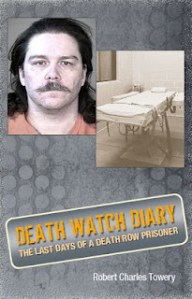
The last 35 days of his life, Robert was placed on “Death Watch” where his every move was recorded and chronicled by prison officials. Robert kept a diary and he sent his writings to his attorneys. Robert authorized his lawyers to release his diary after his execution.
In his narrative, Robert picks at the ironies and absurdities of life in prison. He revels in simple pleasures, such as a good meal or a sports event on television. He yearns for the human contact from his last visitors, and he touchingly tries to comfort his pod-mate, who doesn’t really understand that he is going to his death.
As often happens, the man who was executed was not the same man who had committed the crime. Robert had 20 years to think about his crime and once he was free of the drugs and the torment, he became a thoughtful man. Robert apologized to the family of his victim and to his own family both in his clemency hearing and in his last words before his execution.
Features correspondence between Agnes Vadas and Richard Nields, who is on death row in Ohio. The book contains letters exchanged between the two over six years. They discuss a wide range of topics, including life on death row, how they have coped with challenges in life, and the lessons they have learned from hardship. Agnes Vadas is a musician and human rights activist from Washington. (AuthorHouse, 2005).
Waiting to Die: Life on Death Row by Richard M. Rossi
Provides a first-hand account of his daily life on Arizona’s death row. Rossi was sentenced to death in 1983 and has taken responsibility for the murder he committed. He was originally offered a plea bargain with a life sentence, but he decided to go to trial. He has been on death row for 20 years. In his book, Rossi details how prisoners survive on death row, the conditions under which they live, and the psychological toll that living under a sentence of death takes on prisoners. He also provides a straightforward account of prison policies regulating all aspects of daily life. (Vision Paperbacks, 2004)
Bloodsworth: The True Story of the First Death Row Inmate Exonerated by DNA by Tim Junkin
Junkin recounts the events that led first to the conviction and death sentence, and then to the freeing of Kirk Bloodsworth for the murder of a nine-year-old girl in Maryland. Sister Helen Prejean, author of Dead Man Walking describes the book as “Chilling, heartbreaking, and ultimately inspiring.” Scott Turow says: “Bloodsworth is a tale of courage and determination in the face of the law’s worst nightmare–the execution of an innocent man.” Senator Patrick Leahy calls Bloodsworth “a powerful indictment of the a death penalty system that is fundamentally broken.” (Algonquin Books, 2004).
Still Surviving by Nanon Williams
In his book Still Surviving, Nanon Williams , who was 17 at the time of the crime that placed him on death row, provides a first hand account of living under a sentence of death in Texas. The book details Williams’s journey from teenage boy to adulthood while living in the shadow of the nation’s busiest execution chamber. His text introduces readers to the experiences of solitary confinement and having friends executed, as well as to maintaining relationships with those on the other side of the prison gate. (Breakout Publishing Co., 2003)- Case Profile
Killing Time: An Investigation into the Death Row Case of Mumia Abu-Jamal by Dave Lindorff
Killing Time: An Investigation into the Death Row Case of Mumia Abu-Jamal, authored by Dave Lindorff, examines Abu-Jamal’s capital conviction. It also includes an opening insert about his Batson claim that black jurors were purposefully excluded from the jury that sent him to death row. (Common Courage Press, 2003)
Life on Death Row by Robert W. Murray
A first-person account of living under a death sentence in Arizona, the book explores how inmates cope with execution warrants, lethal injection, prison politics, and day-to-day life in a supermax prison facility
.
Poetic Justice: Reflections on the Big House, the Death House and the American Way of Justice by Professor Robert Johnson
Johnson’s first collection of poems about prison and capital punishment, exploring the day-to-day life of prisoners and examines the emotional impact of serving time on death row. Johnson, a professor of justice, law and society at American University, is an award-winning author of several social science books on crime and punishment and has won the Outstanding Book Award from the Academy of Criminal Justice Sciences. (Northwoods Press, 2003)
Kiss of Death: America’s Love Affair with the Death Penalty by John Bessler
Attorney John Bessler presents arguments against capital punishment based on his work as a pro bono attorney for death row inmates in Texas. Woven into Bessler’s personal account is an examination of U.S. capital punishment practices in contrast to the absence of the death penalty in other nations. The book also addresses the toll executions take on those who participate in the process. (Northeastern University Press, 2003)
The Execution of a Serial Killer: One Man’s Experience Witnessing the Death Penalty by Dr. Joseph Diaz, Ph.D.
The Execution of a Serial Killer: One Man’s Experience Witnessing the Death Penalty details the experiences of author Dr. Joseph Diaz, Ph.D., a criminologist who witnessed the execution of Florida death row inmate Edward Castro in December, 2000. In the book, Diaz explores not only Castro’s criminality, but also Diaz’s own reservations about executions. The book challenges readers to ask themselves if they, too, could witness an execution. (Poncha Press, 2002)
Within These Walls: Memoirs of a Death House Chaplain by Rev. Carroll Pickett
Pickett recalls his 15 years as chaplain to death row inmates in Huntsville, Texas, and provides an account of ministering to 95 men in their final hours before execution. Rev. Pickett examines the death penalty based on his professional and personal experiences in Texas. “Like so many Texans, I was raised in an atmosphere that insisted the only real justice was that which claimed an eye for an eye. I was wrong,” he said. “As I participated in the endless process that would earn my state infamous recognition for its death penalty stance, I found myself wondering just what we were accomplishing.” (St. Martin’s Press, 2002)
A Life in the Balance: The Billy Wayne Sinclair Story by Jodie and Billy Wayne Sinclair
A powerful, graphic and disturbing prison memoir from a former death row inmate who has spent 35 years in Louisiana’s prison system. This book exposes the arbitrariness and violence of extreme punishment, and yet also tells the story of a person’s ability to change. (Arcade Publishing 2001)
A Dream of the Tattered Man: Stories From Georgia’s Death Row by Randolph Loney
In this book, Loney writes about the impact that his 15 years as pastor, family liaison and witness to the executions of the condemned men on Georgia’s death row has had on him. In each of the chapters, Loney reveals the lessons he has learned from these men and expresses his refusal to dismiss them as people beyond redemption. (William B. Eerdmans Publishing, 2001)
Condemned: Inside the Sing Sing Death House by Scott Christianson
Based on archival materials from New York’s legendary prison, includes photos of inmates and documents of their last months at Sing Sing’s death house. Anthony Amsterdam, Professor of Law at New York University School of Law, calls the book “A haunting experience. Combining the clinical virtuosity of an exhumation with the fascination of an archeological dig, it delivers a powerful intellectual message about the death penalty.” (News Release, 12/20/99) (New York University Press, 2000)
Finding Life on Death Row: Profiles of Six Inmates by Katya Lezin
A new book offers profiles of six convicted murders, two of whom have been executed. The profiles provide insight into the lives, crimes, and families of six men and women on death row. Lezin shows how an array of factors can lead people to commit capital crimes and how their poor treatment within our justice system leads them to death row. The cases profiled reveal how the inherently flawed death penalty is most often imposed not on the worst criminals, but on those who are most vulnerable and least able to defend themselves in our criminal justice system. (Northeastern University Press, 1999)
Death Work: A Study of the Modern Execution Process by Prof. Robert Johnson
This superb book takes the reader inside the execution process and accurately conveys the significance of state killing. The chapters on the history of the death penalty are among the most-detailed sources available and help crystallize the motivations behind the use of the death penalty. American University, (2d edition)
Author Thomas Cahill has written a new book, “A Saint on Death Row: The Story of Dominique Green,” about his encounter and gradual understanding of the life of a Texas death row inmate named Dominique Green. Green, who was only 18 at the time of his arrest, was executed in 2004. Cahill’s story of Green’s life highlights issues of race, poverty, and abuse, tracing details of his childhood through his years on death row. Thomas Cahill is probably best known for his New York Times bestseller “How the Irish Saved Civilization.” This newest book will be published by Doubleday and will be released in March 2009.
“A Saint on Death Row: The Story of Dominique Green,” Doubleday Publishing, 2009)
Lethal Rejection: Stories on Crime and Punishment, edited and written in part by American University criminologist Robert Johnson and student Sonia Tabriz, features an array of fiction and poetry on crime and punishment written by prisoners, academics, and students of criminology. The book includes a number of stories about capital punishment. Jocelyn Pollock, Professor of Criminal Justice at Texas State University, writes in the preface, “[H]umans have always used fiction to instruct, enlighten and communicate. Stories take us to places we haven’t been; they help us to understand people who are not like us. In this book, the authors use fiction to convey the reality of prison.” She describes the book’s poetry, prose and plays as methods to “take the reader into the ‘reality’ of prison and the justice system–not through facts and figures, but through the tears and screams, blood and pain of the people chewed up by it.” Todd Clear, a Professor of Criminal Justice at the John Jay College of Criminal Justice, writes, “The book makes us encounter the lives of the confined in a way I have not experienced in any other book about prison life.”
“That Bird Has My Wings” is a new book by Jarvis Jay Masters, an inmate on San Quentin’s death row in California. In this memoir, Masters tells his story from an early life with his heron-addicted mother to an abusive foster home. He describes his escape to the illusory freedom of the streets and through lonely nights spent in bus stations and juvenile homes, and finally to life inside the walls of San Quentin Prison. Using the nub and filler from a ballpoint pen (the only writing instrument allowed him in solitary confinement), Masters chronicles the story of a bright boy who turned to a life of crime, and of a penitent man who embraces Buddhism to find hope. Masters has written this story as a cautionary tale for anyone who might be tempted to follow in his footsteps, and as a plea for understanding about the forgotten members of society. (From publisher’s description).
Renowned death penalty defense attorney Andrea Lyon‘s forthcoming book, Angel of Death Row: My Life as a Death Penalty Defense Lawyer, chronicles her 30 years of experience representing clients in capital murder cases. In all of the 19 cases where she represented defendants who were found guilty of capital murder, jurors spared her clients’ lives. Lyon, who was featured in the PBS documentary Race to Execution and was called the “angel of death row” by the Chicago Tribune, gives readers an inside look at what motivates her during these difficult cases and offers behind-the-scene glimpses into many dramatic courtroom battles. Lyon is the founder of the Center for Justice in Capital Cases based in Illinois and a professor of law at DePaul University College of Law. The book includes a foreword by Alan Dershowitz, who calls Lyon “a storyteller par excellence.”
I Shall Not Die by Billy Neal Moore
In his memoir, former death row inmate Billy Neal Moore describes his time on death row, leading up to the 7 hours before his scheduled execution. Admittedly guilty of murder, Moore spent over 16 years on death row before his death sentence was overturned. He was subsequently freed because of his exemplary behavior. Moore’s account details how he asked for and received forgiveness from the victim’s family. His story is also described in the film “Execution.
Last Words from Death Row: The Wall Unit by Norma Herrera
In Last Words From Death Row: The Walls Unit, Norma Herrera recounts the tribulations she and her family suffered as they worked to free her brother, Leonel, from death row in Texas. The book documents court events and press coverage of the case and captures the family’s efforts to assist Leonel prior to his execution in 1993, four months after the U.S. Supreme Court held in Herrera v. Collins that, in the absence of other constitutional violations, new evidence of innocence is no reason for federal courts to order a new trial. Last Words from Death Row reveals that Leonel was a decorated war veteran with post-traumatic stress disorder when he was sentenced to death for the murder of two police officers. He was nearly beaten to death after his arrest for the crime. He was quickly sentenced to death by a jury that largely consisted of local police department employees or those closely associated with them. As they fought to prove their client’s innocence, Leonel’s appellate attorneys introduced eyewitness evidence that Leonel’s brother had actually committed the crime and that local police officials were part of an effort to hide the truth. One of Leonel’s attorneys, Robert McGlasson, noted, “Indeed, never in my almost ten years of death penalty practice had I seen such extraordinary evidence demonstrating not just my client’s innocence, but the extreme degree of government involvement in deceit and criminal involvement.” In her book, Norma Herrera fulfills her brother’s final wish before his execution. He asked her to tell his story. He later proclaimed to the witnesses at his execution: “I am innocent, innocent, innocent. I am an innocent man, and something very wrong is taking place tonight.” (Nightengale Press, 2007).
Charles D. Flores details his personal experience as an inmate on Texas’ death row. The book, Warrior Within: Inside Report on Texas Death Row, provides a first-hand account of Flores’ death penalty trial and his experiences awaiting execution. It explores his quest to learn more about the law as he fights to prove his innocence and win his freedom. In the book, Flores writes, “I started to comprehend what it meant to be on death row. I was beginning to understand it was a race against the clock, the most important race, I’d ever run. That understanding came at a terrible price, a price I pay daily. It’s paid in the form of the anxiety attacks that come from nowhere that I have today. It’s paid in nightmares that wake me up in a cold sweat, shaking my head trying to knock the haunting images out of it, nightmares of living my last day on death row, being taken to Huntsville and being put in the holding cell next to the death chamber, drowning on fear, choking on terror, as I wait for them to execute me.”
Blue Rage, Black Redemption: A Memoir by Stanley Tookie Williams
A first-hand account of Williams’ personal journey from co-founding the notorious Crips gang to becoming a reformed prisoner and activist for youth from behind bars on California’s death row. The book, which has an epilogue by Barbara Becnel and a foreward by Tavis Smiley, details how Williams became a powerful anti-gang activist during the two decades he spent on death row prior to his December 2005 execution. Williams’ book openly discusses the life of drugs and violence that led to the formation of the Crips, and then offers an inside look into his personal transformation: “Black Redemption depicts the stages of my redemptive awakening during my more than twenty-three years of imprisonment. . . . I hope it will connect the reader to a deeper awareness of a social epidemic,” Williams wrote after finishing the book. (Touchstone Books, 2007).
by American University Criminology Professor Robert Johnson, including one book of satire and a second book of short stories co-authored with prisoner Victor Hassine and criminologist Ania Dobrzanska, address life in prison and on death row in the United States. Johnson’s first book of satire,Justice Follies, offers a collection of parodies that seek to highlight a host of problems within the American prison system. “This book made me laugh out loud. It is outrageous… and the most outrageous thing about it is its ring of truth,” notes Todd Clear, a Professor at John Jay College of Criminal Justice at the City University in New York. (Willo Trees Press, 2005). The Crying Wall, a work by Johnson, Hassine and Dobrzanska, is a collection of short stories that offer readers a look inside the workings of correctional facilities and the realities of day-to-day living in prison. The book’s fifteen fictional pieces capture the emotions of those who are incarcerated.
On October 26, 2004, Dominique Green, thirty, was executed by lethal injection in Huntsville, Texas. Arrested at the age of eighteen in the fatal shooting of a man during a robbery outside a Houston convenience store, Green may have taken part in the robbery but always insisted that he did not pull the trigger. The jury, which had no African Americans on it, sentenced him to death. Despite obvious errors in the legal procedures and the protests of the victims family, he spent the last twelve years of his life on Death Row.




 Truth Be Told: Life Lessons From Death Row
 Waiting to Die: Life on Death Row by Richard M. Rossi
 Bloodsworth: The True Story of the First Death Row Inmate Exonerated by DNA by Tim Junkin
 Killing Time: An Investigation into the Death Row Case of Mumia Abu-Jamal by Dave Lindorff
 Life on Death Row by Robert W. Murray
 Poetic Justice: Reflections on the Big House, the Death House and the American Way of Justice by Professor Robert Johnson
 Kiss of Death: America’s Love Affair with the Death Penalty by John Bessler
 Within These Walls: Memoirs of a Death House Chaplain by Rev. Carroll Pickett
 A Life in the Balance: The Billy Wayne Sinclair Story by Jodie and Billy Wayne Sinclair
 Condemned: Inside the Sing Sing Death House by Scott Christianson
 Finding Life on Death Row: Profiles of Six Inmates by Katya Lezin
 Death Work: A Study of the Modern Execution Process by Prof. Robert Johnson
 Live From Death Row by Mumia Abu Jamal
 Author Thomas Cahill has written a new book, “A Saint on Death Row: The Story of Dominique Green,” about his encounter and gradual understanding of the life of a Texas death row inmate named Dominique Green. Green, who was only 18 at the time of his arrest, was executed in 2004. Cahill’s story of Green’s life highlights issues of race, poverty, and abuse, tracing details of his childhood through his years on death row. Thomas Cahill is probably best known for his New York Times bestseller “How the Irish Saved Civilization.” This newest book will be published by Doubleday and will be released in March 2009.


 Claim your Innocence