Month: August 2015

Arkansas Buys Lethal Injection Drugs, Aims To End Execution Hiatus


LITTLE ROCK, Ark. (Reuters) – Arkansas has bought drugs it plans to use for lethal injections, officials said on Wednesday, as it looks to end a decade-long hiatus on executions that is the longest of any Southern U.S. state.
Arkansas law allows information on the drugs used in executions and the vendors supplying them to remain secret.
Local reports said the drugs included midazolam, a sedative death penalty opponents had challenged as inappropriate for executions, arguing it cannot even achieve the level of unconsciousness required for surgery.
On June 29, the Supreme Court found the drug did not violate the U.S. Constitution’s ban on cruel and unusual punishment, a ruling that provoked a caustic debate among the justices about the death penalty.
The Arkansas attorney general, Leslie Rutledge, acknowledged through a spokesman that the chemicals planned for use in Arkansas were on hand but declined further comment. The Arkansas Department of Correction did not return a call seeking comment.
Eight of the 35 men on Arkansas’s death row, 20 of whom are black, have exhausted all their appeals, according to Rutledge.
It is the attorney general’s responsibility to ask the governor to set execution dates, but Judd Deere, Rutledge’s press secretary, said she had “no timetable to offer on that at this time.”
Arkansas has not put to death a condemned inmate in 10 years. Appeals by death row prisoners and legal disputes over the constitutionality of drugs and procedures in capital cases have idled the Arkansas death chamber since 2005, when Eric Nance, 45, was put to death by lethal injection.
Earlier this year, Republican Governor Asa Hutchinson signed into law a measure giving prison officials the option of using a single large dose of barbiturate or a combination of three drugs to cause death.
Source: Reuters, August 13, 2015


Connecticut’s Top Court Overturns Death Penalty in State


Three years after Connecticut abolished the death penalty for any future crimes, the state’s highest court on Thursday spared the lives of all 11 men who were already on death row when the law took effect, saying it would be unconstitutional to execute them.
The ruling comes in an appeal from Eduardo Santiago, whose attorneys had argued that any execution carried out after repeal would constitute cruel and unusual punishment. Santiago faced the possibility of lethal injection for a 2000 murder-for-hire killing in West Hartford.
The Connecticut Supreme Court, in a 4-3 ruling, agreed with his position.
“Upon careful consideration of the defendant’s claims in light of the governing constitutional principles and Connecticut’s unique historical and legal landscape, we are persuaded that, following its prospective abolition, this state’s death penalty no longer comports with contemporary standards of decency and no longer serves any legitimate penological purpose,” Justice Richard Palmer wrote for the majority.
“For these reasons, execution of those offenders who committed capital felonies prior to April 25, 2012, would violate the state constitutional prohibition against cruel and unusual punishment.”
The ruling means the 11 men on the state’s death row will no longer be subject to execution orders. Those inmates include Joshua Komisarjevsky and Steven Hayes, who were sentenced to die for killing a mother and her two daughters in a 2007 home invasion in Cheshire.
The repeal had eliminated the death penalty while setting life in prison without the possibility of release as the punishment for crimes formerly considered capital offenses.
Santiago was sentenced to lethal injection in 2005 for the murder-for-hire killing of 45-year-old Joseph Niwinski. But the state Supreme Court overturned the death sentence and ordered a new penalty phase in 2012, saying the trial judge wrongly withheld key evidence from the jury regarding the severe abuse Santiago suffered while growing up.
The ruling came just weeks after lawmakers passed the death penalty repeal.
Assistant Public Defender Mark Rademacher argued any new death sentence would violate Santiago’s constitutional rights to equal protection and due process. He said it would be wrong for some people to face the death penalty while others face life in prison for similar murders.
He told the court that Connecticut had declared its opposition to the death penalty and it wouldn’t make sense to execute anybody now.
Senior Assistant State’s Attorney Harry Weller had argued there were no constitutional problems with the new law, and death-row inmates simply face a penalty under the statute that was in effect when they were convicted. He also argued that the court could not repeal just part of the new law.
Connecticut has had just one execution since 1960. Serial killer Michael Ross was put to death 2005 after winning a legal fight to end his appeals.
Source: Associated Press, August 13, 2015

BREAKING NEWS


BREAKING: The Connecticut Supreme Court has ruled that the death penalty violates the state constitution, overturning the death sentences of the 11 men remaining on death row after the state’s 2012 prospective repeal.

Judge Dismisses Lawsuit By Georgia’s Only Woman on Death Row


Kelly Gissendaner, convicted in the murder of her husband in Gwinnett, was to die March 2, but ‘cloudy’ lethal drug forced postponement.

Judge Dismisses Lawsuit By Georgia's Only Woman on Death Row

A U.S. District Court judge has dismissed a lawsuit filed by Georgia death row inmate Kelly Gissendaner, who claimed she was subjected to cruel and unusual punishment on the day of her postponed execution.

The March 2 execution was postponed indefinitely when authorities found a cloudy appearance in the drug to be used for the lethal injection.

According to media reports, the lawsuit was dismissed Monday by U.S. District Judge Thomas Thrash, who said Gissendaner failed to show her Eighth Amendment rights had been violated.

Gissendaner, Georgia’s only woman on death row, was sentenced to die for masterminding the 1997 murder of her husband in Gwinnett County.

The Atlanta Journal-Constitution reported the suit dismissal clears the way for the state to re-schedule Gissendaner’s execution. There was no word on when that might be.

RELATED

Gissendaner was scheduled to die by lethal injection on March 2, but was postponed at the last minute when authorities decided not to use the drug. The execution was scheduled for 7 p.m.; the postponement wasn’t announced until around 11 p.m.

Gissendaner’s suit claimed she was put through undue “mortal fear” as she waited for officials to make a decision on whether or not to use the drug, and charged the state”botched” the execution by failing to have the proper drugs in place for a humane death. The suit also claimed that secrecy surrounding the drugs used for executions in Georgia prevented Gissendaner from proving the execution method could be unconstitutional.

Thrash wrote in his decision, “If anything, the March 2 incident shows that the State is unlikely to use defective drugs,” according to the Associated Press.

Gissendaner, of Auburn, Ga., was convicted of plotting the murder of her husband, Douglas, near Dacula in 1997. If executed, she would be the first woman put to death in Georgia in 70 years.

She was found guilty of convincing her boyfriend Gregory Owen to murder Douglas Gissendaner on Feb. 7, 1997, then went to lengths to deny her involvement, prosecutors said. Owen, who was sentenced to life in prison, avoided the death penaltyby helping prosecutors in the case against Gissendaner.

Authorities said Douglas Gissendaner, a Desert Storm veteran, was beaten and stabbed to death by Owen in a secluded wooded area off Luke Edwards Road near Dacula. The body was found two weeks later.

The attorney general’s office said Owen was waiting for Douglas Gissendaner to return home from a night with church friends, and then took him by knifepoint to the Luke Edwards location. Owen forced the man to his knees, then beat him with a night stick and stabbed him multiple times in the head and neck. Owen took the man’s ring and watch to make it appear it was a robbery.

The attorney general’s office also said Kelly Gissendaner arrived at the scene as the stabbing occurred, and the two took her husband’s vehicle and set it on fire within a mile of the murder scene.

Gissendaner appeared on local television asking for information on her husband’s whereabouts, but authorities said she “basically continued business as usual, even going back to work” in the days after the murder. She gave conflicting stories during interviews with investigators, saying at first there were no marital problems and later admitting to an extra-marital affair with Owen.

Owen confessed to the crime on Feb. 24 and implicated Gissendaner, who was arrested the next day.

Gissendaner was convicted by jury trial on Nov. 18, 1998.

—–

Photo: Kelly Gissendaner; Georgia Dept. of Corrections


Texas: Tracy Beatty wins stay of execution


(TYLER MORNING TELEGRAPH) – A Smith County man who killed his 62-year-old mother, buried her in the backyard and used her credit cards and drained her bank accounts was set to be executed Thursday, but received a stay of execution Tuesday afternoon.
Tracy Beatty, 54, was convicted of kiling his mother Carolyn Ruth Clark in December 2003.
Evidence showed Beatty drained his mother’s bank accounts, stole her car and used the money to buy drugs after he buried her body in the back yard.
“He had been to the penitentiary and was out at one point in time, then he brutally assaulted her, his parole was revoked, and he was sent back to the penitentiary,” Smith County Sheriff’s Major Mike Lusk said at the time. “We have some indication that was part of his motive.”
On Tuesday the Texas Court of Criminal Appeals granted the stay.
There was no indication as to why the court granted the stay.
Source: CBS19TV, August 11, 2015


TEXAS EXECUTION TODAY – Daniel Lee Lopez at 6 p.m EXECUTED 6:31 PM


HUNTSVILLE, Texas (AP) — Texas inmate Daniel Lee Lopez got his wish Wednesday when he was executed for striking and killing a police lieutenant with an SUV during a chase more than six years ago.

The lethal injection was carried out after the U.S. Supreme Court rejected appeals from his attorneys who disregarded both his desire to die and lower court rulings that Lopez was competent to make that decision.

“I hope this execution helps my family and also the victim’s family,” said Lopez, who spoke quietly and quickly. “This was never meant to be, sure beyond my power. I can only walk the path before me and make the best of it. I’m sorry for putting you all through this. I am sorry. I love you. I am ready. May we all go to heaven.”

As the drugs took effect, he took two deep breaths, then two shallower breaths. Then all movement stopped.

He was pronounced dead at 6:31 p.m. CDT — 15 minutes after the lethal dose began.

Lopez, 27, became the 10th inmate put to death this year in Texas, which carries out capital punishment more than any other state. Nationally, he was the 19th prisoner to be executed.

Lopez’s “obvious and severe mental illness” was responsible for him wanting to use the legal system for suicide, illustrating his “well-documented history of irrational behavior and suicidal tendencies,” attorney David Dow, who represented Lopez, had told the high court. Dow also argued the March 2009 crime was not a capital murder because Lopez didn’t intend to kill Corpus Christi Lt. Stuart Alexander.

The officer’s widow, Vicky Alexander, and three friends who were witnesses with her prayed in the chamber before Lopez was pronounced dead by a doctor. Some people selected by Lopez as witnesses sang “Amazing Grace” from an adjacent witness area.

Alexander, 47, was standing in a grassy area on the side of a highway where he had put spike strips when he was struck by the sport utility vehicle Lopez was fleeing in.

Lopez, who also wrote letters to a federal judge and pleaded for his execution to move forward, said last week from death row that a Supreme Court reprieve would be “disappointing.”

“I’ve accepted my fate,” he said. “I’m just ready to move on.”

Nueces County District Attorney Mark Skurka said Lopez showed “no regard for human life” when he fought with an officer during a traffic stop, then sped away, evading pursuing officers and striking Alexander, who had been on the police force for 20 years. Even when he finally was cornered by police cars, Lopez tried ramming his SUV to escape and didn’t stop until he was shot.

“He had no moral scruples, no nothing. It was always about Daniel Lopez, and it’s still about Daniel Lopez,” Skurka said Tuesday. “He’s a bad, bad guy.”

Lopez was properly examined by a psychologist, testified at a federal court hearing about his desire to drop appeals and was found to have no mental defects, state attorneys said in opposing delays to the punishment.

Deputies found a dozen packets of cocaine and a small scale in a false compartment in the console of the SUV.

Records showed Lopez was on probation at the time after pleading guilty to indecency with a child in Galveston County and was a registered sex offender. He had other arrests for assault.

Testimony at his trial showed he had at least five children by three women, and a sixth was born while he was jailed for Alexander’s death. Court records show Lopez had sex with girls as young as 14 and had a history of assaults and other trouble while in school, where he was a 10th-grade dropout.

Copyright 2015 The Associated Press.


HUNTSVILLE, Texas (AP) — Texas inmate Daniel Lee Lopez has been trying to speed up his execution since being sent to death row five years ago for striking and killing a police lieutenant with an SUV during a chase.

On Wednesday, he’s hoping to get his wish.

The 27-year-old prisoner is set to die in Huntsville after getting court approval to drop his appeals. A second inmate scheduled to be executed this week in Texas, the nation’s most active death penalty state, won a court reprieve Tuesday.

Lopez is facing lethal injection for the 2009 death of Corpus Christi Lt. Stuart Alexander. The 47-year-old officer was standing in a grassy area on the side of a highway where he had put spike strips when he was struck by the sport utility vehicle Lopez was fleeing in.

Last week from death row Lopez said: “It’s a waste of time just sitting here. I just feel I need to get over with it.”

Attorneys representing Lopez refused to accept his intentions, questioning federal court findings that Lopez was mentally competent to volunteer for execution. They appealed to the U.S. Supreme Court to halt the punishment, arguing his crime was not a capital murder because he didn’t intend to kill the officer, and that Lopez had mental disabilities and was using the state to carry out long-standing desires to commit suicide.

“It is clear Lopez has been allowed to use the legal system in another attempt to take his own life,” attorney David Dow told the high court.

Lopez, who also wrote letters to a federal judge and pleaded for his execution to move forward, said a Supreme Court reprieve would be “disappointing.”

“It’s crazy they keep appealing, appealing,” he said last week of his lawyers’ efforts. “I’ve explained it to them many times. I guess they want to get paid for appealing.”

Lopez was properly examined by a psychologist, testified at a federal court hearing about his desire to drop appeals and was found to have no mental defects, state attorneys said in opposing delays in the punishment.

Alexander had been a police officer for 20 years. His death came during a chase that began just past midnight on March 11, 2009, after Lopez was pulled over by another officer for running a stop sign in a Corpus Christi neighborhood. Authorities say Lopez was driving around 60 mph.

Lopez struggled with the officer who made the stop and then fled. He rammed several patrol cars, drove at a high speed with his lights off and hit Alexander like “a bullet and a target,” said an officer who testified at Lopez’s 2010 trial.

When finally cornered by patrol cars, Lopez used his SUV as a battering ram trying to escape and wasn’t brought under control until he was shot, officers testified.

“It’s a horrible dream,” Lopez said from death row. “I’ve replayed it in my mind many times.”

Deputies found a dozen packets of cocaine and a small scale in a false compartment in the console of the SUV.

Records show Lopez was on probation at the time after pleading guilty to indecency with a child in Galveston County and was a registered sex offender. He had other arrests for assault.

Lopez would be the 10th inmate executed this year in Texas. Nationally, 18 prisoners have been put to death this year, with Texas accounting for 50 percent of them.

On Tuesday, another death row prisoner, Tracy Beatty, 54, received a reprieve from the Texas Court of Criminal Appeals. He had been scheduled for lethal injection Thursday. He’s on death row for the 2003 slaying of his 62-year-old mother, Carolyn Click, near Tyler in East Texas.

At least seven other Texas inmates have execution dates in the coming months.

The death penalty is about to go on trial in California. Here’s why it might lose


On Aug. 31, the death penalty will go on trial at the Ninth Circuit Court of Appeals. The oral argument stems from a judgment in 2014, in which Federal District Judge Cormac Carney ruled that California’s death penalty system was unconstitutional.
Carney argued that because of the extremely low likelihood of execution and long delays on death row, the system was actually a penalty of life without parole with the remote possibility of death. His ruling declared that execution after such a long delay serves no retributive or deterrent purpose beyond the long prison term, and is therefore arbitrary and unconstitutional (see Jones v. Chappell, 2014). As Carney wrote in his California decision, no rational jury or legislature would design a system that functions as the system actually works. But, he argued, we must evaluate the system we do have, not the one we might prefer to have.
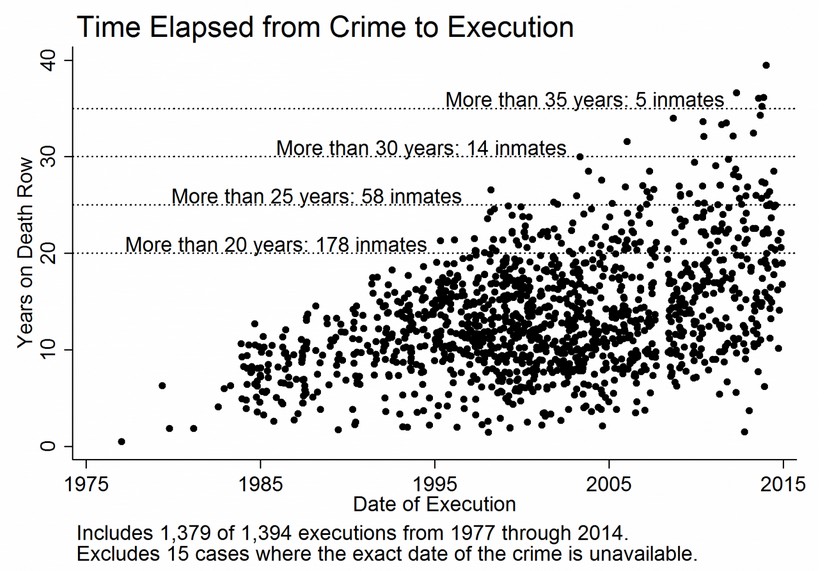
Nationwide, the “new” death penalty consists of 20 years or more on death row, followed by some probability of execution. The average delay from crime to execution for those executed since 2010 is 16 years across the United States, even longer in California, as the judge noted. 38 % of inmates executed nationally since 2010 served more than 20 years; 17 % served more than 25 years; 5 inmates were killed after more than 35 years of delay. The vast majority are never executed.
In a previous post Anna Dietrich and I documented that only about 16 % of condemned inmates across the nation have been executed. By far, the most likely outcome of a death sentence is that it will be overturned on appeal. Many death row inmates simply die of old age. For those few where the death sentence is actually carried out, increasing percentages languish on death row literally for decades before execution.
Supporters of the death penalty argue that Carney overstepped with his sweeping decision throwing out the entire California death penalty. Oral arguments in the Ninth Circuit Court of Appeals will begin at the end of this month. California certainly was at the low end of the distribution of “efficiency” in carrying out its death sentences in our previous analysis. Out of more than 900 death sentences, the state has carried out just 13 executions. It stands as one of the few states, along with Pennsylvania, that has large numbers of death sentences that result in very few executions.
What’s the lag time between sentence and execution outside California?
Except for Virginia, no state in the country carries out even 1/2 of all its death sentences. The most common outcome after a death penalty, by far, is reversal of the death sentence with a new sentence of life without parole. Inmates may sit on death row for years before this reversal.
This graph looks at 1,379 of the 1,394 executions that were carried out between 1977 and 2014 (I could not recover the date of the crime for 15 cases), showing the length of time from crime to execution. Of course, inmates do not move straight from the crime scene to death row. However, there has been no significant increase in the time between crime and death sentence, which averages 1.5 years.
Why is there so much time from sentence to execution?
Delays come for many reasons. Death penalties in California and elsewhere trigger a mandatory appeal to a state’s top court, and then, if not reversed, through the federal system. These are part of the safeguards mandated by the U.S. Supreme Court in the 1976 Gregg decision ushering in the “modern” death penalty. Carney noted that in California, appeals attorneys are not appointed for 3 to 5 years. They take 4 years to learn the case and file their appeal. Attorneys for habeas appeal (through the federal courts) are not appointed, on average, until 8 to 10 years after the death sentence.
Most of this delay results from a severe backlog of death penalty cases, a lack of qualified attorneys who are willing to accept capital assignments under the conditions that the state offers, and delays in appointing required qualified defense counsel.
How long does it take, exactly, to carry out the death penalty?
Each dot on the figure refers to a particular inmate executed. At the lower-left corner, the 1st case is the 1st “modern” execution: Gary Gilmore, executed by firing squad in Utah in 1977. Vertical placement of the dot indicates the number of years from the crime to the execution. Horizontal placement indicates the date of the execution.
As you can see, some executions occur relatively quickly, even today. Across the bottom of the graph are those inmates who “volunteer” for execution by instructing their attorneys to abandon all appeals. 20 of the 206 inmates executed since 2010 waited fewer than 5 years from crime to execution. However, you can see that average delays are increasing dramatically (about one additional year of delay every 3 years), and that increasing numbers of inmates are serving very long sentences before being executed. Many more remain on death row with no execution in sight.
For the 206 inmates executed since 2010, their average time from crime to execution was 16 years. 36 served more than 25 years before their execution. Overall, through 2014, 178 inmates have been executed after serving more than 20 years; 58 after more than 25 years; 14 after more than 30 years; and 5 after more than 35 years. Florida executed Thomas Knight in January 2014 for a crime committed in January 1974 – almost 40 years later. In contrast, Gilmore was killed by Utah’s firing squad in January 1977 for a crime that occurred in July 1976. Knight’s crime came 2 years before Gilmore’s, but he waited another 37 years after Gilmore’s execution on Florida’s death row before that state put him to death.
In the recent Glossip v. Gross decision affirming the use of lethal injection, the U.S. Supreme Court affirmed its support for the death penalty in the opening words of the majority decision: “Because capital punishment is constitutional, there must be a constitutional means for carrying it out.”
In his dissenting opinion, Justice Stephen Breyer noted a number of practical problems with the administration of the punishment. He noted 3 “fundamental constitutional defects”: 1) unreliability; 2) arbitrariness; and 3) unconscionably long delays. These have led, he wrote, to 4) abandonment of the penalty by most places within the United States. Since the Court’s 1976 reaffirmation of capital punishment, replete with new constitutional “safeguards sufficient to ensure that the penalty would be applied reliably and not arbitrarily,” numerous practical problems have emerged, Breyer wrote. “The circumstances and the evidence of the death penalty’s application have changed radically since then,” he wrote. “Given those changes, I believe it is now time to reopen the question.”
Source: The Washington Post, Frank Baumgartner, August 5, 2015. Mr. Baumgartner is the Richard J. Richardson distinguished professor of political science at the University of North Carolina-Chapel Hill.


UPCOMING EXECUTIONS Texas: Daniel Lee Lopez, Tracy Beatty set to die this week


Both death row inmates claim murder was not intentional.
Although Clifton Williams narrowly avoided execution July 16, 2 Texans are scheduled for the gurney next week. Both inmates maintain that they didn’t mean for the individuals they killed to die, though their opinions about their pending fates differ.
Daniel Lee Lopez
Daniel Lee Lopez
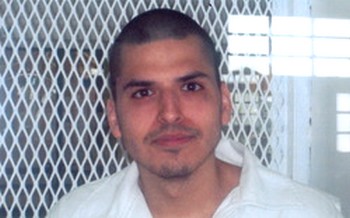
Corpus Christi native Daniel Lee Lopez is scheduled to die first; he’s currently slated to be strapped in at 6pm on Wednesday, Aug. 12. Lopez was driving 60 miles an hour through a neighborhood in March 2009 trying to evade cops and avoid arrest for outstanding warrants when he hit and killed 20-year veteran police officer Stuart Alexander as he was laying Stop Sticks near the highway. Lopez was eventually apprehended after being shot in the arm, neck, and chest. Then 21, he was indicted for 10 offenses, including the capital murder of Alexander. He initially pleaded not guilty, but later changed his stance. He was assigned to a psychologist, who reported that Lopez held an “increasingly firm” opinion that he’d rather a death sentence than live the rest of his life in prison. The state offered life in prison in exchange for a guilty plea, but Lopez pleaded not guilty and went to trial.
Central to the case was debate on whether or not Lopez intentionally ran over Lt. Alexander. At times, he told attorneys that he didn’t mean to do it, that his sight was affected by shots of pepper spray deployed by other officers. Yet, just prior to closing arguments, attorneys informed the judge that Lopez insisted on testifying that he did in fact mean to swerve and hit Alexander. The court rejected Lopez’s request, but the jury still found him guilty on all counts, including capital murder. Lopez waived his right to a state petition for habeas corpus in April 2012 and filed his federal papers that May. The brief, largely blank application asserted 1 solitary ground for relief: that the death penalty in Texas violates the Eighth Amendment prohibition of cruel and unusual punishment. He underwent a series of competency exams and hearings in 2013, and soon after received his right to waive appeal from the 5th Circuit Court of Appeals.
His attorneys – James Rytting, David Dow, and Jeffrey Newberry – maintain that he should never have been found guilty of capital murder, as his testimony concerning his actions continuously flipped from intentional to unintentional. They thus contest that the district court erred in accepting Lopez’s waiver, as Lopez does not understand that the conduct to which he admits – an unintentional murder – does not fall within the definition of capital murder. Lopez, however, remains convinced he’s made the right call. In April, he told the Corpus Christi Caller-Times that he accepts his punishment. “It wasn’t on purpose,” he said. “I killed a police officer because I tried escaping. And it was never intentional but I feel responsible.”
Tracy Beatty
Tracy Beatty
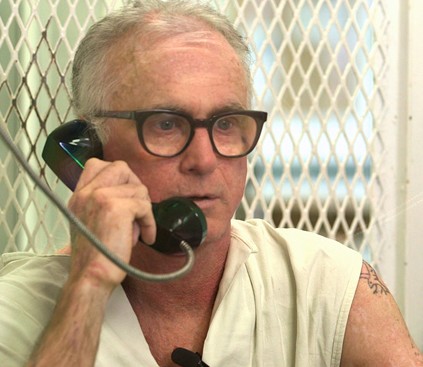
The 2nd individual, Tracy Beatty, goes to the gurney one day after Lopez. Beatty, 54, was arrested for the Nov. 25, 2003, murder of his mother, 62-year-old Carolyn Click. Beatty strangled, smothered, and/or suffocated Click during an argument at her home, and left her in the tub for 2 days before burying her in the ground beside her house and making off with her car and possessions. When questioned, he told authorities that a man named Junior Reynolds had actually killed his mother; that he then killed Reynolds and dumped him “in water” before returning to his mother’s house to ice her in the tub and eventually bury her by the house. But the investigation turned to Beatty. During his arrest, as he was being delivered from Henderson County to the Smith County Jail, he told authorities: “I really didn’t mean to kill her. I came in drunk. She started bitching at me, and I just started choking her. I didn’t even know she was dead until the next morning when I found her still laying on the living room floor.” He was indicted for capital murder the following May and found guilty on Aug. 9, 2004. Deemed a future threat because of 2 prior felony convictions – injury to a child in 1986 and a robbery in 1988 – he was sentenced to death on Aug. 10.
Attorney Jeff Haas argued in petitions for habeas corpus and appeals to the 5th Circuit that his client received ineffective assistance from counsel in two different forms: Trial counsel failed to discover and present mitigating evidence, and failed to properly present enough facts to prove Click’s “killing was a murder rather than capital murder.” Haas pointed to one instance in particular, unmentioned during trial, in which Click and an acquaintance had an argument that a witness indicated looked as though they would “rip each other’s heads off.” He attempted to use that testimony as evidence that Beatty had no intention to kill his mother when he showed up at her house; that a heated conversation escalated to that point. Efforts for relief, however, were denied, and in July 2014, the 5th Circuit denied his application for a certificate of appealability. The Supreme Court rejected his case in May.
Lopez is set to be the 10th Texan executed this year, with Beatty in line to be No. 11. Should both executions go through, the state will end the week having executed 529 people since reinstating the death penalty in 1976.
Source: Austin Chronicle, August 6, 2015


Facts about Colorado’s ‘Death Row’


KUSA – Currently in Colorado, there are three inmates awaiting execution in the Department of Corrections.
Colorado does not have a physical ‘death row.’ Instead, inmates sentenced to death are placed in maximum security ‘administrative segregation’ at Sterling Correctional Facility.
Executions are carried out at the Colorado State Penitentiary in Canon City, Colorado. The inmate is transported there from Sterling during the week of their execution date, set by a judge.
On ‘death row’ in Colorado are Sir Mario Owens, Robert Ray, and Nathan Dunlap.
Owens was sentenced to death in 2008 for the killings of two people in Aurora in 2005. One of the victims had been set to testify against a friend of Owens in a murder trial.
Robert Ray has been awaiting execution since 2009, when he was sentenced to death for plotting the murder of a witness who was set to testify against him in another murder trial. His accomplice was Sir Mario Owens.
Nathan Dunlap opened fire in a Chuck E Cheese in 1993, killing four people at his former workplace. He was sentenced to death in 1996.
In 2013, Governor Hickenlooper granted Dunlap a ‘temporary reprieve’ of his death sentence, meaning as long as Hickenlooper is in office, Dunlap will not be executed.
All three are held at Colorado’s Sterling Correctional Facility.
Colorado’s first execution at the state penitentiary was carried out in 1890. A convicted murdered named Noverto Griego was killed by hanging. That’s how all executions were carried out until 1933, when Colorado’s capital punishment was changed to a gas chamber execution until 1967.
In 1997, Colorado’s first execution in 30 years, and the first to be administered by lethal injection, was carried out on 53-year-old Gary Lee Davis.
In the state of Colorado, 78 men have been executed. The state has never put a woman to death.
45 of the executions were carried out by hanging, 32 by lethal gas, and one by lethal injection, the state’s current method.
Each day an inmate is held awaiting an execution the cost to the state is $102.28. Inmates wear standard issue clothing, which includes prison-made green shirts and green pants.
Death row inmates in Colorado spend 23 hours per day in their own cell. The one hour outside their cell each day is for exercise and showering.
Death row inmates are permitted a television, two books, newspapers, and magazines in their cell.
If the inmates comply with their educational and program requirements, they are permitted to view movies shown by the facility.
Death row inmates are permitted visitors a couple of hours per week. During the inmate’s last week, or “warrant week,” they may have increased visiting hours.
Each time the inmate is moved, it is done with full restraints and a minimum of two correctional officers.
Regular meals are served three times per day and brought to the inmate’s cell. The inmate’s requested ‘last meal’ must be selected from the correctional facility’s main menu.
Generally, a death row inmate will serve a minimum of ten years before the sentence of death is carried out.
Read full details on the inmate’s execution day here.
Source: 9news, Kelly Somaryva, KUSA, Augsut 7, 2015


Louisiana inmates ask for rehearing on death row heat case


State corrections officials complained last fall to a federal appellate court that a Baton Rouge federal judge was micromanaging the Louisiana State Penitentiary at Angola by ordering heat indexes on death row at the Angola prison not top 88 degrees (31° C) from April through October.
Now, the 3 death-row inmates whose 2013 lawsuit against the state prompted Chief U.S. District Judge Brian Jackson’s December order are claiming the 5th U.S. Circuit Court of Appeals also is trying to micromanage the prison.
A 3-judge 5th Circuit panel ruled last month that Jackson’s order effectively required the state to air-condition death row. The panel sent the case back to the judge to consider other remedies to correct the state’s violation of the 3 condemned prisoners’ constitutional protection against cruel and unusual punishment.
Those prisoners have medical conditions, and they claim the sweltering heat on death row exacerbate those ailments.
The appeals court panel said remedies that Jackson could consider include diverting cooler air from the guards’ pod on death row into the death-row tiers; air-conditioning one of the four death-row tiers for the benefit of prisoners susceptible to heat-related illness; giving inmates access to cool showers at least once daily; providing ample supplies of cold drinking water and ice at all times; supplying personal ice containers and individual fans; and installing additional ice machines.
In asking the 5th Circuit panel or the entire appeals court to rehear the case, attorneys for death-row inmates Elzie Ball, Nathaniel Code and James Magee argue Jackson’s order was less intrusive than the remedies suggested by the panel.
“The remedies that the Court suggests – in addition to being insufficient to remedy the constitutional violation – require more micromanaging of the prison’s operation of death row tiers than air conditioning,” the prisoners’ lawyers contend in petitions filed recently at the New Orleans-based 5th Circuit.
Attorneys for the state said 5th Circuit rules do not allow the state to file a response to the petitions unless the court orders a response. The state did not ask for a rehearing.
Jackson approved the state’s court-ordered remediation plan for death row last year, which included adding air conditioning, providing ice chests filled with ice and allowing death-row inmates cold showers once a day. The 5th Circuit halted the plan’s implementation last summer while the case was being appealed.
“The district court did not order air conditioning,” the inmates’ attorneys stress in asking the entire 5th Circuit to vacate the panel’s decision and rehear the case. “The district court made factual findings that a maximum heat index of 88 degrees was necessary to remove unreasonable risks, then gave the prison full latitude in the method of achieving this objective. Defendants chose air conditioning. This distinction is critical.”
The prisoners’ attorneys say the condemned men are confined to their cells for 23 hours a day; have “extremely limited access” to ice, and their drinking water is lukewarm; their lone daily shower is maintained between 100 and 120 degrees (37,7° – 48,8° C); the death-row tiers are equipped with 1 non-oscillating, 30-inch fan for every 2 inmates, and the fans do not provide equal air flow to each cell; and the windows on the tiers are louvers that do not open wide and do not provide the same air flow as traditional windows.
The inmates’ attorneys say Jackson’s establishment of a maximum heat index of 88 degrees must be upheld, and they claim that an increased risk of serious harm from heat-related illness is “widespread” among the 80-plus prisoners on death row.
The state Department of Corrections says it provides constitutionally appropriate accommodations to its inmates. The department also contends that constitutional mandates and established case law do not require air conditioning for death-row prisoners.
Source: The Advocate, August 10, 2015