Supreme Court of the United States

OKLAHOMA – Green Country Family Waits Decades For Justice


TULSA, Oklahoma  april 24 source http://www.newson6.com

For the next 20 years, Debbie and her mother drove to the prison twice a year to oppose parole for both men.

Watch the video news: click here 

Clayton’s daughter and her mother


A Green Country family has waited nearly four decades for justice. Michael Selsor was given a death sentence for murdering Clayton Chandler in 1975. Selsor’s execution is next week.

Chandler’s family has been fighting for 37 years for this execution, waiting while Selsor had years of appeals and a second trial. Now that clemency has been denied, they’re finally allowed to tell their story.

On September 15th, 1975, Clayton Chandler was getting ready to close the U-Tote-M convenience store, along with worker Ina Morris, when Michael Selsor and Richard Dodson came in to rob it.

They later told police they agreed ahead of time: leave no witnesses.

“He had a choice,” daughter Debbie Huggins said. “He did not have to kill Dad; he did not have to pull the trigger.”

After getting around $500 from the register, Selsor shot Clayton six times; he died on the floor. Dodson shot Morris in the head, neck and shoulder, but she survived. The two men were later arrested in California.

At the first trial, a jury found Selsor guilty and sentenced him to die. But the next year, the Supreme Court declared the death penalty unconstitutional and seven years after that, Selsor was up for parole.

“We thought our nightmare in hell was losing Dad, little did we know what was in store for us,” Debbie said.

For the next 20 years, Debbie and her mother drove to the prison twice a year to oppose parole for both men.

“Every year you went before the parole board,” Debbie said. “It took you back to the night he died, gut wrenching, the fear, the trauma, the feelings, they all come forward.”

Selsor’s many appeals paid off and he was granted a new trial 20 years after his first, but that jury also found him guilty and sentenced him to death.

More Than 36 years after Clayton Chandler was gunned down, Selsor is scheduled to die.

“No remorse, no I’m sorry, nothing but hate,” Debbie said.

Debbie says she and her mother were not driven to fight all these years out of a sense of revenge, only by the desire to get justice for the man they loved and lost.

“My dad did not have a choice,” Debbie said. “He’s gone. Michael Selsor should pay the same price.”

Both Selsor and Dodson had records when arrested for murdering Clayton. Plus, Selsor told police they’d committed four robberies before the one they weren’t arrested for. In previous robberies, they stabbed the clerk and shot another with a shotgun.

Selsor’s execution is next Tuesday.

FLORIDA – Death Row Inmate’s Best Lawyer Was Himself


april 16, 2012 

WASHINGTON — Albert Holland Jr., a death row inmate in Florida, has no legal training and seems to be suffering from a mental illness“perhaps a disorder involving paranoia or delusional thoughts,” a federal judge wrote recently.

Albert Holland Jr. won a new trial in a capital case.

Related

But he turns out to be a pretty good lawyer. Two years ago, in allowing Mr. Holland a fresh chance to make his case after his court-appointed lawyer blew a crucial deadline, the Supreme Court praised Mr. Holland’s legal acumen. Indeed, Justice Stephen G. Breyer wrote, Mr. Holland  had a better understanding of the complicated time limits for challenging death sentences in federal court than his lawyer had.

Mr. Holland made good use of the opportunity the Supreme Court gave him. A couple of weeks ago, he won a decision granting him a new trial. In the process, he opened a window on the astoundingly spotty quality of court-appointed counsel in capital cases.

The lawyer whose work the justices had considered was the least of it; he had merely been unresponsive and incompetent. Mr. Holland’s earlier lawyers had failed him in much more colorful ways.

Consider Kenneth Delegal, who was assigned to defend Mr. Holland at a 1996 retrial on charges that he killed a Pompano Beach police officer in 1990. Mr. Delegal was removed from the case after being sent to a mental health facility. Later, the two men would see each other at the Broward County jail, where Mr. Delegal was held on drug and domestic violence charges.

The next lawyer, James Lewis, was a friend of Mr. Delegal’s and had shared office space with him. When Mr. Delegal went to court after his removal from Mr. Holland’s case, seeking to be paid about $40,000 for his work on it, the new lawyer testified on behalf of the old one, saying the fees had been “reasonable and necessary.”

Mr. Delegal died of a drug overdose about a month after the fee hearing, and a local paper asked his former colleague Mr. Lewis about his troubles. “I heard some rumors,” Mr. Lewis said, “but I chose not to know.”

This series of lawyers, Judge Patricia A. Seitz of Federal District Court in Miami wrote this month, “does assist in understanding why someone, perhaps predisposed to paranoia due to a mental disturbance, may have wanted self-representation over court-appointed counsel.”

In granting Mr. Holland a new trial, Judge Seitz ruled that a state judge had violated Mr. Holland’s rights under the Sixth Amendment by refusing to let him represent himself.

At the 1996 retrial, which, like the first trial, ended in a murder conviction and a death sentence, Mr. Holland asked to represent himself at least 10 times, saying he did not trust Mr. Lewis and could in any event do a better job.

Judge Charles M. Greene of the state circuit court in Fort Lauderdale denied the requests, saying Mr. Holland did not have “any specific legal training.” That is not the constitutional standard; indeed, the Supreme Court has said that “technical legal knowledge” is not required.

The relevant questions, Judge Seitz wrote, were whether Mr. Holland understood that he had a right to a court-appointed lawyer and whether he was mentally competent to decide to waive that right.

When Mr. Holland was allowed to address the court, he seemed to make sense. He said, for instance, that Mr. Lewis “denied me effective assistance of counsel because his loyalty was impaired.”

Mr. Holland also told the court that his legal research indicated that his indictment on a charge of attempted felony murder was flawed because there was no such crime in Florida. (“It is noteworthy,” Judge Seitz wrote, that “this statement had a factual basis.” Indeed, the Florida Supreme Court had said as much in 1995 in an unrelated case.)

At other times, Mr. Holland exhibited a certain flair, though it was perhaps not to everyone’s taste.

“From what I have seen in the evidence,” he told Judge Greene, “Ray Charles could come in here and represent himself, and Stevie Wonder, so I don’t need much legal training to do all that.”

Judge Greene acknowledged that Mr. Holland had “voiced concerns and issues in a most eloquent manner” and had expressed himself in a “very coherent and organized manner.”

When it came time to sentence Mr. Holland to death, Judge Greene said he gave little weight to Mr. Holland’s history of mental illness, though he had twice been found not guilty by reason of insanity for robberies in Washington and had been involuntarily hospitalized in the 1980s for four years.

As proof that Mr. Holland was no longer mentally ill, Judge Greene praised him as an able advocate who had “correctly argued case law and factual issues to the court.” His legal skills, then, were proof that he was fit to be executed — but not good enough that he be allowed to defend himself.

These days, Mr. Holland is represented by Todd G. Scher, a Miami Beach lawyer who won in the Supreme Court and persuaded Judge Seitz to order a new trial. A spokesman for the Florida attorney general’s office said prosecutors would ask Judge Seitz to reconsider her ruling.

Mr. Scher said he did not know who would represent Mr. Holland at a retrial. For now, he said, what was clear was that a federal judge had found “a blatant Sixth Amendment violation.”

“It shows that he was right,” Mr. Scher said of his client. “He had concerns about his prior series of lawyer, and his concerns turned out to be valid.”

Death row inmate’s effort to spare live gains momentum – Rob Will


march 31 2012 source : http://www.chron.com

Robert Gene Will II says he couldn't have killed a Harris County officer because Will's hands were tied behind his back. Photo: Ben DeSoto / Houston Chronicle

Like so many before him, Texas death row inmateRobert Gene Will II says he’s not guilty. Given the state of Texas’ record in seeing its death sentences carried out, the odds on getting the right people to believe him are not great.

But there have been exceptions. Will insists that if he can get a fair hearing, he will be another one. He admits he was no saint in his younger days, that he ran with a bad crowd, and yes, that he and a buddy were breaking into a car on the morning of Dec. 4, 2000, when a spotlight suddenly caught them in its glare. Within moments his life changed forever, and Harris County Sheriff’s Deputy Barrett Hill lost his.

Will claims he did not shoot Hill. He has claimed as much since the day of his arrest. He could not have done it, he says, because his hands literally were tied behind his back.

“I am COMPLETELY INNOCENT,” Will wrote on a website dedicated to securing his freedom, “and I am sure anyone who takes the time to look into my case will come to that same conclusion.”

Perhaps not. Those convicting of killing law enforcement officers are even less likely than most of death row’s 288 residents to find sympathy. So it was bound to draw notice when U.S. District Judge Keith Ellison recently showed legal solidarity even as he denied Will’s latest appeal. Ellison said legal limitations – technicalities, if you will – precluded him from siding with Will.

“Questions as to Will’s possible innocence do remain,” Ellison wrote in a March 19 order granting Will the right to appeal to a higher court. “Unfortunately, the court is powerless to address the merits of additional claims raised post-judgment, unsettling though they are.”

Judge suggests review

In a separate opinion two months earlier, issued after a hearing at which Will was allowed to introduce evidence, Ellison reiterated his frustration at not being able to help, and he went further. Although he also denied Will’s motion, the judge made clear that Will’s case should get a broader review. He called one of the original trial judge’s rulings an “error of grave proportion” and said that the presence of rows of uniformed law enforcement officers in the courtroom “would have likely justified post-trial relief had the issue risen on direct appeal.”

“The questions raised during post-judgment factual development about Will’s actual innocence create disturbing uncertainties …,” Ellison wrote in a Jan. 17 memorandum. “On top of the considerable evidence supporting Will’s innocence and the important errors in the trial court, there must also be addressed the total absence of eyewitness testimony or strongly probative forensic evidence. With facts such as these, and only circumstantial evidence supporting Will’s conviction and death sentence, the court laments the strict limitations placed upon it.”

Questions abound

Will, 33, admits that he and Michael Rosario were burglarizing a car when Hill came across them. They ran, but Will was apprehended. He claimed that he was handcuffed when Rosario showed up and shot the deputy. Prosecutors contended that Will shot the deputy and admitted as much to a motorist he encountered during a later carjacking as he was trying to escape. Will’s lawyers argue that the motorist did not mention that in any of her early statements to police.

Will’s lawyers also have argued that Rosario, the son of a Houston police officer who was not charged in the murder, has admitted killing Hill to at least five individuals. They also point to an absence of any forensic evidence connecting Will to the shooting, and to a bullet graze on the back of a jacket Will wore that morning – consistent with a shot being fired by Rosario toward Hill when the latter was close by and in custody. Hill’s weapon was not fired.

Justices’ ruling a factor

Ellison’s sympathetic language after reviewing the case was the first good news Will’s legal team has had in a long time. But even better news arrived on March 20 when the U.S. Supreme Court ruled that simple fairness, if not the Constitution, requires that the lawyers who handle the early appeals of a capital murder conviction do so competently.

In a 7-2 decision in Martinez v. Ryan, the high court ruled those convicted of a crime can in some instances challenge the effectiveness of those hired for so-called habeas corpus appeals at the state level. It is unclear, experts said, whether such a challenge is limited to the very narrow circumstances raised by that Arizona case, or whether it can be applied to all manner of misconduct that results in a defendant being unable to raise an issue in future appeals, such as missing a deadline or failing to file certain claims.

“I think it is arguable that Martinez covers the latter scenario and will be argued by defense counsel that way, but the opinion as written is pretty restrictive,” said Brad Levenson, head of the State Office of Capital Writs, a public defender’s office for appeals in capital murder cases that was established in 2010 in part because of concern over the consistence of legal representation. “I think only time will tell how far Martinez can be interpreted.”

If the decision turns out the be less restrictive than the specifics of the Martinez case, the ruling could be significant. Critics of the decision, including dissenting Justice Antonin Scalia, raise fears that it will prolong death row appeals and be a burden to states. Defense lawyers who specialize in capital cases say it could be a great boon to those who have drawn the black bean of a lousy appeals lawyer.

Ex-lawyer defends work

Will’s former state habeas lawyer, Leslie Ribnik, filed a 28-page legal brief on Will’s behalf, the first 20 pages of which were the same — word for word, typo for typo — as the one he filed in the case of Angel Maturino Resendiz, the notorious “railroad killer” whose serial murders led to his conviction and ultimate execution in 2006.

Ribnik admitted making mistakes in Resendiz’s appeal and missed deadlines, which resulted in the default of some claims. Ribnik later removed himself from the appellate lawyer list and acknowledged he suffered from Parkinson’s disease and likely was feeling the effects even as he was preparing Will’s appeal.

Nevertheless, Ribnik has previously insisted he did an adequate job on Will’s appeal.

“I will own up to my screw-ups — I’ll take my lumps,” Ribnik told the Austin American-Statesman in 2006. “As for Will, I think I did a good job on that one.”

Will’s later appeals lawyers disagreed, pointing out that Ribnik did not investigate the statements from individuals about Rosario’s alleged statements about the shooting, or investigate anything.

“The damage was real,” Will’s lawyer, Samy Khalil, said of Ribnik.

Ellison seemed inclined to agree. If Will’s appeal is again placed before him, he may be able to do something.

“It seems that Judge Ellison could hear the claim now,” Levenson said. “And from what I know, it could be a substantial claim.”

TEXAS – Jesse Joe Hernandez execution – march 28, EXECUTED 6.18 p.m


Jesse Joe Hernandez received lethal injection for the slaying of Karlos Borja (10 months old) 11 years ago.

“Tell my son I love him very much,” the 47-year-old Hernandez said before being put to death. “God bless everybody. Continue to walk with God.”

“Dile a mi hijo que  le quiero mucho”, dijo  Hernández de 47 años de edad, antes de ser condenado a muerte. “Dios bendiga a todo el mundo. Continúe caminando con Dios.”

As the drugs took effect, he repeated his appreciation for those he knew who had gathered to witness the execution. “Love y’all, man,” he said. “… Thank you. I can feel it, taste it. It’s not bad.”

He took about 10 deep breaths, which grew progressively weaker until he was no longer moving. Ten minutes later, at 6:18 p.m. CDT, he was pronounced dead.

———————————————————————-

The U.S. Supreme Court this afternoon rejected Jesse Hernandez’s request for a stay of execution, a court spokesman said.

(Los EE.UU. Corte Suprema de Justicia rechazó esta tarde, Jesse Hernández solicitud de suspensión de la ejecución, comento un portavoz del tribunal.)
The high court ruling came about two hours before the 47-year-old Hernandez, who previously was convicted of a child sex offense, could be taken to the Texas death chamber for lethal injection. The justices’ order was brief and did not include an explanation for their decision.

The Texas attorney general’s office opposed any delay, questioning whether the high court even had jurisdiction in the case because constitutional claims weren’t raised earlier in state courts.

Thomas Jones, an assistant attorney general, said jurors who sent Hernandez to death row probably would not have approved of a trial strategy that attempted to shift blame for the child’s death to the doctors treating him.

“Such an argument smacks of chutzpah,” Jones told the Supreme Court.

The decision clears the way for Texas to put Hernandez to death by injecting him with a series of drugs, including one often used to euthanize family pets. It will be the fourth execution of the year in Texas, the 12th in the United States.

march, 28, 2012 sourcehttp://abclocal.go.com

HUNTSVILLE, TX — The U.S. Supreme Court is considering whether to block the scheduled execution of a convicted child sex offender condemned in the beating death of a 10-month-old boy he was babysitting at a home in Dallas.

Related Content

Forty-seven-year-old Jesse Joe Hernandez is set for lethal injection Wednesday evening in Huntsville for the slaying of Karlos Borjas 11 years ago.

The child was brought to a Dallas hospital in April 2001 with a skull fracture and bruises to his head, thigh and abdomen. A week later, he was taken off life support and died. Hernandez’s DNA was found in Karlos’ blood on a pillowcase and on the child’s clothing.

Hernandez denied beating the children but later acknowledged to a detective he may have hit the boy with a flashlight.

case and court old post  click here

traducion para los hispanicos

Huntsville, Texas (AP) – La Corte Suprema de EE.UU. está considerando la posibilidad de bloquear la ejecución programada de un delincuente sexual sobre menores  condenado a muerte , por golpear  un niño de 10 meses de edad, cuando estaba de  niñera en una casa en Dallas.

Cuarenta y siete años de edad, Jesse Joe Hernández está listo para la inyección letal la noche del miércoles en Huntsville por el asesinato de Karlos Borjas, hace 11 años.

El niño fue llevado a un hospital de Dallas en abril de 2001 con una fractura de cráneo y contusiones en la cabeza, el muslo y el abdomen. Una semana más tarde, se le retirara el respirador artificial y murió. El ADN de Hernández se encuentra en la sangre Karlos ‘en una funda de almohada y en la ropa del niño.

Hernández negó a golpear a los niños, pero más tarde reconoció a un detective que pudo haber golpeado al muchacho con una linterna.

No. 11-9486

Jesse Joe Hernandez v. Texas

from the Court of Criminal Appeals of Texas

Docket Entries

on March 27, 2012

Reply of petitioner Jesse Joe Hernandez filed.

on March 27, 2012

Brief of respondent Texas in opposition filed.

on March 26, 2012

Application (11A904) for a stay of execution of sentence of death, submitted to Justice Scalia.

on March 26, 2012

Petition for a writ of certiorari and motion for leave to proceed in forma pauperis filed. (Response due April 25, 2012)

Parties

Jesse Joe Hernandez, Petitioner, represented by Brad D. Levenson

Texas, Respondent, represented by Thomas M. Jones

Texas, Respondent, represented byFredericka Sargent

Last updated: March 28, 2012

from Us supreme Court :

No. 11-9486      *** CAPITAL CASE ***
Title:
Jesse Joe Hernandez, Petitioner
v.
Texas
Docketed: March 26, 2012
Linked with 11A904
Lower Ct: Court of Criminal Appeals of Texas
  Case Nos.: (WR-62,840-02)
  Decision Date: March 21, 2012
~~~Date~~~ ~~~~~~~Proceedings  and  Orders~~~~~~~~~~~~~~~~~~~~~
Mar 26 2012 Petition for a writ of certiorari and motion for leave to proceed in forma pauperis filed. (Response due April 25, 2012)
Mar 26 2012 Application (11A904) for a stay of execution of sentence of death, submitted to Justice Scalia.
Mar 27 2012 Brief of respondent Texas in opposition filed.
Mar 27 2012 Reply of petitioner Jesse Joe Hernandez filed.

~~Name~~~~~~~~~~~~~~~~~~~~~ ~~~~~~~Address~~~~~~~~~~~~~~~~~~ ~~Phone~~~
Attorneys for Petitioner:
Brad D. Levenson Director (512) 463-8502
Office of Capital Writs
Stephen F. Austin Building
1700 N. Congress Avenue, Suite 460
Austin, TX  78711
Party name: Jesse Joe Hernandez
Attorneys for Respondent:
Thomas M. Jones Assistant Attorney General (512) 936-1400
Office of the Attorney General of Texas
Post Office Box 12548
Capitol Station
Austin, TX  78711-2548
Party name: Texas

California – Death penalty costs – Death Penalty Can’t be Fixed, Time to Replace


march, 27, 2012   sourcehttp://www.foxandhoundsdaily.com

by Donald H. Heller, former Assistant U.S. Attorney & Ron Briggs, El Dorado County Supervisor

As two staunch conservatives, we write in response to SenJoelAndersons attempt to “fix the death penalty” with Senate Bill 1514. Together, the two of us supported California’s current death penalty law and helped enact it in 1978. Today, we agree with Sen. Anderson that the system we helped create is hopelessly broken. But far from tinkering with that system, we have both concluded the solution is to replace it with life without parole by passing the SAFECaliforniaAct on this November’s ballot.

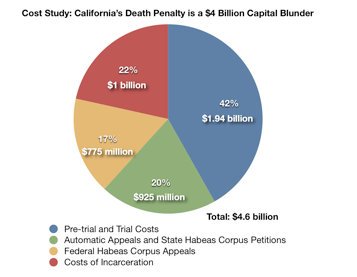
We did not come to this decision lightly, and NO, we are not soft on crime. Just the opposite. SAFE California replaces the death penalty with a sentence of life in prison with absolutely no chance of parole as the maximum punishment for murder. This means convicted killers will remain behind bars forever – but without the exorbitant price tag, terrible toll on the family members of victims, or the risk of executing an innocent person. At over 720 inmates and with a $4 billion price tag, our state runs the nation’s costliest and most populous death row. Nonetheless California has carried out just 13 executions since 1978.

We were intimately involved in writing and promoting our current death penalty law in 1978. We believe that public safety is one of the primary purposes of a government predicated on the rule of law. Justice should be swift and certain. The structure that we helped create is legally sound, having withstood multiple appeals to the U.S. Supreme Court. But, fiscallyspeaking, it has been disastrous. We never contemplated the staggering cost of implementing the death penalty: more than $4 billion to date and approximately $185 million projected per year in ongoing costs.

Source: ExecutingtheWilloftheVoters?” by Judge Arthur Alarcon and Paula Mitchell, 2011

We thought we would bring California savings and safety in dealing with convicted murderers. Instead, we contributed to a nightmarish system that coddles murderers and enriches lawyers. Like Senator Anderson, our effort was intended to bring about greater justice for murder victims. Never did we envision a multi-billion dollar industry that packs murderers onto death row for decades of extremely expensive incarceration. We thought we would empty death row, not triple its population.

Having 34 years of firsthand experiences in this matter we feel the bill proposed by Sen. Anderson will not fix these problems. First and foremost, shortcutting the appeals process means risking innocent lives. Appeals are the safety net that keeps us from executing innocent people. States that shortchange the justice process have executed innocent people, like CameronToddWillingham in Texas.

Beyond the risk of executing the innocent, SB 1514 would simply move appeals from one court to another. That doesn’t alleviate the delay or the expense, it will just move it to a different courthouse.

It won’t eliminate the $1 million each county pays per death penalty trial, or the extra housing costs on death row over the general population – on average $100,000 per inmate per year – and it won’t change the fact that 99% of death row inmates in California die of old age rather than execution. History tells us any change to the death penalty has only added life to criminals, enhanced lawyers paychecks costing taxpayers more and more while appellate dates or new trials continue to torture victims’ families and survivors.

We believe that life without parole protects victims’ families and survivors at a greater savings to taxpayers. California’s best path for safety and savings is life without the possibility of parole.

Please join us in supporting theSAFECaliforniaAct with a “YES” this November. California has another chance at real justice. We should embrace it.

John Lotter, ‘Boys Don’t Cry’ Killer And Death Row Inmate, Denied Appeal By U.S. Supreme Court


march, 27  source : http://www.huffingtonpost.com

OMAHA, Neb. — The U.S. Supreme Court has denied the appeal of a Nebraska death row inmate whose murder case inspired the 1999 film “Boys Don‘t Cry.”

John Lotter and a co-defendant were convicted in the 1993 slaying of Teena Brandon, a 21-year-old woman who lived briefly as a man, and two witnesses to her killing. Lotter has maintained his innocence.

In August, a three-judge panel of the 8th U.S. Circuit Court of Appeals rejected Lotter’s attempt to appeal his conviction, and his request for the full court to consider his appeal was denied.

Lotter then appealed to the U.S. Supreme Court which last week denied Lotter’s request without comment.

Lotter’s attorney, Andre Barry of Lincoln, declined to comment on Tuesday. Lotter can petition the U.S. Supreme Court for a rehearing of the appeal.

Along with Brandon’s death, Lotter and Nissen were convicted of killing Lisa Lambert, 24, and Philip DeVine, 22, who witnessed Brandon’s death in the farmhouse near Humboldt, about 80 miles southeast of Lincoln.

Brandon had reported being raped by the two men. A former Richardson County sheriff was later criticized for his handling of the rape charges and for failing to offer Brandon protective custody.

In a deal with prosecutors to avoid the death penalty, Nissen testified that he stabbed Brandon, but Lotter fired the shots that killed the three. Nissen was sentenced to life in prison.

But in July 2007, he changed his story and said he, not Lotter, shot all three.

true story  of brandon Teena

No. 11-8458      *** CAPITAL CASE ***
Title:
John L. Lotter, Petitioner
v.
Robert Houston, Warden
Docketed: January 24, 2012
Lower Ct: United States Court of Appeals for the Eighth Circuit
  Case Nos.: (11-2223)
  Decision Date: August 23, 2011
  Rehearing Denied: October 31, 2011
~~~Date~~~ ~~~~~~~Proceedings  and  Orders~~~~~~~~~~~~~~~~~~~~~
Jan 20 2012 Petition for a writ of certiorari and motion for leave to proceed in forma pauperis filed. (Response due February 23, 2012)
Feb 17 2012 Brief of respondent Robert Houston, Warden in opposition filed.
Feb 28 2012 Reply of petitioner John L. Lotter filed. (Distributed)
Mar 1 2012 DISTRIBUTED for Conference of March 16, 2012.
Mar 19 2012 Petition DENIED.

TEXAS – Keith Thurmond – EXECUTED


keith Steven Thurmond was pronounced dead at 6:22 PM CST at Huntsville, Texas, executed for murdering his estranged wife, Sharon, and her boyfriend, Guy Fernandez. Strapped on the Gurney in the execution chamber, Thurmond denied killing his wife, although he murdered her in the presence of the couple’s 8-year-old son

If his loved ones are typical, they are re now rushing to the funeral parlor where his body has been sent so they may touch it while it is still warm. The custom stems from the fact that, once a prisoner enters death row, he is permitted no physical contact with is family. In Thurmond’s case, that was about a decade ago.

Suprem court of United States 

No. 11-9083      *** CAPITAL CASE ***
Title:
Keith Thurmond, Petitioner
v.
Texas
Docketed: March 5, 2012
Linked with 11A839
Lower Ct: Court of Criminal Appeals of Texas
  Case Nos.: (WR-62,425-01, and WR-62,425-02)
  Decision Date: February 29, 2012
~~~Date~~~ ~~~~~~~Proceedings  and  Orders~~~~~~~~~~~~~~~~~~~~~
Mar 5 2012 Petition for a writ of certiorari and motion for leave to proceed in forma pauperis filed. (Response due April 4, 2012)
Mar 5 2012 Application (11A839) for a stay of execution of sentence of death, submitted to Justice Scalia.
Mar 6 2012 Brief of respondent in opposition filed.
Mar 6 2012 Reply of petitioner Keith Thurmond filed.
Mar 7 2012 Application (11A839) referred to the Court.
Mar 7 2012 Petition DENIED.
Mar 7 2012 Application (11A839) denied by the Court.

Last News from execution watch : NO WORD FROM HIGH COURT ON THURMOND STAY

I just fielded a news call on whether the Supreme Court has ruled on Keith Thurmond’s request for a stay of tonight’s execution. I had to tell them, “No news yet.”

———————————————————————————————————————————————————————————————————-

The U.S. Supreme Court is considering an emergency request from Keith Thurmond to stop the State of Texas from executing him tonight.

Last-minute requests like this from Texas are routinely considered by Justice Antonin Scalia, though he has the option to poll the full court.

Thurmond, who was denied any federal appeals because his lawyer missed a deadline, is slated to be executed by lethal injection at 6 p.m. in the shooting deaths of his estranged wife and her new boyfriend a decade ago.

If the execution goes through as planned, Execution Watch will provide live coverage and commentary to inform listeners of the realities, versus the cliches, of the Texas death penalty.

The broadcast will be at 6 p.m. Central Time on nonprofit FM station KPFT 90.1 in Houston and online at http://executionwatch.org/ > Listen.

The execution will be the 480th in Texas since 1982 and the 241st since Rick Perry became governor. Perry has already presided over more than 50 percent of all Texas executions in the modern era.

source : execution watch.org

ARIZONA – Robert H. Moorman – Execution – February 29, 2012 EXECUTED 10.23 a.m


The Arizona Department of Corrections has scheduled a Feb. 29 execution for a death row inmate convicted of killing his adoptive mother while on a three-day prison release in 1984.Corrections officials announced the execution date Wednesday for 63-year-old Robert Henry Moorman at the state prison complex in Florence.Moorman recently lost an appeal in the 9th U.S. Circuit Court of Appeals, and the U.S. Supreme Court declined to consider his case.Moorman was serving a nine-year prison term for kidnapping in 1984 when the state let him out on three-day release to visit his adoptive mother at a nearby hotel.Moorman beat, stabbed and strangled the woman, then dismembered her body and threw the pieces away in various trash bins and sewers in Florence before he was captured.

Arizona inmate facing execution hospitalized over illness Arizona death-row inmate Robert Moormann, who is scheduled to be executed Feb.29, was transported to an unnamed hospital Thursday after falling ill at the state prison in Florence, his attorney confirmed.The Arizona Department of Corrections would not provide information — even to Moormann’s attorneys — about Moormann’s condition, but a department spokesman said Thursday afternoon that Moormann was still alive.Moormann, 63, was sentenced to death for the 1984 murder of his adoptive mother.He has a history of health problems and was hospitalized twice last fall, first for an appendectomy and later for a quintuple heart bypass.Arizona prison policy requires death-row inmates facing execution to be kept alive until the last minute before execution by lethal injection.The execution protocol requires that a cardiac defibrillator “be readily available on site in the event that the inmate goes into cardiac arrest at any time prior to dispensing the chemicals; trained medical staff shall make every effort to revive the inmate should this occur.”In 1984, Moormannwas already imprisoned in Florence when he was granted a “compassionate furlough” to visit with his mother at a motel near the prison. During the visit, he killed her and dismembered her, dumping her body in garbage cans.In January, his attorneys argued that Moormann’s deteriorating health had lessened his intellectual functioning to the point where he could not be legally executed.
Arizona Supreme Court asked to stay executionLawyers for death row inmate Robert Henry Moormann have asked the Arizona Supreme Court to stay his scheduled Feb. 29 execution.In a 21-page motion filed Tuesday, Moormann’s attorneys say he was diagnosed in early childhood as being mentally retarded and the state can’t execute him because of that fact.The 63-year-old Moormann was sentenced to death for the 1984 death of his adoptive mother while on a prison furlough.Moormann was serving a prison term of nine years to life for kidnapping when the state let him out on three-day “compassionate furlough” to visit his adoptive mother at a Florence motel.Authorities say Moormann beat, stabbed and suffocated the woman before meticulously dismembering her body.Moormann’s attorneys used an insanity defense, but a jury convicted him of first-degree murder.
Families, others find closure in executionAt 10:23 a.m. on Feb. 29, convicted felon Robert H. Moorman was declared dead following his execution at the Arizona State Prison – 27 years after receiving his sentence.For Tom Rankin this particular order of execution offered a different kind of closure than that for relatives of the victims. He was the police chief in Florence 28 years ago when Moorman committed one of the most heinous crimes in the town’s history.“That was my third execution to observe, but this one was a bit more personal,” Rankin, one of the witnesses, said. “It provided closure for me, not only on that case, but for my law enforcement career. It was the last case that I had pending that I was involved in.“It’s like saying, ‘You’ve done your career. It’s over with now.’”Ironically, the Blue Mist Motel is within sight from the ASP visitors’ parking area. It was at the Blue Mist where, on Jan. 13, 1984, Moorman beat, stabbed and suffocated his adoptive mother, 74-year-old Roberta Moorman, who, according to defense attorneys, sexually abused him into his adult years.Moorman then dismembered Roberta’s body, cutting off her head, legs and arms, halved her torso, and flushed her fingers down the toilet. Most of her remains were found in trash bins around town after asking various businesses if he could “dispose of spoiled meat and animal guts.”Shortly after Moorman asked a corrections employee to dispose of “dog bones,” he was captured. The incident took place during a a three-day “compassionate furlough” from ASP, where Moorman was already serving nine years to life for kidnapping and molesting an 8-year-old girl in 1972.Moorman, 63, was sentenced to death on May 7, 1985. Appeals to overturn his warrant of execution were denied in 1986, 1987 and 1992. A motion to issue a warrant of execution was filed by the attorney general on Oct. 12, 2011 and granted on Nov. 29.Moorman was served his last meal between 7 p.m. and 7:30 p.m. on Feb. 28. It consisted of one double hamburger (two quarter-pound patties prepared “medium”) with two slices of onion, three leaves of lettuce, three tomato slices and a bun; plus French fries (with four ounces of ketchup), two three-ounce beef burritos, three Royal Crown colas, and two 14-ounce containers of Rocky Road ice cream.

A light breakfast was an option, but there was no word on whether or not Moorman accepted it.

From the reporter’s notebook, here’s the sequence of events:

8 a.m. – The media witnesses are greeted and informed that no cameras, pens or outside note pads are allowed – a pencil and note pad is furnished by the prison.

8:38 a.m. – Arizona Department of Corrections Director Charles L. Ryan came to the media room and announced that there were no further stays of execution and no pending motions from the Superior Court.

9:39 a.m. – The media leaves its holding area to another room upstairs. There, a DOC employee offered a briefing on the execution itinerary.

9:45 a.m. – After the briefing, media names were drawn at random to determine the order of entering the viewing gallery. My name was drawn first.

10 a.m. – There’s a delay in the process, as Moorman is having a final meeting with his legal counsel.

10:12 a.m. – The media is led to Housing Unit No. 9, enters the gallery area, and is positioned next to a partition, separate from other witnesses.

10:19 a.m. – Approximately 22 witnesses, other than the media and DOC staff, enter the gallery. An undetermined number of witnesses are on the other side of the partition.

10:21 a.m. – The curtain opens, and Moorman is seen strapped to a gurney, wearing his orange prison apparel. He appears calm as his execution order is being read.

10:23 a.m. – Moorman is asked if he has any final words. Looking up at the ceiling with a slight smile, he responds with an apology to the families involved, adding, “I’m sorry for the pain I caused. I hope this brings closure and they can start healing now. I just hope that they can forgive me in time.”

With that, the process of execution began.

10:24 a.m. – Moorman turns his head to his right and looks at the gallery. One minute later, he begins breathing hard, short of gasping for air, as the lethal injection of pentobarbital began to take effect.

10:27 a.m. – A physician enters the execution room to administer sedation.

10:29 a.m. – Moorman’s eyes are half-closed, looking peaceful, with little, if any, movement.

10:33 a.m. – The DOC announces, “The execution is completed.” The curtain is closed.

10:34 a.m. – The witnesses are excused.

10:40 a.m. – The media gives its witness account to six television stations and various print and radio reporters who did not see the execution.

“Death is never pretty,” Rankin said. “When I was standing there, I was wondering about (Roberta Moorman’s) family and wondering if any of her family was there. I didn’t know because I’ve lost contact with most of them. I didn’t recognize any of the other witnesses.

“For the family’s sake, I hope it’s over. It’s a period I hope they’ll never have to live through again.”

Deacon Ed Sheffer of St. Thomas The Apostle Parish in Tucson, who performs ministry work on death row, has been Moorman’s spiritual advisor for the last 10 years. After the execution, Sheffer said, “At the end, Robert was at a peaceful place and for some time had come to terms with what he had done and his fate. You could hear it in his last words, his thoughts and concerns were for others, not himself.”

Sheffer said Moorman received last rites from Bishop Gerald Kicanas of Tucson on Feb. 21, and had his final communion prior to the execution at approximately 6 a.m.

“He received his communion and was very grateful for our years of working together as he found his relationship with the Lord,” Sheffer said. “He moved from shame to guilt, to asking for mercy and reconciliation.

“His soul is now in God’s hands.”

Rankin noted it was the only case from his days as police chief that resulted in the death penalty, saying, “It’s too bad about the way the death penalty is scheduled, with the long delays and the years it takes to fulfill the sentence. I understand the process, but for the family of the victim, closure should come sooner.

“As for Robert Moorman, he got what he deserved,” Rankin concluded. “There’s no need to talk about him anymore. In law enforcement, we say, ‘case closed.’”