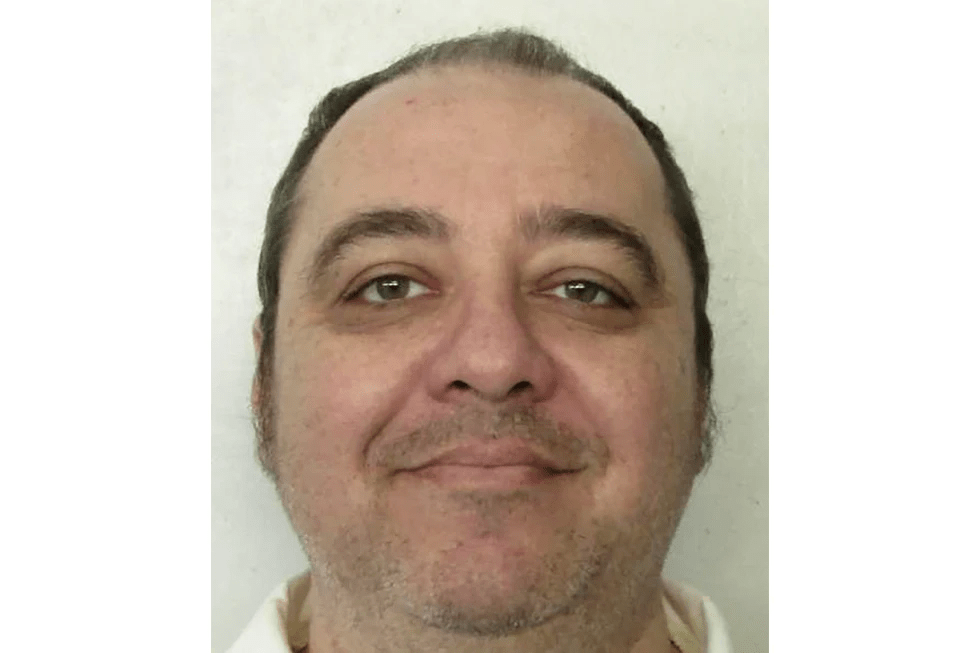
Smith, 58, was executed on Thursday and died from nitrogen hypoxia at 8.25pm CT, the state’s Republican Governor Kay Ivey confirmed.
Final words included, “Tonight Alabama causes humanity to take a step backwards… Thank you for supporting me. Love you all.
“I’m leaving with love, peace and light.” As officials began to administer the gas, Smith turned to his family and signed “I love you.” The witnesses reported seeing Smith thrashing and writhing.
Kenneth Smith Last Moments : From Family and Spiritual Advisors to steak and hash browns
A spokesperson from Alabama Departement of Corrections provided information about the final 48 hours of Smith’s Life.
During Wednesday, Smith received visits from his spiritual advisor, a friend, his brother, two nieces, his son, grandson, wife and attorney. Despite refusing breakfast and only partially eating his dinner, he did consume a lunch tray, accompanied by a Montain Dew, coffee, and a Pepsi. Addionally, he had a conversation with his wife over the phone.
Thursday, he was again visited by his spiritual advisor, his mom, wife, two friends, son, two daughter-in-law, and attorney. Again he spoke on the phone with his wife.
He was seen drinking coffee, sprite, and water. He hate his breakfast, wich consisted of two biscuits, eggs, grape jelly, applesauce and orange juice.
10 A.M Smith ate his final meal of T-bone steak, hash browns, toast and eggs slathered in A1 steak sauce, the Rev. Jeff Hood, Smith’s spiritual adviser, said in a statement.
“He is terrified at the torture that could come. But he’s also at peace. One of the things he told me he is finally getting out,” he added
His witness are set to be his wife, two sons, attorney, and a friend.
Kenneth Smith lawyers continue to push for execution stay
Kenneth Eugene Smith was not provided with a full copy of the protocol for his execution by nitrogen hypoxia until November 2023, his lawyers have said, as they once again petitioned for a stay of execution.
In court documents filed on Thursday, lawyers said that Smith “did not endorse (and could not have endorsed) the procedures in the Protocol before he had seen them”.
“Mr Smith has not walked away from his allegation that nitrogen hypoxia is a feasible and available alternative method of execution to lethal injection. When he made the argument he had not seen ADOC’s Protocol for executing condemned people by nitrogen hypoxia,” the filing stated.
“He was only provided with a heavily redacted copy of the Protocol in late August, at the same time that the State informed him that he would be the first person subject to it and moved in the Alabama Supreme Court for authority to execute him under its procedures.
“Mr Smith did not receive an unredacted copy of the Protocol until late November when the district court ordered Respondents to produce it. Mr Smith did not endorse (and could not have endorsed) the procedures in the Protocol before he had seen them.”
The filing continued: “And, of course, the ‘devil is in the details’ of the Protocol, so his current challenge is to the procedures in the Protocol—specifically to the use of a mask to deliver nitrogen instead of other feasible and available alternatives, including a hood or a closed chamber—not to nitrogen hypoxia per se.
“When the State permitted condemned people in Alabama to elect nitrogen hypoxia as the method of their execution, ADOC adopted an election form that expressly provided that those condemned people so electing did not ‘waive [their] right to challenge the constitutionality of any protocol adopted for carrying out execution by nitrogen hypoxia.’
“Neither did Mr. Smith when he alleged that nitrogen hypoxia was a feasible and available alternative method of execution in the Lethal Injection Action.”
Smith execution method ‘thoroughly vetted’ says Governor
Alabama Governor Kay Ivey said that the method of execution for Kenneth Eugene Smith had been “thoroughly vetted” and she was “confident” that they were ready to proceed.
“Nitrogen hypoxia is the method previously requested by the inmate as an alternative to lethal injection,” Governor Ivey said in a statement.
“This method has been thoroughly vetted, and both the Alabama Department of Corrections and the Attorney General’s Office have indicated it is ready to go. The Legislature passed this law in 2018, and it is our job to implement it. I am confident we are ready to move forward.”
It comes amid ongoing debate about the method – which is previously untested.
Execution timeline
Kenneth Eugene Smith scheduled to be put to death with nitrogen gas on Thursday
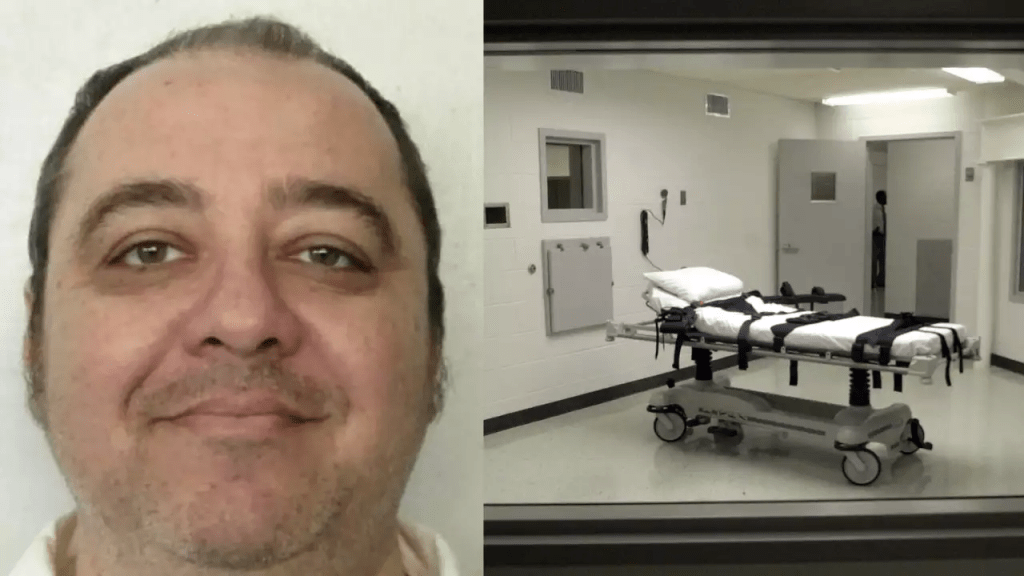
Accordingly, Governor Ivey has set a 30-hour time frame for the execution to occur beginning at 12:00 a.m. on Thursday, January 25, 2024, and expiring at 6:00 a.m. on Friday, January 26, 2024. The execution will take place at the William C. Holman Correctional Facility (CF) in Atmore, Alabama.
The tentative start time will be 6:00 p.m. on the 25th. This, of course, may change based on the conclusion of the required legal proceedings.
Alabama death row inmate Kenneth Eugene Smith says he is not prepared to become the first person ever put to death by nitrogen gas.
Smith, 58, told The Guardian he has now been moved to the “death cell” in an Alabama Department of Corrections (ADOC) facility ahead of his Thursday execution, but that he is not ready to be executed using the untested method.
Smith’s attorneys have filed a request with the 11th US Circuit Court of Appeals to stop the execution because the nitrogen gas method carries the risk of prolonged death and suffering.
Additionally, his attorneys have asked the US Supreme Court to review whether the execution will violate the US Constitution. Officials previously tried to execute Smith in 2022 but failed after they were not able to insert IV lines into his system.
Now, his attorneys argue that the state might not have the right to try and put him to death a second time.
“It is uncontroverted that ADOC inflicted actual physical and psychological pain on Smith by repeatedly trying (and failing) to establish IV access through his arms, hands, and by a central line as he was strapped to a gurney for hours,” the filing said.
“Mr Smith’s was the third consecutive execution that ADOC botched or aborted for that same reason. ADOC’s failed attempt to execute Mr Smith caused him severe physical pain and psychological torment, including posttraumatic stress disorder.”
Smith said he’s not ready to be put to death with an untested treatment, given how a botched first execution attempt went.
“I am not ready for that. Not in no kind of way. I’m just not ready, brother,” Smith told the newspaper. He admitted that he’s had a recurring nightmare since the first execution attempt of being escorted back into the death chamber.
“All I had to do was walk into the room in the dream for it to be overwhelming. I was absolutely terrified,” he said. “It kept coming up.”
Discussing his upcoming execution date, he said he has dreams that “they’re coming to get me.” He currently spends most of his days being “sick in his stomach” and frequently suffers from nausea and stress.
“They haven’t given me a chance to heal,” Smith said. “I’m still suffering from the first execution and now we’re doing this again. They won’t let me even have post-traumatic stress disorder — you know, this is ongoing stress disorder.”
The inmate then presented a scenario in which a victim of abuse was forced back into an abusive situation, explaining that that’s how the new execution attempt makes him feel.
“A person who did that would probably be seen as a monster,” he said. “But when the government does it, you know, that’s something else.”
In April 1996, Smith was convicted of capital murder for his role in the death of 45-year-old Elizabeth Sennett, a pastor’s wife in Colbert County. Officials discovered that she’d been stabbed multiple times inside her home.
Smith was part of a two-person murder-for-hire scheme, which appeared to be put together by the woman’s husband. The jury voted 11 to 1 to put Smith away for life. However, the judge presiding over the case overrode the jury’s verdict and sentenced him to death.
Speaking of the crime, he said he wishes he “had done things differently.”
He added: “One second, one moment in a man’s life and that’s been the only incident — I’ve not had any incident with officers, not a single fight with inmates, in 35 years. Violence is not who I am.
“I’ve been in prison for 35 years, how have I not been punished,” he continued. “Thirty-five years. I have not gone unpunished for 35 years. I have suffered doing this. So has my family.”
Supreme court
January 18, 2024 Application (23A664) for stay of execution of sentence of death, submitted to Justice Thomas Stay of Execution
January 22, 2024 Response to application from respondent Alabama filed. Main document
January 23,2024 Reply of Kenneth Eugene Smith in support of application submitted. Reply
January 24, 2024 Application (23A664) referred to the Court. Application (23A664) for stay of execution of sentence of death submitted to Justice Thomas and by him referred to the Court is denied. The petition for a writ of certiorari is denied.
Alabama will be allowed to put an inmate to death with nitrogen gas later this month, a federal judge ruled Wednesday, clearing the way for what would be the nation’s first execution using a new method the inmate’s lawyers criticize as cruel and experimental.
U.S. District Judge R. Austin Huffaker rejected inmate Kenneth Eugene Smith’s request for a preliminary injunction to stop his scheduled Jan. 25 execution by nitrogen hypoxia. Smith’s attorneys have said Alabama is trying to make Smith the “test subject” for an untried execution method after he survived the state’s previous attempt to put him to death by lethal injection.
Why it matters: This untested hypoxia execution method, the first of its kind in the U.S., could prove to be “painful and humiliating,” human rights experts said.
“Hypoxia is a state in which oxygen is not available in sufficient amounts at the tissue level to maintain adequate homeostasis,” per research in the National Institutes of Health.
Smith’s attorney, Robert Grass, said he will appeal the decision but declined further comment. The question of whether the execution can ultimately proceed could end up before the U.S. Supreme Court.
Smith, now 58, was one of two men convicted of the murder-for-hire of a preacher’s wife that rocked Alabama in 1988. Prosecutors said Smith and the other man were each paid $1,000 to kill ElizabethSennett on behalf of her husband, who was deeply in debt and wanted to collect on insurance.
Alabama Attorney General Steve Marshall praised Wednesday’s decision, saying it moves the state closer to “holding Kenneth Smith accountable for the heinous murder-for-hire slaying” he was convicted of committing.
“Smith has avoided his lawful death sentence for over 35 years, but the court’s rejection today of Smith’s speculative claims removes an obstacle to finally seeing justice done,” his statement added.
The state’s plans call for placing a respirator-type face mask over Smith’s nose and mouth to replace breathable air with nitrogen, causing him to die from lack of oxygen. Three states — Alabama, Mississippi and Oklahoma — have authorized nitrogen hypoxia as an execution method, but none has used it so far.
Smith’s attorneys argued the new protocol is riddled with unknowns and potential problems and violates a constitutional ban on cruel and unusual punishment.
Huffaker acknowledged that execution by nitrogen hypoxia is a new method but noted that lethal injection — now the most common execution method in the country — once was also new. He said while Smith had shown the theoretical risks of pain and suffering under Alabama’s protocol, those risks don’t rise to an unconstitutional violation.
“Smith is not guaranteed a painless death. On this record, Smith has not shown, and the court cannot conclude, the Protocol inflicts both cruel and unusual punishment rendering it constitutionally infirm under the prevailing legal framework,” Huffaker wrote in the 48-page ruling.
Huffaker also wrote that there wasn’t enough evidence to find the method “is substantially likely to cause Smith superadded pain short of death or a prolonged death.”
Smith survived a prior attempt to execute him. The Alabama Department of Corrections tried to give Smith a lethal injection in 2022 but called it off when authorities couldn’t connect two intravenous lines.
The Rev. Dr. Jeff Hood, Smith’s spiritual adviser who plans to be with Smith during the execution, said he was troubled by the ruling. “Horror is an understatement. The State of Alabama now has the permission of a federal court to suffocate its citizens,” Hood said.
Experts appointed by the United Nations Human Rights Council earlier this month cautioned that, in their view, the execution method would violate the prohibition on torture and other cruel, inhuman or degrading punishment.
Wednesday’s ruling followed a December court hearing and legal filings in which attorneys for Smith and Alabama gave diverging descriptions of the risks and humaneness of death from nitrogen gas exposure.
The state attorney general’s office had argued that the deprivation of oxygen would “cause unconsciousness within seconds, and cause death within minutes.” Its court filings compared the new execution method to industrial accidents in which people passed out quickly and died after exposure to nitrogen gas.
But Smith’s attorneys noted in court filings that the American Veterinary Medical Association wrote in 2020 euthanasia guidelines that nitrogen hypoxia is an acceptable method of euthanasia for pigs but not for other mammals because it could create an “anoxic environment that is distressing for some species.”
Smith’s attorneys also argued that the gas mask, which sits over the nose and mouth, would interfere with Smith’s ability to pray aloud or make a final death chamber statement.
The attorney general’s office called those concerns speculative.
Alabama’s prison system agreed to minor changes to settle concerns that Smith’s spiritual adviser would be unable to minister to him before the execution. The state wrote in a court filing that the adviser could enter the execution chamber before the mask was placed on Smith’s face to pray with him and anoint him with oil.
The murder victim Sennett was found dead on March 18, 1988, in the home she shared with her husband Charles Sennett Sr. in Alabama’s northern Colbert County. The coroner testified the 45-year-old woman had been stabbed repeatedly. Her husband, then the pastor of the Westside Church of Christ, killed himself when the murder investigation focused on him as a suspect, according to court documents.
Smith’s initial 1989 conviction was overturned on appeal. He was retried and convicted again in 1996. The jury recommended a life sentence by a vote of 11-1, but a judge overrode the recommendation and sentenced Smith to death. Alabama no longer allows a judge to override a jury’s decision on death penalty decisions.
John Forrest Parker, the other man convicted in the case, was executed in 2010.
The synthetic painkiller fentanyl has been the driving force behind the nation’s opioid epidemic, killing tens of thousands of Americans last year in overdoses. Now two states want to use the drug’s powerful properties for a new purpose: to execute prisoners on death row.
As Nevada and Nebraska push for the country’s first fentanyl-assisted executions, doctors and death penalty opponents are fighting those plans. They have warned that such an untested use of fentanyl could lead to painful, botched executions, comparing the use of it and other new drugs proposed for lethal injection to human experimentation.
States are increasingly pressed for ways to carry out the death penalty because of problems obtaining the drugs they long have used, primarily because pharmaceutical companies are refusing to supply their drugs for executions.
The situation has led states such as Florida, Ohio and Oklahoma to turn to novel drug combinations for executions. Mississippi legalized nitrogen gas this spring as a backup method – something no state or country has tried. Officials have yet to say whether it would be delivered in a gas chamber or through a gas mask.
Other states have passed laws authorizing a return to older methods, such as the firing squad and the electric chair.
“We’re in a new era,” said Deborah Denno, a law professor at Fordham University. “States have now gone through all the drugs closest to the original ones for lethal injection. And the more they experiment, the more they’re forced to use new drugs that we know less about in terms of how they might work in an execution.”
Supporters of capital punishment blame critics for the crisis, which comes amid a sharp decline in the number of executions and decreasing public support for the death penalty. As of late November, 23 inmates had been put to death in 2017 – fewer than in all but one year since 1991. Nineteen states no longer have capital punishment, with a third of those banning it in the past decade.
“If death penalty opponents were really concerned about inmates’ pain, they would help reopen the supply,” said Kent Scheidegger of the Criminal Justice Legal Foundation, which advocates the rights of crime victims. Opponents “caused the problem we’re in now by forcing pharmaceuticals to cut off the supply to these drugs. That’s why states are turning to less-than-optimal choices.”
Prison officials in Nevada and Nebraska have declined to answer questions about why they chose to use fentanyl in their next executions, which could take place in early 2018. Many states shroud their procedures in secrecy to try to minimize legal challenges.
But fentanyl offers several advantages. The obvious one is potency. The synthetic drug is 50 times more powerful than heroin and up to 100 times more powerful than morphine.
“There’s cruel irony that at the same time these state governments are trying to figure out how to stop so many from dying from opioids, that they now want to turn and use them to deliberately kill someone,” said Austin Sarat, a law professor at Amherst College who has studied the death penalty for more than four decades.
Another plus with fentanyl: It is easy to obtain. Although the drug has rocketed into the news because of the opioid crisis, doctors frequently use it to anesthetize patients for major surgery or to treat severe pain in patients with advanced cancer.
Nevada officials say they had no problem buying fentanyl.
“We simply ordered it through our pharmaceutical distributor, just like every other medication we purchase, and it was delivered,” Brooke Keast, a spokeswoman for the Nevada Department of Corrections, said in an email. “Nothing out of the ordinary at all.”
The state, which last put someone to death in 2006, had planned its first fentanyl-assisted execution for November. The inmate involved, 47-year-old Scott Dozier, was convicted of killing a man in a Las Vegas hotel, cutting him into pieces and stealing his money.
According to documents obtained by The Washington Post, Nevada’s protocol calls for Dozier first to receive diazepam – a sedative better known as Valium – and then fentanyl to cause him to lose consciousness. Large doses of both would cause a person to stop breathing, according to three anesthesiologists interviewed for this report.
Yet Nevada also plans to inject Dozier with a third drug, cisatracurium, to paralyze his muscles – a step medical experts say makes the procedure riskier.
“If the first two drugs don’t work as planned or if they are administered incorrectly, which has already happened in so many cases . . . you would be awake and conscious, desperate to breathe and terrified but unable to move at all,” said Mark Heath, a professor of anesthesiology at Columbia University. “It would be an agonizing way to die, but the people witnessing wouldn’t know anything had gone wrong because you wouldn’t be able to move.”
John DiMuro, who helped create the fentanyl execution protocol when he was the state’s chief medical officer, said he based it on procedures common in open-heart surgery. He included cisatracurium because of worries that the Valium and fentanyl might not fully stop an inmate’s breathing, he said. “The paralytic hastens and ensures death. It would be less humane without it.”
A judge postponed Dozier’s execution last month over concerns about the paralytic, and the case is awaiting review by Nevada’s Supreme Court. In the meantime, Nebraska is looking toward a fentanyl-assisted execution as soon as January. Jose Sandoval, the leader of a bank robbery in which five people were killed, would be the first person put to death in that state since 1997.
Sandoval would be injected with the same three drugs proposed in Nevada, plus potassium chloride to stop his heart.
Even at much lower concentrations, intravenous potassium chloride often causes a burning sensation, according to Heath. “So if you weren’t properly sedated, a highly concentrated dose would feel like someone was taking a blowtorch to your arm and burning you alive,” he said.
Fentanyl is just the latest in a long line of approaches that have been considered for capital punishment in the United States. With each, things have often gone wrong.
When hangings fell out of favor in the 19th century – because of botched cases and the drunken, carnival-like crowds they attracted – states turned to electrocution. The first one in 1890 was a grisly disaster: Spectators noticed the inmate was still breathing after the electricity was turned off, and prison officials had to zap the man all over again.
Gas chambers were similarly sold as a modern scientific solution. But one of the country’s last cyanide gas executions, in 1992, went so badly that it left witnesses crying and the warden threatening to resign rather than attempt another one.
Lethal injection, developed in Oklahoma in 1977, was supposed to solve these problems. It triggered concerns from the start, especially because of the paralytic drug used. Even so, the three-drug injection soon became the country’s dominant method of execution.
In recent years, as access to those drugs has dried up, states have tried others. Before the interest in fentanyl, many states tested a sedative called midazolam – leading to what Supreme Court Justice Sonia Sotomayor called “horrifying deaths.”
Dennis McGuire, who raped and killed a pregnant newlywed in Ohio, became the first inmate on whom that state’s new protocol was tried. Soon after the 2014 execution began, his body writhed on the table as he gasped for air and made gurgling, snorting noises that sounded as though he was drowning, according to witnesses.
The same year, Oklahoma used midazolam on an inmate convicted of kidnapping and killing a teenager; authorities aborted the execution after Clayton Lockett kicked, writhed and grimaced for 20 minutes, but he died not long after. Three months later, Arizona used midazolam on JosephWood III, who was convicted of killing his ex-girlfriend and her father. Officials injected him more than a dozen times as he struggled for almost two hours.
Like officials in other states, Arizona officials argued that the inmate did not suffer and that the procedure was not botched. Later, they said they would never again use midazolam in an execution.
Joel Zivot, a professor of anesthesiology and surgery at Emory University, called the states’ approach ludicrous. “There’s no medical or scientific basis for any of it,” he said. “It’s just a series of attempts: obtain certain drugs, try them out on prisoners, and see if and how they die.”
The bad publicity and continuing problems with drug supply have sent some of the 31 states where capital punishment remains legal in search of options beyond lethal injection. Turning to nitrogen gas would solve at least one issue.
“Nitrogen is literally in the air we breathe – you can’t cut off anyone’s supply to that,” said Scheidegger, who strongly supports the idea.
In addition to Mississippi, Oklahoma has authorized nitrogen gas as a backup to lethal injection. Corrections officials and legislators in Louisiana and Alabama have said they hope to do the same.
And yet, critics note, there is almost no scientific research to suggest that nitrogen would be more humane.
Zivot is among those skeptical that nitrogen would work as hoped.
“There’s a difference between accidental hypoxia, like with pilots passing out, and someone knowing you’re trying to kill him and fighting against it,” he said. “Have you ever seen someone struggle to breathe? They gasp until the end. It’s terrifying.”
Dozier, the inmate Nevada hopes to execute soon with fentanyl has said he would prefer death by firing squad over any other method. In more than a dozen interviews, experts on both sides of the issue expressed similar views.
Of all the lethal technology humans have invented, the gun has endured as one of the most efficient ways to kill, said Denno, who has studied the death penalty for a quarter-century.
“The reason we keep looking for something else,” she said, “is because it’s not really for the prisoner. It’s for the people who have to watch it happen. We don’t want to feel squeamish or uncomfortable. We don’t want executions to look like what they really are: killing someone.”





 Claim your Innocence