Murder

Georgia Sets March 20 Execution Date for Willie Pye Despite Strong Evidence of Intellectual Disability and Previous Finding of Ineffective Representation by Attorney with History of Racial Bias EXECUTED 11.03 PM


UDPATE march 22. 2024

he state of Georgia on Wednesday executed death row inmate Willie Pye, who was convicted and sentenced to die for the 1993 murder of Alicia Lynn Yarbrough.

The execution – Georgia’s first in more than four years – was carried out by lethal injection at 11:03 p.m. at a prison in Jackson, about 50 miles south of Atlanta, the Georgia Department of Corrections said in a news release. Pye did not make a final statement, it said.

Pye, 59, was put to death after the US Supreme Court denied his final appeals late Wednesday. In a clemency petition and various court filings, Pye and his attorneys had argued for his life to be spared, citing an intellectual disability, a troubled upbringing and ineffective assistance of counsel.

“The State of Georgia obtained Willie’s death sentence only after providing him a racist and incompetent defense attorney. And the State has insisted on standing by that death sentence in spite of his lifelong intellectual disability and the fact that he presents a danger to no one in prison,” his attorney, Nathan Potek, said after the execution.

“The people of Georgia deserve better,” he added, describing Pye as a loving son, brother and uncle who “will be dearly missed by his friends, family, and his legal team.”

March 7, 2024

The Georgia Attorney General has announced that Willie James Pye, who previously had his death sentence reversed due to his attorney’s failure to investigate his background, only to see the death sentence reinstated on appeal, is set to be executed on March 20. Mr. Pye’s court-appointed trial attorney, Johnny Mostiler, has been accused of ineffective representation or racial bias in at least four cases involving Black defendants and reportedly called one of his own clients a “little n****r.” Mr. Pye has also exhibited “undisputed” signs of intellectual disability, with an IQ of 68 and a history of learning difficulties. Georgia has not conducted an execution in over four years, and Mr. Pye is the state’s first scheduled execution date in about two years.

Mr. Pye was convicted and sentenced to death in 1996 for the kidnapping, robbery, rape, and murder of his ex-girlfriend Alicia Yarbrough. At the time, Mr. Mostiler had a lump-sum deal with Spalding County to represent the entire indigent criminal caseload, which numbered some 800 felony and five capital cases. He also had an active private civil practice. Mr. Mostiler only spent about 150 hours on Mr. Pye’s case, including the trial itself, while studies have found that thousands of hours are typically required for effective capital defense representation. He also spent less than five hours preparing the case for a life sentence, most of it on the day of the penalty phase and the day before. Due to his limited investigation, he did not uncover evidence of Mr. Pye’s traumatic upbringing and intellectual disability. Mr. Pye grew up experiencing “near-constant physical and emotional abuse, extreme parental neglect, endangerment, and abject poverty.” He battled severe depressive episodes and reported hearing voices prior to the killing. However, Mr. Mostiler relied on Mr. Pye’s sister to recruit family members as witnesses and told them only to testify to Mr. Pye’s good character, without delving into the difficulties of Mr. Pye’s childhood. He did not request an evaluation of Mr. Pye’s intellectual functioning or develop evidence regarding the claim even after the state expert tested Mr. Pye’s IQ at 68, in the impairment range. 

At least three of Mr. Mostiler’s clients have been executed, including Kenneth Fults and Curtis Osborne; Mr. Mostiler infamously slept through portions of Mr. Fults’ trial, and he told a white client that he would spend much more money on his case than on Mr. Osborne’s because “that little n****r deserves the chair.” In Frederick Whatley’s case, Mr. Mostiler allowed the prosecution to force Mr. Whatley to reenact the murder while shackled in manacles and leg irons. Justice Sonia Sotomayor later wrote that it was “hard to imagine a more prejudicial example of needless shackling.” A 2001 profile of Mr. Mostiler following his death found that he had handled “more than seven times the number of indigent cases the American Bar Association (ABA) believes is manageable…turning over one case every 100 minutes, less time than a private attorney might devote to a simple traffic violation.” The profile called him the “archetype” of “meet ’em, greet ’em, and plead ’em” lawyers. 

In 2021, the U.S. Court of Appeals for the Eleventh Circuit overturned Mr. Pye’s death sentence, unanimously finding that Mr. Mostiler failed to investigate and present a broad range of available mitigating and rebuttal evidence. The panel did not reach the merits of Mr. Pye’s intellectual disability claim, writing that the ineffective assistance claim was sufficient to require a new sentencing trial, but highlighted substantial evidence of Mr. Pye’s low cognitive functioning. However, on the state’s motion, the Eleventh Circuit reconvened en banc (with the full court) and reinstated Mr. Pye’s death sentence. The court acknowledged that Mr. Mostiler’s performance was deficient, but held that it was required under the Anti-Terrorism and Effective Death Penalty Act (AEDPA) to defer to the state court’s finding that Mr. Mostiler’s performance did not prejudice Mr. Pye. The majority interpreted AEDPA and Supreme Court precedent to conclude that even if the state court’s decision rests on clear errors, federal courts must defer to that decision if there are “additional rationales” that support it. In other words, the federal reviewing court may theorize reasons for the state court’s outcome and adopt those reasons to justify a state court decision that is otherwise wrong on the facts or the law.

Willie James Pye v. Warden, Georgia Diagnostic and Classification Prison (US COURT OF APPEALS) 2021

wo judges dissented in full, while two additional judges joined the dissent in part but concurred in the judgment. Dissenting Judge Jill Pryor wrote that the majority had directly violated Supreme Court precedent by “turning to justifications the state never even hinted at” and relying on “a half-baked textual analysis” in support. She further argued that the holding “creates a practically impossible path to relief for habeas petitioners…[i]f federal courts can bury unreasonable findings under an avalanche of new reasons the state court never gave, then unreasonable findings will virtually never be important enough to satisfy the majority’s test.” 

Judge Pryor also noted the “undisputed evidence” of Mr. Pye’s low intellectual functioning. Supreme Court jurisprudence and scientific research recognize IQ scores below 70 as a strong, often definitive indicator of intellectual disability. Georgia has one of the lowest appellate success rates of intellectual disability claims by capital defendants, with an 11% success rate compared to 82% in neighboring North Carolina. Georgia is also the only state that requires defendants to prove their intellectual disability “beyond a reasonable doubt” at trial, and a 2017 study found that only one defendant had ever been found exempt from the death penalty on these grounds in three decades. Research shows that states that significantly deviate from accepted clinical standards, including Georgia, are much less likely to exempt defendants from the death penalty based on intellectual disability.

Judge Pryor concluded that under the majority’s ruling, the “writ of habeas corpus is illusory—impossible, even, to obtain.” She wrote that as the author of the panel opinion, reading the full court’s opinion made her feel like she had “stepped through the looking glass.” However, “what happened during Alice’s time through the looking glass was a dream…This case, unfortunately, is not.”  

Man on death row for cousin killing says he was ‘framed’ as Kim Kardashian backs his case


January 28, 2024

Ivan Cantu was sentenced to death in 2001 for the murders of his cousin James Mosqueda and his cousin’s fiancée Amy Kitchen, but he has always maintained his innocence and now Kim Kardashian is fighting for his release

Kim Kardashian is fighting to save death row inmate Ivan Cantu after he was convicted for the murders of his cousin and his cousin’s fiancée.

Kim Kardashian has now become involved in the case ( Image: Getty Images)

Cantu has been on death row for more than two decades. He was sentenced to death in 2001 for the fatal shootings of James Mosqueda and Amy Kitchen, but has always maintained his innocence.

Amy and James were killed during a robbery at their home in North Dallas back in November 2000. Cantu has accused police officers of taking “witness statements and testimony at face value” and not properly investigating the claims. He alleges this led to “false and untruthful information” which culminated in his arrest.

Ivan Cantu was sentenced to death

(Image: Texas Department of Criminal Justice)

Investigators said they believed robbery was the motive for the killings. “Officers believe the crime occurred because robbery was the motive, the murders occurred during a robbery attempt, the car was taken, and some other items were also missing,” police told FOX 4 at the time.

At Cantu’s trial, prosecutors presented evidence of his fingerprints on the gun used in the murders, as well as bloody clothing seized from Cantu which had the victims’ DNA on it. However, true crime podcaster Matt Duff claims Cantu’s fiancée and the state’s star witness Amy Boettcher, who is now deceased, lied on the stand.

“Amy said Ivan had stolen James’s watch and then tossed it out the window,” Matt said during an episode of the Cousins by Blood podcast. The private investigator added: “Early in my investigation I discovered the Rolex. Although it was reported missing, it was later recovered at the house and given back to the family. So the family had that Rolex all along, but no one figured that out until 2019 when I started this case.”

Amy also claimed Cantu proposed to her using a diamond ring she alleges was taken from one of the victims. Witnesses have since come forward and said Amy and Cantu announced their engagement and shown off the ring a week before the murders.

Two jurors who originally voted to find Cantu murder have now come forward and said they don’t want him to be executed until new evidence can be reviewed. The Texas Criminal Court of Appeals could grant an evidentiary hearing, where Cantu’s lawyer could challenge the evidence presented in 2001.

The 50-year-old had been set for execution on April 26, 2023, but state District Judge Benjamin Smith in Collin County, where Cantu was convicted, withdrew the execution date and said more time was needed to review Cantu’s claims. However, his execution has now been rescheduled to February 28, 2024.

Kim Kardashian has now taken to Instagram to speak out about Cantu’s case. Posting on her Story, she wrote: “I heard about Ivan Cantu’s case from Sister Helen Prejean and was really moved by it. In 2001, Ivan was convicted of killing his cousin, James Mosqueda, and his fiancée, Amy Kitchen. Ivan has always maintained his innocence claiming that the rival drug dealer framed him for the murder.”

Explaining how her fans can help, the reality star added: “Texas now has a conviction integrity unity. The prosecutors offices are beginning to recognize that there are a lot of mistakes in convictions. They encourage you to write into their integrity units about specific cases, so I am encouraging everyone to write in about the case of Ivan Cantu. The time to act to save Ivan Cantu is now!”

EXECUTION CARRIED OUT OKLAHOMA Phillip Dean Hancock 11/30/2023


Oklahoma executes man who claimed he killed two in self-defense

Phillip Dean Hancock killed by lethal injection after Republican governor declines to commute sentence despite recommendation

Oklahoma executed a man on Thursday who claimed he acted in self-defense when he shot and killed two men in Oklahoma City in 2001.

Phillip Dean Hancock, 59, received a three-drug lethal injection at the Oklahoma state penitentiary and was declared dead at 11.29am.

He requested a bucket of Kentucky Fried Chicken, dark meat only with no sides, as his final meal which he had with a root beer he bought on his own from commissary, according to a prison spokesman.

His execution went forward once the Republican governor, Kevin Stitt, declined to commute his sentence, despite a clemency recommendation from the state’s pardon and parole board.

“By unnecessarily stringing out his decision-making process for weeks, he has left the families of the victims in this case, all of Phil’s advocates and loved ones, the prison workers, and Phil himself, waiting for the news,” Abraham Bonowitz, executive director of the anti-death penalty group Death Penalty Action, said in a statement.

A spokeswoman for Stitt did not immediately respond to a message seeking comment on the governor’s decision to deny clemency or why it was delayed until shortly after the execution was originally scheduled.

Hancock had long claimed he shot and killed Robert Jett Jr, 37, and James Lynch, 58, in self-defense after the two men attacked him inside Jett’s home in south Oklahoma City. Hancock’s attorneys claimed at a clemency hearing this month that Jett and Lynch were members of outlaw motorcycle gangs and that Jett lured Hancock, who was unarmed, to Jett’s home.

A female witness said Jett ordered Hancock to get inside a large cage before swinging a metal bar at him. After Jett and Lynch attacked him, his attorneys said, Hancock managed to take Jett’s pistol from him and shoot them both, claiming to the parole board that “they forced me to fight for my life.”

Hancock’s lawyers also have said his trial attorneys have acknowledged they were struggling with substance abuse during the case and failed to present important evidence.

But attorneys for the state argued that Hancock gave shifting accounts of what exactly happened and that his testimony did not align with physical evidence.

Hancock is the fourth incarcerated person in Oklahoma to be executed this year and the 11th since Oklahoma resumed executions in October 2021 following a nearly six-year hiatus resulting from problems with lethal injections in 2014 and 2015. Oklahoma has executed more people per capita than any other state since the 1976 reinstatement of the death penalty.

Phillip Hancock says he wants his case to be remembered in last words before execution

EXECUTION CARRIED OUT TEXAS DAVID RENTERIA 16/11/2023, 22 years after child abduction, killing


HUNTSVILLE, Texas − David Santiago Renteria spoke his last words Thursday night, strapped to a gurney at the Huntsville Unit, minutes before being executed in the 2001 abduction and killing of 5-year-old Alexandra Flores.

Renteria, 53, was injected with a lethal dose of pentobarbital Thursday, Nov. 16, on a dark, cold and rainy evening at the Texas Department of Criminal Justice’s prison. His time of death was 7:11 p.m. CST, prison officials said.

With his family and Alexandra’s family present, Renteria gave his final statements.

Killer’s final words

Renteria prayed before singing a hymn in English and another in Spanish after witnesses, including relatives of his victim, entered the death chamber and watched through a window a few feet from him during his execution.

Looking at his victim’s relatives, Renteria also said: “There is not a day that goes by that I do not think about the fateful events of that day and what transpired.

“There are no words to describe what you’re going through, and I understand that.”

He told his sister and a friend, watching through another window, that he was “good… strong”.

“I love you all, I truly do. I’ll see you in the next life,” Renteria added.

He then began reciting The Lord’s Prayer as the drugs began flowing. “Our father, who art in heaven” is as far as he got.

“I taste it,” he said of the drug, before mumbling something and all movement stopped.

The Renteria family watched the execution from a different room from Alexandra’s family. Glass windows separated the witnesses from Renteria.

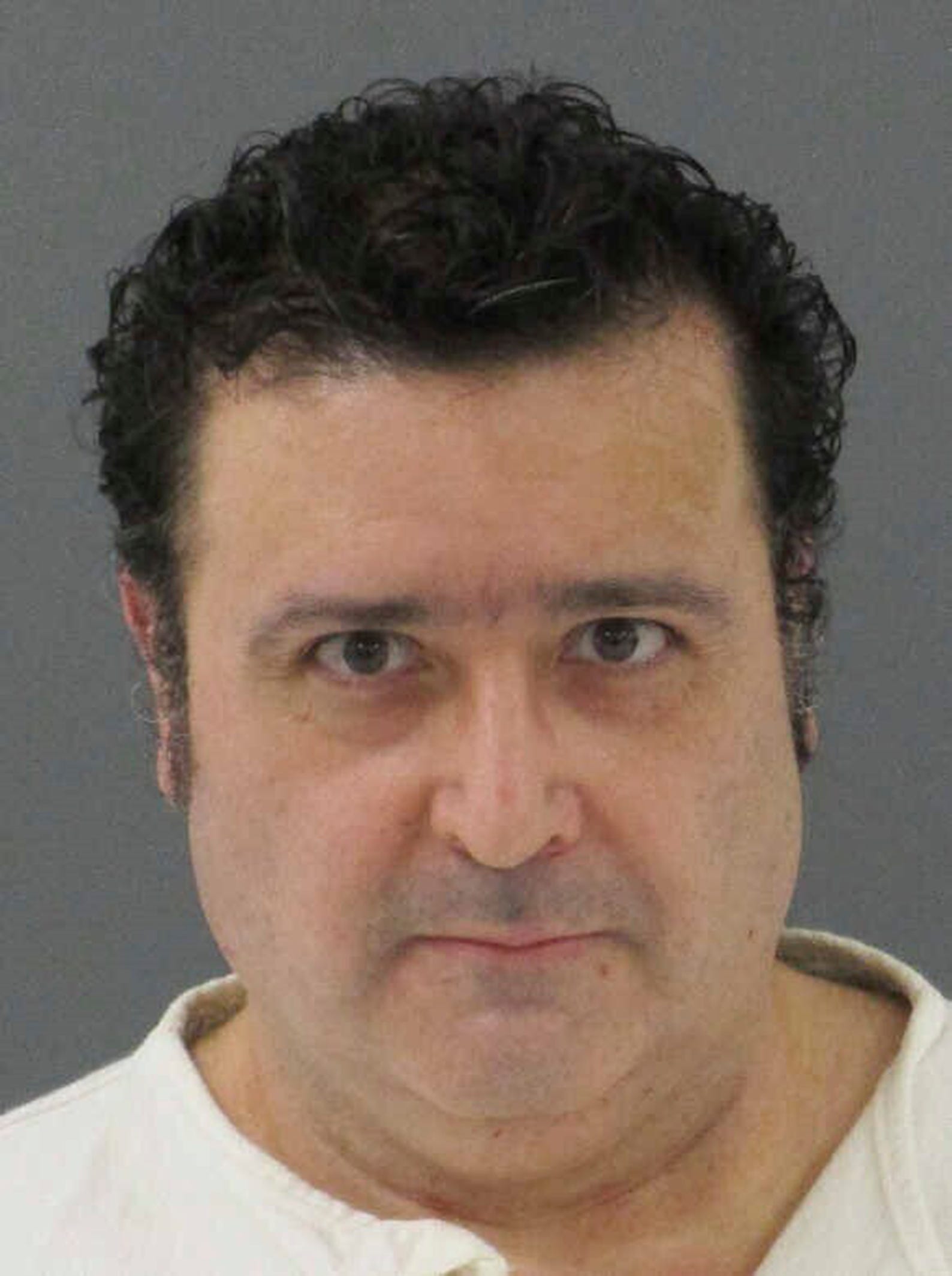
This photo released by the Texas Department of Criminal Justice shows death row inmate David Renteria. Renteria, a Texas inmate convicted of strangling a 5-year-old girl taken from an El Paso store and then burning her body nearly 22 years ago is facing execution. (Texas Department of Criminal Justice)

Alexandra’s sister, Sandra Frausto, and brother, Ignacio Frausto, attended the execution.

Renteria’s sister Cecilia Esparza and a friend also were present.

Esparza collapsed when she walked into the viewing room, and prison officials brought her a chair and she cried. Renteria told his sister through the glass, “I love you.”

Last days on Texas death row for one of El Paso’s most notorious killers

Renteria spent his final days meeting with visitors, laying in bed, watching TV through a cell door and sleeping, a Death Watch report states. The times listed below are in Central time zone.

On his execution day, starting at 12:15 a.m., he sat on his bed and began writing. The report does not state what he wrote.

He began packing up his property about 2:30 a.m., before sitting on the floor and reading a book around 4 a.m., the report states. He then continued packing up his property and cleaning the floor between 5 to 7:30 a.m.

Renteria was allowed to talk to fellow inmates at 7:30 a.m., before meeting with visitors from 8 to 11:30 a.m., the death watch states.

He was then transferred from the Texas Department of Criminal Justice’s Polunsky Unit in Livingston, Texas, to the Huntsville Unit to await his execution.

A victim of Renteria’s from a different criminal incident and her mother also attended the execution. Renteria was previously convicted and sentenced to 20 years in prison for indecency with a child in El Paso.

The execution was also attended by 14 state law enforcement and governmental officials.

Renteria grew up in the Lower Valley and was a tribal member of the Ysleta del Sur Pueblo, according to the Texas Coalition to Abolish the Death Penalty.

While in prison, he rededicated himself to his Roman Catholic faith, the coalition reported.

Renteria’s execution ends a nearly 22-year legal battle waged in what has been described as one of the most heinous crimes committed in El Paso.

“I’ve always been a supporter of the death penalty and from a law enforcement perspective, I just think some people are too dangerous to be in our society and that is certainly one individual who I think that that the death penalty is absolutely appropriate,” El Paso County Sheriff Richard Wiles said. “It’s a long time coming. I think it’s been what? Twenty-one years. I was actually the assistant (El Paso police) chief, (Carlos) Leon was the chief when that horrific crime occurred. It was really tough on everybody. I can’t even imagine what that family went through and what they’re still going through today.

“Hopefully, this will give them a little bit of relief to help them in their recovery that is going to take the rest of their lives, Wiles said. “I can’t even imagine losing my 5-year-old daughter to such a horrific crime.”

Justice served for Alexandra Flores in 2001 abduction nearly 22 years later

Renteria’s execution came two days before the 22nd anniversary of the day he kidnapped 5-year-old Alexandra Flores from an El Paso Walmart, strangled her to death and then burned her body. It also comes six days before his 54th birthday.

Renteria abducted Alexandra Nov. 18, 2001, as she was Christmas shopping with her parents at an El Paso Lower Valley Walmart.

Her parents realized she was missing and searched the store but could not find her. Alexandra was seen on store surveillance video exiting the store about 5:15 p.m. with Renteria.

Alexandra’s body was found about 7:10 a.m. the next day in an alley 16 miles (25km) away.. She was naked and partially burned in a carport near Downtown El Paso.

An autopsy revealed Alexandra was strangled to death and then set ablaze, court documents state. Investigators later revealed there were no signs of sexual assault.

A palm print on a plastic bag found over Alexandra’s head was determined to be from Renteria, court documents state.

El Paso Police Department investigators discovered that a vehicle registered to Renteria was at 9441 Alameda Ave. at the time and date of Alexandra’s disappearance. Renteria also told police he was at the location at the time and date of her disappearance, court documents state.

Renteria went to trial for the death of Alexandra in September 2003. He claimed in his trial that Barrio Azteca gang members forced him to kidnap the girl and someone else was the person who killed her, court records show.

A jury convicted him of capital murder and he was sentenced to death.

Appeals court justices heard the case in 2006 and upheld the conviction. However, the justices ordered a new sentencing phase of the trial.

The resentencing was ordered because of “exclusion of evidence showing the defendant’s remorse violated due process by preventing defendant from rebutting the State’s case when the State left jury with false impression and emphasized it,” the justices wrote in their opinion.

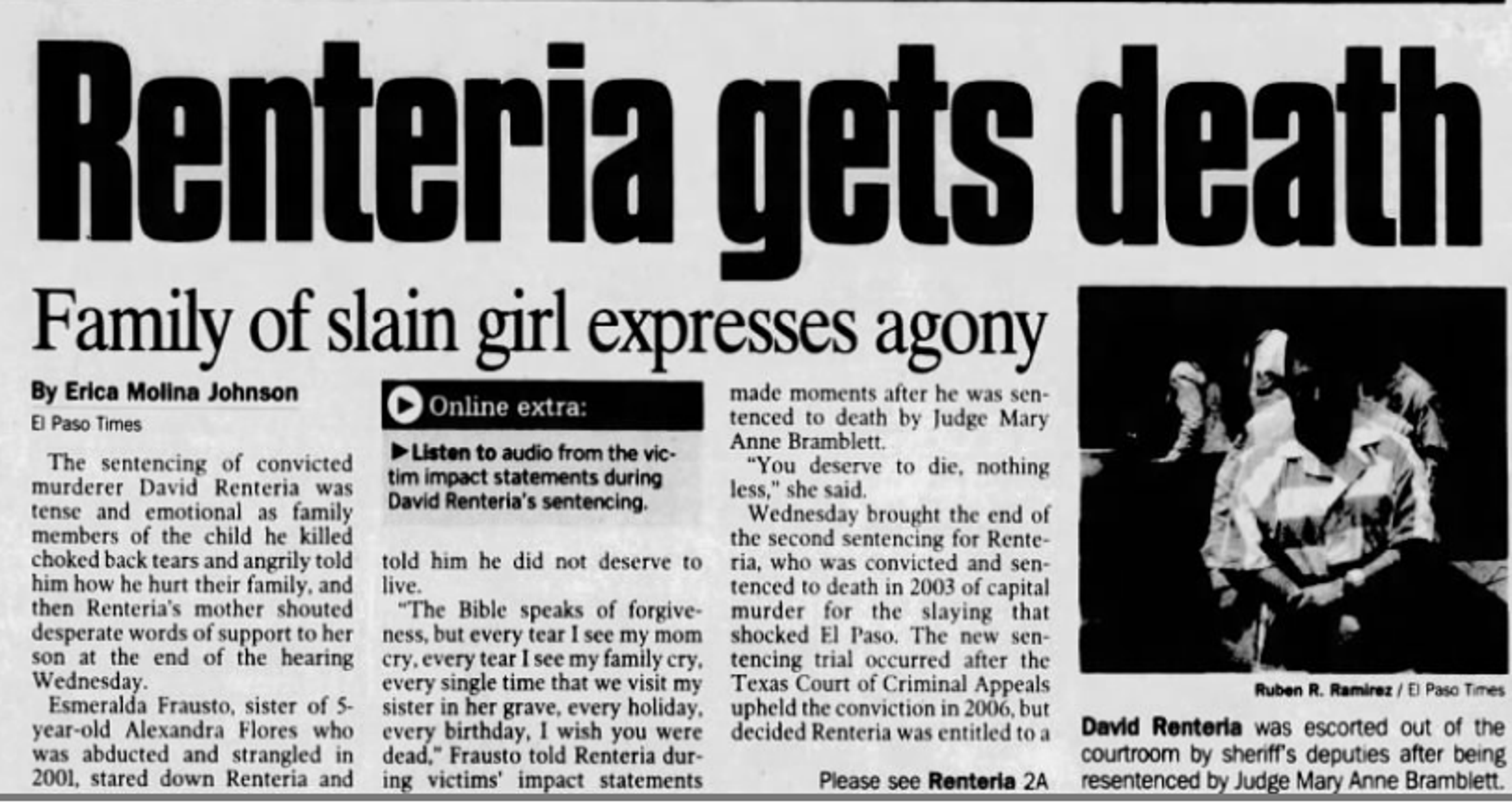
A May 15, 2008, El Paso Times article reporting David Santiago Renteria was given the death penalty during his resentencing hearing.

A May 15, 2008, El Paso Times article reporting David Santiago Renteria was given the death penalty during his resentencing hearing. 

KTSM 9 NEWS

DAVID SANTIAGO RENTERIA v. THE STATE OF TEXAS (Original)

El Paso Sheriff Deputy Peter Herrera’s family speaks after death penalty sentence

Who was Amber McLaughlin, the first transgender woman executed in the US? 04/01/2023


On Tuesday evening, 3rd January, Missouri witnessed the execution of the first transgender woman in the U.S. Amber McLaughlin, a 49-year-old openly transgender woman was executed in Missouri for a 2003 murder. This is the first-ever execution of a transgender in the U.S. Amber McLaughlin was found guilty of stalking and killing a former girlfriend before disposing of her body near the Mississippi River in St. Louis. McLaughlin’s fate was sealed earlier Tuesday when Republican Gov. Mike Parson denied the request for clemency.

McLaughlin was convicted of first-degree murder in 2006 in the killing of Beverly Guenther, and a judge sentenced her to death after the jury deadlocked on its sentencing decision. Missouri Gov. Mike Parson denied clemency Tuesday after advocates expressed concern over her sentencing.

“McLaughlin is a violent criminal,” Parson said in a statement Tuesday. “Ms Guenther’s family and loved ones deserve peace. The State of Missouri will carry out McLaughlin’s sentence according to the Court’s order and deliver justice.”

What was the 2003 case of McLaughlin?

McLaughlin was in a relationship with a woman, Beverly Guenther before her transition into a transgender woman. After they stopped dating, McLaughlin would show up at the suburban St. Louis office where the 45-year-old Guenther worked, sometimes hiding inside the building, according to court records. Guenther obtained a restraining order, and police officers occasionally escorted her to her car after work.

When Guenther did not return home on the night of 20th November 2003, her neighbours called the police. Officers went to the office building and discovered a blood trail and a broken knife handle near her car. McLaughlin led police to a location near the Mississippi River in St. Louis a day later, where the body had been dumped. Authorities claimed she was raped and repeatedly stabbed with a steak knife.

In 2006, McLaughlin was found guilty of first-degree murder. McLaughlin was sentenced to death by a judge after a jury deadlocked on the verdict. According to Komp, Missouri and Indiana are the only states where a judge can sentence someone to death.

A court in 2016 ordered a new sentencing hearing, but a federal appeals court panel reinstated the death penalty in 2021.

McLaughlin was pronounced dead at 6:51 pm. at the Eastern Reception, Diagnostic and Correctional Center in Bonne Terre, according to the Missouri Department of Corrections.

McLaughlin spoke quietly with a spiritual adviser at her side as the fatal dose of pentobarbital was injected. McLaughlin breathed heavily a couple of times, then shut her eyes. She was pronounced dead a few minutes later.

Final statement

“I am sorry for what I did,” McLaughlin said in a final, written, statement. “I am a loving and caring person.”

This morning McLaughlin was served a final meal of a cheeseburger, french fries, a strawberry milkshake and peanut M&Ms.

McLaughlin began her transition in prison about three years ago, according to a fellow inmate and friend, Jessica Hicklin. Hicklin said she rarely spoke to McLaughlin before McLaughlin’s transition, describing her fellow inmate as shy.

“Definitely a vulnerable person,” Hicklin described McLaughlin. “Definitely afraid of being assaulted or victimised, which is more common for trans folks in the Department of Corrections.”

Copiah County man convicted of capital murder will remain on death row


David Dickerson was convicted for the murder of Paula Hamilton in 2012.

A Copiah County man will remain on death row.

The State Supreme Court denied the appeal of 51-year-old David Dickerson. He was convicted for the murder of his ex-girlfriend, Paula Hamilton, who was the mother of his daughter.

Mississippi justices reject latest appeal in death row case | WJTV
Dickerson was convicted in 2012 for shooting Paula Hamilton to death and setting her body on fire in Copiah County.
Paula Hamilton

Dickerson shot Hamilton to death and then burned her body. He was convicted of capital murder in 2012.

Dickerson appealed his conviction and death sentence based upon an alleged intellectual disability.

In a mental evaluation, Dickerson was ruled mentally competent to stand trial and doctors said he had no credible symptoms of mental illness according to court documents.

The doctors also said Dickerson was uncooperative and fabricated psychiatric symptoms. His appeal was denied Thursday.

OHIO – Death penalty stays on table for Bryant


March 21, 2021

Faces trial in murder of 4-year-old boy

A judge denied a defense request that possibility of the death penalty be removed from the aggravated murder charge Kimonie D. Bryant faces in the shooting death of Rowan Sweeney, 4.

Bryant also is charged in the attempted murder of four adults.

Attorneys for Bryant, 24, of Struthers, filed a motion seeking dismissal of the death penalty and made oral arguments during a hearing before Judge Anthony D’Apolito in Mahoning County Common Pleas Court.

Bryant is accused of killing Rowan on Sept. 21, 2020, at the home Rowan shared with his mother and her boyfriend on Perry Street in Struthers. Bryant also is charged in the shootings of Rowan’s mother and three other adults who were there.

D’Apolito has been holding monthly hearings in the case and plans to continue to do so up to the Sept. 13 trial date.

He denied the defense’s request this week.

In their defense filing, attorneys for Bryant noted that this murder is “not a popular case” in that it involves the killing of a 4-year-old, which has prompted “Justice for Rowan” yard signs in Struthers and elsewhere.

“But the job of the lawyers and (judge) is the same in this and every case: to do the job effectively, objectively and without regard to personalities.”

It adds: “If someone else entered the home and did the shooting, as was testified to at the bindover hearing of Brandon Crump, then death would be an unjust penalty.”

Authorities have described Crump, 18, who is charged with aggravated robbery connected to the incidents that resulted in Rowan’s death, as a co-defendant of Bryant. He is not accused of shooting anyone.

Law enforcement officials have not specified how Crump’s alleged robbery is connected to the shootings, but Mahoning County Prosecutor Paul Gains said at the time Bryant was indicted that investigators believe about $5,000 in cash was in the home at the time of the shootings.

After Bryant is accused of fleeing from the home, the cash on the coffee table was gone, Gains said.

Judge Theresa Dellick of Mahoning County Juvenile Court has bound over Crump’s case to adult court, meaning he will be tried as an adult if a grand jury indicts him. Crump was originally charged in juvenile court because he was 17 at the time of Rowan’s death.

The filing says that when the death penalty was “reinvented” in the 1970s after being “invalidated” in most states in a 1972 U.S. Supreme Court decision, state legislatures sought to “rake in political capital that executing people yields.”

The filing called Ohio’s death penalty statute “vague and unconstitutional” and asked D’Apolito to remove the death penalty from Bryant’s indictment.

The filing argues that courts that have “rebuffed constitutional challenges to the death penalty have (strayed from) the concept of limited government ordained by the Constitution.”

Ohio’s death-penalty statute fails to genuinely narrow the class of individuals who are eligible for the death penalty, the filing states. “By failing to do so, the statute permits arbitrary and capricious imposition of the death penalty.”

The suspect in the Atlanta-area shootings could face the death penalty


March 18, 2021

robert aaron long

  • Robert Long, 21, was charged with eight counts of murder by Georgia prosecutors Wednesday.
  • Eight people, six of whom were Asian, were killed at three Atlanta massage parlours on Tuesday.
  • Long said he did it to remove sexual temptation but prosecutors are considering hate crime charges.

The suspect in Tuesday night’s Atlanta-area shootings could meet the threshold for receiving the death penalty under Georgia law.

On Wednesday, prosecutors charged Robert Aaron Long, 21, with eight counts of murder and one count of aggravated assault after shootings took place at three massage parlors across the city area.

In a press conference on Wednesday, law enforcement officials said that Long admitted to carrying out the attacks. However, he has yet to enter a plea to the charges.

He is due to appear in court Thursday, where he may issue a plea but does not have to.

If Long is ultimately convicted, the charges open him to Georgia’s death penalty. Prosecutors would have to choose whether to pursue it, and so far have not discussed the matter in public.

Robert Long Georgia Shooting
Security footage released by the Cherokee Sheriff’s Office in Georgia shows the 21-year-old suspect, Robert Long, getting into a car. Cherokee Sheriff’s Office

Under title 17 of the 2010 Georgia Code, most murders do not qualify for punishment by death.

But if one of 11 criteria are met, then it can be considered. They are listed here by the Atlanta Journal-Constitution, which also reported that Long could face the death penalty.

Some of the criteria – such as if the offender was on the run from prison, or if the victim was a police officer – appear not to apply. Others are broader, such as if the killings took place during another crime, or using a particularly dangerous weapon.

In Georgia, the death penalty is carried out by lethal injection. As of January, 39 men and one woman were on death row, state Department of Corrections data shows.

Out of the eight people killed on Tuesday night, six were Asian women, meaning prosecutors are deciding whether to charge Long with a hate crime, The Atlanta Journal Constitution and 11Alive reported.

Long told law enforcement that race did not play a part in the attack, saying instead that he was a sex addict and wanted to remove temptation.

“During his interview, he gave no indicators that this was racially motivated,” Frank Reynolds, Cherokee County Sheriff, said Wednesday.

“We asked him that specifically and the answer was no.”

The attack on Tuesday is the latest in a series which indicates attacks on Asian Americans in the US is on the rise.

As of Thursday morning, four of the Atlanta-area victims had been identified: Xiaojie Tan, 49, Delaina Ashley Yaun, 33, Paul Andre Michels, 54, and Daoyou Feng, 44.

David Barkley, senior Southeast counsel for the Anti-Defamation League, told the AJC: “We would urge the local prosecutor to bring hate crime charges along with the other charges.”

FLORIDA – Prison inmate who beat, killed his cellmate sentenced to death


A Santa Rosa Correctional Institution inmate who viciously beat and killed his cellmate in an apparent racial attack was sentenced to death Monday.

Shawn Rogers, 37, will be placed on death row for the murder and kidnapping of Ricky Dean Martin in 2012.

Rogers, who is a black man, and Martin, a white man, shared a cell in the prison. When word of unarmed black teenager Trayvon Martin’s death made it to the prison, Rogers carried out the racially motivated attack on Ricky Dean Martin that left him tied at the hands and feet, bruised, cut and in a coma that eventually killed him.

The court heard during Rogers’ trial that blood was smeared on the cell’s walls, and Rogers covered Martin’s body with a prayer rug before guards arrived. Martin’s face was covered with a pair of bloody boxer shorts.

A civil lawsuit filed by Martin’s family against the prison further claims Martin had filed grievances in the days before his death, saying he feared for his life and wanted to be moved from Rogers’ cell.

The same suit claims Rogers also raped Martin, though that claim was not presented by the state in Rogers’ criminal case.

Circuit Judge John Simon read a portion of Rogers’ sentencing document during court Monday, finding that the court agrees with the 12-person jury’s unanimous death recommendation.

“Mindful that a human life is at stake … the aggravating factors far outweigh the mitigating factors,” Simon said during sentencing, adding that not only did Rogers murder Martin, but he humiliated him in the process.

Rogers remained stoic as Simon read the document, not making any gestures or saying anything to his attorney, Kenneth Brooks. Rogers will join 349 other Florida prisoners on death row.

Neither Brooks nor prosecutor Jack Schlechter made any motions or arguments before Simon handed down the sentence. Both sides were allowed to present mitigating and aggravating factors in the case at a separate hearing in November, during which Simon heard about Rogers’ troubled past, with one doctor having called his upbringing a “perfect storm” for trouble.

At that same hearing, prosecutors pointed out Rogers had been functional to represent himself at trial, and was capable of premeditation because he voiced to others he would carry out an attack on a white person in the wake of Trayvon Martin’s death.

In addition to the death sentence for the murder charge, Simon sentenced Rogers to life in prison for the kidnapping to inflict terror charge.

Simon told Rogers he is entitled to an appeals process and per state law his death sentence will be automatically reviewed by the Supreme Court.

The civil lawsuit is still ongoing in Federal Court.

Mississippi Man Back on Death Row, Mental Evaluation Ordered


JACKSON, Miss. — The Mississippi Supreme Court on Thursday reinstated the death sentence of an inmate convicted of killing a prison guard.

Justices also ordered a state circuit court judge to hold another hearing on the mental capacity of Willie C. Russell , who came within hours of being executed more than two decades ago.

Russell, now 57, was convicted in the 1989 killing of Argentra Cotton, a guard at the Mississippi State Penitentiary at Parchman, where Russell was imprisoned for armed robbery, escape and kidnapping convictions in Hinds County.

A federal appeals court blocked the execution in January 1997 after Russell claimed he didn’t have a lawyer to appeal his death sentence. Russell later claimed he was intellectually disabled and could not be executed.

Sunflower County Circuit Judge Betty W. Sanders agreed and overturned the death sentence, and Russell remained in prison. On Thursday, justices said Sanders should have heard more testimony.

A majority of justices wrote that Russell underwent psychological testing in 2006 in an aggravated assault case, but he never underwent an assessment of intellectual disability.

In 2014, Sanders denied the state’s request for Russell to be evaluated for intellectual disability, saying the previous testing was sufficient. Five of the nine justices said Thursday that the judge conducted a “one-sided” hearing about Russell’s mental capacity before she overturned his death sentence.

However, four justices wrote a dissent, saying Russell had undergone enough psychological testing in 2006, and results of those tests could be used to determine whether he has an intellectual disability.

The U.S. Supreme Court ruled in 2002 that it is unconstitutional to execute a person who has intellectual disabilities.

Sanders is retired from the bench. A majority of justices said Thursday that an expert chosen by the state must be allowed to evaluate Russell before a circuit judge holds new hearing about his mental capacity.