last meal

FINAL LAST 48 HOURS OF SMITH’S LIFE. Died at 8.25 pm


Smith, 58, was executed on Thursday and died from nitrogen hypoxia at 8.25pm CT, the state’s Republican Governor Kay Ivey confirmed.

Final words included, “Tonight Alabama causes humanity to take a step backwards… Thank you for supporting me. Love you all.

I’m leaving with love, peace and light.” As officials began to administer the gas, Smith turned to his family and signed “I love you.” The witnesses reported seeing Smith thrashing and writhing.

Kenneth Smith Last Moments : From Family and Spiritual Advisors to steak and hash browns

A spokesperson from Alabama Departement of Corrections provided information about the final 48 hours of Smith’s Life.

During Wednesday, Smith received visits from his spiritual advisor, a friend, his brother, two nieces, his son, grandson, wife and attorney. Despite refusing breakfast and only partially eating his dinner, he did consume a lunch tray, accompanied by a Montain Dew, coffee, and a Pepsi. Addionally, he had a conversation with his wife over the phone.

Thursday, he was again visited by his spiritual advisor, his mom, wife, two friends, son, two daughter-in-law, and attorney. Again he spoke on the phone with his wife.

He was seen drinking coffee, sprite, and water. He hate his breakfast, wich consisted of two biscuits, eggs, grape jelly, applesauce and orange juice.

10 A.M Smith ate his final meal of T-bone steak, hash browns, toast and eggs slathered in A1 steak sauce, the Rev. Jeff Hood, Smith’s spiritual adviser, said in a statement.

“He is terrified at the torture that could come. But he’s also at peace. One of the things he told me he is finally getting out,” he added

His witness are set to be his wife, two sons, attorney, and a friend.

EXECUTION CARRIED OUT OKLAHOMA Phillip Dean Hancock 11/30/2023


Oklahoma executes man who claimed he killed two in self-defense

Phillip Dean Hancock killed by lethal injection after Republican governor declines to commute sentence despite recommendation

Oklahoma executed a man on Thursday who claimed he acted in self-defense when he shot and killed two men in Oklahoma City in 2001.

Phillip Dean Hancock, 59, received a three-drug lethal injection at the Oklahoma state penitentiary and was declared dead at 11.29am.

He requested a bucket of Kentucky Fried Chicken, dark meat only with no sides, as his final meal which he had with a root beer he bought on his own from commissary, according to a prison spokesman.

His execution went forward once the Republican governor, Kevin Stitt, declined to commute his sentence, despite a clemency recommendation from the state’s pardon and parole board.

“By unnecessarily stringing out his decision-making process for weeks, he has left the families of the victims in this case, all of Phil’s advocates and loved ones, the prison workers, and Phil himself, waiting for the news,” Abraham Bonowitz, executive director of the anti-death penalty group Death Penalty Action, said in a statement.

A spokeswoman for Stitt did not immediately respond to a message seeking comment on the governor’s decision to deny clemency or why it was delayed until shortly after the execution was originally scheduled.

Hancock had long claimed he shot and killed Robert Jett Jr, 37, and James Lynch, 58, in self-defense after the two men attacked him inside Jett’s home in south Oklahoma City. Hancock’s attorneys claimed at a clemency hearing this month that Jett and Lynch were members of outlaw motorcycle gangs and that Jett lured Hancock, who was unarmed, to Jett’s home.

A female witness said Jett ordered Hancock to get inside a large cage before swinging a metal bar at him. After Jett and Lynch attacked him, his attorneys said, Hancock managed to take Jett’s pistol from him and shoot them both, claiming to the parole board that “they forced me to fight for my life.”

Hancock’s lawyers also have said his trial attorneys have acknowledged they were struggling with substance abuse during the case and failed to present important evidence.

But attorneys for the state argued that Hancock gave shifting accounts of what exactly happened and that his testimony did not align with physical evidence.

Hancock is the fourth incarcerated person in Oklahoma to be executed this year and the 11th since Oklahoma resumed executions in October 2021 following a nearly six-year hiatus resulting from problems with lethal injections in 2014 and 2015. Oklahoma has executed more people per capita than any other state since the 1976 reinstatement of the death penalty.

Phillip Hancock says he wants his case to be remembered in last words before execution

EXECUTION CARRIED OUT ALABAMA Casey McWhorte 11/16/2023


Casey A. McWhorter, sentenced for murder on May 13, 1994

Casey McWhorter (ALABAMA DEPARTMENT OF CORRECTIONS)

An Alabama man who shot and killed his friend’s father in a premeditated robbery in 1993 has been put to death, killed by lethal injection on Thursday — over 30 years after the initial crime. Before he died, however, he had a dire message for other youth who were going through a tough mental time like he was.

Casey McWhorter was convicted of first-degree murder and sentenced to death after slaughtering 34-year-old Edward Lee Williams, 34, at the age of 18. He and two other teens, Williams’ 15-year-old son, conspired to steal money from his home and kill him. He went to the home to commit the crime but didn’t have the intention of actually following through with the killing, he said in a recent interview.

But the situation escalated after the older Williams came home during the robbery and surprised the teens. He said they had been in the home grabbing various items when he came in and began fighting with his son over the gun he had. That’s when McWhorter came out of one of the back rooms. Williams immediately noticed him and started swinging at him, and so he did the only thing he could think to do — he shot the other gun that was in his hand at that point, and it hit Williams in the abdomen despite McWhorter saying he had aimed for the legs.

Casey A. McWhorter spent most of his adult life on Alabama’s death row. Thursday night he died there.

The state of Alabama executed McWhorter, 49, by lethal injection in the death chamber of the William C. Holman Correctional Facility in Atmore. He was convicted of capital murder in 1994 in connection with a 1993 Marshall County robbery and homicide. He went to death row when he was 19. He had been 18 three months earlier, when the murder was committed.

The drapes of the media witness room opened at 6:30 p.m. McWhorter was lying in a bed partially covered by a tightly drawn white sheet. His head and torso were slightly elevated. He was lying cruciform, with both arms facing palm up. Restraints for his body were on top of the sheet. Two IV lines came from a small window in the back wall of the death chamber. One appeared to enter his right arm near the inside of his elbow, and the other appeared to enter his left arm at the inside of his left elbow.

Warden Terry Raybon read the death warrant and governor’s order of execution. McWhorter was given the opportunity to say last words.

His final words were: “I would like to say I love my mother and family. I would like to say to the victim’s family I’m sorry. I hope you found peace.” He then also took a jab at his executioner, the prison warden, who faced many accusations of domestic violence accusations decades ago, calling him a “habitual abuser of women.””

At 6:33 p.m. McWhorter closed his eyes. A minute later he shifted his legs, clenched his fists and moved his fingers.

He was approached by his spiritual advisor.

At 6:35 p.m. he was moving his fingers. And at 6:37 p.m. he raised his head, made a yawning motion, appeared to gasp and his eyes rolled into the back of his head. At 6:39 p.m. he appeared to stop breathing.

His spiritual advisor made the sign of the cross.

A few minutes after a corrections officer inside the death chamber bent to McWhorter’s ear and loudly called his name, the officer then touched his face and pinched the inside of his right arm.

At 6:47 p.m. the drapes to the media witness room were drawn.

McWhorter’s official time of death was given as 6:56 p.m.

McWhorter’s final meal consisted of Turtles candy, and he had visits with his mother, stepdad and a spiritual advisor, a prison spokesperson said. He also spoke with his attorney and his friends by phone. His death was the second execution in Alabama this year.

After the execution, a news conference was held inside the media center.

It took two “sticks” to access McWhorter’s veins, one to his right arm and one to his left arm, said John Hamm, commissioner of the Alabama Department of Corrections. He read a lengthy letter from April Williams, the daughter of Edward Lee Williams, the victim of the homicide.

She was 16 when her father was murdered.

“My Dad was only 33 years old. He should still be here,” the letter read, in part. “He should be ready to retire.”

Gilbert “Bert” Williams, Edward Lee Williams’ brother, addressed the media.

“It took 30 years for this to occur. It’s a kind of unfortunate that we had to wait this long, but justice has been served,” he said.

Gilbert Williams compared McWhorter’s execution to “…the peaceful death to a murderous dog.”

There are three witness rooms in the death chamber, which is attached to the building that houses death row. One witness room is for the victim’s family, one is for the media and the inmate‘s witnesses, and one is for state officials. McWhorter had no witnesses.

Who was Amber McLaughlin, the first transgender woman executed in the US? 04/01/2023


On Tuesday evening, 3rd January, Missouri witnessed the execution of the first transgender woman in the U.S. Amber McLaughlin, a 49-year-old openly transgender woman was executed in Missouri for a 2003 murder. This is the first-ever execution of a transgender in the U.S. Amber McLaughlin was found guilty of stalking and killing a former girlfriend before disposing of her body near the Mississippi River in St. Louis. McLaughlin’s fate was sealed earlier Tuesday when Republican Gov. Mike Parson denied the request for clemency.

McLaughlin was convicted of first-degree murder in 2006 in the killing of Beverly Guenther, and a judge sentenced her to death after the jury deadlocked on its sentencing decision. Missouri Gov. Mike Parson denied clemency Tuesday after advocates expressed concern over her sentencing.

“McLaughlin is a violent criminal,” Parson said in a statement Tuesday. “Ms Guenther’s family and loved ones deserve peace. The State of Missouri will carry out McLaughlin’s sentence according to the Court’s order and deliver justice.”

What was the 2003 case of McLaughlin?

McLaughlin was in a relationship with a woman, Beverly Guenther before her transition into a transgender woman. After they stopped dating, McLaughlin would show up at the suburban St. Louis office where the 45-year-old Guenther worked, sometimes hiding inside the building, according to court records. Guenther obtained a restraining order, and police officers occasionally escorted her to her car after work.

When Guenther did not return home on the night of 20th November 2003, her neighbours called the police. Officers went to the office building and discovered a blood trail and a broken knife handle near her car. McLaughlin led police to a location near the Mississippi River in St. Louis a day later, where the body had been dumped. Authorities claimed she was raped and repeatedly stabbed with a steak knife.

In 2006, McLaughlin was found guilty of first-degree murder. McLaughlin was sentenced to death by a judge after a jury deadlocked on the verdict. According to Komp, Missouri and Indiana are the only states where a judge can sentence someone to death.

A court in 2016 ordered a new sentencing hearing, but a federal appeals court panel reinstated the death penalty in 2021.

McLaughlin was pronounced dead at 6:51 pm. at the Eastern Reception, Diagnostic and Correctional Center in Bonne Terre, according to the Missouri Department of Corrections.

McLaughlin spoke quietly with a spiritual adviser at her side as the fatal dose of pentobarbital was injected. McLaughlin breathed heavily a couple of times, then shut her eyes. She was pronounced dead a few minutes later.

Final statement

“I am sorry for what I did,” McLaughlin said in a final, written, statement. “I am a loving and caring person.”

This morning McLaughlin was served a final meal of a cheeseburger, french fries, a strawberry milkshake and peanut M&Ms.

McLaughlin began her transition in prison about three years ago, according to a fellow inmate and friend, Jessica Hicklin. Hicklin said she rarely spoke to McLaughlin before McLaughlin’s transition, describing her fellow inmate as shy.

“Definitely a vulnerable person,” Hicklin described McLaughlin. “Definitely afraid of being assaulted or victimised, which is more common for trans folks in the Department of Corrections.”

EXECUTION CARRIED OUT 2022 – OKLAHOMA GILBERT POSTELLE 02.18.2022


GILBERT POSTELLE

Gilbert Ray Postelle was pronounced dead by lethal injection at 10:14 a.m. Thursday morning. He’s the fourth death row inmate to be killed since the state resumed capital punishment in October after a six-year moratorium. He was 35.

Five media members were selected by a random draw to witness the execution: Sean Murphy (Associated Press), Nolan Clay (The Oklahoman), Wayne Stafford (KOKH), Storme Jones (KWTV) and Dylan Goforth (The Frontier).

The witnesses said the execution appeared to happen without any complications. Their accounts were largely in line with the December execution of Bigler Stouffer and the January execution of Donald Grant, but drastically different from the October execution of John Marion Grant, who convulsed two dozen times and vomited multiple times during his execution.

Postelle did not have any last words.

Swindle’s sister, Shelli Milner, made a statement following the execution.

“It’s never over for the families of the victims. Today is not a joyous day for anyone. Today did not end anyone’s suffering. Today did not put closure on anything,” Milner said. “To know that [Postelle] will never walk this earth again does give me a little more peace than I had yesterday, but I will never have peace knowing what he did to my brother Donnie, to Amy, to James and to Terry.”

There are no more executions scheduled in the state at this point. Pending the results of the upcoming trial over the constitutionality of the current lethal injection protocol later this month, the state may schedule more executions.

Death row inmate Gilbert Ray Postelle’s request for clemency was denied by the Oklahoma Pardon and Parole Board in a 4-1 vote in December 2021.

Postelle, then 19, shot and killed four people — 57-year-old James D. Alderson, 56-year-old Terry L. Smith, 49-year-old James “Donnie” Swindle Jr., and 26-year-old Amy J. Wright — in southeast Oklahoma City on Memorial Day in 2005. The assault included nearly 100 shots fired from two assault rifles.

He was convicted of the four murders and given the death sentence for two.

Three others were charged with conspiracy and four counts of first-degree murder in the slayings. His brother, David Bradford Postelle, was sentenced to life in prison and their father, Earl Bradford Postelle, was ruled incompetent to stand trial in 2006. Another man, Randal Wade Byus, agreed to cooperate with authorities and pleaded guilty to reduced charges in 2008.

Postelle and his family believed one of the victims were responsible for a 2004 motorcycle accident, which left the elder Postelle physically and mentally disabled.

Gilbert Postelle’s attorney said he suffered from years of methamphetamine abuse that began around the age of 12. In 2021, he testified that he had been using meth for days leading up to the killings and doesn’t remember much about the crimes.

Last month, attorneys for Donald Grant and Postelle argued that the state’s lethal injection protocol exposed the two men to a constitutionally unacceptable risk of severe pain, citing the October 2021 execution of John Grant, who convulsed and vomited before he died.

Oklahoma’s method of execution — lethal injection — has been criticized as painful and terrifying, with claims it induces a sense of drowning comparable to the torture tactic of waterboarding.

Oklahoma held off on lethal injections for nearly six years after two botched executions. The state resumed the practice last fall, killing John Grant in October, Bigler Stouffer in December and Donald Grant in January.

The three-drug cocktail is being reviewed for constitutionality in district court in a trial that begins on Feb. 28.

Postelle’s last meal included 20 chicken nuggets, three large fries, one crispy chicken sandwich, one large cola, and one caramel frappe.

Execution carried out 2022- OKLAHOMA Donald Grant – JANV. 27.2022


McALESTER, Okla. — An Oklahoma man who had offered to be executed by firing squad was put to death by lethal injection Thursday morning, officials said.

Donald Anthony Grant, 46, was pronounced dead at 10:16 a.m. CT at the Oklahoma State Penitentiary, a state corrections spokesman announced.

The execution began at 10:03 a.m., and Grant was declared unconscious at 10:08 a.m. before his death at 10:16 a.m., Corrections Department Director Scott Crow said.

There were 18 witnesses, including news reporters, prosecutors, a police chief and loved ones of Grant and his victims.

Grant’s disjointed final words lasted two minutes before a prison staff member in the execution chamber stopped him and cut off the microphone.

“Grant’s last words were “yo God I got this, I got this, it’s nothing” before saying “I’ve got things to handle, no doubt, no doubt.” He also said “Brooklyn for life” among his other chants. Grant reportedly grew up in Brooklyn, New York, and was raised in and out of various foster homes.

Grant kept speaking after the microphone was turned off, looking toward his family members sitting in the front row of the witness room.

At one point, tears appeared to be rolling down his face.

Grant killed Brenda McElyea, 29, and Felicia Suzette Smith, 43, so there would be no witnesses to his robbery at the La Quinta Inn in Del City in July 2001.

LAST MEALGrant, the first person to be given the death penalty in 2022.

After requesting a very large meal, the inmate was given a lethal injection, currently the only approved method in Oklahoma. Grant’s menu included sesame chicken, six egg rolls, shrimp fried rice and a large apple fritter. If there was no dessert, Grant asked for three pints of strawberry ice cream. 

16 last meal requests from Nevada’s death-row inmates


Convicted murderer Scott Dozier is scheduled to be executed Nov. 14, 2017, the first execution in Nevada in 11 years.  (STAYED)

He will be able to request a last meal, provided it can be prepared at Ely State Prison; no outside food can be brought in.

Below are the last meal requests of prisoners executed in the state of Nevada since July 1954.

Steak
Leroy Linden, executed July 15, 1954 for the murder of Clarence Dodd.

Salami, roquefort cheese and anchovies
Frank Pedrini, executed July 15, 1954 for the murder of Clarence Dodd.

Steak and chocolate ice cream
Earl Lewis Steward, executed Feb. 24, 1960 for the murder of Thomas Jessen.

Chicken, vegetable soup, cherry pie, cheese and coffee
Thayne Archibald, executed Aug. 21, 1961 for the murder of Albert Waters.

Filet mignon, tossed salad with Thousand Island dressing, asparagus, baked potato with sour cream and an unspecified dessert
Jesse Bishop, executed Oct. 22, 1979 for the 1977 murder of David Ballard.

Jumbo shrimp, french fries, tossed salad with French dressing, clam chowder, cookies and candy
Carroll Cole, executed Dec. 6, 1985 for the 1979 murder of Marie Cushman.

Four double bacon cheeseburgers, french fries and a large Coke
William Paul Thompson, executed June 19, 1989 for the 1984 murder of Randy Waldron.

Pepsi
Sean Patrick Flanagan, executed June 23, 1989 for the 1987 murders of James Lewandowski and Albert Duggins.

Pizza with anchovies, apple pie, chocolate ice cream, jelly doughnuts and soft drinks
Thomas E. Baal, executed June 3, 1990 for the 1988 murder of Frances Maves.

Lasagna, chicken Parmesan, salad and ice cream
Richard Allen Moran, executed March 30, 1996 for the 1984 murders of Sandra Devere, Russell Rhodes and Linda VanderVoort.

No special request — standard inmate meal
Roderick Abeyta, executed Oct. 5, 1998 for the 1989 murder of Donna Martin.

Steak, rice, corn, applesauce and a Sprite
Alvaro Calambro, executed April 5, 1999 for the 1994 murders of Peggy Crawford and Keith Christopher.

Crab salad, French bread, 4-ounce lobster tail, mango, cheesecake, vanilla ice cream and aloe juice
Sebastian Stephanous Bridges, executed April 21, 2001 for the 1997 murder of Hunter Blatchford.

Cheeseburger with onions, pickle and tomatoes; french fries; three slices of pepperoni pizza; one pint each of vanilla, chocolate and chocolate chip ice cream; apple; banana; orange; a 20-ounce Coke and a 20-ounce Pepsi
Lawrence Colwell Jr., executed March 26, 2004 for the 1994 murder of Frank Rosenstock.

Two cheeseburgers and a Coke
Terry Jess Dennis, executed Aug. 12, 2004 for the 1999 murder of Ilona Straumanis.

Fish sandwich, french fries and lemon-lime soft drink
Daryl Mack, executed April 26, 2006 for the 1988 murder of Betty Jane May.

Missouri: July 14, scheduled execution of David Zink EXECUTED 7:41 PM


Zinks last meal was a cheeseburger, french fries, cheesecake and a soft drink, official said.

In a final statement, Zink said:

“I can’t imagine the pain and anguish one experiences when they learn that someone has killed a loved one, and I offer my sincerest apology to Amanda Morton’s family and friends for my actions. I hope my execution brings them the peace and satisfaction they seek.

I also have to apologize to the second set of victims, my family and friends, that had the unfortunate circumstance of developing emotions which will now cause them pain and suffering upon my execution. I kept my promise to fight this case for their benefit, and although unsuccessful to prevent the execution, we have been successful in exposing some serious flaws that offend the basic concept of the American Justice System.

For those who remain on death row, understand that everyone is going to die. Statistically speaking, we have a much easier death than most, so I encourage you to embrace it and celebrate our true liberation before society figures it out and condemns us to life without parole and we too will die a lingering death.”

7:50 p.m.

A Missouri inmate who killed a 19-year-old woman after sexually attacking her and tying her to a cemetery tree has been executed.

Fifty-five-year-old David Zink was put to death by injection Tuesday at a state prison south of St. Louis after the U.S. Supreme Court and Gov. Jay Nixon declined to intervene.

Zink was a paroled sex offender in 2001 when he abducted Amanda Morton after hitting her car on an Interstate 44 exit ramp a mile from her home. He told investigators he feared his drunken fender-bender could violate his parole and send him back to prison.

Jurors convicted Zink in 2004 and recommended a death sentence.

Corrections Department spokesman Mike O’Connell said Zink was pronounced dead at 7:41 p.m.

———

7 p.m.

The U.S. Supreme Court is refusing to block the scheduled execution of a Missouri inmate who killed a 19-year-old woman in 2001 after sexually attacking her and tying her to a cemetery tree.

The nation’s high court on Tuesday declined 55-year-old David Zink’s request to intervene. His lethal injection is set for later Tuesday. Gov. Jay Nixon also denied Zink’s request for clemency.

Zink was a paroled sex offender in 2001 when he abducted Amanda Morton after hitting her car on an Interstate 44 exit ramp a mile from her home. He told investigators he feared his drunken fender-bender could violate his parole and send him back to prison.

Jurors convicted Zink in 2004 and recommended a death sentence.

———

6:50 p.m.

Missouri’s governor has cleared the way for the scheduled execution of an inmate who killed a 19-year-old woman in 2001 after sexually attacking her and tying her to a cemetery tree.

Gov. Jay Nixon on Tuesday denied 55-year-old David Zink’s request for clemency and refused to block the execution scheduled for later Tuesday at a prison south of St. Louis.

Zink was a paroled sex offender in 2001 when he abducted Amanda Morton after hitting her car on an Interstate 44 exit ramp a mile from her home. He told investigators he feared his drunken fender-bender could violate his parole and send him back to prison.

Jurors convicted Zink in 2004 and recommended a death sentence. Nixon called the acts “brutal and horrifying” and said his denial of clemency upholds the jury’s decision.

———

11:30 a.m.

A Missouri inmate’s hopes of avoiding a scheduled execution for a 2001 killing are now in the hands of the U.S. Supreme Court and the governor.

A three-judge panel with the 8th U.S. Circuit Court of Appeals on Tuesday declined without comment David Zink’s claims that the death penalty is unconstitutional.

The St. Louis-based court on Monday rejected Zink’s challenge of the drug process used in lethal injections.

The nation’s high court is still weighing Zink’s case, and Gov. Jay Nixon is reviewing Zink’s clemency request.

Zink is scheduled to be put to death at 6 p.m. Tuesday for the killing of a 19-year-old Amanda Morton.

12:01 a.m.

A Missouri inmate is hoping federal appellate courts or the state’s governor spare him from his scheduled execution for the 2001 killing of a 19-year-old woman he abducted.

Fifty-five-year-old David Zink has 11th-hour appeals with the St. Louis-based 8th U.S. Circuit Court of Appeals and the U.S. Supreme Court, and a clemency request also was in Gov. Jay Nixon’s hands.

The Missouri Supreme Court declined to intervene Monday.

Zink was out on parole after serving 20 years in Texas on rape, abduction and escape charges when he abducted Amanda Morton after hitting her car from behind on a freeway ramp a mile from her Strafford home.

Zink later tied her to a cemetery tree in western Missouri, then snapped her neck before severing her spinal cord.

“The horror and fear 19-year-old Amanda Morton must have felt after being kidnapped by David Zink that July night is truly unimaginable,” Attorney General Chris Koster made the following statement following the execution. “David Zink callously took a young woman’s life, and it is fitting he pay by losing his own.”

Jurors in western Missouri’s St. Clair County deliberated 90 minutes in 2004 before convicting Zink and recommending a death sentence for the killing of Amanda Morton. Authorities said Zink abducted her after hitting her car from behind on an Interstate 44 exit ramp a mile from her Strafford home. Morton was driving home after visiting a friend.

Police found Morton’s Chevrolet Cavalier abandoned on the ramp with the keys in the ignition, the engine running and the headlights and hazard lights on. Her purse, credit card and medication were found inside the vehicle.

Just months before the slaying, Zink had been released from a Texas prison after serving 20 years on rape, abduction and escape charges. Fearing that his drunken fender-bender with Morton could violate his parole and send him back to prison, Zink initially abducted Morton, taking her to a motel. That site’s manager later saw a televised news report about Morton’s disappearance, recognized her as the woman who had checked in with Zink, and gave investigators Zink’s name and license plate number from motel registration.

Zink, after being arrested at his parents’ home, led authorities to Morton’s buried body in a cemetery, confessing matter-of-factly and at times laughing on videotape that he had tied her to a tree there and told her to look up. When the bewildered Morton begrudgingly glanced skyward, Zink said, he snapped her neck.

Worried that Morton might regain consciousness, Zink admitted, he used a knife to sever her spinal cord at the neck and covered her body with leaves before retrieving from his home a shovel he used to bury her.

“If I think that you’re going to pose a threat to my freedom, it is set in my mind I want to eliminate you,” Zink says in his videotaped confession.

An autopsy later showed that Morton had eight broken ribs and 50 to 100 blunt-force injuries. Morton also had been sexually assaulted, with DNA evidence linked to Zink found on her body.

Missouri has executed five men this year and 16 since November 2013. Only Texas has executed more inmates over that span
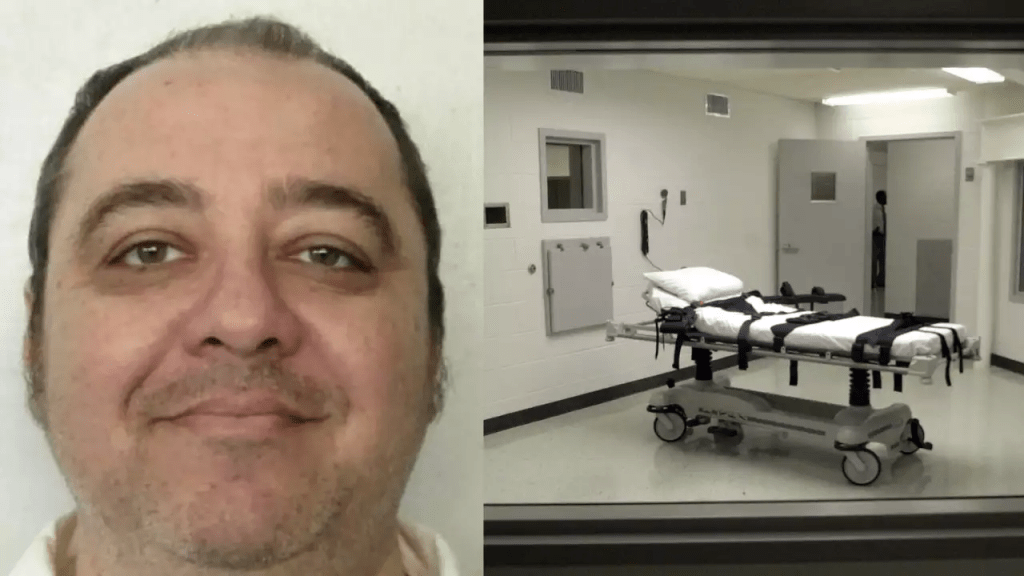
Missouri – Richard Strong Execution – June 9, 2015


June 10,2015

Missouri murderer Richard Strong was executed by lethal injection Tuesday night after authorities turned aside a last-minute plea from his daughter, who was only months old when Strong killed her mother and 2-year-old half-sister.

Strong, 47, was pronounced dead at 6:58 p.m. at the Eastern Reception, Diagnostic and Correctional Center in Bonne Terre, Missouri, according to the state Department of Corrections.

He ate a last meal of fried chicken, a cheeseburger and donuts, and asked forgiveness, according to the department.

His last words were: “Jehovah-jireh, you’re my provider. Your grace is sufficient for me. Forgive me for my sin. Abba-Abba, take my soul in your hands.”

Gov. Jay Nixon focused on Strong’s victims in a statement, acknowledging “there have been many lives deeply affected by these crimes.”

Petrina Thomas, whose niece was the toddler Strong killed, witnessed the execution and said in a statement she read to reporters that her family “was so glad that it is finally over.” (Read her full statement below.)

The execution was carried out after an unsuccessful plea for clemency from his daughter, who was a baby in 2000 when Strong murdered her mother and her half-sister. Last-minute appeals to the U.S. Supreme Court and to Nixon also failed.

Strong was sentenced to death in 2003 for fatally stabbing his 23-year-old girlfriend, Eva Washington, and her daughter from a previous relationship, Zandrea Thomas, in their suburban St. Louis apartment. He left Alyshia Strong, his baby with Washington, unharmed.

Alyshia Strong, now 14, said she has forgiven her father and pleaded for clemency in the days before his execution.

“I understand that my father needs to face consequences and to pay for what he did, but I do not think it is right for me to lose my father as part of the punishment,” Alyshia Strong wrote in her clemency petition.

She wrote that she frequently visits her dad in prison, and said his advice led her to behave better in school.

“My father told me that I should stay clear of the drama at school, and stay focused on the books, not the people. I listened to my father’s advice, and I can honestly say that I had less drama in my school year than I would have if I had not listened to my father,” she wrote.

The U.S. Supreme Court voted 5-4 against issuing a stay that would have postponed Tuesday’s execution. Strong’s attorney, Jennifer Herndon, argued that Strong was mentally ill. She said both Strong and Washington suffered from mental illness and argued frequently, according to The Associated Press.

“He just snapped,” Herndon said. “It was just sort of a powder keg waiting to explode. It wasn’t a healthy relationship.”

Nixon declined to halt the lethal injection, saying in a statement that the fatal stabbing of the mother and daughter was “very brutal.”

Strong is the fourth person to be executed in Missouri this year, and the 16th in the U.S.

Petrina Thomas, Zandrea Thomas’ aunt, read this statement during a press briefing following the execution, according to the Department of Corrections:

On behalf of the Thomas family, we would like to thank the state of Missouri for finally providing our family with closure of the horrific death of my niece and her mom. For 14 years, we have impatiently waited for this day to come. It has been said that time heals all wounds. I do not agree; the wounds remain. In time, the mind, protecting its sanity, covers them with scar tissue and the pain lessens, but it is never gone. The reality is we will grieve forever. We will not get over the loss of our loved ones, and we will learn to live with it. We will heal, and we will rebuild around the loss that we have suffered. We will never be the same again. He had a chance to watch his daughter grow up and laugh and smile with her. We never got a chance to see her first day of school, graduations, or watch her go on prom. My brother will never get a chance to walk his daughter down the aisle for her wedding day. Human life has dignity at any age. Nothing can justify the shedding of innocent blood or the taking of lives. You must take 100 percent responsibility for your choices and your actions, and pay with your own life. Revelation 21:4 reads: “He will wipe every tear from their eyes. There will be no more death or mourning or crying or pain, for the old order of things has passed away.”

We are at peace now and so glad that it is finally over. Thank you

Missouri executes William Rousan


Last meal: Bacon cheeseburger, onion rings, soft drink, and pecan pie

William Rousan’s last words were,

“My trials and transgressions have been many. But thanks be to my Lord and savior, Jesus Christ, I have a new home in his heavenly kingdom.”

April 23, 2014

— Missouri executed an inmate early Wednesday who was convicted of killing a farming couple in 1993 as part of a plot to steal their cows.

William Rousan’s last words were, “My trials and transgressions have been many. But thanks be to my Lord and savior, Jesus Christ, I have a new home in his heavenly kingdom.”

Before he was killed, Rousan, 57, mouthed words to his brother-in-law and a minister he had invited to his execution. As the drug was administered, he breathed deeply twice and then was still. He was declared dead at 12:10 a.m., nine minutes after the procedure started.

Prosecutors say Rousan, his teenage son, Brent Rousan, and his brother, Robert Rousan, murdered Charlie and Grace Lewis on Sept. 21, 1993 as part of a plot to steal their cows. Brent Rousan is serving life in prison without parole, and Robert Rousan served seven years in prison before being released in 2001.

The slain couple’s son and two daughters were among those who witnessed the execution, which took place only a few miles from where their parents were killed. Their son, Michael Lewis, spoke afterward.

“I draw no real satisfaction from Mr. Rousan’s incarceration or execution, for neither can replace or restore the moments lost with my parents or give my sons back the grandparents they never got to know,” he said.

Gov. Jay Nixon declined William Rousan’s clemency request Tuesday evening, clearing the way for the execution to proceed. In a statement explaining his decision, Nixon said he thought Rousan’s sentence was appropriate for his alleged role as the mastermind behind the “cold-blooded plot” that led to the couple’s slayings.

Earlier Tuesday, the U.S. Supreme Court turned down Rousan’s request to delay his execution.

Efforts to spare Rousan’s life hinged an argument that has held little sway over the courts — concerns about the secrecy used to obtain the execution drug, and the possibility that a substandard drug could cause pain and suffering in the execution process.

Several states, including Missouri, now use compounded execution drugs purchased from unnamed pharmacies. Courts so far have allowed most executions to move forward. However, on Monday, the Oklahoma Supreme Court stayed the executions of two death row inmates who challenged the secrecy surrounding the process of procuring execution drugs.

Missouri has executed one death row inmate each month since November. Another Missouri inmate, Russell Bucklew, is scheduled for execution on May 21. Only Texas, with seven executions, has executed more inmates than Missouri’s four so far in 2014. Florida has also executed four inmates this year.

According to prosecutors, William Rousan masterminded the plot to kill Grace Lewis, 62, and Charles Lewis, 67, at their farm near Bonne Terre. At the time, Rousan also lived in the same area of St. Francois County, about 70 miles southwest of St. Louis.

Authorities say the three men drove by the farm, and William Rousan pointed out the cattle to steal. They parked about two miles away and hiked through the woods to the farm. They watched as the couple returned home. Charles Lewis began cutting the lawn with a riding mower while his wife spoke to the couple’s daughter on the phone.

Brent Rousan, then 16, ambushed Charles Lewis, shooting him six times. Grace Lewis told her daughter on the phone she heard gunfire and stepped outside to check on the commotion. Brent Rousan shot her several times. She managed to go back into the home, but William Rousan followed her, placed a garment bag over her head and carried her outside.

He turned to his son and said, “Finish her off.” Brent Rousan fired a single shot into the side of her head.

The men placed the bodies in a tarp and put them near a shed. Later that night, they returned, along with another Rousan brother, loaded the bodies in the Lewis’ pickup truck, and took two cows, a VCR, jewelry, a saddle and other items.

For almost exactly a year, they got away with the crime. The couple seemingly had vanished without a trace.

In September 1994 investigators received two tips that helped them solve the case: Rousan’s brother-in-law, Bruce Williams, called police to implicate Rousan in the couple’s killings and a sister of William and Robert Rousan sold a VCR to a pawn shop that had been stolen from the Lewises.

The bodies were found buried in a shallow grave covered with concrete and a pile of horse manure on the farm where William Rousan was living at the time. After a four-day manhunt, Rousan was arrested while hiding in a barn on Sept. 20, 1994. He was caught with a .22-caliber semi-automatic rifle and a knife.

Brent Rousan pleaded guilty to two counts of first-degree murder and was sentenced to life in prison without the possibility of parole. Robert Rousan cooperated with prosecutors and pleaded guilty to second-degree murder.