El Paso

EXECUTION CARRIED OUT TEXAS DAVID RENTERIA 16/11/2023, 22 years after child abduction, killing


HUNTSVILLE, Texas − David Santiago Renteria spoke his last words Thursday night, strapped to a gurney at the Huntsville Unit, minutes before being executed in the 2001 abduction and killing of 5-year-old Alexandra Flores.

Renteria, 53, was injected with a lethal dose of pentobarbital Thursday, Nov. 16, on a dark, cold and rainy evening at the Texas Department of Criminal Justice’s prison. His time of death was 7:11 p.m. CST, prison officials said.

With his family and Alexandra’s family present, Renteria gave his final statements.

Killer’s final words

Renteria prayed before singing a hymn in English and another in Spanish after witnesses, including relatives of his victim, entered the death chamber and watched through a window a few feet from him during his execution.

Looking at his victim’s relatives, Renteria also said: “There is not a day that goes by that I do not think about the fateful events of that day and what transpired.

“There are no words to describe what you’re going through, and I understand that.”

He told his sister and a friend, watching through another window, that he was “good… strong”.

“I love you all, I truly do. I’ll see you in the next life,” Renteria added.

He then began reciting The Lord’s Prayer as the drugs began flowing. “Our father, who art in heaven” is as far as he got.

“I taste it,” he said of the drug, before mumbling something and all movement stopped.

The Renteria family watched the execution from a different room from Alexandra’s family. Glass windows separated the witnesses from Renteria.
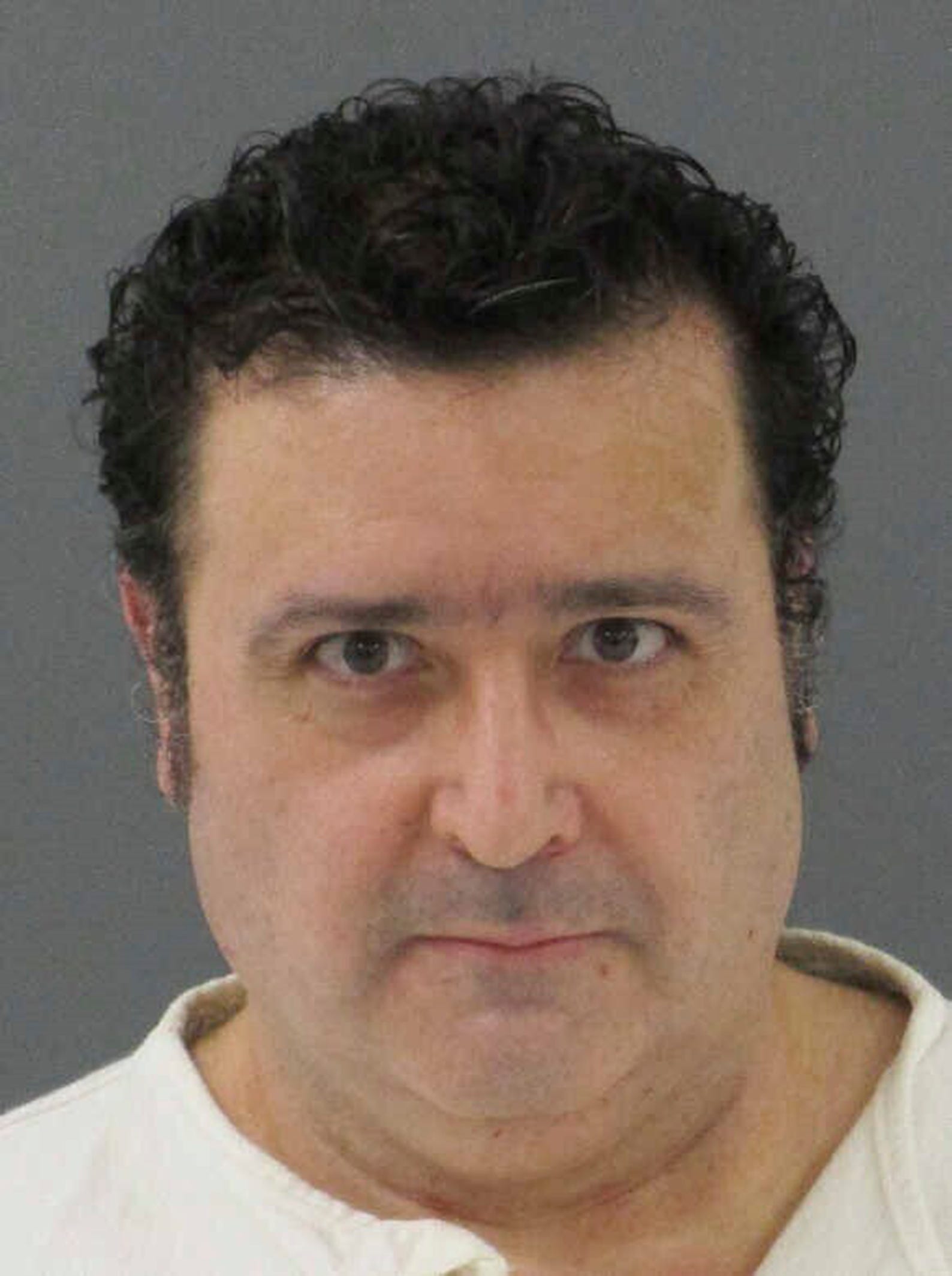
This photo released by the Texas Department of Criminal Justice shows death row inmate David Renteria. Renteria, a Texas inmate convicted of strangling a 5-year-old girl taken from an El Paso store and then burning her body nearly 22 years ago is facing execution. (Texas Department of Criminal Justice)

Alexandra’s sister, Sandra Frausto, and brother, Ignacio Frausto, attended the execution.

Renteria’s sister Cecilia Esparza and a friend also were present.

Esparza collapsed when she walked into the viewing room, and prison officials brought her a chair and she cried. Renteria told his sister through the glass, “I love you.”

Last days on Texas death row for one of El Paso’s most notorious killers

Renteria spent his final days meeting with visitors, laying in bed, watching TV through a cell door and sleeping, a Death Watch report states. The times listed below are in Central time zone.

On his execution day, starting at 12:15 a.m., he sat on his bed and began writing. The report does not state what he wrote.

He began packing up his property about 2:30 a.m., before sitting on the floor and reading a book around 4 a.m., the report states. He then continued packing up his property and cleaning the floor between 5 to 7:30 a.m.

Renteria was allowed to talk to fellow inmates at 7:30 a.m., before meeting with visitors from 8 to 11:30 a.m., the death watch states.

He was then transferred from the Texas Department of Criminal Justice’s Polunsky Unit in Livingston, Texas, to the Huntsville Unit to await his execution.

A victim of Renteria’s from a different criminal incident and her mother also attended the execution. Renteria was previously convicted and sentenced to 20 years in prison for indecency with a child in El Paso.

The execution was also attended by 14 state law enforcement and governmental officials.

Renteria grew up in the Lower Valley and was a tribal member of the Ysleta del Sur Pueblo, according to the Texas Coalition to Abolish the Death Penalty.

While in prison, he rededicated himself to his Roman Catholic faith, the coalition reported.

Renteria’s execution ends a nearly 22-year legal battle waged in what has been described as one of the most heinous crimes committed in El Paso.

“I’ve always been a supporter of the death penalty and from a law enforcement perspective, I just think some people are too dangerous to be in our society and that is certainly one individual who I think that that the death penalty is absolutely appropriate,” El Paso County Sheriff Richard Wiles said. “It’s a long time coming. I think it’s been what? Twenty-one years. I was actually the assistant (El Paso police) chief, (Carlos) Leon was the chief when that horrific crime occurred. It was really tough on everybody. I can’t even imagine what that family went through and what they’re still going through today.

“Hopefully, this will give them a little bit of relief to help them in their recovery that is going to take the rest of their lives, Wiles said. “I can’t even imagine losing my 5-year-old daughter to such a horrific crime.”

Justice served for Alexandra Flores in 2001 abduction nearly 22 years later
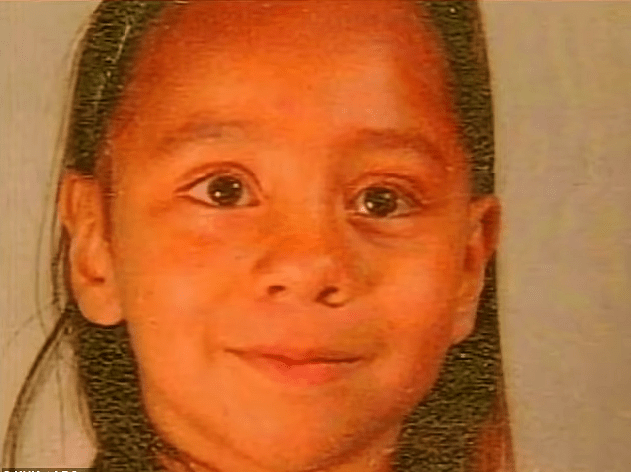
Renteria’s execution came two days before the 22nd anniversary of the day he kidnapped 5-year-old Alexandra Flores from an El Paso Walmart, strangled her to death and then burned her body. It also comes six days before his 54th birthday.

Renteria abducted Alexandra Nov. 18, 2001, as she was Christmas shopping with her parents at an El Paso Lower Valley Walmart.

Her parents realized she was missing and searched the store but could not find her. Alexandra was seen on store surveillance video exiting the store about 5:15 p.m. with Renteria.

Alexandra’s body was found about 7:10 a.m. the next day in an alley 16 miles (25km) away.. She was naked and partially burned in a carport near Downtown El Paso.

An autopsy revealed Alexandra was strangled to death and then set ablaze, court documents state. Investigators later revealed there were no signs of sexual assault.

A palm print on a plastic bag found over Alexandra’s head was determined to be from Renteria, court documents state.

El Paso Police Department investigators discovered that a vehicle registered to Renteria was at 9441 Alameda Ave. at the time and date of Alexandra’s disappearance. Renteria also told police he was at the location at the time and date of her disappearance, court documents state.

Renteria went to trial for the death of Alexandra in September 2003. He claimed in his trial that Barrio Azteca gang members forced him to kidnap the girl and someone else was the person who killed her, court records show.

A jury convicted him of capital murder and he was sentenced to death.

Appeals court justices heard the case in 2006 and upheld the conviction. However, the justices ordered a new sentencing phase of the trial.

The resentencing was ordered because of “exclusion of evidence showing the defendant’s remorse violated due process by preventing defendant from rebutting the State’s case when the State left jury with false impression and emphasized it,” the justices wrote in their opinion.
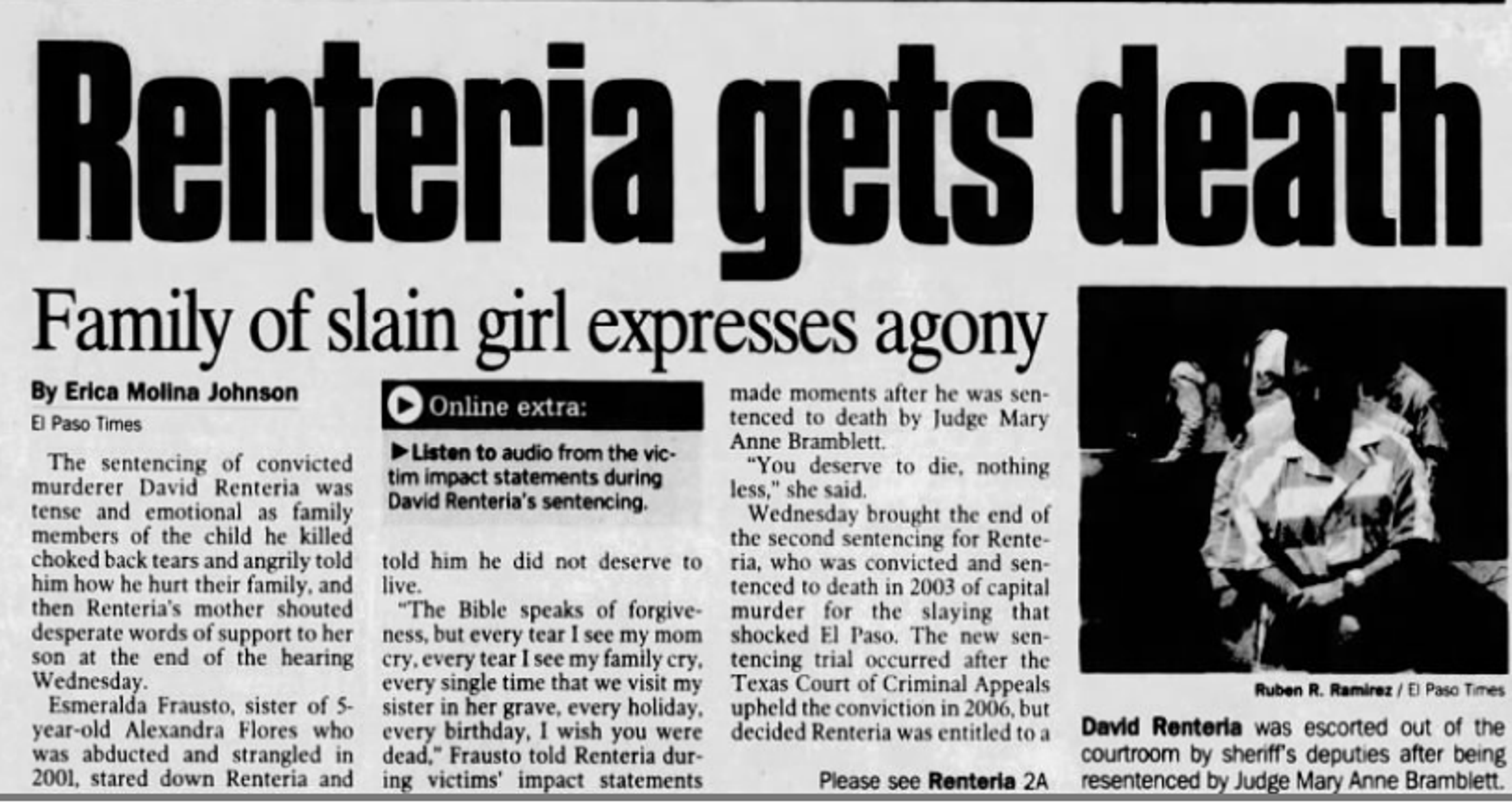
A May 15, 2008, El Paso Times article reporting David Santiago Renteria was given the death penalty during his resentencing hearing.

A May 15, 2008, El Paso Times article reporting David Santiago Renteria was given the death penalty during his resentencing hearing. 

KTSM 9 NEWS

DAVID SANTIAGO RENTERIA v. THE STATE OF TEXAS (Original)

El Paso Sheriff Deputy Peter Herrera’s family speaks after death penalty sentence

Texas Defender Service (TDS)


June 20,2013
The July 10 execution date for our client, Rigoberto Avila, Jr., has been withdrawn by 41st District Court Judge Annabell Perez to give Mr. Avila time to litigate new scientific evidence relevant to the merots of hos case. El Paso DA Jaime Esparza did not oppose Mr. Avila’s motion to withdraw the July 10 execution date.

TEXAS – George’s Case – EXECUTED


 Execution day click here
George Rivas, 30, is, without question, a career criminal. Highly intelligent with a larger than life ego, it is little wonder that he plotted the Connally Unit breakout and appointed himself ringleader of the Texas 7. When it comes time for him to leave this world, an appropriate epitaph might read, “Guilty of crimes against humanity, and guilty of a wasted life.”Born in El Paso, Texas, on May 6, 1970, the six foot, 231 pound brown-haired, brown-eyed criminal with rugged good looks and a soft-spoken voice, could have been just about anything he wanted to make of himself had it not been for his lust for cash.Rivas, described by a former classmate as a “Beavis and Butthead kind of guy,” had aspirations of becoming a policeman before he turned to a life of crime, and spoke of his dream often. But he would never become a cop. Raised by his grandmother and grandfather after his parents divorced when he was 6, Rivas cruised through high school without attracting a lot of attention. Having a fascination with guns, he named his two dogs Ruger and Baretta, and began thinking about a life of crime.Characterized as intelligent, well spoken and friendly, Rivas did not get into trouble with the law until shortly after graduating from Ysleta High School in 1988 where, according to a high school spokesman, he was identified as a quiet guy who did not participate in any school activities. He committed his first robbery and burglary the following year, but since he had no prior criminal record he was sentenced to probation for 10 years.While on probation, Rivas enrolled at the University of Texas at El Paso where he signed up as a general studies major in the fall of 1992. After three semesters, unable to shake his criminal bent and lust for cash, he dropped out in the spring of 1993 and embarked on a short-lived criminal career that would land him in prison. There were striking similarities to his crimes that tied him to a string of robberies in El Paso that could be seen in his modus operandi of the prison breakout and the robbery of the Radio Shack in Pearland, as well as to a string of holdups, at least a dozen, that he was suspected of committing in Texas, New Mexico, and Arizona.One of the robberies he was suspected of committing occurred on October 3, 1992, at a Radio Shack in El Paso. According to a police report, he was suspected of handcuffing a salesman and then robbing the store of cash, two-way radios, as well as other merchandise.Less than three weeks later, on October 23, he was suspected of entering a Checker Auto Parts store under the guise of buying a car battery when he pulled a gun on a salesman. He was accused of forcing the salesman to remove his uniform shirt, after which he handcuffed him and forced him into the restroom. He then put on the uniform shirt and forced the store’s assistant manager to open the safe, of which he cleaned out all the cash on hand.Barely two weeks after the auto parts store robbery, Rivas walked into an El Paso Oshman’s sporting goods store near closing time under the guise of looking at ski boots. He went so far as to ask the assistant manager to keep the store open a bit longer so that he could purchase a pair of the boots, and explained that he was waiting for a friend to bring his wallet to him. When he was satisfied that he had the assistant manager’s cooperation, he pulled out a gun and ordered him to call all of the employees together.”I’m with store security,” Rivas told the employees as they arrived one by one. After he had gathered everyone together, he pulled out his gun and announced, “This is a robbery.” He then called an accomplice on a two-way radio, took a uniform shirt from an employee and put it on so that he wouldn’t unduly stand out just in case someone unexpectedly came in, such as the police, and he and his accomplice handcuffed all of the employees except one to a heavy ski grinding machine. Afterward, Rivas forced the store’s manager to empty the safe for him. He took all of the cash, $5095, as well as 58 guns. He didn’t touch anything during the robbery, but instead forced the employee to pick up and pack the items that he wanted to steal.”I’ve written down all of your license plate numbers and can find out where you live if anyone tries to identify us,” Rivas said as he and his accomplice left the store. He also said that he would return and kill them if anyone called the police.The employees waited about twenty minutes after Rivas and his accomplice left the store. They then dragged the ski grinding machine to a phone and called the police, after which they dragged the machine back to its original location out of fear that Rivas might return and find out what they had done.Rivas’s next known robbery occurred on May 12, 1993, when Rivas, donning a blond wig and brandishing a gun, went inside a Furr’s grocery store in El Paso and forced all of the employees into a back room. He took all of the cash that he could locate.On May 25, 1993, Rivas and an accomplice disguised themselves as security guards and walked into a Toys ‘R’ Us store. After rounding up eight employees, Rivas and his accomplice robbed the store. Although his previous robberies had been carried out with military-like precision, in this case he somehow missed one of the employees who escaped and called the police. When the police arrived, Rivas and his accomplice held them at bay for more than three hours by using the employees as hostages. However, a SWAT team was called in when the police officers realized that they weren’t going to get anywhere. The SWAT team stormed the store and found Rivas, wearing a blond wig, hiding in an air conditioning duct. They also recovered some of the guns that had been stolen from the Oshman’s sporting goods store robbery earlier. Although his arrest ended the string of local robberies, he was still suspected of committing the numerous robberies in other parts of Texas, Arizona and New Mexico.

Following his arrest, numerous employees from the various stores that he had robbed positively identified Rivas as the perpetrator. At his trial, he claimed that he was having dinner with his wife during the Oshman’s robbery and had been mistakenly identified. The jury didn’t buy his claims of mistaken identity in that case, or any of the others, and he was convicted of multiple counts of aggravated armed robbery, aggravated kidnapping, and burglary under various theories of law.

Dr. Richard Coons, a court-appointed Austin psychiatrist, examined Rivas prior to his trial. Despite the fact that nobody had been injured during the commission of any of Rivas’s crimes, Coons opinion was that had only been a matter of luck and not because of Rivas’s kindness.

“He demonstrates an unusual degree of interest, creativity and intensity in his craft,” Coons said. “He is confident and arrogant. He is a mastermind and a leader. He has no conscience, and he does not speak the truth.”

Rivas was sentenced to 18 life terms in prison, 17 of which were ordered to run consecutively. The judge wanted to make certain that he never left prison, alive.

Following Rivas’s escape from the Connally Unit, Dr. Coons was contacted by members of the news media and related that when Rivas and his cohorts were found and confronted by the police, the confrontation would likely turn deadly.

source : trutv
Supreme court of united states
No. 11-6812      *** CAPITAL CASE ***
Title:
George Rivas, Petitioner
v.
Rick Thaler, Director, Texas Department of Criminal Justice, Correctional Institutions Division
Docketed: October 12, 2011
Lower Ct: United States Court of Appeals for the Fifth Circuit
  Case Nos.: (10-70007)
  Decision Date: July 14, 2011
~~~Date~~~ ~~~~~~~Proceedings  and  Orders~~~~~~~~~~~~~~~~~~~~~
Oct 10 2011 Petition for a writ of certiorari and motion for leave to proceed in forma pauperis filed. (Response due November 14, 2011)
Nov 9 2011 Brief of respondent Rick Thaler, Director, Texas Department of Criminal Justice, Correctional Institutions Division in opposition filed.
Nov 23 2011 DISTRIBUTED for Conference of December 9, 2011.
Dec 12 2011 Petition DENIED.

~~Name~~~~~~~~~~~~~~~~~~~~~ ~~~~~~~Address~~~~~~~~~~~~~~~~~~ ~~Phone~~~
Attorneys for Petitioner:
Franklyn Mickelsen Broden & Mickelsen (214) 720-9552
2600 State Street
Dallas, TX  75204
Party name: George Rivas
Attorneys for Respondent:
Edward L. Marshall Chief, Post Conviction Litigation Division (512) 936-1400
    Counsel of Record Office of the Attorney General
P.O. Box 12548
Capitol Station
Austin, TX  78711-2548
edward.marshall@oag.state.tx.us
Party name: Rick Thaler, Director, Texas Department of Criminal Justice, Correctional Institutions Division