death row

Georgia Sets March 20 Execution Date for Willie Pye Despite Strong Evidence of Intellectual Disability and Previous Finding of Ineffective Representation by Attorney with History of Racial Bias EXECUTED 11.03 PM


UDPATE march 22. 2024

he state of Georgia on Wednesday executed death row inmate Willie Pye, who was convicted and sentenced to die for the 1993 murder of Alicia Lynn Yarbrough.

The execution – Georgia’s first in more than four years – was carried out by lethal injection at 11:03 p.m. at a prison in Jackson, about 50 miles south of Atlanta, the Georgia Department of Corrections said in a news release. Pye did not make a final statement, it said.

Pye, 59, was put to death after the US Supreme Court denied his final appeals late Wednesday. In a clemency petition and various court filings, Pye and his attorneys had argued for his life to be spared, citing an intellectual disability, a troubled upbringing and ineffective assistance of counsel.

“The State of Georgia obtained Willie’s death sentence only after providing him a racist and incompetent defense attorney. And the State has insisted on standing by that death sentence in spite of his lifelong intellectual disability and the fact that he presents a danger to no one in prison,” his attorney, Nathan Potek, said after the execution.

“The people of Georgia deserve better,” he added, describing Pye as a loving son, brother and uncle who “will be dearly missed by his friends, family, and his legal team.”

March 7, 2024

The Georgia Attorney General has announced that Willie James Pye, who previously had his death sentence reversed due to his attorney’s failure to investigate his background, only to see the death sentence reinstated on appeal, is set to be executed on March 20. Mr. Pye’s court-appointed trial attorney, Johnny Mostiler, has been accused of ineffective representation or racial bias in at least four cases involving Black defendants and reportedly called one of his own clients a “little n****r.” Mr. Pye has also exhibited “undisputed” signs of intellectual disability, with an IQ of 68 and a history of learning difficulties. Georgia has not conducted an execution in over four years, and Mr. Pye is the state’s first scheduled execution date in about two years.

Mr. Pye was convicted and sentenced to death in 1996 for the kidnapping, robbery, rape, and murder of his ex-girlfriend Alicia Yarbrough. At the time, Mr. Mostiler had a lump-sum deal with Spalding County to represent the entire indigent criminal caseload, which numbered some 800 felony and five capital cases. He also had an active private civil practice. Mr. Mostiler only spent about 150 hours on Mr. Pye’s case, including the trial itself, while studies have found that thousands of hours are typically required for effective capital defense representation. He also spent less than five hours preparing the case for a life sentence, most of it on the day of the penalty phase and the day before. Due to his limited investigation, he did not uncover evidence of Mr. Pye’s traumatic upbringing and intellectual disability. Mr. Pye grew up experiencing “near-constant physical and emotional abuse, extreme parental neglect, endangerment, and abject poverty.” He battled severe depressive episodes and reported hearing voices prior to the killing. However, Mr. Mostiler relied on Mr. Pye’s sister to recruit family members as witnesses and told them only to testify to Mr. Pye’s good character, without delving into the difficulties of Mr. Pye’s childhood. He did not request an evaluation of Mr. Pye’s intellectual functioning or develop evidence regarding the claim even after the state expert tested Mr. Pye’s IQ at 68, in the impairment range. 

At least three of Mr. Mostiler’s clients have been executed, including Kenneth Fults and Curtis Osborne; Mr. Mostiler infamously slept through portions of Mr. Fults’ trial, and he told a white client that he would spend much more money on his case than on Mr. Osborne’s because “that little n****r deserves the chair.” In Frederick Whatley’s case, Mr. Mostiler allowed the prosecution to force Mr. Whatley to reenact the murder while shackled in manacles and leg irons. Justice Sonia Sotomayor later wrote that it was “hard to imagine a more prejudicial example of needless shackling.” A 2001 profile of Mr. Mostiler following his death found that he had handled “more than seven times the number of indigent cases the American Bar Association (ABA) believes is manageable…turning over one case every 100 minutes, less time than a private attorney might devote to a simple traffic violation.” The profile called him the “archetype” of “meet ’em, greet ’em, and plead ’em” lawyers. 

In 2021, the U.S. Court of Appeals for the Eleventh Circuit overturned Mr. Pye’s death sentence, unanimously finding that Mr. Mostiler failed to investigate and present a broad range of available mitigating and rebuttal evidence. The panel did not reach the merits of Mr. Pye’s intellectual disability claim, writing that the ineffective assistance claim was sufficient to require a new sentencing trial, but highlighted substantial evidence of Mr. Pye’s low cognitive functioning. However, on the state’s motion, the Eleventh Circuit reconvened en banc (with the full court) and reinstated Mr. Pye’s death sentence. The court acknowledged that Mr. Mostiler’s performance was deficient, but held that it was required under the Anti-Terrorism and Effective Death Penalty Act (AEDPA) to defer to the state court’s finding that Mr. Mostiler’s performance did not prejudice Mr. Pye. The majority interpreted AEDPA and Supreme Court precedent to conclude that even if the state court’s decision rests on clear errors, federal courts must defer to that decision if there are “additional rationales” that support it. In other words, the federal reviewing court may theorize reasons for the state court’s outcome and adopt those reasons to justify a state court decision that is otherwise wrong on the facts or the law.

Willie James Pye v. Warden, Georgia Diagnostic and Classification Prison (US COURT OF APPEALS) 2021

wo judges dissented in full, while two additional judges joined the dissent in part but concurred in the judgment. Dissenting Judge Jill Pryor wrote that the majority had directly violated Supreme Court precedent by “turning to justifications the state never even hinted at” and relying on “a half-baked textual analysis” in support. She further argued that the holding “creates a practically impossible path to relief for habeas petitioners…[i]f federal courts can bury unreasonable findings under an avalanche of new reasons the state court never gave, then unreasonable findings will virtually never be important enough to satisfy the majority’s test.” 

Judge Pryor also noted the “undisputed evidence” of Mr. Pye’s low intellectual functioning. Supreme Court jurisprudence and scientific research recognize IQ scores below 70 as a strong, often definitive indicator of intellectual disability. Georgia has one of the lowest appellate success rates of intellectual disability claims by capital defendants, with an 11% success rate compared to 82% in neighboring North Carolina. Georgia is also the only state that requires defendants to prove their intellectual disability “beyond a reasonable doubt” at trial, and a 2017 study found that only one defendant had ever been found exempt from the death penalty on these grounds in three decades. Research shows that states that significantly deviate from accepted clinical standards, including Georgia, are much less likely to exempt defendants from the death penalty based on intellectual disability.

Judge Pryor concluded that under the majority’s ruling, the “writ of habeas corpus is illusory—impossible, even, to obtain.” She wrote that as the author of the panel opinion, reading the full court’s opinion made her feel like she had “stepped through the looking glass.” However, “what happened during Alice’s time through the looking glass was a dream…This case, unfortunately, is not.”  

TEXAS – Ivan Cantu execution set for today 6PM EXECUTED 6PM47


Subscribe to continue reading

Subscribe to get access to the rest of this post and other subscriber-only content.

All 58 Louisiana death row inmates with no execution date wait as bill proposes death by nitrogen gas


Subscribe to continue reading

Subscribe to get access to the rest of this post and other subscriber-only content.

Utah Court Rules Prisoner Suffering from Dementia Requires a Competency Assessment Following the State’s Request for Execution


Subscribe to continue reading

Subscribe to get access to the rest of this post and other subscriber-only content.

USA: Execution set despite fair trial concerns


Subscribe to continue reading

Subscribe to get access to the rest of this post and other subscriber-only content.

Man on death row for cousin killing says he was ‘framed’ as Kim Kardashian backs his case


January 28, 2024

Ivan Cantu was sentenced to death in 2001 for the murders of his cousin James Mosqueda and his cousin’s fiancée Amy Kitchen, but he has always maintained his innocence and now Kim Kardashian is fighting for his release

Kim Kardashian is fighting to save death row inmate Ivan Cantu after he was convicted for the murders of his cousin and his cousin’s fiancée.

Kim Kardashian has now become involved in the case ( Image: Getty Images)

Cantu has been on death row for more than two decades. He was sentenced to death in 2001 for the fatal shootings of James Mosqueda and Amy Kitchen, but has always maintained his innocence.

Amy and James were killed during a robbery at their home in North Dallas back in November 2000. Cantu has accused police officers of taking “witness statements and testimony at face value” and not properly investigating the claims. He alleges this led to “false and untruthful information” which culminated in his arrest.

Ivan Cantu was sentenced to death

(Image: Texas Department of Criminal Justice)

Investigators said they believed robbery was the motive for the killings. “Officers believe the crime occurred because robbery was the motive, the murders occurred during a robbery attempt, the car was taken, and some other items were also missing,” police told FOX 4 at the time.

At Cantu’s trial, prosecutors presented evidence of his fingerprints on the gun used in the murders, as well as bloody clothing seized from Cantu which had the victims’ DNA on it. However, true crime podcaster Matt Duff claims Cantu’s fiancée and the state’s star witness Amy Boettcher, who is now deceased, lied on the stand.

“Amy said Ivan had stolen James’s watch and then tossed it out the window,” Matt said during an episode of the Cousins by Blood podcast. The private investigator added: “Early in my investigation I discovered the Rolex. Although it was reported missing, it was later recovered at the house and given back to the family. So the family had that Rolex all along, but no one figured that out until 2019 when I started this case.”

Amy also claimed Cantu proposed to her using a diamond ring she alleges was taken from one of the victims. Witnesses have since come forward and said Amy and Cantu announced their engagement and shown off the ring a week before the murders.

Two jurors who originally voted to find Cantu murder have now come forward and said they don’t want him to be executed until new evidence can be reviewed. The Texas Criminal Court of Appeals could grant an evidentiary hearing, where Cantu’s lawyer could challenge the evidence presented in 2001.

The 50-year-old had been set for execution on April 26, 2023, but state District Judge Benjamin Smith in Collin County, where Cantu was convicted, withdrew the execution date and said more time was needed to review Cantu’s claims. However, his execution has now been rescheduled to February 28, 2024.

Kim Kardashian has now taken to Instagram to speak out about Cantu’s case. Posting on her Story, she wrote: “I heard about Ivan Cantu’s case from Sister Helen Prejean and was really moved by it. In 2001, Ivan was convicted of killing his cousin, James Mosqueda, and his fiancée, Amy Kitchen. Ivan has always maintained his innocence claiming that the rival drug dealer framed him for the murder.”

Explaining how her fans can help, the reality star added: “Texas now has a conviction integrity unity. The prosecutors offices are beginning to recognize that there are a lot of mistakes in convictions. They encourage you to write into their integrity units about specific cases, so I am encouraging everyone to write in about the case of Ivan Cantu. The time to act to save Ivan Cantu is now!”

Texas Death Row inmate Ivan Cantu faces 3rd execution date, maintains innocence


January 11, 2024

Texas death row inmate Ivan Cantu is now facing his third scheduled execution date after the Texas Criminal Court of Appeals denied him a new trial following his filing of a petition to present new evidence in his case.

Cantu has been on death row for over two decades for murdering his cousin, James Mosqueda, a known drug dealer, and his cousin’s fiance, Amy Kitchen, in 2000. 

Since Cantu’s conviction in 2001, new information and holes in the state’s case raise questions of reasonable doubt, according to Matt Duff, a private investigator who has researched the case since 2019. The new developments in Cantu’s case included a trial witness recanting his testimony and a pair of jurors in his trial coming forward to express concerns about the conviction.

Duff documented his private investigation and created a lengthy, in-depth podcast titled “Cousins by Blood.” His work dives into Cantu’s case with first-hand interviews, including Cantu’s early jail tapes in 2000 and an interview with the state’s star witness that helped put him on death row. 

Ivan Cantu has been given two prior execution dates, but both have been halted. 

In 2022, after the DNA hearing concluded, Cantu received an execution date for April 2023. But Collin County District Judge Benjamin Smith withdrew that death warrant after Bunn filed her appeal outlining the new evidence.

Then, on August 23, a judge dismissed the new evidence for procedural reasons without considering the merit of her arguments. 

This month, Bunn filed a new request with the court to reexamine the ballistic evidence in the case since Duff and other investigators have conducted their own ballistics experiments that cast more doubt on some of the police’s original conclusions. 

To this day, Bunn doesn’t know if she has received everything related to Cantu’s case from the Collin County District Attorney’s Office and from the Dallas Police Department. Part of the issue is that 20 years have passed since the original trial, and many people currently working in those departments weren’t around then. Another issue was jurisdiction—Dallas police, then and now, don’t usually work with Collin County prosecutors—but the murders happened in a portion of North Dallas that extends into Collin County. 

Winning post-conviction relief is extremely difficult in Texas, though not impossible: 464 people have been exonerated of various crimes here since 1989, according to the National Registry of Exonerations. About a third of those cases were overturned due to perjury or false accusations, according to the registry. Nearly one in five was due to inadequate legal defense. 

Almost 70 exonerations were from Dallas County. But Cantu’s case was tried in Collin County, even though it was investigated by the Dallas Police Department. Since 1989, only four people sent to prison from Collin County have been exonerated.  

The judge who presided over Cantu’s trial, Charles Sandoval, has since been heralded “the worst judge in Collin County”. Known as “Hang Them All Sandoval,” he lost his seat in 2008 after developing a reputation for cruelty and for making decisions based not on law but on courtroom favorites. One of the four recent Collin County exonerations was of former Judge Suzanne Wooten, who was convicted of bribery after successfully challenging Sandoval in a judicial campaign. That accusation came directly from Sandoval, but the charges were later overturned and discredited as a baseless vendetta. 

On Valentine’s Day, Cantu will submit his paperwork to tell the prison system who he wants there on his execution day and what he wants the state to do with his body afterward. He’ll explain where he wants his few belongings and any money left in his account to go. 

Sister Helen Prejean, author of the book Dead Man Walking, is acting as Cantu’s spiritual adviser. She’ll be there with Cantu during his execution if his date holds. But in the meantime, she is a fierce advocate for the date to be withdrawn. 

“There’s no way I’m simply going to acquiesce, hold his hand, and pray him into eternity without doing every single thing I can to get the truth out so that Texas does not execute this man who very possibly might be innocent,” Prejean told

Prejean, along with Cantu’s other supporters, are calling on Collin County to again withdraw his death warrant. It’s one of many ongoing efforts to spare Cantu’s life—and to give him another day in court. Officials from the county did not respond to requests for comment for this story. 

“If you want to execute me, that’s fine,” Cantu said over the closed-circuit phone in the Polunsky Unit. “Just give me a fair trial.”

“The criminal court of appeals deemed the claims in Ivan’s application were procedural barred, meaning it should have been included in Ivan’s 2004 habeas filing,” Duff said. “If the claims raised were based on a 2009 law (ex. Parte Chabot) and 2022 recant of a state’s star witness, that information was clearly unavailable in 2004.”

“The court’s ruling is unjust and needs to be overturned,” Duff added. 

Cantu responded to the court’s decision on death row through the Texas Department of Criminal Justice email system.

“I’m disappointed with the Texas Court of Criminal Appeals for not reviewing my case on the merits,” Cantu writes. “I’m entitled to a new trial according to state law precedent and the constitution of the United States.”

“Where is State Rep. Jeff Leach?” Cantu added. “Leach advocates for other death row inmates such as Melissa Lucio and Jeffery Wood, who are not even from Collin County. Why isn’t he advocating for the injustice occurring in his own backyard?”

Texas State Rep. Jeff Leach was contacted for comment by phone and via email on Friday, Sept. 1, and again on Monday, Sept. 5, and has yet to reply as of noon on Wednesday, Sept. 6. 

Cantu’s execution date is scheduled for Feb. 28, 2024. 

Documentary

EXECUTION CARRIED OUT OKLAHOMA Phillip Dean Hancock 11/30/2023


Oklahoma executes man who claimed he killed two in self-defense

Phillip Dean Hancock killed by lethal injection after Republican governor declines to commute sentence despite recommendation

Oklahoma executed a man on Thursday who claimed he acted in self-defense when he shot and killed two men in Oklahoma City in 2001.

Phillip Dean Hancock, 59, received a three-drug lethal injection at the Oklahoma state penitentiary and was declared dead at 11.29am.

He requested a bucket of Kentucky Fried Chicken, dark meat only with no sides, as his final meal which he had with a root beer he bought on his own from commissary, according to a prison spokesman.

His execution went forward once the Republican governor, Kevin Stitt, declined to commute his sentence, despite a clemency recommendation from the state’s pardon and parole board.

“By unnecessarily stringing out his decision-making process for weeks, he has left the families of the victims in this case, all of Phil’s advocates and loved ones, the prison workers, and Phil himself, waiting for the news,” Abraham Bonowitz, executive director of the anti-death penalty group Death Penalty Action, said in a statement.

A spokeswoman for Stitt did not immediately respond to a message seeking comment on the governor’s decision to deny clemency or why it was delayed until shortly after the execution was originally scheduled.

Hancock had long claimed he shot and killed Robert Jett Jr, 37, and James Lynch, 58, in self-defense after the two men attacked him inside Jett’s home in south Oklahoma City. Hancock’s attorneys claimed at a clemency hearing this month that Jett and Lynch were members of outlaw motorcycle gangs and that Jett lured Hancock, who was unarmed, to Jett’s home.

A female witness said Jett ordered Hancock to get inside a large cage before swinging a metal bar at him. After Jett and Lynch attacked him, his attorneys said, Hancock managed to take Jett’s pistol from him and shoot them both, claiming to the parole board that “they forced me to fight for my life.”

Hancock’s lawyers also have said his trial attorneys have acknowledged they were struggling with substance abuse during the case and failed to present important evidence.

But attorneys for the state argued that Hancock gave shifting accounts of what exactly happened and that his testimony did not align with physical evidence.

Hancock is the fourth incarcerated person in Oklahoma to be executed this year and the 11th since Oklahoma resumed executions in October 2021 following a nearly six-year hiatus resulting from problems with lethal injections in 2014 and 2015. Oklahoma has executed more people per capita than any other state since the 1976 reinstatement of the death penalty.

Phillip Hancock says he wants his case to be remembered in last words before execution

EXECUTION CARRIED OUT TEXAS DAVID RENTERIA 16/11/2023, 22 years after child abduction, killing


HUNTSVILLE, Texas − David Santiago Renteria spoke his last words Thursday night, strapped to a gurney at the Huntsville Unit, minutes before being executed in the 2001 abduction and killing of 5-year-old Alexandra Flores.

Renteria, 53, was injected with a lethal dose of pentobarbital Thursday, Nov. 16, on a dark, cold and rainy evening at the Texas Department of Criminal Justice’s prison. His time of death was 7:11 p.m. CST, prison officials said.

With his family and Alexandra’s family present, Renteria gave his final statements.

Killer’s final words

Renteria prayed before singing a hymn in English and another in Spanish after witnesses, including relatives of his victim, entered the death chamber and watched through a window a few feet from him during his execution.

Looking at his victim’s relatives, Renteria also said: “There is not a day that goes by that I do not think about the fateful events of that day and what transpired.

“There are no words to describe what you’re going through, and I understand that.”

He told his sister and a friend, watching through another window, that he was “good… strong”.

“I love you all, I truly do. I’ll see you in the next life,” Renteria added.

He then began reciting The Lord’s Prayer as the drugs began flowing. “Our father, who art in heaven” is as far as he got.

“I taste it,” he said of the drug, before mumbling something and all movement stopped.

The Renteria family watched the execution from a different room from Alexandra’s family. Glass windows separated the witnesses from Renteria.

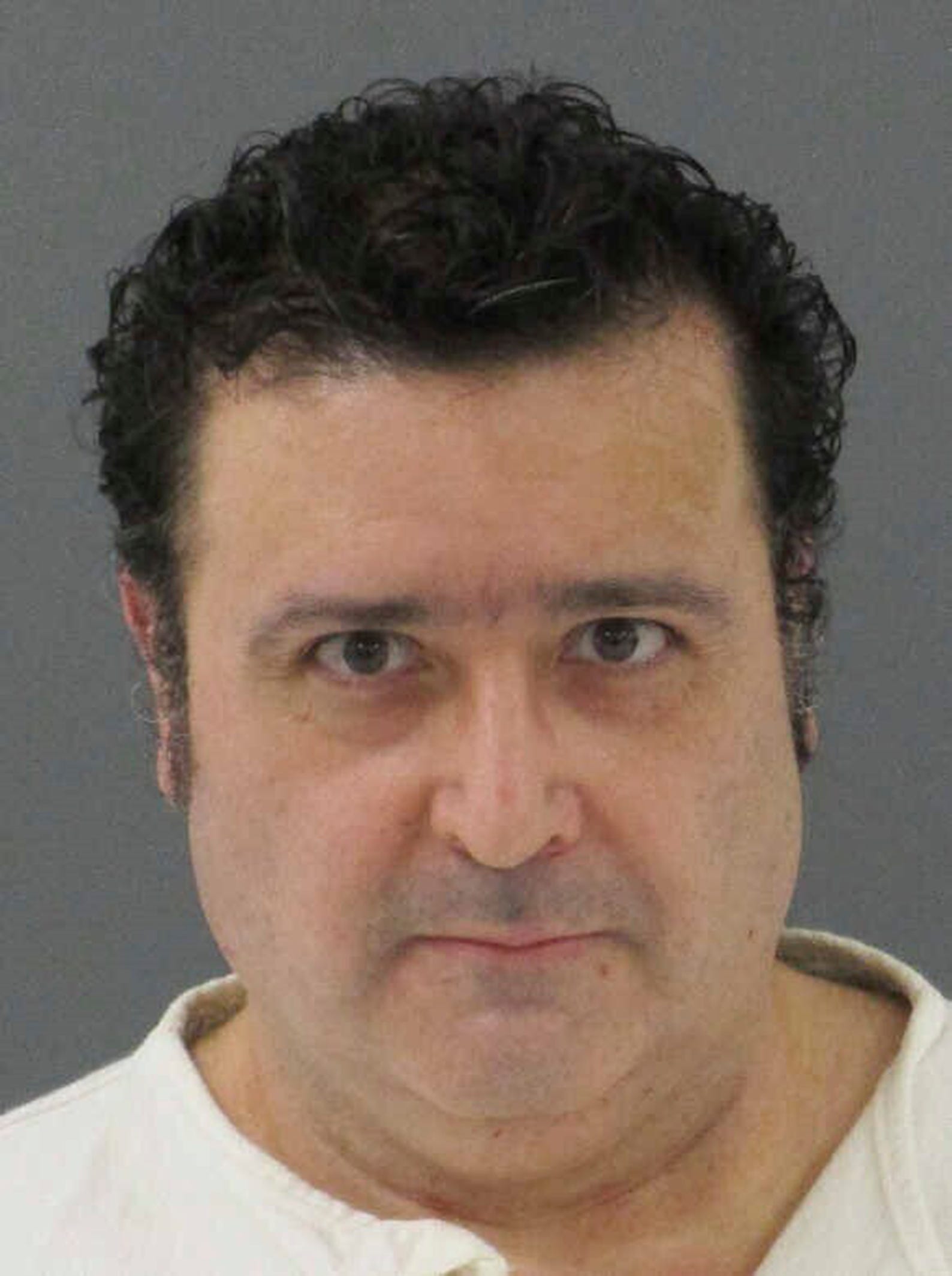
This photo released by the Texas Department of Criminal Justice shows death row inmate David Renteria. Renteria, a Texas inmate convicted of strangling a 5-year-old girl taken from an El Paso store and then burning her body nearly 22 years ago is facing execution. (Texas Department of Criminal Justice)

Alexandra’s sister, Sandra Frausto, and brother, Ignacio Frausto, attended the execution.

Renteria’s sister Cecilia Esparza and a friend also were present.

Esparza collapsed when she walked into the viewing room, and prison officials brought her a chair and she cried. Renteria told his sister through the glass, “I love you.”

Last days on Texas death row for one of El Paso’s most notorious killers

Renteria spent his final days meeting with visitors, laying in bed, watching TV through a cell door and sleeping, a Death Watch report states. The times listed below are in Central time zone.

On his execution day, starting at 12:15 a.m., he sat on his bed and began writing. The report does not state what he wrote.

He began packing up his property about 2:30 a.m., before sitting on the floor and reading a book around 4 a.m., the report states. He then continued packing up his property and cleaning the floor between 5 to 7:30 a.m.

Renteria was allowed to talk to fellow inmates at 7:30 a.m., before meeting with visitors from 8 to 11:30 a.m., the death watch states.

He was then transferred from the Texas Department of Criminal Justice’s Polunsky Unit in Livingston, Texas, to the Huntsville Unit to await his execution.

A victim of Renteria’s from a different criminal incident and her mother also attended the execution. Renteria was previously convicted and sentenced to 20 years in prison for indecency with a child in El Paso.

The execution was also attended by 14 state law enforcement and governmental officials.

Renteria grew up in the Lower Valley and was a tribal member of the Ysleta del Sur Pueblo, according to the Texas Coalition to Abolish the Death Penalty.

While in prison, he rededicated himself to his Roman Catholic faith, the coalition reported.

Renteria’s execution ends a nearly 22-year legal battle waged in what has been described as one of the most heinous crimes committed in El Paso.

“I’ve always been a supporter of the death penalty and from a law enforcement perspective, I just think some people are too dangerous to be in our society and that is certainly one individual who I think that that the death penalty is absolutely appropriate,” El Paso County Sheriff Richard Wiles said. “It’s a long time coming. I think it’s been what? Twenty-one years. I was actually the assistant (El Paso police) chief, (Carlos) Leon was the chief when that horrific crime occurred. It was really tough on everybody. I can’t even imagine what that family went through and what they’re still going through today.

“Hopefully, this will give them a little bit of relief to help them in their recovery that is going to take the rest of their lives, Wiles said. “I can’t even imagine losing my 5-year-old daughter to such a horrific crime.”

Justice served for Alexandra Flores in 2001 abduction nearly 22 years later

Renteria’s execution came two days before the 22nd anniversary of the day he kidnapped 5-year-old Alexandra Flores from an El Paso Walmart, strangled her to death and then burned her body. It also comes six days before his 54th birthday.

Renteria abducted Alexandra Nov. 18, 2001, as she was Christmas shopping with her parents at an El Paso Lower Valley Walmart.

Her parents realized she was missing and searched the store but could not find her. Alexandra was seen on store surveillance video exiting the store about 5:15 p.m. with Renteria.

Alexandra’s body was found about 7:10 a.m. the next day in an alley 16 miles (25km) away.. She was naked and partially burned in a carport near Downtown El Paso.

An autopsy revealed Alexandra was strangled to death and then set ablaze, court documents state. Investigators later revealed there were no signs of sexual assault.

A palm print on a plastic bag found over Alexandra’s head was determined to be from Renteria, court documents state.

El Paso Police Department investigators discovered that a vehicle registered to Renteria was at 9441 Alameda Ave. at the time and date of Alexandra’s disappearance. Renteria also told police he was at the location at the time and date of her disappearance, court documents state.

Renteria went to trial for the death of Alexandra in September 2003. He claimed in his trial that Barrio Azteca gang members forced him to kidnap the girl and someone else was the person who killed her, court records show.

A jury convicted him of capital murder and he was sentenced to death.

Appeals court justices heard the case in 2006 and upheld the conviction. However, the justices ordered a new sentencing phase of the trial.

The resentencing was ordered because of “exclusion of evidence showing the defendant’s remorse violated due process by preventing defendant from rebutting the State’s case when the State left jury with false impression and emphasized it,” the justices wrote in their opinion.

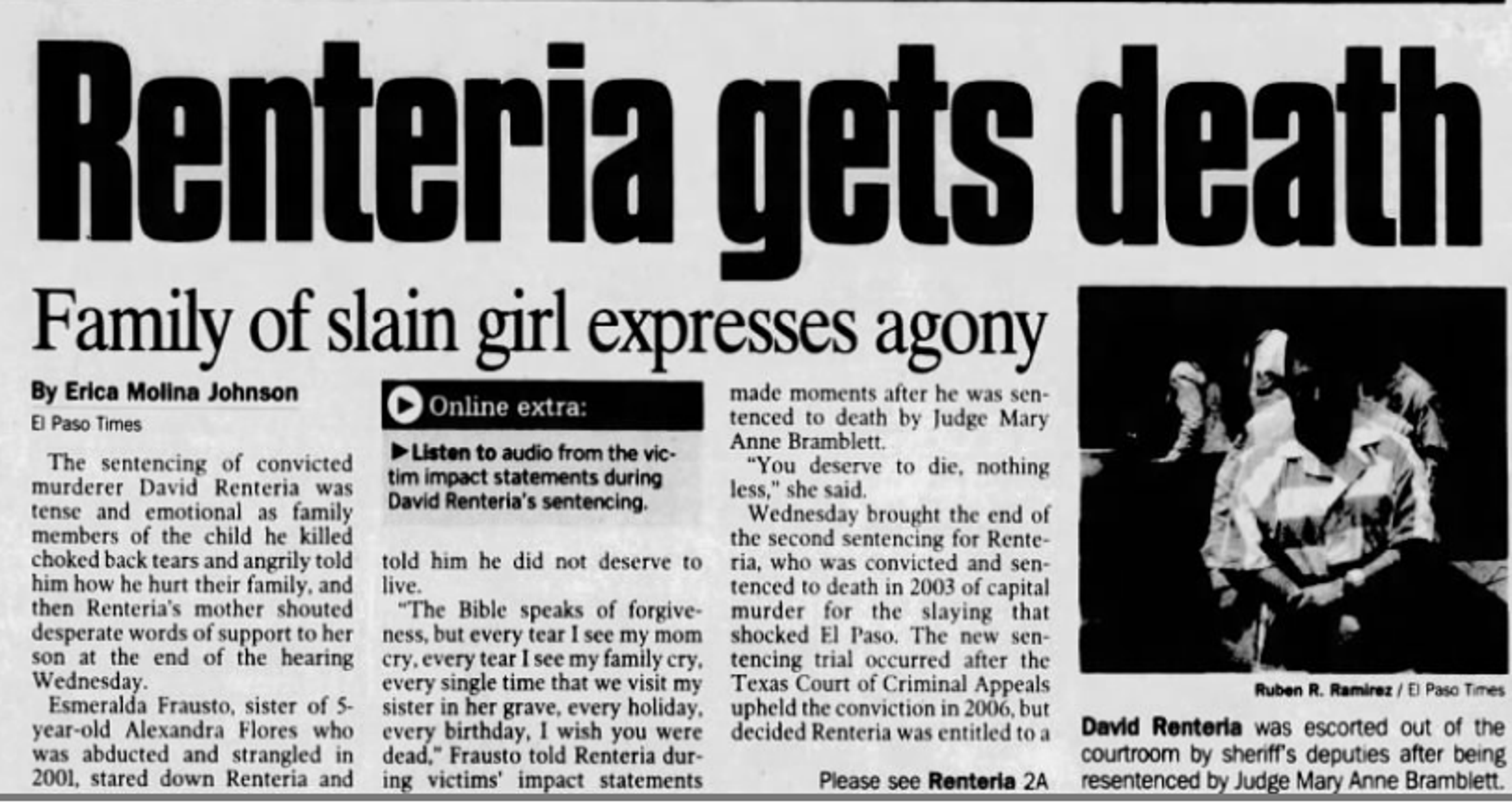
A May 15, 2008, El Paso Times article reporting David Santiago Renteria was given the death penalty during his resentencing hearing.

A May 15, 2008, El Paso Times article reporting David Santiago Renteria was given the death penalty during his resentencing hearing. 

KTSM 9 NEWS

DAVID SANTIAGO RENTERIA v. THE STATE OF TEXAS (Original)

El Paso Sheriff Deputy Peter Herrera’s family speaks after death penalty sentence

EXECUTION CARRIED OUT ALABAMA Casey McWhorte 11/16/2023


Casey A. McWhorter, sentenced for murder on May 13, 1994

Casey McWhorter (ALABAMA DEPARTMENT OF CORRECTIONS)

An Alabama man who shot and killed his friend’s father in a premeditated robbery in 1993 has been put to death, killed by lethal injection on Thursday — over 30 years after the initial crime. Before he died, however, he had a dire message for other youth who were going through a tough mental time like he was.

Casey McWhorter was convicted of first-degree murder and sentenced to death after slaughtering 34-year-old Edward Lee Williams, 34, at the age of 18. He and two other teens, Williams’ 15-year-old son, conspired to steal money from his home and kill him. He went to the home to commit the crime but didn’t have the intention of actually following through with the killing, he said in a recent interview.

But the situation escalated after the older Williams came home during the robbery and surprised the teens. He said they had been in the home grabbing various items when he came in and began fighting with his son over the gun he had. That’s when McWhorter came out of one of the back rooms. Williams immediately noticed him and started swinging at him, and so he did the only thing he could think to do — he shot the other gun that was in his hand at that point, and it hit Williams in the abdomen despite McWhorter saying he had aimed for the legs.

Casey A. McWhorter spent most of his adult life on Alabama’s death row. Thursday night he died there.

The state of Alabama executed McWhorter, 49, by lethal injection in the death chamber of the William C. Holman Correctional Facility in Atmore. He was convicted of capital murder in 1994 in connection with a 1993 Marshall County robbery and homicide. He went to death row when he was 19. He had been 18 three months earlier, when the murder was committed.

The drapes of the media witness room opened at 6:30 p.m. McWhorter was lying in a bed partially covered by a tightly drawn white sheet. His head and torso were slightly elevated. He was lying cruciform, with both arms facing palm up. Restraints for his body were on top of the sheet. Two IV lines came from a small window in the back wall of the death chamber. One appeared to enter his right arm near the inside of his elbow, and the other appeared to enter his left arm at the inside of his left elbow.

Warden Terry Raybon read the death warrant and governor’s order of execution. McWhorter was given the opportunity to say last words.

His final words were: “I would like to say I love my mother and family. I would like to say to the victim’s family I’m sorry. I hope you found peace.” He then also took a jab at his executioner, the prison warden, who faced many accusations of domestic violence accusations decades ago, calling him a “habitual abuser of women.””

At 6:33 p.m. McWhorter closed his eyes. A minute later he shifted his legs, clenched his fists and moved his fingers.

He was approached by his spiritual advisor.

At 6:35 p.m. he was moving his fingers. And at 6:37 p.m. he raised his head, made a yawning motion, appeared to gasp and his eyes rolled into the back of his head. At 6:39 p.m. he appeared to stop breathing.

His spiritual advisor made the sign of the cross.

A few minutes after a corrections officer inside the death chamber bent to McWhorter’s ear and loudly called his name, the officer then touched his face and pinched the inside of his right arm.

At 6:47 p.m. the drapes to the media witness room were drawn.

McWhorter’s official time of death was given as 6:56 p.m.

McWhorter’s final meal consisted of Turtles candy, and he had visits with his mother, stepdad and a spiritual advisor, a prison spokesperson said. He also spoke with his attorney and his friends by phone. His death was the second execution in Alabama this year.

After the execution, a news conference was held inside the media center.

It took two “sticks” to access McWhorter’s veins, one to his right arm and one to his left arm, said John Hamm, commissioner of the Alabama Department of Corrections. He read a lengthy letter from April Williams, the daughter of Edward Lee Williams, the victim of the homicide.

She was 16 when her father was murdered.

“My Dad was only 33 years old. He should still be here,” the letter read, in part. “He should be ready to retire.”

Gilbert “Bert” Williams, Edward Lee Williams’ brother, addressed the media.

“It took 30 years for this to occur. It’s a kind of unfortunate that we had to wait this long, but justice has been served,” he said.

Gilbert Williams compared McWhorter’s execution to “…the peaceful death to a murderous dog.”

There are three witness rooms in the death chamber, which is attached to the building that houses death row. One witness room is for the victim’s family, one is for the media and the inmate‘s witnesses, and one is for state officials. McWhorter had no witnesses.