california

More Evidence Against the Death Penalty


april 12, 2012 source : http://www.nytimes.com

Connecticut is poised to become the 17th state without the death penalty and the fifth in five years to abolish it. Gov. Dannel Malloy is expected to sign the repeal bill approved by the Legislature in recent days.

Connecticut is part of a growing movement against capital punishment, with repeal measures now proposed in California, Florida, Georgia, Kansas, Kentucky and Washington. Other states like Ohio, Oregon and Pennsylvania are reviewing their death penalty laws.

This shift comes at a time when new analyses of capital punishment show gross injustice in its application and enormous costs in continuing to impose it. In Connecticut, a powerful, comprehensive study provided evidence that state death sentences are haphazardly meted out, with virtually no connection to the heinousness of the crime.

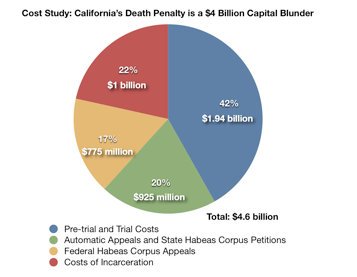
In California, two former death penalty proponents — a prosecutor who drafted the 1978 ballot initiative that expanded the state’s death penalty and a leading supporter of the 1978 law — are now championing a new ballot measure to repeal the penalty. They point to a study showing that, since 1978, California has spent roughly $4 billion on the death penalty to carry out 13 executions. “The cost of our system of capital punishment is so enormous that any benefit that could be obtained from it — and I now think there’s very little or zero benefit — is so dollar-wasteful that it serves no effective purpose,” Donald Heller, the drafter of the 1978 measure, said recently.

Decades of research show that racial bias pervades death penalty cases. Minority defendants with white victims are much more likely to be sentenced to death than others;35 percent of those executed nationally since 1976 were black, though blacks currently make up 12.6 percent of the population. The problem of inadequate counsel permeates the system, with many indigent defendants sentenced to death after major blunders by court-assigned lawyers. And a horrific number of innocent people have ended up on death row: 17 convicts with death sentences have been exonerated with DNA evidence since 1993, 123 with other evidence since 1973.

Any careful evaluation leads to what the American Law Institute concluded after a reviewof decades of executions: the system cannot be fixed. It is practically impossible to rid the legal process of biases driven by race, class and politics. The growing number of states reconsidering this barbaric system is a welcome sign. Capital punishment, by overwhelming evidence, should be abolished throughout the United States.

Related News

10 years after DNA cleared York County man, death penalty still debated


april 8, 2012 source : http://www.ydr.com

Some believe that Pennsylvania will eventually abolish the death penalty.

Ten years ago today, Ray Krone walked out of an Arizona prison after DNA tests showed he did not murder a Phoenix bartender in 1991.

He became the 100th death row exonoree, and his case came at a time when federal legislators were considering death penalty reform, said Richard Dieter, executive director of the Death Penalty Information Center.

What shook many was that Krone had been convicted twice in the murder, he said.

Krone was a military veteran, a Bible reader, and one of the top graduates in his Dover Area High School class. He had maintained his innocence during the 10 years he spent in prison, two of those years on death row.

“It was a revelation that so many mistakes could have been made,” Dieter said.

In the past 10 years, several states, such as Illinois, New Mexico and New Jersey, have abolished the death penalty, Dieter said. Others, such as Maryland, Connecticut and California, are seriously considering it.

The number of executions nationwide has dropped in the last 10 years, and the public is more aware of the errors that can occur.

Pennsylvania to study the death penalty

The last execution in Pennsylvania took place in 1999.

It marked only the third execution in the state since 1976, and in all three cases, the defendants gave up their appeal efforts.

Yet, today, more than 200 remain on death row in the state. Eleven are from York County cases.

A death penalty without executions is not a death penalty, Dieter said.

The state Senate passed a resolution in December authorizing a study of the death penalty.

Sen. Stewart Greenleaf, R-Montgomery/Bucks counties, who sponsored the resolution, said he thinks the review is appropriate, given the studies done by other states. Questions about the cost, deterrence and appropriateness of the death penalty need to be answered, according to a news release.

The study will involve The Justice Center for Research at Penn State,

the Pennsylvania Interbranch Commission on Gender, Racial and Ethnic Fairness, and the Pennsylvania Joint State Government Commission.

The task force will study more than a dozen areas, including whether the selection of defendants for capital trials is arbitrary, unfair or discriminatory, and whether adequate procedural protections exist to prevent an innocent person from being sentenced to death and executed.

It will have two years to do the work.

Problems with the death penalty

Some, such as Kathleen Lucas of Springettsbury Township, believe it is only a matter of time until Pennsylvania repeals capital punishment.

Since the 1970s, 140 exonerations now have been reported nationwide, said Lucas, executive director for

Pennsylvanians for Alternatives to the Death Penalty. Six have been in Pennsylvania.

In addition to Krone’s exoneration, the Sept. 21 execution of Troy Davis in Georgia has left a bad taste in people’s mouths, she said.

Davis was sentenced to death for the 1989 murder of a police officer, but he maintained his innocence until the end. His defense team had argued that some of the witnesses had recanted their statements that implicated him.

Pennsylvania has been singled out for problems with the death penalty, Lucas said. The American Bar Association cited numerous areas for reform in a 2007 report.

Studies have revealed, for example, that 98.6 percent of jurors in capital cases in Pennsylvania failed to understand “at least some” portion of the jury instructions, the report states.

Of those questioned, 82.8 percent of the jurors did not believe “that a life sentence really meant life in prison,” according to the report.

Racial and geographical disparities also exist, according to the report. A Pennsylvania Supreme Court committee found that one third of black death-row inmates in Philadelphia County would have received sentences of life in prison if they had not been black.

Death penalty cases are costly

Lucas questions why the state keeps the death penalty when it isn’t executing anyway. She argues the money spent on capital cases costs three times or more than sentencing a defendant to life.

The average death penalty case in Maryland costs about $3 million, according to the Death Penalty Information Center (citing the Urban Institute, 2008). It’s anticipated the state will pay $186 million for cases pursued between 1978 and 1999. The state has had five executions since 1976.

Death penalty cases demand more work because of what’s at stake, Dieter said. Typically, two defense lawyers and two prosecutors are assigned to the case. They must prepare for two phases — the trial and the sentencing — which require different investigations.

“We’re just throwing money down a big, black hole,” said Marc Bookman, executive director of the Atlantic Center for Capital Representation.

It also costs more money to incarcerate death-row inmates, Bookman said.

In these tough economic times, Lucas said, the money could be used elsewhere, such as education. Police also could pursue cold cases.

Support of the death penalty

The state District Attorneys Association doesn’t think the death penalty should be abolished, executive director Richard Long said.

It helps to bring a measure of closure to the victim’s family, and it has a deterrent effect as well.

“We think Pennsylvania has decided it’s an appropriate penalty in the most egregious type of murder cases,” he said.

It is the Third Circuit Court of Appeals that is slowing down the cases, Long said. The appeals are not moving through the process and being addressed in a timely manner — no matter what the outcome.

Many cases are being overturned because of problems, such as ineffective counsel, Lucas said.

Some, who started with the death penalty, end up with a life sentence, Dieter said. Pennsylvania has done studies and made efforts to fix problems, but “at this point, I think it’s still not working.”

York County District Attorney Tom Kearney said he has taken an oath to uphold the will of the people.

“When we seek the penalty, it is for the worst of the worst, and that is what we’re charged with doing,” he said.

His office takes great pains to consult with the victims, looking at the statute and reviewing the case to determine if the death penalty is a realistic option.

He pointed to the Michael and Nanette Craver case as an example. His office withdrew the death penalty against the couple in the death of their 7-year-old adopted Russian son.

That’s because after talking with experts, it appeared the mitigating circumstances would outweigh the aggravating circumstances. It would have meant a life in prison without parole.

The couple later was convicted at trial of involuntary manslaughter, child endangerment and conspiracy.

“The taking of a life is a serious business,” Kearney said. “This is not something we do on the fly.”

Kearney said he thinks it’s healthy for the community to discuss the death penalty and whether they believe legislators should change the law.

Local defense attorney Gerald Lord said he has handled numerous death penalty cases in which the defendants are found not guilty of first-degree murder. Some are convicted of lesser charges.

Lord cited the 2003 shooting death of 25-year-old Anthony Lloyd as an example.

A jury acquitted his client, Dorian Eady of Erie, of first- and third-degree murder, attempted homicide, aggravated assault and reckless endangerment in the case. At one point, he faced a death penalty notice.

Witnesses testified Eady was in Buffalo the day before the shooting and in Erie when the shooting occurred. Eady had always maintained his innocence.

“It’s the ultimate penalty, and if you make a mistake, you can’t take it back,” Lord said.

Ten years later

As for Ray Krone, he moved back to York County and has made attempts to resume a normal life.

He has been thankful for the support of his friends, family and the residents of York County, he said. It has helped him as he has traveled across the country trying to make a difference.

Krone has been an outspoken proponent of abolishing the death penalty. He has spoken with legislators, students and others about his case, wrongful convictions, DNA testing and judicial reform.

Krone serves as director for communications and training for Witness to Innocence, an organization that consists of exonerated death row survivors and their loved ones who are fighting to end the death penalty.

Krone said he traveled to Connecticut last year to testify along with Barry Scheck of the Innocence Project for the repeal of the death penalty.

Legislators did not approve the repeal last year, but it is moving through the legislature this year.

“If they could do it to me, they could do it to anybody,” Krone said.


Who is on death row

Eleven people from York County cases are on death row in Pennsylvania.

They are:

— Kevin Dowling, 53, convicted in the October 1997 murder of Spring Grove shop owner Jennifer Myers. The York County District Attorney’s Office maintained Dowling killed Myers to prevent her from testifying against him in an attempted rape and robbery case.

— Daniel Jacobs, 41, convicted in the February 1992 stabbing death of his girlfriend, Tammy Lee Mock of York, and the drowning of their 7-month old daughter, Holly Danielle Jacobs.

— Harve Johnson, 30, convicted in the April 2008 beating death of 2-year-old Darisabel Baez.

— Kevin Mattison, 35, for the December 2008 shooting death of Christian Agosto during a robbery and burglary. Mattison of Baltimore had a previous murder conviction for killing a man in a street fight in Maryland in 1995.

— Hubert Lester Michael Jr., 55, pleaded guilty to the July 1993 kidnapping and shooting death of 16-year-old Trista Elizabeth Eng in the Dillsburg area.

— Milton Montalvo, 49, and Noel Montalvo, 48, convicted of the April 1998, stabbing deaths of Miriam Asencio-Cruz and Manuel Ramirez Santana, also known as Nelson Lugo. Asencio-Cruz was Milton Montalvo’s estranged common-law wife, and Santana was her friend.

— Hector Morales, 29, convicted of the July 2009 murder and burglary of Ronald Simmons Jr. Simmons was shot about 12 hours before he was to testify against Morales in a drug case.

— John Small, 52, convicted of the 1981 murder and attempted rape of 17-year-old Cheryl Smith, whose body was found in West Manheim Township.

— Mark Newton Spotz, 41, convicted of the February 1995 shooting death of Penny Gunnet, 41, of New Salem, his third victim in a four-day crime spree through central and eastern Pennsylvania.

— Paul Gamboa-Taylor, 51, pleaded guilty to the May 1991, hammer slayings of four family members: his wife, Valeria L. Gamboa-Taylor; their two children, Paul, 4, and Jasmine, 2; and another child, Lance Barshinger, 2. He received a life sentence for killing his mother-in-law, Donna M. Barshinger.

About the Krone case

Ray Krone was convicted twice and later exonerated in the 1991 murder of a Phoenix bartender.

Kim Ancona, 36, was found stabbed to death Dec. 29, 1991, in the CBS Restaurant Lounge in Arizona.

Police began their investigation, including questioning Krone. Police arrested him on New Year’s Eve.

Krone believed that police, in their investigation, would realize they had the wrong man. But he went to trial in the summer of 1992. An expert presented a videotape showing that a bite sample from Krone matched a bite mark on the victim’s breast.

A jury found Krone guilty of first-degree murder and kidnapping. He was sentenced to death.

In 1995, the Arizona Supreme Court overturned Krone’s conviction, granting him a new trial.

At his second trial in 1996, the prosecution argued that the bite marks on the victim’s body matched Krone’s “unique dentition.” Krone’s attorney, Christopher Plourd of San Diego, countered that the bite marks were not Krone’s, and the saliva found on the victim provided a DNA pattern that excluded Krone.

A jury convicted him again.

Maricopa County Superior Court Judge James McDougall said he had doubts about Krone’s guilt and sentenced him to life in prison.

In 2002, testing of DNA on the victim’s clothes proved Krone wasn’t the killer and instead implicated Kenneth Phillips Jr.

Krone was freed that year after 10 years in prison.

Krone sued Maricopa County in Arizona, and the city of Phoenix over his wrongful conviction. He received settlements totaling $4.4 million.

Krone now lives in Conewago Township.


Life in prison

Is there a difference between how death row inmates versus those sentenced to life without parole live in prison?

The answer is yes, said Sue McNaughton, press secretary for the state Department of Corrections.

Death row inmates are locked in their cells 22 hours a day. They are allowed outside to exercise, to shower or to research their appeals in a mini law library, she said.

When they do leave their cells, they are shackled and escorted by several staff members, McNaughton said.

Inmates who are in for life live in regular housing. In general population, two inmates can live in a cell, but those with lifetime sentences might be offered a single cell.

Inmates serving a life sentence can work prison jobs, she said. They can go to the library to read a book. They are not as restricted.

Death Row inmate who killed mother dies after illness


april 4, 2012 source : http://www.pressdemocrat.com

SACRAMENTO — A Death Row inmate has died of natural causes while awaiting execution for killing his own mother.

Lt. Sam Robinson, a spokesman for San Quentin State Prison, said Frank Manuel Abilez died in the prison’s hospital Tuesday.

Abilez, who was 53, had a long-term illness. Robinson says his death was expected but would not discuss the illness, citing privacy laws.

Abilez was on death row for sodomizing and strangling his 68-year-old mother in 1996. He was convicted by a Los Angeles County jury in 1997 and sentenced to die for killing Beatrice Abilez Loza, a mother of 10.

The state Department of Corrections and Rehabilitation says 76 condemned inmates have died of natural causes or committed suicide since California reinstated the death penalty in 1978. Fourteen have been executed.

California – Judge rejects Raymond man’s request for new trial


march, 31 sourcehttp://www.unionleader.com

BRENTWOOD — A judge rejected a Raymond man’s argument for a new trial, which was based on claims he was wrongfully convicted of raping a 41-year-old woman in 2009.

Raymond Payette, 55, a former Raymond public works employee, claimed he received ineffective assistance from his defense lawyer and that prosecutors engaged in misconduct.

He alleged prosecutors should have never allowed the victim to testify about DNA found on her underwear.

Chief Justice Tina Nadeau heard testimony from Payette’s former lawyer at a hearing in February before reaching her decision on March 22.

Payette is serving 7 to 15 years in state prison after being convicted by a jury of aggravated felonious sexual assault.

Defense lawyer Tom Gleason argued that Payette’s former attorney, Gerard LaFlamme, should have objected to testimony about DNA samples found on the woman’s underwear. The DNA did not match Payette, according to Gleason.

LaFlamme testified he made a tactical decision to not object to the woman’s testimony about the DNA as a means to question her veracity.

Nadeau agreed LaFlamme’s decision was a sound tactic to use at trial.

“Even objectionable testimony can help a defendant’s case,” Nadeau wrote in a five-page order.

During the trial, Payette even argued the sex he had with the woman was consensual, lessening the importance of the testimony, Nadeau noted.

Nadeau also rejected the contention that Payette was barred from testifying in his own defense. LaFlamme testified in February that after analyzing the evidence against his client before and toward the end the trial, he advised against Payette taking the stand, Nadeau wrote. LaFlamme was concerned that Payette was not hold up under questioning by prosecutors.

But the decision whether to testify was ultimately left up to Payette, Nadeau wrote.

The sexual assault happened on the night of July 16, 2009. Payette made his way into the woman’s home by asking to wash his hands after petting horses that were behind her home, prosecutors said.

Payette was recently completed a 1-to-2 year prison sentence on a witness tampering conviction related to the sexual assault case. He will be eligible for parole in July 2016 on the sexual assault sentence.

California – Death penalty costs – Death Penalty Can’t be Fixed, Time to Replace


march, 27, 2012   sourcehttp://www.foxandhoundsdaily.com

by Donald H. Heller, former Assistant U.S. Attorney & Ron Briggs, El Dorado County Supervisor

As two staunch conservatives, we write in response to SenJoelAndersons attempt to “fix the death penalty” with Senate Bill 1514. Together, the two of us supported California’s current death penalty law and helped enact it in 1978. Today, we agree with Sen. Anderson that the system we helped create is hopelessly broken. But far from tinkering with that system, we have both concluded the solution is to replace it with life without parole by passing the SAFECaliforniaAct on this November’s ballot.

We did not come to this decision lightly, and NO, we are not soft on crime. Just the opposite. SAFE California replaces the death penalty with a sentence of life in prison with absolutely no chance of parole as the maximum punishment for murder. This means convicted killers will remain behind bars forever – but without the exorbitant price tag, terrible toll on the family members of victims, or the risk of executing an innocent person. At over 720 inmates and with a $4 billion price tag, our state runs the nation’s costliest and most populous death row. Nonetheless California has carried out just 13 executions since 1978.

We were intimately involved in writing and promoting our current death penalty law in 1978. We believe that public safety is one of the primary purposes of a government predicated on the rule of law. Justice should be swift and certain. The structure that we helped create is legally sound, having withstood multiple appeals to the U.S. Supreme Court. But, fiscallyspeaking, it has been disastrous. We never contemplated the staggering cost of implementing the death penalty: more than $4 billion to date and approximately $185 million projected per year in ongoing costs.

Source: ExecutingtheWilloftheVoters?” by Judge Arthur Alarcon and Paula Mitchell, 2011

We thought we would bring California savings and safety in dealing with convicted murderers. Instead, we contributed to a nightmarish system that coddles murderers and enriches lawyers. Like Senator Anderson, our effort was intended to bring about greater justice for murder victims. Never did we envision a multi-billion dollar industry that packs murderers onto death row for decades of extremely expensive incarceration. We thought we would empty death row, not triple its population.

Having 34 years of firsthand experiences in this matter we feel the bill proposed by Sen. Anderson will not fix these problems. First and foremost, shortcutting the appeals process means risking innocent lives. Appeals are the safety net that keeps us from executing innocent people. States that shortchange the justice process have executed innocent people, like CameronToddWillingham in Texas.

Beyond the risk of executing the innocent, SB 1514 would simply move appeals from one court to another. That doesn’t alleviate the delay or the expense, it will just move it to a different courthouse.

It won’t eliminate the $1 million each county pays per death penalty trial, or the extra housing costs on death row over the general population – on average $100,000 per inmate per year – and it won’t change the fact that 99% of death row inmates in California die of old age rather than execution. History tells us any change to the death penalty has only added life to criminals, enhanced lawyers paychecks costing taxpayers more and more while appellate dates or new trials continue to torture victims’ families and survivors.

We believe that life without parole protects victims’ families and survivors at a greater savings to taxpayers. California’s best path for safety and savings is life without the possibility of parole.

Please join us in supporting theSAFECaliforniaAct with a “YES” this November. California has another chance at real justice. We should embrace it.

CALIFORNIA – Supreme Court Denies Death Row Inmate’s Request for New Attorneys


Kenneth Clair

March 5, 2012

The Supreme Court ruled Monday that a California death row inmate cannot have his conviction overturned because he disagreed with the defense strategy his attorneys used.

The case appears to limit the control of defendants over their attorneys’ tactics.

The defendant was Kenneth Clair, who was convicted and sentenced to death in 1987 for burglary and murder.

He was represented by court-appointed attorneys because Clair could not afford to hire his own.

After Clair was convicted, his attorneys filed appeals and petitions of habeas corpus arguing their client should not be sentenced to death.

Clair said they should have been trying to appeal his conviction by arguing he was innocent of burglary and murder.

In 2005, he filed a petition to change federal public defenders.

A federal judge denied his request. However, the 9th U.S. Circuit Court of Appeals overturned the lower court judge’s decision.

The U.S. Supreme Court decided unanimously that the Court of Appeals was incorrect.

Justice Elena Kagan, who wrote the court’s decision, said Clair waited too long to change attorneys. The judge in his case was two weeks away from ruling on his habeas corpus petition.

Habeas corpus refers to a request for a ruling that a defendant has been wrongfully convicted.

Kagan said Clair’s petition for new attorneys should be decided under the “interests of justice” standard.

The standard uses a test that balances factors such as whether defendants might lose their liberty, livelihoods, suffer damage to their reputations and a substantial question of law is presented.

Attorneys for California said a different standard should be used. They said Clair could be granted new attorneys only if he proved he was denied adequate representation by his court-appointed attorneys.

Kagan said California’s argument was unpersuasive.

“The state acknowledges, this test comes from … well, from nowhere,” Kagan wrote. “Inventiveness is often an admirable quality, but here we think the state overdoes it.”

The dispute arose after Clair complained in a letter to the court that his attorneys were ignoring evidence found by his prosecutor that might show he was innocent.

They should have been using the evidence to appeal his conviction, he said.

Instead, they continued arguing he should not be given the death penalty.

Initially, Clair and his attorneys reached an agreement and the defendant dropped his complaint. Later, the same dispute arose, prompting Clair to write a second letter to the court saying he wanted different attorneys.

When the second request was denied, Clair appealed, eventually reaching the Supreme Court.

The court’s decision Monday said Clair waited too long.

“The court received Clair’s second letter while putting the finishing touches on its denial of his habeas petition,” Kagan wrote. “The case was all over but the deciding; counsel, whether old or new, could do nothing more in the trial court proceedings. At that point and in that forum, Clair’s conflict with his lawyers no longer mattered. … The court was not required to appoint a new lawyer just so Clair could file a futile motion.”

Although the California attorney general won on most of his arguments, the Supreme Court’s frustration with the procedures followed in the case was obvious during oral arguments.

California’s deputy attorney general, Ward Campbell, argued that the “interests of justice” standard was the wrong way to determine whether criminal defendants should be granted new attorneys.

The standard made it too easy for defendants to delay proceedings against them by filing a complaint against their attorneys, he said.

Justice Sonia Sotomayor asked whether California’s attorney general was using a different test she described as a “sort of a made-up standard.”

She also asked, “Can you point to one case in which this standard has been used by any district court or court of appeals?”

Campbell replied, “No, I cannot.”

Justice Ruth Bader Ginsburg asked, “Where did you get it from?”

Campbell replied that it was derived from Supreme Court interpretations of the Sixth Amendment’s right to representation by counsel.

source : Article © AHN