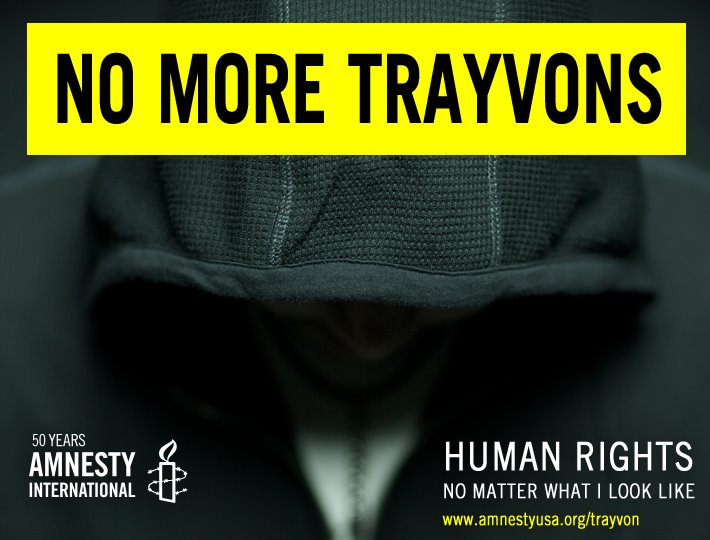
It doesn’t matter if you’re wearing a hoodie or a hijab, human rights are universal!

March 28, 2012 source :http://socialistworker.org
why is Alabama opposing DNA testing?Rebekah Skelton reports on a case where an Alabama man’s life is at stake. March 28, 2012
THOMAS ARTHUR has been on Alabama’s death row for 30 years. He was convicted of killing Troy Wicker in 1982, but has always maintained his innocence. Recently, a federal appeals court stayed Arthur’s March 29 execution date over an issue about lethal injection, though that stay could be lifted at any time. The real question, however, remains this: Will Thomas Arthur be executed in Alabama without being allowed to have DNA testing that could prove his innocence? There is a piece of evidence, an “Afro wig” worn by Wicker’s killer as a disguise, that could be tested for Arthur’s DNA. The wig has already been tested once for DNA, after another Alabama prisoner, Bobby Ray Gilbert, confessed to Wicker’s murder in 2008. However, the testing was inconclusive–there wasn’t a match for Gilbert or Arthur. Ultimately, the original judge decided that Gilbert’s confession wasn’t credible, and despite a lack of other physical evidence tying Arthur to the crime, she recommended that the Alabama Supreme Court deny Arthur’s appeal, which it did. Now, Arthur’s defense team is asking for a more advanced DNA test, called a mini-STR DNA analysis, on the wig, but Alabama’s attorney general is fighting the request–arguing that this test wouldn’t be any more accurate than the previous one. On top of that, there is no law guaranteeing Arthur the right to further DNA testing.
If the lawyers have offered to pay for the testing, what could possibly be the problem? If the test shows that Arthur’s innocent, the state of Alabama can rest easy knowing they didn’t condemn an innocent man to death. And if it show’s he’s guilty, it would only affirm what the state has already convicted him of, at no cost to them. However, as Andrew Cohen pointed out in a February article in The Atlantic, the general consensus among prosecutors and judges is to value “finality” in cases, rather than “accuracy.” Sharon Keller, the presiding judge of the Texas Court of Criminal Appeals, outlined this position in a 2000 “Frontline” interview, saying, “We can’t give new trials to everyone who establishes, after conviction, that they might be innocent. We would have no finality in the criminal justice system, and finality is important.” – – – – – – – – – – – – – – – – IT SHOULD be clear to anyone with a conscience that if there’s even a small chance that someone might be innocent after being convicted, the court should do everything in its power to ensure they have the right person–especially when someone’s life is at stake. But lately, prosecutors have been fighting harder than ever to keep defendants from having access to post-conviction DNA testing. Hank Skinner has been on Texas death row since 1995. His case has many similarities to Arthur’s, such as DNA evidence the court is denying him the right to have tested and a heavy emphasis on an eyewitness who at one point or another recanted. “Since these guys are on their electoral deadlines, their finality has nothing to do with accuracy,” said Skinner’s wife Sandrine Ageorges-Skinner. “You can’t rush justice.” The goal of any justice system has to be to find the truth. As Sandrine said, since no justice system is ever going to be infallible–there have been 289 post-conviction DNA exonerations in the U.S., according to the Innocence Project–prosecutors and judges must be willing to admit that they might have convicted the wrong person. Post-conviction DNA testing must be granted to prisoners whose guilt is questionable–o matter what the cost, and especially when it could be an innocent person who’s paying the ultimate price. First published at The New Abolitionist. |

that’s already been a month Claim your innocence is online, and over 3000 views, 143 posts, thank you all for your interest, thank you to those who follow my blog, I am very grateful. take care.

march 29, source :http://www2.journalnow.com
For those fortunate few who’ve never been exposed to the criminal justice system, it might seem odd to learn that more than 90 percent of all criminal convictions in federal and state courts are the result of plea agreements with prosecutors.
Because of the crushing volume of cases, the courts would not work without the use of “plea bargains” that avoid the necessity of time-consuming trials.
Now come two rulings by the U.S. Supreme Court that underscore what should be obvious: Defendants have a constitutional right to effective counsel by their attorneys when considering plea negotiations, the Journal’s Michael Hewlett reported. The rulings are expected to change the way pleas bargains are handled, which may mean more work for defense attorneys but perhaps a better system of justice overall.
The revelation of so many wrongful convictions in recent years makes the idea that defendants have a right to a clear understanding of any plea offer a no-brainer — and long overdue. Criminal defense lawyers should be expected to do a thorough job briefing their clients when prosecutors offer plea bargains.
“This could affect every defendant in the system,” Ron Wright, a professor at Wake Forest University School of Law, told the Journal. It won’t bring the system to a halt, he said, but defense attorneys likely will have to file more paperwork and take more time to ensure their clients get the right legal advice regarding plea offers. That’s a worthy goal.
In one of the cases the high court ruled on, Anthony Cooper rejected a plea offer because his attorney told him that prosecutors could not prove the crime. He was sentenced to 30 years in prison instead of the seven years he could have received under the plea.
Cooper’s attorney “had no business practicing criminal law if he didn’t know better than that,” Pete Clary, Forsyth County’s public defender, told the Journal. Clary said defense attorneys have an ethical obligation to present all plea offers to their clients and advise them accordingly.
Forsyth County District Attorney Jim O’Neill said plea offers are written down and placed in the public court file, and the defendant is informed of the plea offer in open court.
If that is accompanied by a defense attorney’s consultation with his client on the pros and cons of the offer, then the defendant has been treated fairly and equitably by our system of justice. That should be a given

march 29, 2012 source : http://www.myfoxal.com
A new execution date has been set for death row inmate Thomas Douglas Arthur.
Officials with the Alabama Department of Corrections say Arthur will be put to death on Thursday, March 29th at 6 pm. That will happen at Holman Correctional Facility in Atmore.
Arthur has served more than 24 years on Alabama’s death row. He was convicted in the contract killing of businessman Troy Wicker in 1982.
Thomas Douglas had challenged his scheduled execution by lethal injection, claiming the state’s use of a new anesthesia did not completely sedate inmates before the lethal drugs were administered. He said the practice was cruel and unusual.
The court on Wednesday declined a request by Alabama’s attorney general’s office to reconsider a March 21 decision allowing Arthur to go forward with his challenge.
Spokeswoman Joy Patterson said the Alabama attorney general’s office was not going to appeal the court decision Wednesday.
State attorneys have pointed to successful executions where the drug — pentobarbital — was used.
The court last week decided to put Arthur’s execution on hold while the challenge was heard. It marked the fifth time that Arthur — who has maintained his innocence for more than 29 years while on death row — was spared execution.
According to court documents filed by the State of Alabama, Troy Wicker’s wife, Judy, testified that she had a sexual relationship with Arthur and paid him $10,000 to kill her husband.
11th court read the docket click here
Thomas Douglas Arthur Website
case and old post click here

march 28, source :http://www.guardian.co.uk
Texas, America’s most prolific practitioner of the death penalty, has launched an extraordinary attack on the international anti-death penalty charity Reprieve, accusing it of intimidating and harassing drug companies and likening the group to violent prison gangs responsible for the eruption of prison riots.
The attack comes from the Texas department of criminal justice, TDCJ, which each year carries out the lion’s share of executions in America. In a letter to the attorney general of Texas, Greg Abbott, the TDCJ accuses Reprieve of “intimidation and commercial harassment” of manufacturers of medical drugs used in lethal injections.
In astonishingly vivid language, the TDCJ says that Reprieve, which is headquartered in London, “crosses the line from social activists dedicated to their cause to authoritarian ideologues who menace and harass private citizens who decline to submit to Reprieve’s opinion on the morality of capital punishment by lethal injection”.
Reprieve’s tactics present the risk, the Texas prison service claims, of violence. “It is not a question of if but when Reprieve’s unrestrained harassment will escalate into violence against a supplier.”
In the most colourful accusation, the TDCJ compares the human rights organisation to gangs operating in Texas prisons. It writes that Reprieve’s methods “present classic, hallmark practices comparable to practices by gangs incarcerated in the TDCJ who intimidate and coerce rival gang members and which have erupted into prison riots”.
The Texas letter takes the war of words between US states still practising executions and anti-death penalty campaigners to a new level. Reprieve has long had fraught relations with states practising capital punishment in the US, but never before has it been accused of fomenting violence.
Maya Foa, Reprieve’s specialist campaigner on lethal injection, said the accusation was absurd. “Pharmaceutical manufacturers have been objecting to the use of medicines in executions since the lethal injection was invented – Reprieve didn’t create these ethical scruples! And far from harassing them, Reprieve defends these companies and their ideals and we have excellent relationships with them.
“Medicines are made to improve and save lives, not to end them in executions. This principle is at the core of the pharmaceutical profession, and companies have long objected to the misuse of their products by US departments of corrections.”
Texas makes its assault on Reprieve in a 15-page brief that it composed in response to a request for information from the Guardian relating to the quanitity of anaesthetic that the prison service had left in its supplies. The pool of anaesthetic – the first drug used in a cocktail of three chemicals that makes up the lethal injection – has been running low as a result of s boycotts in Europe and other countries.
In its brief, the TDCJ makes a case for withholding the information requested by the Guardian on security grounds. It says that to release information on drug stocks would help Reprieve identify the source of the medicines and that in turn would create “a substantial risk of physical harm to the supplier”.
As supporting evidence, the TDCJ cites the example of Lundbeck, a Danish drug company that is one of the world’s leading producers of the anaesthetic pentobarbital, trademarked as Nembutal. Last summer the firm placed strict restrictions on the distribution of Nembutal to prevent it being used in executions in the US.
Texas claims that Lundbeck imposed the restriction in response to intimidation by Reprieve. “Lundbeck acquiesced to Reprieve’s unrestrained harassment and agreed to deny orders from prisons located in those states active in carrying out death penalty sentences,” the brief says.
But Lundbeck has told the Guardian that its move to impose restrictions on the end use of Nembutal had nothing to do with Reprieve. “We acted because we are a company that wants to help save people’s lives and we are against the misuse of our drugs in prisons. We took our stance long before we were contacted by Reprieve.”
In a gesture that makes a mockery of the claim of intimidation, Lundbeck this week has signed a Hippocratic oath that pledges its commitment to advance the health of the public and avoid inflicting any harm. The oath was drawn up by Reprieve as part of its campaign to block the use of medical drugs in executions.
Texas is the powerhouse of the death penalty in America. Since executions began in the modern era in 1976, the state has put to death 480 people – four times more than the next most plorific practitioner, Virginia, with 109.
Last year, it executed 13 prisoners, again far more than any other state.
The enthusiasm of Texas for judicial killings became an issue in the presidential race last September when its governor, Rick Perry, told a cheering TV audience at a Republican nomination debate that he never lost sleep over the thought that some of the 240 people who have been executed on his watch may have been innocent.

source : http://www.sfgate.com
March 27 (Bloomberg) — Twenty-one death row inmates won an order barring use of sodium thiopental, an imported drug given as anesthesia prior to administration of lethal injections.
U.S. District Judge Richard Leon in Washington today ruled that the federal Food and Drug Administration violated its own rules by allowing entry of the drug into the country without first ensuring its efficacy.
“Prisoners on death row have an unnecessary risk that they will not be anesthetized properly prior to execution,” Leon wrote in a 22-page ruling, adding that the agency had created a “slippery slope” for entry of other unapproved drugs.
In an accompanying two-page order, the judge banned the import of thiopental, calling it a misbranded and unapproved drug, and directed Arizona, California, Georgia, South Carolina and Tennessee and any others with stocks of the barbiturate to send them to the FDA.
Attorneys for the inmates had argued that use of the drug during execution could lead to so-called anesthesia awareness, in which they may experience suffocation, pain and cardiac arrest.
The shipments of thiopental entering the U.S. originated from an Austrian facility owned by Sandoz International GmbH, a German company, according to the complaint. The drug was shipped to the U.S. from a London wholesaler, Dream Pharma Ltd., the inmates said.
Dream Pharma bought the drug from a unit of Archimedes Pharma Ltd., a closely held company based in Reading, U.K., according to the complaint.
Imported Drug
The FDA countered that release of the imported drug within the U.S. was an act of enforcement discretion, and that “reviewing substances imported or used for the purpose of state-authorized lethal injection clearly falls outside of FDA’s public health role,” according to Leon’s ruling.
The judge heard arguments from both sides on Feb. 9.
Leon said there was no dispute that the FDA hadn’t reviewed foreign or domestic thiopental for safety and effectiveness. Because it was unapproved, the federal Food, Drug and Cosmetic Act required the agency to bar its import, he said.
Shelly Burgess, a spokeswoman for the FDA, said she couldn’t immediately comment on the judge’s decision.
The case is Beaty v. Food and Drug Administration, 11-cv- 289, U.S. District Court for the District of Columbia (Washington).
read momerandum opinion : click here
read order by Judge Richard J. Leon : click here

march 26, 2012, source : http://edition.cnn.com
Washington (CNN) — Few Americans have any real idea how the Supreme Court operates, since cameras are barred, and the case arguments and opinions are often dry and confusing for nonlawyers.
That’s too bad because the high court’s impact on Americans is incalculable. When disputes arise, the nine justices serve as the final word for a nation built on the rule of law. They interpret the Constitution and all that it brings with it: how we conduct ourselves in society, boundaries for individuals and the government, questions literally of life and death.
As the late justice William Brennan once wrote, “The law is not an end in itself, nor does it provide ends. It is preeminently a means to serve what we think is right.” And whether right or wrong, when it came to deciding who won the 2000 presidential election, it was the court’s conclusions that ultimately ended the issue, but not the controversy.
Preview: ‘The implications … are impossible to overstate’
A similarly epic constitutional showdown is now before the court over challenges to the health care reform law promoted by congressional Democrats and President Barack Obama — and opposed by a coalition of 26 states.
Article Three of the Constitution says, “The Judicial power of the United States, shall be vested in one supreme Court … the judges, both of the supreme and inferior courts, shall hold their offices during good behavior.”
Read a transcript of Monday’s court arguments on health care
Here’s a look at the history of the court, how it works and how you, the citizen, can interact with it:
Court goes back the late 1700s
The Supreme Court first met in 1790, as the ultimate part of the judicial branch of government. There are nine justices, led by the Chief Justice of the United States (that’s the official title). All justices — and all federal judges — are first nominated by the president and must be confirmed by the Senate. They serve for as long as they choose. The court has occupied its current building in Washington only since 1935. Previously, it borrowed space in Senate chambers in the Capitol Building.Explaining the health c
The Constitution’s framers envisioned the judiciary as the “weakest,” “least dangerous” branch of government. And while the court has often been accused over the years of being too timid in asserting its power, there is little doubt when the justices choose to flex their judicial muscle, the results can be far-reaching. Just look at how cases such as Brown v. Board of Education (1954 — integrating public schools), Roe v. Wade (1973 — legalizing abortion) and even Bush v. Gore (2000) have affected the lives of Americans.
Blockbuster decisions by the high court over the years
Traditionally, each term begins the first Monday in October, and final opinions are issued usually by late June. Justices divide their time between “sittings,” where they hear cases and issue decisions, and “recesses,” where they meet in private to write their decisions and consider other business before the court.
Court arguments are open to the public in the main courtroom, and visitors have the option of watching all the arguments or only a small portion. Tradition is very important. You will notice the justices wearing black robes, and quill pins still adorn the desks, as they have for more than two centuries.
Where to sit? Seniority counts
The justices are seated by seniority, with the chief justice in the middle. The two junior justices (currently Sonia Sotomayor and Elena Kagan) occupy the opposite ends of the bench. Before public arguments and private conferences, where decisions are discussed, the nine members all shake hands as a show of harmony of purpose. In the past, all lawyers appearing before the court wore formal “morning clothes,” but today only federal government lawyers carry on the tradition. The solicitor general is the federal government’s principal lawyer before the federal bench.
As the gavel sounds and justices are seated, the marshal shouts the traditional welcome, which reads: “Oyez! Oyez! Oyez! All persons having business before the honorable, the Supreme Court of the United States, are admonished to draw near and give their attention, for the court is now sitting. God save the United States and this Honorable Court.”
Frequently asked questions about the court and the case
Arguments usually begin at 10 a.m. and since most cases involve appellate review of decisions by other courts, there are no juries or witnesses, just lawyers from both sides addressing the bench. The cases usually last about an hour, and lawyers from both sides very often have their prepared oral briefs interrupted by pointed questions from a justice.
This give-and-take, question-and-answer repartee can be entertaining, and it requires lawyers to think concisely and logically on their feet. And by the tone of their questioning, it often gives insight into a justice’s thinking, a barometer of his/her decision-making.
You can listen if you like
No cameras are allowed, but the public sessions are audio recorded, and are available for listening, usually several days later. The health care arguments — for this week — will be available only shortly after each of the four separate arguments end, at the court’s website.
After the arguments, conferences are scheduled, where justices discuss and vote on the cases. In these closed-door sessions, the nine members are alone. No clerks or staff are allowed. No transcripts of their remarks are kept, and it is the role of the junior justice (Elena Kagan for the past two years) to take notes and answer any inquiries from the outside.
Justices spend much of their time reviewing the cases and writing opinions. And they must decide which cases they will actually hear in open court. When asked just before her 2006 retirement what the jurists do most of the time, Sandra Day O’Connor said bluntly, “We read. We read on average 1,500 pages a day. We read. Sometimes we write.” Added Justice Antonin Scalia: “We try to squeeze in a little time for thinking.”
Read the full article : click here

Jesse Joe Hernandez received lethal injection for the slaying of Karlos Borja (10 months old) 11 years ago.
“Tell my son I love him very much,” the 47-year-old Hernandez said before being put to death. “God bless everybody. Continue to walk with God.”
“Dile a mi hijo que le quiero mucho”, dijo Hernández de 47 años de edad, antes de ser condenado a muerte. “Dios bendiga a todo el mundo. Continúe caminando con Dios.”
As the drugs took effect, he repeated his appreciation for those he knew who had gathered to witness the execution. “Love y’all, man,” he said. “… Thank you. I can feel it, taste it. It’s not bad.”
He took about 10 deep breaths, which grew progressively weaker until he was no longer moving. Ten minutes later, at 6:18 p.m. CDT, he was pronounced dead.
———————————————————————-
The U.S. Supreme Court this afternoon rejected Jesse Hernandez’s request for a stay of execution, a court spokesman said.
The Texas attorney general’s office opposed any delay, questioning whether the high court even had jurisdiction in the case because constitutional claims weren’t raised earlier in state courts.
Thomas Jones, an assistant attorney general, said jurors who sent Hernandez to death row probably would not have approved of a trial strategy that attempted to shift blame for the child’s death to the doctors treating him.
“Such an argument smacks of chutzpah,” Jones told the Supreme Court.
The decision clears the way for Texas to put Hernandez to death by injecting him with a series of drugs, including one often used to euthanize family pets. It will be the fourth execution of the year in Texas, the 12th in the United States.
march, 28, 2012 source : http://abclocal.go.com
HUNTSVILLE, TX — The U.S. Supreme Court is considering whether to block the scheduled execution of a convicted child sex offender condemned in the beating death of a 10-month-old boy he was babysitting at a home in Dallas.
Forty-seven-year-old Jesse Joe Hernandez is set for lethal injection Wednesday evening in Huntsville for the slaying of Karlos Borjas 11 years ago.
The child was brought to a Dallas hospital in April 2001 with a skull fracture and bruises to his head, thigh and abdomen. A week later, he was taken off life support and died. Hernandez’s DNA was found in Karlos’ blood on a pillowcase and on the child’s clothing.
Hernandez denied beating the children but later acknowledged to a detective he may have hit the boy with a flashlight.
case and court old post click here
traducion para los hispanicos
Huntsville, Texas (AP) – La Corte Suprema de EE.UU. está considerando la posibilidad de bloquear la ejecución programada de un delincuente sexual sobre menores condenado a muerte , por golpear un niño de 10 meses de edad, cuando estaba de niñera en una casa en Dallas.
Cuarenta y siete años de edad, Jesse Joe Hernández está listo para la inyección letal la noche del miércoles en Huntsville por el asesinato de Karlos Borjas, hace 11 años.
El niño fue llevado a un hospital de Dallas en abril de 2001 con una fractura de cráneo y contusiones en la cabeza, el muslo y el abdomen. Una semana más tarde, se le retirara el respirador artificial y murió. El ADN de Hernández se encuentra en la sangre Karlos ‘en una funda de almohada y en la ropa del niño.
Hernández negó a golpear a los niños, pero más tarde reconoció a un detective que pudo haber golpeado al muchacho con una linterna.
Docket Entries
Reply of petitioner Jesse Joe Hernandez filed.
Brief of respondent Texas in opposition filed.
Application (11A904) for a stay of execution of sentence of death, submitted to Justice Scalia.
Petition for a writ of certiorari and motion for leave to proceed in forma pauperis filed. (Response due April 25, 2012)
Jesse Joe Hernandez, Petitioner, represented by Brad D. Levenson
Texas, Respondent, represented by Thomas M. Jones
Texas, Respondent, represented byFredericka Sargent
from Us supreme Court :
|
|||||||||||||||||||||||||||
| ~~Name~~~~~~~~~~~~~~~~~~~~~ | ~~~~~~~Address~~~~~~~~~~~~~~~~~~ | ~~Phone~~~ |
| Attorneys for Petitioner: | ||
| Brad D. Levenson | Director | (512) 463-8502 |
| Office of Capital Writs | ||
| Stephen F. Austin Building | ||
| 1700 N. Congress Avenue, Suite 460 | ||
| Austin, TX 78711 | ||
| Party name: Jesse Joe Hernandez | ||
| Attorneys for Respondent: | ||
| Thomas M. Jones | Assistant Attorney General | (512) 936-1400 |
| Office of the Attorney General of Texas | ||
| Post Office Box 12548 | ||
| Capitol Station | ||
| Austin, TX 78711-2548 | ||
| Party name: Texas | ||

march, 27, 2012 source : http://www.foxandhoundsdaily.com
by Donald H. Heller, former Assistant U.S. Attorney & Ron Briggs, El Dorado County Supervisor
As two staunch conservatives, we write in response to Sen. JoelAnderson’s attempt to “fix the death penalty” with Senate Bill 1514. Together, the two of us supported California’s current death penalty law and helped enact it in 1978. Today, we agree with Sen. Anderson that the system we helped create is hopelessly broken. But far from tinkering with that system, we have both concluded the solution is to replace it with life without parole by passing the SAFECaliforniaAct on this November’s ballot.
We did not come to this decision lightly, and NO, we are not soft on crime. Just the opposite. SAFE California replaces the death penalty with a sentence of life in prison with absolutely no chance of parole as the maximum punishment for murder. This means convicted killers will remain behind bars forever – but without the exorbitant price tag, terrible toll on the family members of victims, or the risk of executing an innocent person. At over 720 inmates and with a $4 billion price tag, our state runs the nation’s costliest and most populous death row. Nonetheless California has carried out just 13 executions since 1978.
We were intimately involved in writing and promoting our current death penalty law in 1978. We believe that public safety is one of the primary purposes of a government predicated on the rule of law. Justice should be swift and certain. The structure that we helped create is legally sound, having withstood multiple appeals to the U.S. Supreme Court. But, fiscallyspeaking, it has been disastrous. We never contemplated the staggering cost of implementing the death penalty: more than $4 billion to date and approximately $185 million projected per year in ongoing costs.
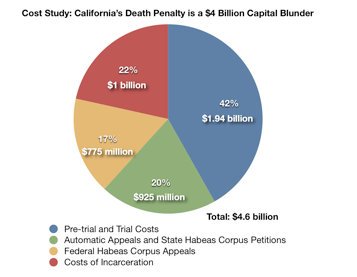
Source: “ExecutingtheWilloftheVoters?” by Judge Arthur Alarcon and Paula Mitchell, 2011
We thought we would bring California savings and safety in dealing with convicted murderers. Instead, we contributed to a nightmarish system that coddles murderers and enriches lawyers. Like Senator Anderson, our effort was intended to bring about greater justice for murder victims. Never did we envision a multi-billion dollar industry that packs murderers onto death row for decades of extremely expensive incarceration. We thought we would empty death row, not triple its population.
Having 34 years of firsthand experiences in this matter we feel the bill proposed by Sen. Anderson will not fix these problems. First and foremost, shortcutting the appeals process means risking innocent lives. Appeals are the safety net that keeps us from executing innocent people. States that shortchange the justice process have executed innocent people, like CameronToddWillingham in Texas.
Beyond the risk of executing the innocent, SB 1514 would simply move appeals from one court to another. That doesn’t alleviate the delay or the expense, it will just move it to a different courthouse.
It won’t eliminate the $1 million each county pays per death penalty trial, or the extra housing costs on death row over the general population – on average $100,000 per inmate per year – and it won’t change the fact that 99% of death row inmates in California die of old age rather than execution. History tells us any change to the death penalty has only added life to criminals, enhanced lawyers paychecks costing taxpayers more and more while appellate dates or new trials continue to torture victims’ families and survivors.
We believe that life without parole protects victims’ families and survivors at a greater savings to taxpayers. California’s best path for safety and savings is life without the possibility of parole.
Please join us in supporting theSAFECaliforniaAct with a “YES” this November. California has another chance at real justice. We should embrace it.

 Alabama death row prisoner Thomas Arthur
 Claim your Innocence