USA NEWS

A Second Jailhouse Snitch Claims a Secret Deal With Texas Prosecutor


Nearly six years before before Navarro County prosecutor John Jackson used a jailhouse snitch to help send Cameron Todd Willingham to his death, Jackson made similar use of an inmate informant in a different death penalty trial.
In both cases, the informants later said their testimony resulted from secret deals they made with the prosecutor, which were withheld from defense lawyers.
Jackson had strong evidence in the December 1986 trial of Ernest Baldree for murdering a husband and wife as he stole cash and jewelry. But Jackson also bolstered his case with testimony from Kyle Barnett, a convicted drug user and burglar, who told the jury that Baldree confessed to the crime while they were both inmates in the Navarro County Jail. Baldree was executed in 1997.
On September 10, 1991, 11 months before Willingham went on trial, Barnett signed a sworn affidavit for lawyers working on Baldree’s appeal. Barnett said that Jackson, along with Navarro County District Attorney Patrick Batchelor, pressured him to testify against Baldree in exchange for favorable treatment in his own case.
The scenario that Barnett described echoes allegations later made in the far more famous case of Cameron Todd Willingham, who was executed in 2004 for the arson murder of his three young daughters.
Last March, the Texas State Bar filed a formal accusation of misconduct against Jackson, accusing him of obstruction of justice, making false statements and concealing evidence favorable to Willingham. The bar action accused Jackson of failing to disclose to Willingham’s defense a deal with Johnny Webb, a jailhouse informant who testified that Willingham confessed to the crime while they were both in the Navarro County Jail.
Webb now says his testimony was false—that Willingham never confessed—and that Jackson threatened him with a lengthy jail term if he did not help the prosecution, so the two made a secret deal.
Jackson has denied making any deal with Webb, and says he helped Webb because he was facing death threats because of his testimony.
Source: The Marshall Project, Maurice Possley, Maurice Chammah, August 18, 2015


Related:


Texas prosecutor made secret deals in more than one death penalty case, report says


August 18, 2015 (washington post)

A now-retired Texas prosecutor struck secret deals to secure key testimony in more than one death penalty case, according to a new report.

After uncovering evidence last summer that Navarro County prosecutor John Jackson arranged such a deal in one death penalty case, The Marshall Project, a news nonprofit focused on criminal justice issues, reported Tuesday that Jackson did the same in another, earlier case. In both instances, the report says, defense attorneys were not told about the deals and those testifying reported feeling pressured into doing so and guided in what to share.

The new story alleges that Jackson bolstered a 1986 case against Ernest Baldree—who was charged with murdering a husband and wife during a robbery—with testimony from Kyle Barnett, who was an inmate with Baldree.

But Barnett says he never wanted to testify against Baldree: “The prosecutors there had me in a position where it would be real hard on me if I refused,” he said, according to the report. Barnett said Baldree admitted to the murders, but was also remorseful, saying he was high on speed and didn’t know what he was doing—a fact, he says, prosecutors were uninterested in hearing.

“The scenario that Barnett described strongly echoes allegations later made in the far more famous case of Cameron Todd Willingham, who was executed in 2004 for the arson murder of his three young daughters,” Maurice Possley and Maurice Chammah write.

Jackson had, for more than 20 years, denied making a deal in that case, too, but a story by Possley republished by The Washington Post last summer cast doubt on his denial.

[Fresh doubts over a Texas execution]

The former inmate who provided testimony against Willingham in that case, Johnny E. Webb, told Possley that he had been coerced and his testimony that Willingham confessed was a lie. Jackson at the time called the allegation a “complete fabrication.”

Jackson has also alleged that he and Barnett have never had contact. But Barnett says Jackson and his prosecution team told him that they needed his testimony.

“They told me that, if I would testify, they would allow me to the Cenikor Drug Rehabilitation program in Fort Worth for violating my probation,” Barnett explained in an affidavit, according to the new report. “They said if I didn’t testify, I’d be going back to the prison for a long time.”

Read more:

A second jailhouse snitch claims a secret deal with Texas prosecutor

Louisiana: Black jurors more likely to be struck from Caddo juries


Black prospective jurors in Caddo Parish are 3 times more likely to be struck from a jury than whites, a new study released today says.
The study, conducted by anti-death penalty group Reprieve Australia, looked at 332 felony jury trials prosecuted by the Caddo Parish District Attorney Office from Jan. 28, 2003, and Dec. 5, 2012.
In the cases examined, the DA’s office used discretionary “peremptory” challenge, which doesn’t require stating a reason, to reject potential jurors. What emerged was a troubling pattern which has garnered renewed scrutiny for jury selection practices in Caddo Parish.
“In the absence of any evidence to the contrary, this pattern discloses that it strongly suggests race has played a role in the exercise of these peremptory challenges, by the Caddo Parish DA’s Office, Ursula Noye, Reprieve Australia’s vice president and Blackstrikes Fellow, said.
The nonprofit found:
–Of the trials examined, 227 (83 %) involved a black defendant.
–The district attorney’s office used discretionary “peremptory challenges” to strike qualified potential black jurors 46 % of the time as opposed to the 15 % of the time for non-black jurors.
–In Caddo Parish 22 % of trials had 2 or fewer black jurors. Not 1 defendant was acquitted in a trial were there 2 or fewer black jurors. The 51 trials with 3 or more black jurors had an acquittal rating of 12 %.
–In 224 12-% juries, there was an average of 3.86 jurors per jury who were black. 206 of these juries returned a verdict.
–Some Caddo DA prosecutors struck black jurors at rate of 4.5 to 5 times the rate they struck non-black jurors.
Source: The Advertiser, August 18, 2015

U.S.: 95% of Prosecutors Are White and They Treat Blacks Worse


About one in three black men in the United States can expect to be incarcerated at some point in their lives. Black men comprise 6% of the U.S. population but 35% of the prison population.
Along the way, they will meet a lot of white people.
Local police forces are, on average, 88 percent white. Places like Ferguson, Missouri, are but the most extreme examples of nearly all-white police departments patrolling majority-nonwhite precincts.
But the white cop is only the first responder. Throughout the criminal justice system, defendants will repeatedly encounter disproportionately white—sometimes all-white—agents of the law. Most importantly, the charges against them will be set by 95 percent white prosecutors, elected on state and local levels. In fact, two-thirds of states that elect their prosecutors have no black prosecutors at all.
Since prosecutors convict 86 percent of the prison population, this means a nearly all-white cadre of attorneys is putting a disproportionately black cohort of defendants in jail.
Now, do all these statistics really matter? Sure, it looks bad that prosecutors are almost entirely white, but that doesn’t make them racist, right?
In fact, the racial divide among prosecutors correlates with how they unequally treat black and white defendants.
Remember, the overwhelming majority of criminal cases never make it to judge or jury. A stunning 97 percent of federal convictions and roughly 95 percent of state convictions are the result of guilty pleas reached through plea bargaining between prosecutors and defense attorneys: If the defendant pleads guilty before a trial, he or she will receive a lesser sentence than what would likely result from a conviction after trial.
In this environment, prosecutors have enormous leverage, unchecked discretion, and nearly absolute immunity. They decide initial charges, how to negotiate with defense attorneys, and whether to accept a given plea bargain or proceed to trial.

Click here to read the full article

Source: The Daily Beast, Jay Michaelson, August 17, 2015

STUDIES: Racial Bias in Jury Selection


A new study of trials in Caddo Parish, Louisiana, revealed that potential jurors who were black were much more likely to be struck from juries than non-blacks. The results were consistent with findings from Alabama, North Carolina, and other parts of Louisiana, highlighting an issue that will be reviewed by the U.S. Supreme Court this fall. In Caddo Parish, an area known for its many death sentences, prosecutors used peremptory strikes against 46% of black jurors, but only 15% of other jurors, according to the study by Reprieve Australia. The racial composition of the juries appeared to make a difference in the ultimate outcome of the cases. The study found that no defendants were acquitted by juries with 2 or fewer black jurors, but 19% were acquitted when 5 or more jurors were black. In an Alabama study, prosecutors used peremptory strikes to remove 82% of eligible black potential jurors from trials in which the death penalty was imposed. A study of death penalty cases in North Carolina found that prosecutors struck 53% of black potential jurors but only 26% of others.


In the death penalty case from Georgia that will be heard by the Supreme Court, Foster v. Chatman, all black prospective jurors were excluded from the jury. Prosecutors marked the names of black prospective jurors with a B and highlighted those names in green. Whenever such potential jurors had noted their race on questionnaires, prosecutors circled the word “black.”


Exclusion of Blacks From Juries Raises Renewed Scrutiny,” New York Times, August 16, 2015; U. Noye, “Blackstrikes: A Study of the Racially Disparate Use of Peremptory Challenges by the Caddo Parish District Attorney’s office,” Reprieve Australia, August, 2015)

Colorado lawmakers bump into death-row inmate Nathan Dunlap


August 17, 2015

In June, four Colorado legislators got face-to-face with death row inmate Nathan Dunlap, the Chuck E. Cheese killer whose execution was postponed last October by Gov. John Hickenlooper to the dismay of many pro-death-penalty Coloradans.

Like they do most summers, these members of the Capital Development Committee were touring state colleges, universities and other facilities to find out how taxpayers’ dollars are being spent and to consider future funding requests.

The June 8-10 tour took the committee to northeastern Colorado, to tour the Sterling Correctional Facility, which houses the state’s three death row inmates.

Legislators on the Sterling visit were Reps. Ed Vigil, D-Fort Garland and J. Paul Brown, R-Ignacio; and Sens. Randy Baumgardner, R-Hot Sulphur Springs and Jerry Sonnenberg, R-Sterling.

According to the legislators, the accidental encounter was uneventful and Dunlap was “very polite.”

Baumgardner said Dunlap came out of an elevator with a guard and had to walk through the group of mostly pro-death-penalty lawmakers because the space was so tight.

The inmate was held by the arm by the guard and was in full chains and shackles, according to Vigil.

“We were surprised,” Baumgardner said, and he believed Dunlap was as well.

Vigil described the situation as “surreal. It took me a second to recognize him,” he said.

“It’s a pretty nice facility,” Baumgardner said of the prison. There are things that need to be looked at, but that’s true for all of the state’s prisons, he added.

As to how meeting Dunlap impacted their opinions about the death penalty, the encounter didn’t change any minds, according to the legislators.


LOUSIANA : No A/C for death row inmates at Angola: decision made final, barring another appeal


August 17, 2015

Death row inmates at Louisiana State Penitentiary who claimed in a federal lawsuit that triple-digit temperatures inside their cells at Angola amounts to cruel and unusual punishment have been denied a rehearing of their case.

The decision by the 5th U.S. Circuit Court of Appeals not to re-examine the case, which was handed down Friday (Aug. 14), upheld a decision delivered July 8 by a three-judge 5th Circuit panel. The July 8 decision found heat indices reaching up to 108 inside the inmates’ cells did, in fact, violate the Eighth Amendment of the U.S. Constitution. However, the panel explained in its July 8 decision, the prison should not be required to install air-conditioning on death row to remedy the violation.

U.S. District Judge Brian Jackson had earlier ruled the conditions were unconstitutional and ordered the state to create and implement a plan, which included air conditioning, for cooling off death row.

The state appealed Jackson’s decision, but in the meantime, a plan was drafted. Death row tiers, built in 2008, are only heated and ventilated. The plan would have also provided inmate with chests filled with ice and allowed them daily cold showers. An appeals court intervened on behalf of the state before the prison ever put the plans in place, halting the implementation with an injunction while agreeing to take a look at the case.

The 5th Circuit on July 8 offered a few reasons why installing air conditioning on death row would have gone too far to provide relief for the plaintiffs. Air conditioning would be available year-round, when temperatures were often not extreme; it would cool off inmates who didn’t have medical conditions worsened by heat; and air conditioning “of course is expensive.”

Attorneys for the inmates argued in their request for a rehearing that Jackson’s order for air conditioning was less intrusive — and involved more micromanaging — than the remedies suggested by the panel.

The three inmates who filed suit, Nathaniel Code, 57; Elzie Ball, 60; James Magee, 35, all have medical conditions, such as diabetes and hypertension, that can be exacerbated by high heat. 

It’s unclear, the inmates’ attorney Mercedes Montagnes indicated, whether or not the inmates will appeal the case to the U.S. Supreme Court.

“We…have not yet decided our next step,” she said in an emailed statement.

Death row inmate seeks medical evaluation


August 17, 2015

A medical examination done Friday on a death row inmate convicted in a 1994 Columbia triple murder is expected to determine whether a benign brain tumor will cause complications with the state’s lethal injection protocol, according to federal court documents.

Ernest Lee Johnson has been in prison since June 1995, and a noncancerous tumor was discovered in his brain years later. Doctors removed part of the tumor in 2008, and the last scan of Johnson’s brain, in 2011, showed the remaining tumor wasn’t growing, according to a motion filed in June by one of his attorneys, Kansas City-based Jeremy Weis. The motion requested funding to hire physician Joel Zivot, assistant professor of anesthesiology and surgery at Emory University’s School of Medicine and the medical director of the cardio-thoracic intensive care unit at Emory University Hospital, to examine and evaluate Johnson.

Chief Judge Greg Kays of the Western District of Missouri in late June approved $7,200 for Zivot to review Johnson’s medical records and perform another scan of the condemned man’s brain, as well as to pay for travel time, consultation with attorneys and help in drafting an affidavit. Zivot will “render an expert medical opinion as to how Mr. Johnson will respond to the lethal injection drugs and whether he will respond differently than other Missouri inmates due to his unique medical condition,” Weis wrote.

Weis and Johnson’s other attorney, William Gaddy, did not respond to messages seeking comment. Michael Spillane, a Missouri assistant attorney general, is representing Troy Steele, the warden of Potosi Correctional Center, where Johnson is being held, who is named as the defendant in the case. Nanci Gonder, spokeswoman for the attorney general’s office, said the examination was conducted on Friday and that Spillane is waiting to obtain a copy of Zivot’s findings. Johnson’s next court date has not been set.

The most recent federal litigation continues a flurry of post-conviction proceedings for Johnson. Johnson was convicted in 1995 of the Feb. 12, 1994, murders of Fred Jones, 58, Mary Bratcher, 46, and Mable Scruggs, 57. His death sentence was twice overturned, in 1999 and 2003. The Missouri Supreme Court in 2008 affirmed a 2006 Pettis County jury’s decision to put Johnson back on death row, despite arguments from his attorneys that his IQ was in the 60s, far below the average of 100. Attorneys had previously gotten the sentence reversed because of Johnson’s mental retardation. The state’s highest court in 2008 had ruled his representation hadn’t successfully proven Johnson’s mental handicap.

As Jones, Bratcher and Scruggs closed a Casey’s General Store on Ballenger Lane, Johnson came in armed with a handgun and robbed the cash register before bludgeoning the victims to death with a hammer and flat-head screwdriver.

Johnson’s case went to the Eighth U.S. Circuit Court of Appeals in early 2013. A three-judge panel in December that year denied his application for appeal, and the U.S. Supreme Court in October 2014 denied a petition to hear the case. Nothing has been filed in the pending U.S. District Court case since Kays approved Zivot’s examination on June 22.

© 2015 Columbia Daily Tribune. All rights reserved. This material may not be published, broadcast, rewritten or redistributed.

William Petit, Dad of Murdered Family, Reacts to Connecticut Death Penalty Ruling


It was a crime of epic cruelty, and the culprits were sentenced to pay the ultimate price.
Steven Hayes (Left) and Joshua Komisarjevsky  AP PHOTO/CONNECTICUT STATE POLICE
But a decision by Connecticut’s highest court means the 2 men who carried out the chilling Petit family murders will be spared execution, along with 9 other death-row inmates.
Steven Hayes and Joshua Komisarjevsky now get life sentences for a 2007 home invasion robbery in which they raped and strangled Jennifer Petit, tied her daughters Hayley and Michaela to their beds, and set the home ablaze.
Petit’s sister, Cynthia Hawke Renn, told NBC News that she is “disheartened” by the Connecticut Supreme Court’s finding that a 2012 legislative repeal of the death penalty should also apply to those who committed their crimes earlier.
“I really do think that cruel and unusual crimes really do deserve cruel and unusual punishment,” she said.
“For people who commit such heinous and horrific crimes – when you torture and rape them and their children, douse them with gasoline and burn them alive – is there not something that should be worse?
“Shouldn’t there be a worse punishment out there for someone who takes a life in such a cruel and unusual way?”
Jennifer Petit’s husband, Dr. William Petit, who was beaten during the siege but escaped to call for help, had fought against the 2012 repeal of the death penalty. He noted in a statement Thursday that the court was divided in its ruling.
“The dissenting justices clearly state how the 4 members of the majority have disregarded keystones of our government structure such as the separation of powers and the role of judicial precedent to reach the decision they hand down yesterday.
“The death penalty and its application is a highly charged topic with profound emotional impact, particularly on their victims and their loved ones.”
Connecticut’s death row includes killers who have been there since 1989. The latest addition is Richard Roszkowski, who was sentenced last year, after legislative repeal, but was still eligible because the crime occurred in 2006.
He was convicted of killing a former neighbor, Holly Flannery, her 9-year-old daughter Kylie and a landscaper, Thomas Gaudet.
Kylie’s grandmother, Flo Tipke, said the court ruling was a blow.
“We went through two trials and now it kind of feels like it was a huge waste of time and money,” she said. “We’re very sad. We feel that the way he murdered our grandchild and our daughter-in-law was cruel and heinous and I don’t feel any punishment they could have given him would be too cruel or heinous.”
Mary Jo Gellenbeck – whose sister Diana was kidnapped and killed by another death-row prisoner, Daniel Webb – said she favors Thursday’s ruling.
“I don’t support the death penalty so I’m happy to see that Connecticut is moving in the direction of eliminating that,” she said.
Gellenbeck said her opposition to capital punishment stems in part from the danger that someone innocent could be put to death, though she is certain Webb murdered her sister.
“I think David Webb is a danger to society,” she said. “But if he is behind bars without parole, it’s what everybody wants.”
Source: NBC news, August 14, 2015

Arkansas Buys Lethal Injection Drugs, Aims To End Execution Hiatus


LITTLE ROCK, Ark. (Reuters) – Arkansas has bought drugs it plans to use for lethal injections, officials said on Wednesday, as it looks to end a decade-long hiatus on executions that is the longest of any Southern U.S. state.
Arkansas law allows information on the drugs used in executions and the vendors supplying them to remain secret.
Local reports said the drugs included midazolam, a sedative death penalty opponents had challenged as inappropriate for executions, arguing it cannot even achieve the level of unconsciousness required for surgery.
On June 29, the Supreme Court found the drug did not violate the U.S. Constitution’s ban on cruel and unusual punishment, a ruling that provoked a caustic debate among the justices about the death penalty.
The Arkansas attorney general, Leslie Rutledge, acknowledged through a spokesman that the chemicals planned for use in Arkansas were on hand but declined further comment. The Arkansas Department of Correction did not return a call seeking comment.
Eight of the 35 men on Arkansas’s death row, 20 of whom are black, have exhausted all their appeals, according to Rutledge.
It is the attorney general’s responsibility to ask the governor to set execution dates, but Judd Deere, Rutledge’s press secretary, said she had “no timetable to offer on that at this time.”
Arkansas has not put to death a condemned inmate in 10 years. Appeals by death row prisoners and legal disputes over the constitutionality of drugs and procedures in capital cases have idled the Arkansas death chamber since 2005, when Eric Nance, 45, was put to death by lethal injection.
Earlier this year, Republican Governor Asa Hutchinson signed into law a measure giving prison officials the option of using a single large dose of barbiturate or a combination of three drugs to cause death.
Source: Reuters, August 13, 2015


The death penalty is about to go on trial in California. Here’s why it might lose


On Aug. 31, the death penalty will go on trial at the Ninth Circuit Court of Appeals. The oral argument stems from a judgment in 2014, in which Federal District Judge Cormac Carney ruled that California’s death penalty system was unconstitutional.
Carney argued that because of the extremely low likelihood of execution and long delays on death row, the system was actually a penalty of life without parole with the remote possibility of death. His ruling declared that execution after such a long delay serves no retributive or deterrent purpose beyond the long prison term, and is therefore arbitrary and unconstitutional (see Jones v. Chappell, 2014). As Carney wrote in his California decision, no rational jury or legislature would design a system that functions as the system actually works. But, he argued, we must evaluate the system we do have, not the one we might prefer to have.
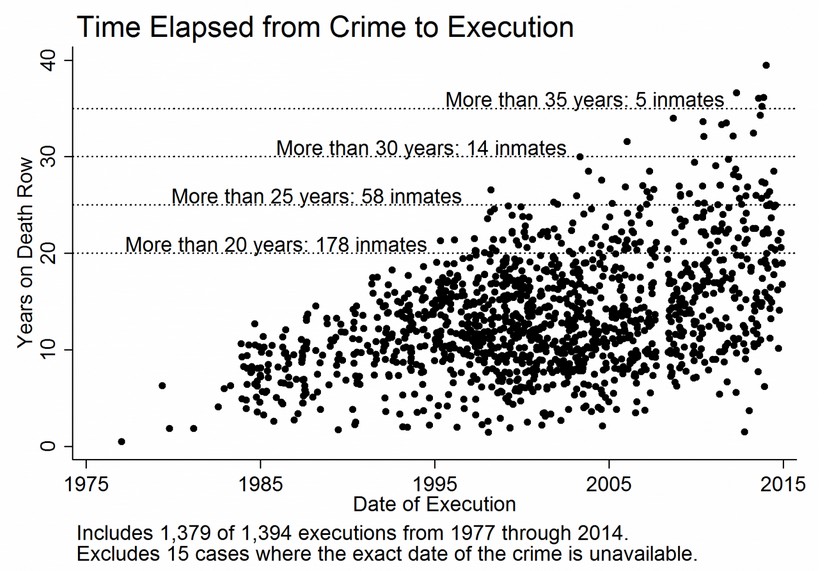
Nationwide, the “new” death penalty consists of 20 years or more on death row, followed by some probability of execution. The average delay from crime to execution for those executed since 2010 is 16 years across the United States, even longer in California, as the judge noted. 38 % of inmates executed nationally since 2010 served more than 20 years; 17 % served more than 25 years; 5 inmates were killed after more than 35 years of delay. The vast majority are never executed.
In a previous post Anna Dietrich and I documented that only about 16 % of condemned inmates across the nation have been executed. By far, the most likely outcome of a death sentence is that it will be overturned on appeal. Many death row inmates simply die of old age. For those few where the death sentence is actually carried out, increasing percentages languish on death row literally for decades before execution.
Supporters of the death penalty argue that Carney overstepped with his sweeping decision throwing out the entire California death penalty. Oral arguments in the Ninth Circuit Court of Appeals will begin at the end of this month. California certainly was at the low end of the distribution of “efficiency” in carrying out its death sentences in our previous analysis. Out of more than 900 death sentences, the state has carried out just 13 executions. It stands as one of the few states, along with Pennsylvania, that has large numbers of death sentences that result in very few executions.
What’s the lag time between sentence and execution outside California?
Except for Virginia, no state in the country carries out even 1/2 of all its death sentences. The most common outcome after a death penalty, by far, is reversal of the death sentence with a new sentence of life without parole. Inmates may sit on death row for years before this reversal.
This graph looks at 1,379 of the 1,394 executions that were carried out between 1977 and 2014 (I could not recover the date of the crime for 15 cases), showing the length of time from crime to execution. Of course, inmates do not move straight from the crime scene to death row. However, there has been no significant increase in the time between crime and death sentence, which averages 1.5 years.
Why is there so much time from sentence to execution?
Delays come for many reasons. Death penalties in California and elsewhere trigger a mandatory appeal to a state’s top court, and then, if not reversed, through the federal system. These are part of the safeguards mandated by the U.S. Supreme Court in the 1976 Gregg decision ushering in the “modern” death penalty. Carney noted that in California, appeals attorneys are not appointed for 3 to 5 years. They take 4 years to learn the case and file their appeal. Attorneys for habeas appeal (through the federal courts) are not appointed, on average, until 8 to 10 years after the death sentence.
Most of this delay results from a severe backlog of death penalty cases, a lack of qualified attorneys who are willing to accept capital assignments under the conditions that the state offers, and delays in appointing required qualified defense counsel.
How long does it take, exactly, to carry out the death penalty?
Each dot on the figure refers to a particular inmate executed. At the lower-left corner, the 1st case is the 1st “modern” execution: Gary Gilmore, executed by firing squad in Utah in 1977. Vertical placement of the dot indicates the number of years from the crime to the execution. Horizontal placement indicates the date of the execution.
As you can see, some executions occur relatively quickly, even today. Across the bottom of the graph are those inmates who “volunteer” for execution by instructing their attorneys to abandon all appeals. 20 of the 206 inmates executed since 2010 waited fewer than 5 years from crime to execution. However, you can see that average delays are increasing dramatically (about one additional year of delay every 3 years), and that increasing numbers of inmates are serving very long sentences before being executed. Many more remain on death row with no execution in sight.
For the 206 inmates executed since 2010, their average time from crime to execution was 16 years. 36 served more than 25 years before their execution. Overall, through 2014, 178 inmates have been executed after serving more than 20 years; 58 after more than 25 years; 14 after more than 30 years; and 5 after more than 35 years. Florida executed Thomas Knight in January 2014 for a crime committed in January 1974 – almost 40 years later. In contrast, Gilmore was killed by Utah’s firing squad in January 1977 for a crime that occurred in July 1976. Knight’s crime came 2 years before Gilmore’s, but he waited another 37 years after Gilmore’s execution on Florida’s death row before that state put him to death.
In the recent Glossip v. Gross decision affirming the use of lethal injection, the U.S. Supreme Court affirmed its support for the death penalty in the opening words of the majority decision: “Because capital punishment is constitutional, there must be a constitutional means for carrying it out.”
In his dissenting opinion, Justice Stephen Breyer noted a number of practical problems with the administration of the punishment. He noted 3 “fundamental constitutional defects”: 1) unreliability; 2) arbitrariness; and 3) unconscionably long delays. These have led, he wrote, to 4) abandonment of the penalty by most places within the United States. Since the Court’s 1976 reaffirmation of capital punishment, replete with new constitutional “safeguards sufficient to ensure that the penalty would be applied reliably and not arbitrarily,” numerous practical problems have emerged, Breyer wrote. “The circumstances and the evidence of the death penalty’s application have changed radically since then,” he wrote. “Given those changes, I believe it is now time to reopen the question.”
Source: The Washington Post, Frank Baumgartner, August 5, 2015. Mr. Baumgartner is the Richard J. Richardson distinguished professor of political science at the University of North Carolina-Chapel Hill.