
Subscribe to continue reading
Subscribe to get access to the rest of this post and other subscriber-only content.
Subscribe to get access to the rest of this post and other subscriber-only content.

Subscribe to get access to the rest of this post and other subscriber-only content.

January 28, 2024
Ivan Cantu was sentenced to death in 2001 for the murders of his cousin James Mosqueda and his cousin’s fiancée Amy Kitchen, but he has always maintained his innocence and now Kim Kardashian is fighting for his release
Kim Kardashian is fighting to save death row inmate Ivan Cantu after he was convicted for the murders of his cousin and his cousin’s fiancée.

Kim Kardashian has now become involved in the case ( Image: Getty Images)
Cantu has been on death row for more than two decades. He was sentenced to death in 2001 for the fatal shootings of James Mosqueda and Amy Kitchen, but has always maintained his innocence.
Amy and James were killed during a robbery at their home in North Dallas back in November 2000. Cantu has accused police officers of taking “witness statements and testimony at face value” and not properly investigating the claims. He alleges this led to “false and untruthful information” which culminated in his arrest.

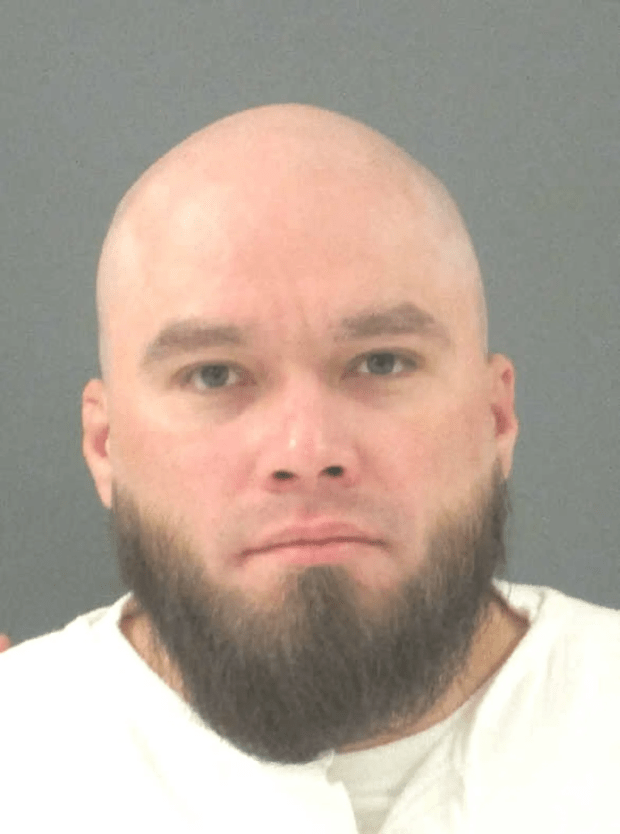
Ivan Cantu was sentenced to death
(Image: Texas Department of Criminal Justice)
Investigators said they believed robbery was the motive for the killings. “Officers believe the crime occurred because robbery was the motive, the murders occurred during a robbery attempt, the car was taken, and some other items were also missing,” police told FOX 4 at the time.
At Cantu’s trial, prosecutors presented evidence of his fingerprints on the gun used in the murders, as well as bloody clothing seized from Cantu which had the victims’ DNA on it. However, true crime podcaster Matt Duff claims Cantu’s fiancée and the state’s star witness Amy Boettcher, who is now deceased, lied on the stand.
“Amy said Ivan had stolen James’s watch and then tossed it out the window,” Matt said during an episode of the Cousins by Blood podcast. The private investigator added: “Early in my investigation I discovered the Rolex. Although it was reported missing, it was later recovered at the house and given back to the family. So the family had that Rolex all along, but no one figured that out until 2019 when I started this case.”
Amy also claimed Cantu proposed to her using a diamond ring she alleges was taken from one of the victims. Witnesses have since come forward and said Amy and Cantu announced their engagement and shown off the ring a week before the murders.
Two jurors who originally voted to find Cantu murder have now come forward and said they don’t want him to be executed until new evidence can be reviewed. The Texas Criminal Court of Appeals could grant an evidentiary hearing, where Cantu’s lawyer could challenge the evidence presented in 2001.
The 50-year-old had been set for execution on April 26, 2023, but state District Judge Benjamin Smith in Collin County, where Cantu was convicted, withdrew the execution date and said more time was needed to review Cantu’s claims. However, his execution has now been rescheduled to February 28, 2024.
Kim Kardashian has now taken to Instagram to speak out about Cantu’s case. Posting on her Story, she wrote: “I heard about Ivan Cantu’s case from Sister Helen Prejean and was really moved by it. In 2001, Ivan was convicted of killing his cousin, James Mosqueda, and his fiancée, Amy Kitchen. Ivan has always maintained his innocence claiming that the rival drug dealer framed him for the murder.”
Explaining how her fans can help, the reality star added: “Texas now has a conviction integrity unity. The prosecutors offices are beginning to recognize that there are a lot of mistakes in convictions. They encourage you to write into their integrity units about specific cases, so I am encouraging everyone to write in about the case of Ivan Cantu. The time to act to save Ivan Cantu is now!”

January 11, 2024

Texas death row inmate Ivan Cantu is now facing his third scheduled execution date after the Texas Criminal Court of Appeals denied him a new trial following his filing of a petition to present new evidence in his case.
Cantu has been on death row for over two decades for murdering his cousin, James Mosqueda, a known drug dealer, and his cousin’s fiance, Amy Kitchen, in 2000.
Since Cantu’s conviction in 2001, new information and holes in the state’s case raise questions of reasonable doubt, according to Matt Duff, a private investigator who has researched the case since 2019. The new developments in Cantu’s case included a trial witness recanting his testimony and a pair of jurors in his trial coming forward to express concerns about the conviction.
Duff documented his private investigation and created a lengthy, in-depth podcast titled “Cousins by Blood.” His work dives into Cantu’s case with first-hand interviews, including Cantu’s early jail tapes in 2000 and an interview with the state’s star witness that helped put him on death row.
Ivan Cantu has been given two prior execution dates, but both have been halted.
In 2022, after the DNA hearing concluded, Cantu received an execution date for April 2023. But Collin County District Judge Benjamin Smith withdrew that death warrant after Bunn filed her appeal outlining the new evidence.
Then, on August 23, a judge dismissed the new evidence for procedural reasons without considering the merit of her arguments.
This month, Bunn filed a new request with the court to reexamine the ballistic evidence in the case since Duff and other investigators have conducted their own ballistics experiments that cast more doubt on some of the police’s original conclusions.
To this day, Bunn doesn’t know if she has received everything related to Cantu’s case from the Collin County District Attorney’s Office and from the Dallas Police Department. Part of the issue is that 20 years have passed since the original trial, and many people currently working in those departments weren’t around then. Another issue was jurisdiction—Dallas police, then and now, don’t usually work with Collin County prosecutors—but the murders happened in a portion of North Dallas that extends into Collin County.
Winning post-conviction relief is extremely difficult in Texas, though not impossible: 464 people have been exonerated of various crimes here since 1989, according to the National Registry of Exonerations. About a third of those cases were overturned due to perjury or false accusations, according to the registry. Nearly one in five was due to inadequate legal defense.
Almost 70 exonerations were from Dallas County. But Cantu’s case was tried in Collin County, even though it was investigated by the Dallas Police Department. Since 1989, only four people sent to prison from Collin County have been exonerated.
The judge who presided over Cantu’s trial, Charles Sandoval, has since been heralded “the worst judge in Collin County”. Known as “Hang Them All Sandoval,” he lost his seat in 2008 after developing a reputation for cruelty and for making decisions based not on law but on courtroom favorites. One of the four recent Collin County exonerations was of former Judge Suzanne Wooten, who was convicted of bribery after successfully challenging Sandoval in a judicial campaign. That accusation came directly from Sandoval, but the charges were later overturned and discredited as a baseless vendetta.
On Valentine’s Day, Cantu will submit his paperwork to tell the prison system who he wants there on his execution day and what he wants the state to do with his body afterward. He’ll explain where he wants his few belongings and any money left in his account to go.
Sister Helen Prejean, author of the book Dead Man Walking, is acting as Cantu’s spiritual adviser. She’ll be there with Cantu during his execution if his date holds. But in the meantime, she is a fierce advocate for the date to be withdrawn.
“There’s no way I’m simply going to acquiesce, hold his hand, and pray him into eternity without doing every single thing I can to get the truth out so that Texas does not execute this man who very possibly might be innocent,” Prejean told
Prejean, along with Cantu’s other supporters, are calling on Collin County to again withdraw his death warrant. It’s one of many ongoing efforts to spare Cantu’s life—and to give him another day in court. Officials from the county did not respond to requests for comment for this story.
“If you want to execute me, that’s fine,” Cantu said over the closed-circuit phone in the Polunsky Unit. “Just give me a fair trial.”
“The criminal court of appeals deemed the claims in Ivan’s application were procedural barred, meaning it should have been included in Ivan’s 2004 habeas filing,” Duff said. “If the claims raised were based on a 2009 law (ex. Parte Chabot) and 2022 recant of a state’s star witness, that information was clearly unavailable in 2004.”
“The court’s ruling is unjust and needs to be overturned,” Duff added.
Cantu responded to the court’s decision on death row through the Texas Department of Criminal Justice email system.
“I’m disappointed with the Texas Court of Criminal Appeals for not reviewing my case on the merits,” Cantu writes. “I’m entitled to a new trial according to state law precedent and the constitution of the United States.”
“Where is State Rep. Jeff Leach?” Cantu added. “Leach advocates for other death row inmates such as Melissa Lucio and Jeffery Wood, who are not even from Collin County. Why isn’t he advocating for the injustice occurring in his own backyard?”
Texas State Rep. Jeff Leach was contacted for comment by phone and via email on Friday, Sept. 1, and again on Monday, Sept. 5, and has yet to reply as of noon on Wednesday, Sept. 6.
Cantu’s execution date is scheduled for Feb. 28, 2024.
Documentary

HUNTSVILLE, Texas − David Santiago Renteria spoke his last words Thursday night, strapped to a gurney at the Huntsville Unit, minutes before being executed in the 2001 abduction and killing of 5-year-old Alexandra Flores.
Renteria, 53, was injected with a lethal dose of pentobarbital Thursday, Nov. 16, on a dark, cold and rainy evening at the Texas Department of Criminal Justice’s prison. His time of death was 7:11 p.m. CST, prison officials said.
With his family and Alexandra’s family present, Renteria gave his final statements.
Killer’s final words
Renteria prayed before singing a hymn in English and another in Spanish after witnesses, including relatives of his victim, entered the death chamber and watched through a window a few feet from him during his execution.
Looking at his victim’s relatives, Renteria also said: “There is not a day that goes by that I do not think about the fateful events of that day and what transpired.
“There are no words to describe what you’re going through, and I understand that.”
He told his sister and a friend, watching through another window, that he was “good… strong”.
“I love you all, I truly do. I’ll see you in the next life,” Renteria added.
He then began reciting The Lord’s Prayer as the drugs began flowing. “Our father, who art in heaven” is as far as he got.
“I taste it,” he said of the drug, before mumbling something and all movement stopped.
The Renteria family watched the execution from a different room from Alexandra’s family. Glass windows separated the witnesses from Renteria.
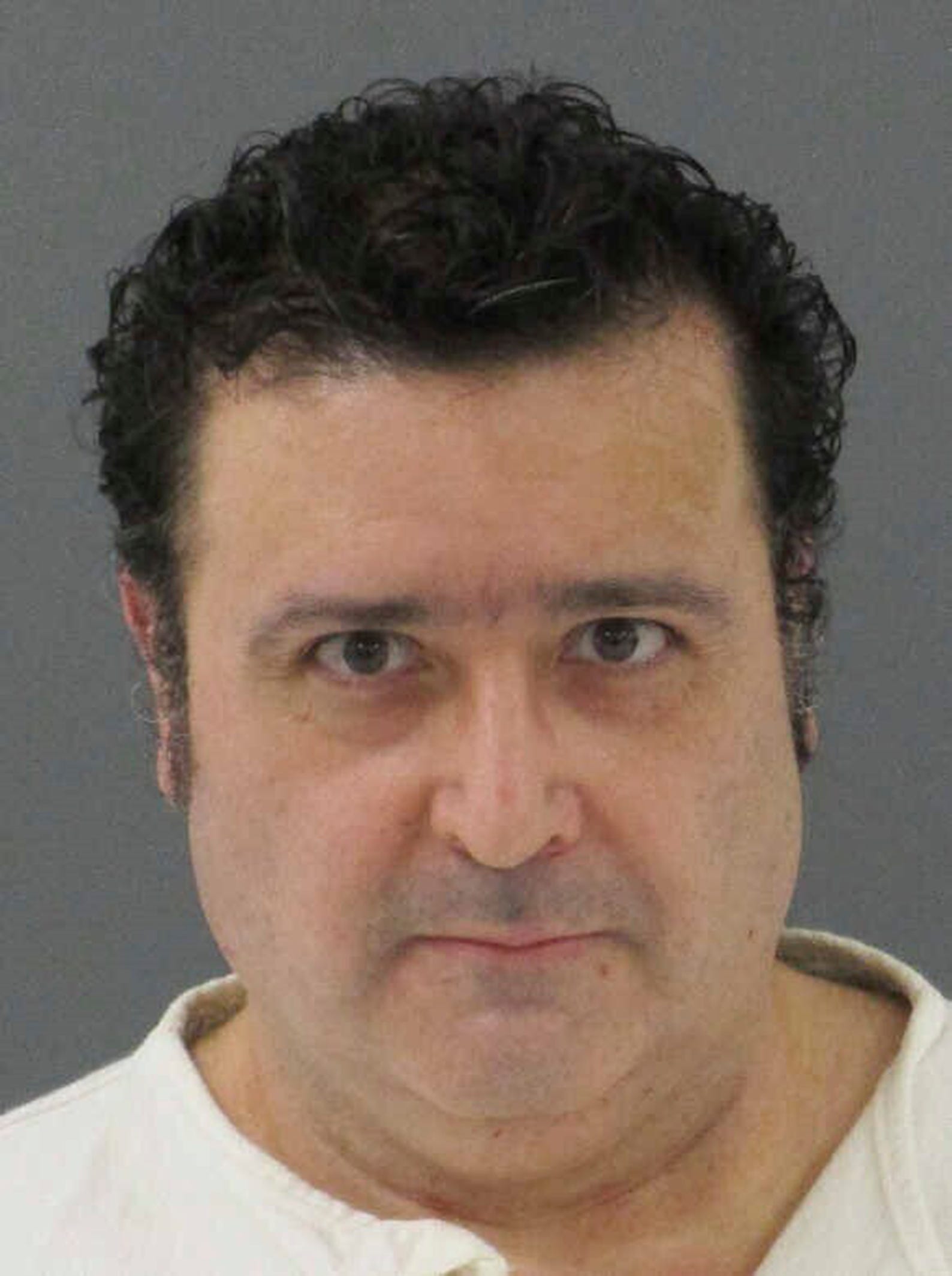
This photo released by the Texas Department of Criminal Justice shows death row inmate David Renteria. Renteria, a Texas inmate convicted of strangling a 5-year-old girl taken from an El Paso store and then burning her body nearly 22 years ago is facing execution. (Texas Department of Criminal Justice)
Alexandra’s sister, Sandra Frausto, and brother, Ignacio Frausto, attended the execution.
Renteria’s sister Cecilia Esparza and a friend also were present.
Esparza collapsed when she walked into the viewing room, and prison officials brought her a chair and she cried. Renteria told his sister through the glass, “I love you.”
Renteria spent his final days meeting with visitors, laying in bed, watching TV through a cell door and sleeping, a Death Watch report states. The times listed below are in Central time zone.
On his execution day, starting at 12:15 a.m., he sat on his bed and began writing. The report does not state what he wrote.
He began packing up his property about 2:30 a.m., before sitting on the floor and reading a book around 4 a.m., the report states. He then continued packing up his property and cleaning the floor between 5 to 7:30 a.m.
Renteria was allowed to talk to fellow inmates at 7:30 a.m., before meeting with visitors from 8 to 11:30 a.m., the death watch states.
He was then transferred from the Texas Department of Criminal Justice’s Polunsky Unit in Livingston, Texas, to the Huntsville Unit to await his execution.
A victim of Renteria’s from a different criminal incident and her mother also attended the execution. Renteria was previously convicted and sentenced to 20 years in prison for indecency with a child in El Paso.
The execution was also attended by 14 state law enforcement and governmental officials.
Renteria grew up in the Lower Valley and was a tribal member of the Ysleta del Sur Pueblo, according to the Texas Coalition to Abolish the Death Penalty.
While in prison, he rededicated himself to his Roman Catholic faith, the coalition reported.
Renteria’s execution ends a nearly 22-year legal battle waged in what has been described as one of the most heinous crimes committed in El Paso.
“I’ve always been a supporter of the death penalty and from a law enforcement perspective, I just think some people are too dangerous to be in our society and that is certainly one individual who I think that that the death penalty is absolutely appropriate,” El Paso County Sheriff Richard Wiles said. “It’s a long time coming. I think it’s been what? Twenty-one years. I was actually the assistant (El Paso police) chief, (Carlos) Leon was the chief when that horrific crime occurred. It was really tough on everybody. I can’t even imagine what that family went through and what they’re still going through today.
“Hopefully, this will give them a little bit of relief to help them in their recovery that is going to take the rest of their lives, Wiles said. “I can’t even imagine losing my 5-year-old daughter to such a horrific crime.”
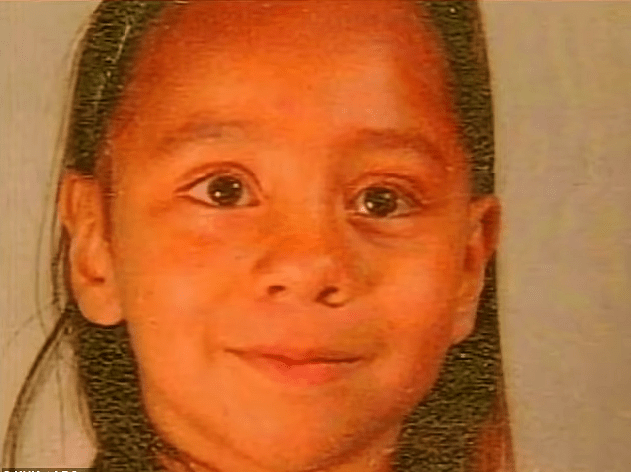
Renteria’s execution came two days before the 22nd anniversary of the day he kidnapped 5-year-old Alexandra Flores from an El Paso Walmart, strangled her to death and then burned her body. It also comes six days before his 54th birthday.
Renteria abducted Alexandra Nov. 18, 2001, as she was Christmas shopping with her parents at an El Paso Lower Valley Walmart.
Her parents realized she was missing and searched the store but could not find her. Alexandra was seen on store surveillance video exiting the store about 5:15 p.m. with Renteria.
Alexandra’s body was found about 7:10 a.m. the next day in an alley 16 miles (25km) away.. She was naked and partially burned in a carport near Downtown El Paso.
An autopsy revealed Alexandra was strangled to death and then set ablaze, court documents state. Investigators later revealed there were no signs of sexual assault.
A palm print on a plastic bag found over Alexandra’s head was determined to be from Renteria, court documents state.
El Paso Police Department investigators discovered that a vehicle registered to Renteria was at 9441 Alameda Ave. at the time and date of Alexandra’s disappearance. Renteria also told police he was at the location at the time and date of her disappearance, court documents state.
Renteria went to trial for the death of Alexandra in September 2003. He claimed in his trial that Barrio Azteca gang members forced him to kidnap the girl and someone else was the person who killed her, court records show.
A jury convicted him of capital murder and he was sentenced to death.
Appeals court justices heard the case in 2006 and upheld the conviction. However, the justices ordered a new sentencing phase of the trial.
The resentencing was ordered because of “exclusion of evidence showing the defendant’s remorse violated due process by preventing defendant from rebutting the State’s case when the State left jury with false impression and emphasized it,” the justices wrote in their opinion.
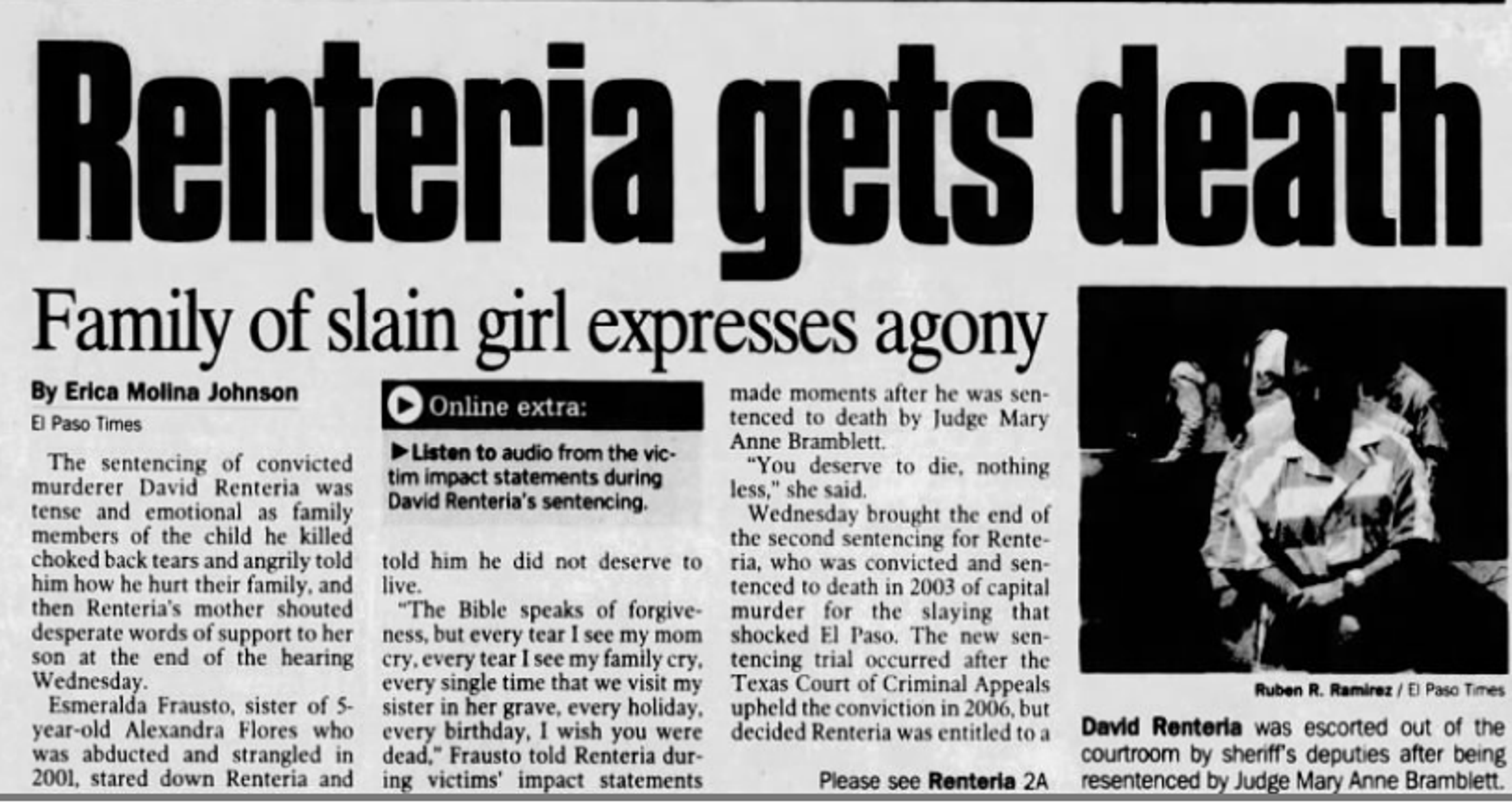
A May 15, 2008, El Paso Times article reporting David Santiago Renteria was given the death penalty during his resentencing hearing.
DAVID SANTIAGO RENTERIA v. THE STATE OF TEXAS (Original)
El Paso Sheriff Deputy Peter Herrera’s family speaks after death penalty sentence

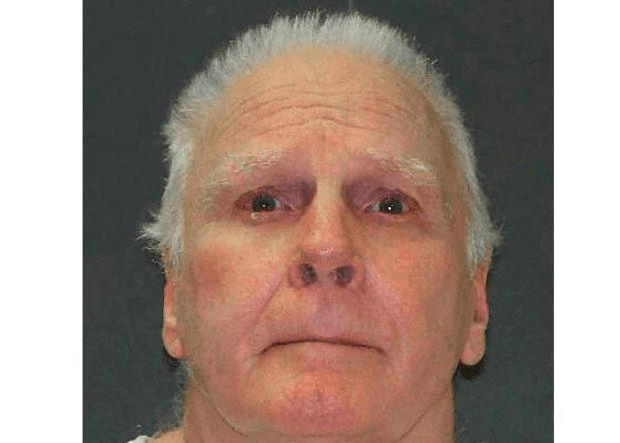
Huntsville, Texas — Texas’ oldest death row inmate was executed Thursday for killing a Houston police officer during a traffic stop nearly 32 years ago.
Carl Wayne Buntion, 78, was put to death at the state penitentiary in Huntsville. He was condemned for the June 1990 fatal shooting of Houston police officer James Irby, a nearly 20-year member of the force.
The U.S. Supreme Court had declined a request by Buntion’s attorneys to stop his execution.
“I wanted the Irby family to know one thing: I do have remorse for what I did,” Buntion said while strapped to the Texas death chamber gurney. “I pray to God that they get the closure for me killing their father and Ms. Irby’s husband.
“I hope to see you in heaven some day and when you show up I will give you a big hug.”
Buntion, joined by his spiritual adviser, began praying Psalm 23, “The Lord is my Shepherd…” as the lethal dose of the powerful sedative pentobarbital began. He took a deep breath, coughed once, then took three less pronounced breaths before all movement stopped.
He was pronounced dead at 6:39 p.m., 13 minutes later.
Several dozen motorcyclists, showing support for the slain motorcycle officer, loudly revved their engines as the execution took place, the roar clearly audible in the death chamber.
Buntion had been on parole for just six weeks when he shot the 37-year-old Irby. Buntion, who had an extensive criminal record, was a passenger in the car that Irby pulled over. In 2009, an appeals court vacated Buntion’s sentence, but another jury resentenced him to death three years later.
“I feel joy,” the officer’s widow, Maura Irby, said after watching Buntion’s execution. “I’m sorry someone died. But I didn’t think of him as a person. I just thought of him as a thing, as a cancer on the face of my family.”
Before his slaying, James Irby had talked of retirement and spending more time with his two children, who at the time were 1 and 3 years old, Maura Irby, 60, said earlier.
“He was ready to fill out the paperwork and stay home and open a feed store,” she said. “He wanted to be the dad that was there to go to all the ballgames and the father daughter dances. He was a super guy, the love of my life.”
Leading up to his execution, various state and federal courts had also turned down appeals by Buntion’s lawyers to stop his death sentence. The Texas Board of Pardons and Paroles on Tuesday had rejected his clemency request.
Buntion’s attorneys said he was responsible for Irby’s death and “deserved to be punished severely for that crime.”
But they argued his execution was unconstitutional because the jury’s finding he would be a future danger to society – one of the reasons he was given a death sentence- has proven incorrect, and also his execution would serve no legitimate purpose because so much time has passed since his conviction. His attorneys described Buntion as a geriatric inmate who posed no threat as he suffered from arthritis, vertigo and needed a wheelchair.
“This delay of three decades undermines the rationale for the death penalty. … Whatever deterrent effect there is diminished by delay,” his attorneys David Dow and Jeffrey Newberry, wrote in court documents.
With his execution, Buntion became the oldest person Texas has put to death since the Supreme Court lifted its ban on capital punishment in 1976. The oldest inmate executed in the U.S. in modern times was Walter Moody Jr., who was 83 years old when he was put to death in Alabama in 2018.
Buntion was also the first inmate executed in Texas in 2022. Although Texas has been the nation’s busiest capital punishment state, it had been nearly seven months since it carried out an execution. There have been only three executions in each of the last two years, due in part to the coronavirus pandemic and delays over legal questions about Texas’ refusal to allow spiritual advisers to touch inmates and pray aloud in the death chamber.
In March, the U.S. Supreme Court said states must accommodate requests to have faith leaders pray and touch inmates during executions.
As Texas prepared to execute Buntion, officials in Tennessee canceled the execution of an inmate Thursday in what would have been the state’s first execution since the start of the pandemic. Oscar Smith, 72, was scheduled to die for the 1989 killings of his estranged wife and her teenage sons. Republican Gov. Bill Lee didn’t elaborate on what issue forced the surprise 11th-hour stop to the planned execution.
Texas prison officials agreed to Buntion’s request to allow his spiritual adviser to pray aloud and touch him while he was put to death.
The adviser, Barry Brown, placed his right hand on Buntion’s right ankle in the moments before the drugs began flowing and prayed for about five minutes. He said Buntion no longer was a “hard-headed young man” but had been “humbled by the walls and cold steel of prison.”
While the execution stirred up painful memories for her, Irby said it also reminded her of her advocacy work in public safety after her husband’s death, including helping put together legislation that allowed victim impact statements at trials.
“I still miss him, 32 years later,” she said Thursday night.

10.05.2022
UPDATE 10.06.2022
In the execution chamber, his spiritual adviser, Dana Moore, placed his right hand on the inmate’s chest, and held it there for the duration. With his back to witnesses, Moore offered a brief prayer.
“Look upon John with your grace,” he prayed. “Grant him peace. Grant all of us peace.” As Moore’s prayer ended, Ramirez responded: “Amen.”
After the prayer, Ramirez addressed five of Castro’s relatives — including four of his children — as they watched through a window a few feet from him. “I have regret and remorse,” he said.” This is such a heinous act. I hope this finds you comfort. If this helps you, then I am glad.
I hope in some shape or form this helps you find closure.”
Ramirez expressed love to his wife, son and friends, concluding with: “Just know that I fought a good fight, and I am ready to go.”
As the lethal dose of pentobarbital took effect, he took several short breaths then began snoring. Within a minute, all movement stopped. Ramirez was pronounced dead 14 minutes later, at 6:41 p.m. CDT.
John Henry Ramirez, 38, was sentenced to death over the 2004 fatal stabbing of 46-year-old convenience store clerk Pablo Castro during a drug-fueled string of robberies.

His execution date was delayed last year after Ramirez claimed his religious freedom was being violated because state prison rules prevented his pastor from touching him and praying aloud during the procedure.
Ramirez’s fight ended up clarifying the role of spiritual advisers in death chambers nationwide after the US Supreme Court sided with the convicted murderer in March.
The court ruled that states must accommodate the wishes of death row inmates who want to have their religious leaders
The Texas Board of Pardons and Paroles declined on Monday to commute Ramirez’s death sentence to a lesser penalty.
Ramirez has exhausted all possible appeals and there is no final request to the Supreme Court planned, his attorney Seth Kretzer said.
Ramirez was convicted of stabbing Castro 29 times in a robbery that cops said was the culmination of a three-day binge fueled by a mix of pot, pills, booze and cocaine — and yielded him just $1.25.
He fled to Mexico immediately after but was arrested 3 1/2 years later.
If Ramirez’s execution goes ahead as planned, he would be the third inmate put to death this year in Texas and the 11th in the country.

April 12, 2021
Ramiro Felix Gonzales was scheduled to be executed at 6 pm local time, on Tuesday, April 20, 2021, at the Walls Unit of the Huntsville State Penitentiary in Huntsville, Texas. His execution has been rescheduled to November 17, 2021. Thirty-eight-year-old Ramiro is convicted of the murder of 19-year-old Bridget Townsend on January 15, 2001, in Bandera, Texas. Ramiro has spent the last 14 years on Texas’ death row.

While pregnant with him, Ramiro’s mother allegedly used drugs and then abandoned him after his birth. Ramiro was primarily raised by his grandmother and was allegedly sexually abused by a male relative. He dropped out of school after the seventh grade and was using drugs and alcohol regularly by the age of 12. Prior to his arrest, he worked as a welder and a fence builder.
In 2003, Ramiro Gonzales was in Bandera County jail awaiting transport to a prison, after being convicted of abducting and raping a woman. While waiting, Gonzales asked to speak with Sheriff James MacMillian. Gonzales told the Sheriff that he had information about Bridget Townsend, a teenager who had disappeared two years earlier. Initially, the Sheriff did not believe Gonzales, but when Gonzales offered to take the Sheriff to the location of Bridget’s body, the Sheriff became interested.
Sitting in the passenger seat, Gonzales directed the Sheriff to a ranch where Gonzales lived with his family, but they did not stop at the ranch. They continued driving over jeep trails to a remote cedar-covered hillside. Gonzales, the Sheriff, and a jail administrator exited the vehicle. During the 100 yard walk to Bridgett’s remains, Gonzales described the jewelry she had been wearing, wear she had been standing when he shot her, and where he had put the body. A human skull, along with other bones, were found close to the location where Gonzales claimed to have shot her. The bones had been slightly scattered by wildlife.
During the drive back to the jail, Gonzales gave conflicting stories about the night when Bridget was shot. Initially, Gonzales blamed the Mexican Mafia and Bridget’s boyfriend, Joe Leal, saying they hired him. Then he claimed that he and Joe had agreed to kill Bridget. The conflicting stories continued once they returned to the jail. Finally, Gonzales confessed that all his previous stories were lies and that he was solely responsible for Bridget’s death. This version, for which he gave a signed confession, matched the evidence that was discovered during the investigation.
Joe Leal had been Gonzales’ drug dealer. On January 14, 2001, Gonzales had phoned Joe’s house to obtain more drugs. Bridget answered the phone, saying Joe was at work. Gonzales, knowing Bridget was at the house, decided to drive over and steal some cocaine. Gonzales pushed his way past Bridget after she answered the door. He continued to ignore Bridget while her stole between $150 and $500 in cash.
When Bridget began calling Joe, Gonzales dragged her into a bedroom and tied her up. He asked if Joe had any drugs in the house. When she responded negatively, he took her out to this truck, pausing to turn out the lights so that they would not be spotted. Gonzales drove back to the ranch, stopping to pick up his grandfather’s .243 caliber deer rifle.
Gonzales confessed that he had planned to shoot Bridget so that no one would know he had robbed Joe, nor that he had kidnapped Bridget. Gonzales drove Bridget to the spot where her remains were later found. Gonzales forced Bridget to walk towards the brush as he began loading the rifle. Bridget promised money, drugs, or sex if Gonzales would spare her life. Gonzales unloaded the weapon, and took her back to the truck to assault her; after which, he, again, took her into the brush and shot her.
Gonzales then returned home and interacted with his family as though nothing was wrong. He had returned to the weapon to where he retrieved it and flung the empty shell casing away from the house. Gonzales also denied, multiple times, seeing Bridget that night or visiting Joe’s house.
During Gonzales’ trial, a women who he had kidnapped and raped, testified that she believed she would have been killed if she had not managed to escape.
This is not Ramiro Gonzales’ first scheduled execution date. He has had at least two previous executions dates that were stayed for unknown reasons. According to the online execution calendar provided by the Texas Department of Criminal Justice, Ramiro’s execution date has been rescheduled. No reason has been provided for the date change.
Please pray for peace and healing for the family of Bridget. Please pray for strength for the family of Ramiro. Pleas pray that if Ramiro is innocent, lacks the competency to be executed, or should not be executed for any other reason that evidence will be presented prior to his execution. Please pray that Ramiro will come to find peace through a personal relationship with Jesus Christ, if he has not already found one.

| Date | Number Since 1976 | State | Name | Age | Race | Victim Race | Method | Drug Protocol | Years from Sentence to Execution |
|---|---|---|---|---|---|---|---|---|---|
| 1/15/20 | 1513 | TX | John Gardner | 64 | W | 1 White female | Lethal Injection | 1-drug (Pentobarbital) | 13 |
| 1/29/20 | 1514 | GA | Donnie Lance | 65 | W | 1 White male, 1 White female | Lethal Injection | 1-drug (Pentobarbital) | 21 |
| 2/6/20 | 1515 | TX | Abel Ochoa | 47 | L | 2 Latinx females | Lethal Injection | 1-drug (Pentobarbital) | 17 |
| 2/20/20 | 1516 | TN | Nicholas Todd Sutton | 58 | W | 1 White male | Electrocution | N/A | 34 |
| 3/5/20 | 1517 | AL | Nathaniel Woods | 43 | B | 3 White males | Lethal Injection | 3-drug (Midazolam) | 14 |
| 5/19/20 | 1518 | MO | Walter Barton | 64 | W | 1 White female | Lethal injection | 1-drug (Pentobarbital) | 26 |
| 7/8/20 | 1519 | TX | Billy Joe Wardlow | 45 | W | 1 White male | Lethal injection | 1-drug (Pentobarbital) | 25 |
| 7/14/20 | 1520 | Federal | Daniel Lewis Lee | 47 | W | 1 White male, 2 White female | Lethal injection | 1-drug (Pentobarbital) | 21 |
| 7/16/20 | 1521 | Federal | Wesley Ira Purkey | 68 | W | 1 White female | Lethal injection | 1-drug (Pentobarbital) | 17 |
| 7/17/20 | 1522 | Federal | Dustin Lee Honken | 52 | W | 2 White males, 3 White females | Lethal injection | 1-drug (Pentobarbital) | 14 |
| 8/26/20 | 1523 | Federal | Lezmond Mitchell | 38 | NA | 2 Native American females | Lethal injection | 1-drug (Pentobarbital) | 17 |
| 8/28/20 | 1524 | Federal | Keith Dwayne Nelson | 45 | W | 1 White female | Lethal injection | 1-drug (Pentobarbital) | 18 |
| 9/22/20 | 1525 | Federal | William Emmett LeCroy | 50 | W | 1 White female | Lethal injection | 1-drug (Pentobarbital) | 16 |
| 9/24/20 | 1526 | Federal | Christopher Andre Vialva | 40 | B | 1 White male, 1 White female | Lethal injection | 1-drug (Pentobarbital) | 20 |
| 11/19/20 | 1527 | Federal | Orlando Hall | 49 | B | 1 Black female | Lethal injection | 1-drug (Pentobarbital) | 25 |
| 12/10/20 | 1528 | Federal | Brandon Bernard | 40 | B | 1 White male, 1 White female | Lethal injection | 1-drug (Pentobarbital) | 20 |
| 12/11/20 | 1529 | Federal | Alfred Bourgeois | 56 | B | 1 Black female | Lethal injection | 1-drug (Pentobarbital) | 18 |

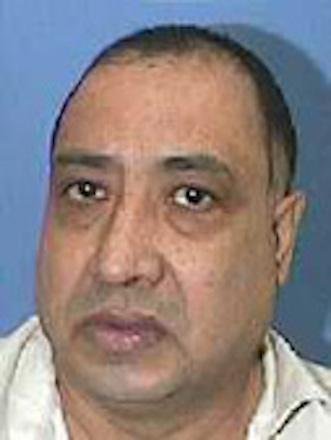
The Texas Court of Criminal Appeals has stayed the execution of a man who says he’s intellectually disabled and thus can’t constitutionally be put to death.
The court handed down the ruling Wednesday, ordering a lower court to review the merits of Ramiro Ibarra’s arguments.
Ibarra, 66, was sentenced to death in 1997 for the sexual assault and murder of 16-year-old Maria Zuniga a decade earlier in McLennan County. He was scheduled to be executed March 4.
Ibarra has challenged his death sentence a number of times on intellectual disability grounds, saying it violates the Eighth Amendment, which bars cruel and unusual punishment.
The court declined the stay on seven other claims presented by Ibarra’s lawyers, including that the state relied on “outdated and unreliable DNA tests” to secure his conviction, that the state presented false and misleading evidence, that the death sentence was based on false testimony, and that his execution would violate due process.
Ibarra is the third death-row inmate scheduled to be executed in Texas this year who has received a stay.

 Claim your Innocence