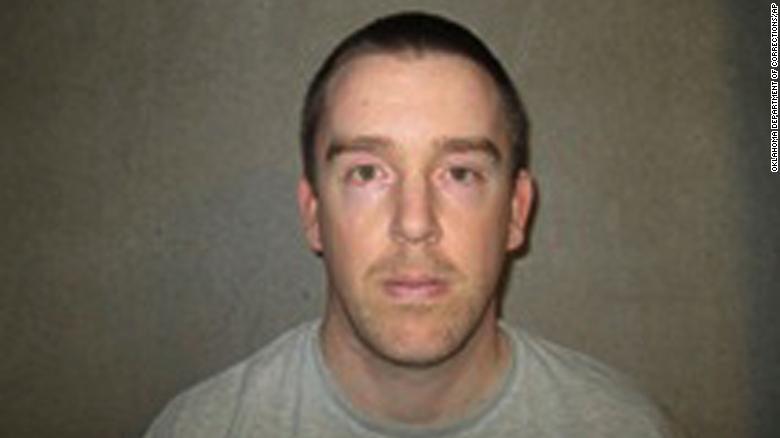
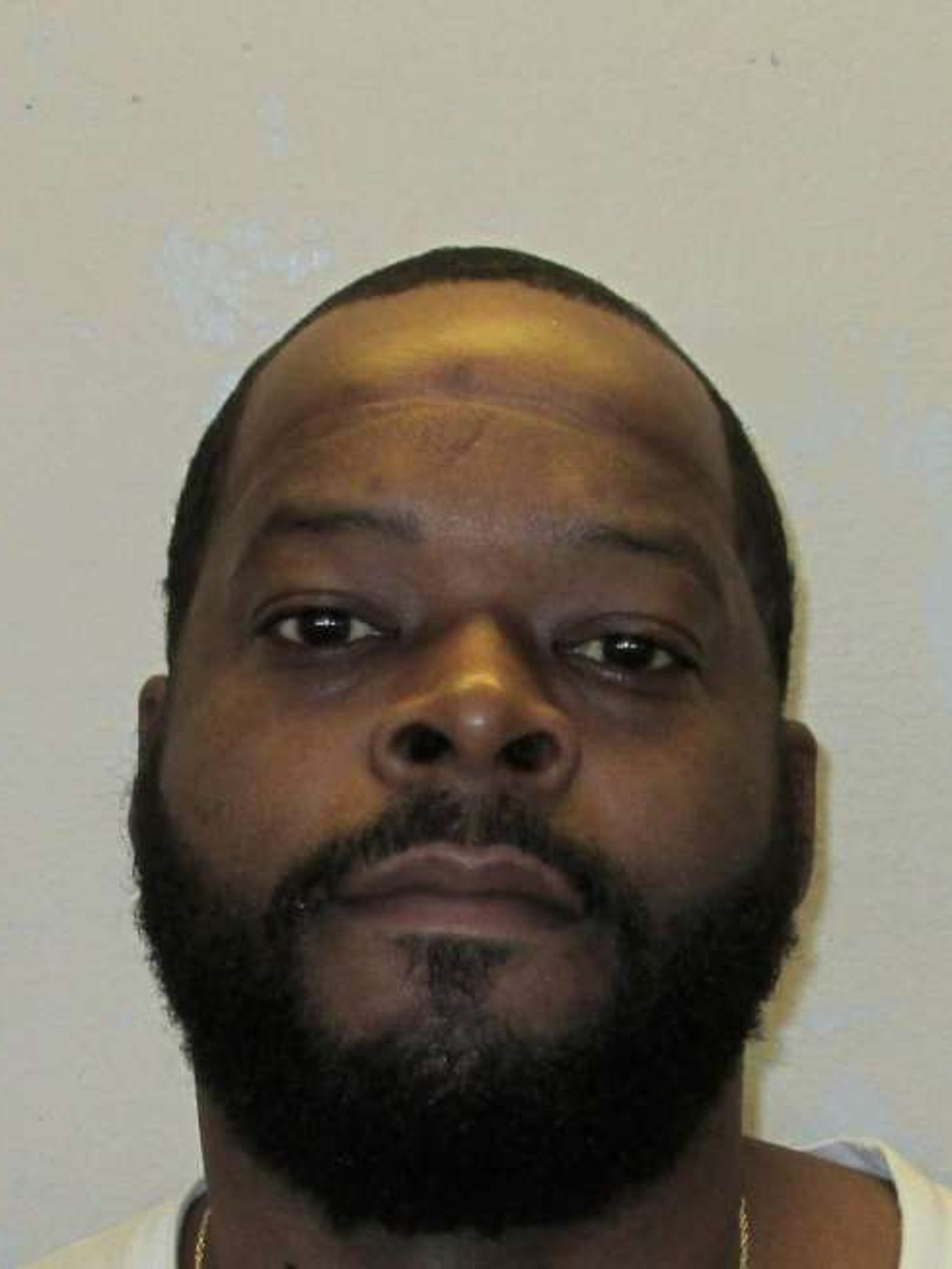
Inmates on the death row

Governor Issues Reprieve For Three Ohio Death Row Inmates


April, 9 2021

Three Ohio death row inmates will not be executed this year as planned.

Governor Mike DeWine has issued a reprieve for Timothy Hoffner, John David Stumpf and Lawrence Landrum. The three were supposed to be executed on different dates this summer and fall.

But DeWine says he’s postponing them due to ongoing problems with getting the supply of drugs used for lethal injections. The three men’s execution dates are reset for the summer and fall of 2024.

Conviction, death penalty upheld of Oklahoman in beheading


March 18, 2021

OKLAHOMA CITY — The Oklahoma Court of Criminal Appeals on Thursday upheld the murder conviction and death sentence of man in the beheading of a co-worker in the Oklahoma City suburb of Moore.

The court rejected claims that Alton Alexander Nolen, 36, was mentally ill and incompetent to stand trial in addition to improper jury selection, improper photographic evidence and prosecutorial misconduct.

Nolen’s defence attorneys did not immediately return a phone call for comment.

Nolen was convicted and sentenced to death in for the 2014 beheading of 54-year-old Colleen Hufford at Vaughan Foods.

Prosecutors said Nolen killed Hufford and wounded another co-worker after being suspended from his job at the plant for making threatening statements to co-workers.

San Quentin death row inmate dies


March 17, 2021

Another condemned inmate at San Quentin has died, according to the Department of Corrections and Rehabilitation.

64-year-old Johnny Mungia passed away at a hospital on Tuesday, March 16th.

This Aug. 24, 2018, photo released by the California Department of Corrections and Rehabilitation shows Johnny Mungia, a 64-year-old death row inmate who died on March 16, 2021, at a hospital. (California Department of Corrections and Rehabilitation via AP)

Mungia’s cause of death is under investigation, but foul play is not suspected.

An official cause of death is pending the results of an autopsy by the Marin County Coroner.

On April 7, 1997, Mungia was found guilty of the first-degree murder of 73-year-old Alma Franklin by a Riverside County jury and sentenced to death on April 14, 1997.

There are currently 705 people on California’s death row.

A convicted Oklahoma killer’s death sentence was overturned because of a landmark US Supreme Court ruling


March12, 2021

The murder convictions and death sentence of Shaun Michael Bosse, seen in this undated photo, were overturned by an Oklahoma appeals court on Thursday, March 11, 2021.
 Shaun Michael Bosse

An Oklahoma death row inmate is set to receive a new trial after a court overturned his conviction based on a US Supreme Court ruling last year that determined a large part of the state is Native American territory for the purposes of federal criminal law

.The Oklahoma Court of Criminal Appeals ruled Thursday the state did not have the jurisdiction to prosecute Shaun Bosse, who was sentenced to death in 2012 for the murders of 24-year-old Katrina Griffin, her 8-year-old son and 6-year-old daughter because the victims were members of the Chickasaw Nation and the murders took place on the reservation.The appeals court cited the Supreme Court’s landmark July 2020 ruling in McGirt vs. Oklahoma, in which the justices ruled 5-4 that a broad swath of the state was Native American land for the purposes of federal criminal law. According to federal law, crimes that involve Native Americans on a reservation are subject to federal, not state, jurisdiction.CNN has reached out to an attorney for Bosse for comment.District Attorney Greg Mashburn, who prosecuted Bosse, told CNN in an interview Friday that federal prosecutors will assume jurisdiction in the case.”I’m devastated for the family (of Bosse’s victims),” Mashburn said. “They can’t heal. They’re just going to have to go through this whole process again. I’m just really upset for them and hate that they’re going to have to sit through another trial.”

Autopsy: California serial killer known as ‘I-5 Strangler’ was strangled himself in prison


March, 2021 A California serial killer who authorities say strangled and raped at least seven women was fatally choked himself in a state prison, officials said Wednesday.

Roger Reece Kibbe, 81, known as the “I-5 Strangler” in the 1970s and 1980s, was spotted unresponsive Sunday in his cell at Mule Creek State Prison southeast of Sacramento — his 40-year-old cellmate standing nearby.

This Aug. 1, 2013, photo provided by the California Department of Correction and Rehabilitation shows inmate Roger Reece Kibbe.

An autopsy showed Kibbe had been manually strangled, the Amador County Sheriff’s Office said, calling the death a homicide.

No charges have been filed in the death of Kibbe, a former suburban Sacramento furniture maker whose brother was a law enforcement officer.

He was initially convicted in 1991 of strangling Darcine Frackenpohl, a 17-year-old who had run away from her home in Seattle. Her nearly nude body was found west of South Lake Tahoe below Echo Summit in September 1987.

Investigators said then that they suspected him in other similar slayings.

But it wasn’t until 2009 that a San Joaquin County District Attorney’s Office investigator used new developments in evidence to connect him to six additional slayings in multiple Northern California counties, with several victims found alongside Interstate 5 or other highways in 1986. Kibbe was serving multiple life terms for the slayings when he was killed.

Authorities said they never stopped trying to prove that he was responsible for even more deaths. Investigators secretly took him on multiple field trips from prison with the hope that he would reveal the whereabouts of more victims.

They would buy him an egg McMuffin and a Coke for breakfast, another Coke and a hamburger and fries for lunch, Vito Bertocchini, a retired San Joaquin County sheriff’s detective and district attorney’s investigator, told The Sacramento Bee.

Bertocchini spent nearly two decades pursuing Kibbe and thinks he must have killed others during the 10-year gap between his first and last known slayings. Investigators have said they found other women who had been killed and dumped with Kibbe’s trademark of cutting his victims’ clothing in odd patterns.

He was finally captured after Sacramento police said a would-be victim escaped and they recovered a garrote made from a pair of dowels and parachute cord along with scissors and other items.

Investigators said they matched the cord to rope found with Frackenpohl’s body and at Kibbe’s house, all with microscopic dots of red paint. DNA eventually linked him to two other victims, and he agreed to cooperate in exchange for prosecutors taking the death penalty off the table.

Kibbe never admitted to other killings beyond those with which he was charged, but Bertocchini said he never stopped trying to elicit another confession.

Even after he retired in 2012, each year he sent Kibbe birthday and Christmas cards, asking him to speak up if he recalled anything about other victims. He and his old partner last visited Kibbe in prison in 2019, but still he wouldn’t admit to any more victims.

Now it’s too late, but Bertocchini called Kibbe’s death by strangulation “some fitting justice.”

“I don’t wish ill on anyone,” Bertocchini said. “But I hope he remembered every one of his victims while he was being killed.”

Wyoming considering repeal of death penalty


The state has had only one execution in 55 years.

March 9, Wyoming may become the next state to outlaw capital punishment.

bill was introduced in the state Senate last week by Republican Sen. Brian Boner that would end the death penalty as potential punishment for a murder conviction. Boner told ABC News that the current law, in effect since 1976, is antiquated and costs taxpayers over $750,000 a year.

In the last 55 years, the state has only held one execution, back in 1992, a nonpartisan nonprofit that tracks death row inmates.

“We are dealing with a significant budget crisis, and we’re looking at old rules that don’t work,” Boner told ABC News. “It’s time to get rid of it.”

The bill passed the state Senate’s revenue committee with a 4-1 vote on March 4 and will move on to a full vote. The legislative session ends April 2.

If the bill passes and is signed into law, Wyoming would become the 24th state to abolish the death penalty since the federal government allowed it in 1973.

Robert Dunham, executive director of the Death Penalty Information Center, testified at the committee hearing. He told ABC News that Wyoming is following a similar path to one seen across the country, with fewer juries and judges giving out death penalty sentences. That decrease has garnered the attention of politicians on both sides of the aisle, Dunham added.

“We have seen an abolition in practice follow by an abolishing in the law,” Dunham said.

Dunham added that there is an increased sense of morality when it comes to executions because, on average, there has been one exoneration for every eight executions.

“It is no longer debatable that innocent people are going to be sentenced to death. It is no longer debatable that innocent people have been executed,” he said. “That’s given legislators of all political and philosophical beliefs great pause.”

Boner agreed and said that eliminating the death penalty in Wyoming would create a “more efficient criminal justice system.” Two years ago, a similar measure passed in the Wyoming House but failed in the Senate with a vote of 18-12. Boner said a lot has changed since then, particularly during the pandemic.

Wyoming Gov. Mark Gordon told legislators last summer that he was “very seriously” considering imposing a moratorium on the use of capital punishment, claiming it is “a luxury that we cannot afford.”

Dunham said that there will likely be a bigger push from advocates to repeal the law and more pressure on other states to re-examine their policies. Last month, Virginia’s Legislature passed a bill to end death penalty in the state.

“Regardless of what the outcome is,” Dunham added, “what we are seeing in Wyoming is the declining support of capital punishment across all demographic groups.”

Former Alabama Chief Justice, lieutenant governor back new trial for death row inmate


March 19, A group of 14 former judges and prosecutors — including a former Alabama lieutenant governor and a former Alabama Chief Justice — urged a Jefferson County judge Tuesday to set a new trial for a death row inmate convicted in 1998.

In two of seven friend-of-the-court briefs filed with the Jefferson County Circuit Court on Tuesday morning, the signatories wrote that the court should follow the guidance of Jefferson County District Attorney Danny Carr, who said the court should grant Toforest Johnson a new trial amid questions about the conduct in the first. 

“The DA’s decision to vacate Mr. Johnson’s conviction is a heavy one made after an exhaustive investigation of the surrounding circumstances and irregularities leading to his conviction; this weighty decision should be given significant deference by the Court,” said a brief signed by former Alabama Chief Justice Drayton Nabers; former Alabama Supreme Court Justice Ralph Cook; former Alabama State Bar President Bill Clark; retired Judge William Bowen and attorney Bobby Segall. “To disregard District Attorney Carr’s decision would frustrate the exact duties he was elected to perform and further undermine public confidence in our criminal justice system.”

Toforest Johnson’s conviction

A jury convicted Johnson in 1998 of the 1995 murder of William Hardy, a Jefferson County deputy sheriff. Hardy was working as a private security guard at a Birmingham hotel when he was shot and killed in the hotel’s parking lot early in the morning of July 19, 1995. Police arrested Johnson and charged him with murder a few hours later. 

No physical evidence linked Johnson to the scene, and Johnson, 48, maintains his innocence. A jury could not reach a verdict in the first trial, but a jury in a second trial convicted Johnson. After the conviction, Johnson’s attorneys learned that a witness for the prosecution named Violet Ellison received $5,000 from the state after approaching the police in response to a reward offered. 

Johnson’s attorneys filed a motion known as a Brady claim, saying prosecutors withheld evidence that could have raised questions about the witness’ credibility. State courts upheld the conviction, but the U.S. Supreme Court ordered new hearings on the Brady claim in 2017. 

Last year, Jefferson County Circuit Judge Teresa T. Pulliam denied Johnson’s Brady claim, ruling that Johnson had not established “by a preponderance of the evidence” that Ellison “either came forward or gave testimony out of a ‘hope of reward,’ or that the state had knowledge of such motivation at or before the time of the trial.” 

But in June, Carr said Johnson should get a new trial, citing issues with Ellison and other witnesses and the fact that prosecutors could not settle on a theory of the case. 

“A prosecutor’s duty is not merely to secure convictions, but to seek justice,” Carr wrote in a brief to the court.

Toforest Johnson

Convicted murderer Joseph Duncan, on death row, facing aggressive brain cancer


Appellate Court Overturns Duncan's Death Penalty

March 8 – Convicted murderer and sexual predator Joseph Duncan may not see the death penalty after all because he is now facing aggressive brain cancer.

According to our partners at The Spokesman-review, Duncan has stage 4 glioblastoma and doctors are giving him six to 12 months to live.

Doctors gave the life expectancy on November 20 which puts Duncan four months into the timeframe.

Duncan was sentenced to the death penalty in 2005. He is convicted of killing Brenda Groene, her boyfriend and her 13-year-old son inside their home near Coeur d’Alene. He kidnapped Groene’s two other children Shasta, 8, and Dylan, 9.

Duncan tortured and abused the children, eventually killing Dylan.

Shasta was rescued seven weeks later when a waitress at the Coeur d’Alene Denny’s recognized the little girl and Duncan inside the restaurant.

Oklahoma panel moves toward commuting death row inmate’s sentence


March 8 – Oklahoma’s Pardon and Parole Board voted 3-1 on Monday to advance death row inmate Julius Jones’ request for a reduced sentence.

OKLAHOMA CITY — Oklahoma’s Pardon and Parole Board voted 3-1 on Monday to advance death row inmate Julius Jones’ request for a reduced sentence, setting up the possibility he could avoid lethal injection.

The board’s approval moves Jones’ commutation request to a second-stage hearing later this year in which both Jones and his supporters will be able to address the board. If approved at the second stage, the commutation request will be forwarded to Republican Gov. Kevin Stitt for a final decision.

Jones, 40, maintains he is innocent of the 1999 shooting death of Edmond businessman Paul Howell, who was shot to death in front of his family during a carjacking.

Julius Jones was convicted and sentenced to die for the 1999 shooting death of Edmond businessman Paul Howell.
JULIUS JONES

Jones’ case drew the attention of reality television star Kim Kardashian West and numerous professional athletes with Oklahoma ties after it was featured in 2018 on the ABC television documentary series “The Last Defense.”

State prosecutors say the evidence against Jones is overwhelming and have defended his death sentence, urging the board to reject his commutation request.

“To this day, Jones has not expressed an ounce of remorse for his callous actions,” District Attorney David Prater wrote in a letter to the panel. “Instead, he continues to victimize the Howell family by fueling a media circus with outright lies and by making a farce of this clemency process.”

Questions Linger for Anthony Shore, Larry Swearingen


Update 2019.

Larry Swearingen, 48, was executed by lethal injection Wednesday evening for the December 1998 killing of Melissa Trotter. The 19-year-old was last seen leaving her community college in Conroe, and her body was found nearly a month later in a forest near Huntsville, about 70 miles north of Houston.

Swearingen was pronounced dead at 6:47 p.m. His last words were: “Lord forgive them. They don’t know what they are doing.”

Larry Swearingen, en 2009

January, 18 2018

Houston serial killer Anthony Shore faces another death date, this one Jan. 18. Shore was originally set for execution in October, but that got halted by the Harris County District Attorney’s Office amid rumors he was planning to confess to another murder: the 1998 killing of Melissa Trotter. Except Larry Swearingen had been convicted of kidnapping, raping, and strangling Trotter in 2000, and by then was preparing for his own execution in November.

Assistant District Attorney Tom Berg said his office revoked Shore’s execution warrant at the request of Montgomery County D.A. Brett Ligon, who believed Shore was colluding with Swearingen. (He says a folder was found in Shore’s cell with information relating to Trotter’s death.) Berg said the Texas Rangers have since interviewed Shore, who admitted he had “nothing to do” with Trotter’s murder. Shore alleged he and Swearingen once contemplated conspiring, but had since “parted ways.” Berg, who says his office and Ligon’s have reviewed the interview, said Shore decided not to “take the fall” for his fellow inmate. Shore has exhausted his appeals; Berg said he’s unaware of any new attempts to stay Shore’s execution, and concluded that his case will see its “inevitable end” next Thursday.

Shore’s execution is just the beginning of a busy month.

Swearingen, however, had his November execution stayed due to a filing error, and has since been granted additional DNA testing. Unlike Shore, who confessed to killing four girls between 1986 and 1995, Swearingen has maintained his innocence. His supporters, including his lawyer James Rytting, say he was in a county jail for outstanding traffic warrants at the time of Trotter’s murder. The 19-year-old was last seen on Dec. 8, 1998, with Swearingen (who wasn’t arrested until three days later), but her body wasn’t discovered until Jan. 2. Rytting said forensic evidence suggests her body could not have been dumped in the woods until “a week or 10 days” after Swearingen was arrested.

Included in the evidence sent out for testing is Trotter’s rape kit, which was never tested and could exonerate Swearingen should analysts uncover another DNA profile. Samples of hair particles found on Trot­ter’s undergarments and the alleged murder weapon (a torn pair of pantyhose) will also be tested. The evidence was shipped out in December and testing will likely take four weeks.

Rytting was alarmed that the state had reissued an execution date for Shore. “They shouldn’t be putting the guy into the ground with these questions still around,” he said. He says two witnesses, with no connection to Swearingen, told the D.A.’s Office that Shore suggested to them that he was connected to Trotter’s murder. The information, Rytting said, would “sure as hell” make Shore a suspect had it been provided prior to Swearingen’s conviction. “It’s a type of incriminating statement the prosecution seizes on all the time,” he said. “You don’t get to wiggle out of it with an ‘Aw shucks, I was kidding.'”

Shore will likely mark the first state-sanctioned killing of 2018, and his is just the beginning. William Rayford is scheduled for Jan. 30, and John Battaglia for Feb. 1.