Lethal injection

Georgia Sets March 20 Execution Date for Willie Pye Despite Strong Evidence of Intellectual Disability and Previous Finding of Ineffective Representation by Attorney with History of Racial Bias EXECUTED 11.03 PM


UDPATE march 22. 2024

he state of Georgia on Wednesday executed death row inmate Willie Pye, who was convicted and sentenced to die for the 1993 murder of Alicia Lynn Yarbrough.

The execution – Georgia’s first in more than four years – was carried out by lethal injection at 11:03 p.m. at a prison in Jackson, about 50 miles south of Atlanta, the Georgia Department of Corrections said in a news release. Pye did not make a final statement, it said.

Pye, 59, was put to death after the US Supreme Court denied his final appeals late Wednesday. In a clemency petition and various court filings, Pye and his attorneys had argued for his life to be spared, citing an intellectual disability, a troubled upbringing and ineffective assistance of counsel.

“The State of Georgia obtained Willie’s death sentence only after providing him a racist and incompetent defense attorney. And the State has insisted on standing by that death sentence in spite of his lifelong intellectual disability and the fact that he presents a danger to no one in prison,” his attorney, Nathan Potek, said after the execution.

“The people of Georgia deserve better,” he added, describing Pye as a loving son, brother and uncle who “will be dearly missed by his friends, family, and his legal team.”

March 7, 2024

The Georgia Attorney General has announced that Willie James Pye, who previously had his death sentence reversed due to his attorney’s failure to investigate his background, only to see the death sentence reinstated on appeal, is set to be executed on March 20. Mr. Pye’s court-appointed trial attorney, Johnny Mostiler, has been accused of ineffective representation or racial bias in at least four cases involving Black defendants and reportedly called one of his own clients a “little n****r.” Mr. Pye has also exhibited “undisputed” signs of intellectual disability, with an IQ of 68 and a history of learning difficulties. Georgia has not conducted an execution in over four years, and Mr. Pye is the state’s first scheduled execution date in about two years.

Mr. Pye was convicted and sentenced to death in 1996 for the kidnapping, robbery, rape, and murder of his ex-girlfriend Alicia Yarbrough. At the time, Mr. Mostiler had a lump-sum deal with Spalding County to represent the entire indigent criminal caseload, which numbered some 800 felony and five capital cases. He also had an active private civil practice. Mr. Mostiler only spent about 150 hours on Mr. Pye’s case, including the trial itself, while studies have found that thousands of hours are typically required for effective capital defense representation. He also spent less than five hours preparing the case for a life sentence, most of it on the day of the penalty phase and the day before. Due to his limited investigation, he did not uncover evidence of Mr. Pye’s traumatic upbringing and intellectual disability. Mr. Pye grew up experiencing “near-constant physical and emotional abuse, extreme parental neglect, endangerment, and abject poverty.” He battled severe depressive episodes and reported hearing voices prior to the killing. However, Mr. Mostiler relied on Mr. Pye’s sister to recruit family members as witnesses and told them only to testify to Mr. Pye’s good character, without delving into the difficulties of Mr. Pye’s childhood. He did not request an evaluation of Mr. Pye’s intellectual functioning or develop evidence regarding the claim even after the state expert tested Mr. Pye’s IQ at 68, in the impairment range. 

At least three of Mr. Mostiler’s clients have been executed, including Kenneth Fults and Curtis Osborne; Mr. Mostiler infamously slept through portions of Mr. Fults’ trial, and he told a white client that he would spend much more money on his case than on Mr. Osborne’s because “that little n****r deserves the chair.” In Frederick Whatley’s case, Mr. Mostiler allowed the prosecution to force Mr. Whatley to reenact the murder while shackled in manacles and leg irons. Justice Sonia Sotomayor later wrote that it was “hard to imagine a more prejudicial example of needless shackling.” A 2001 profile of Mr. Mostiler following his death found that he had handled “more than seven times the number of indigent cases the American Bar Association (ABA) believes is manageable…turning over one case every 100 minutes, less time than a private attorney might devote to a simple traffic violation.” The profile called him the “archetype” of “meet ’em, greet ’em, and plead ’em” lawyers. 

In 2021, the U.S. Court of Appeals for the Eleventh Circuit overturned Mr. Pye’s death sentence, unanimously finding that Mr. Mostiler failed to investigate and present a broad range of available mitigating and rebuttal evidence. The panel did not reach the merits of Mr. Pye’s intellectual disability claim, writing that the ineffective assistance claim was sufficient to require a new sentencing trial, but highlighted substantial evidence of Mr. Pye’s low cognitive functioning. However, on the state’s motion, the Eleventh Circuit reconvened en banc (with the full court) and reinstated Mr. Pye’s death sentence. The court acknowledged that Mr. Mostiler’s performance was deficient, but held that it was required under the Anti-Terrorism and Effective Death Penalty Act (AEDPA) to defer to the state court’s finding that Mr. Mostiler’s performance did not prejudice Mr. Pye. The majority interpreted AEDPA and Supreme Court precedent to conclude that even if the state court’s decision rests on clear errors, federal courts must defer to that decision if there are “additional rationales” that support it. In other words, the federal reviewing court may theorize reasons for the state court’s outcome and adopt those reasons to justify a state court decision that is otherwise wrong on the facts or the law.

Willie James Pye v. Warden, Georgia Diagnostic and Classification Prison (US COURT OF APPEALS) 2021

wo judges dissented in full, while two additional judges joined the dissent in part but concurred in the judgment. Dissenting Judge Jill Pryor wrote that the majority had directly violated Supreme Court precedent by “turning to justifications the state never even hinted at” and relying on “a half-baked textual analysis” in support. She further argued that the holding “creates a practically impossible path to relief for habeas petitioners…[i]f federal courts can bury unreasonable findings under an avalanche of new reasons the state court never gave, then unreasonable findings will virtually never be important enough to satisfy the majority’s test.” 

Judge Pryor also noted the “undisputed evidence” of Mr. Pye’s low intellectual functioning. Supreme Court jurisprudence and scientific research recognize IQ scores below 70 as a strong, often definitive indicator of intellectual disability. Georgia has one of the lowest appellate success rates of intellectual disability claims by capital defendants, with an 11% success rate compared to 82% in neighboring North Carolina. Georgia is also the only state that requires defendants to prove their intellectual disability “beyond a reasonable doubt” at trial, and a 2017 study found that only one defendant had ever been found exempt from the death penalty on these grounds in three decades. Research shows that states that significantly deviate from accepted clinical standards, including Georgia, are much less likely to exempt defendants from the death penalty based on intellectual disability.

Judge Pryor concluded that under the majority’s ruling, the “writ of habeas corpus is illusory—impossible, even, to obtain.” She wrote that as the author of the panel opinion, reading the full court’s opinion made her feel like she had “stepped through the looking glass.” However, “what happened during Alice’s time through the looking glass was a dream…This case, unfortunately, is not.”  

TEXAS – Ivan Cantu execution set for today 6PM EXECUTED 6PM47


Subscribe to continue reading

Subscribe to get access to the rest of this post and other subscriber-only content.

EXECUTION CARRIED OUT TEXAS DAVID RENTERIA 16/11/2023, 22 years after child abduction, killing


HUNTSVILLE, Texas − David Santiago Renteria spoke his last words Thursday night, strapped to a gurney at the Huntsville Unit, minutes before being executed in the 2001 abduction and killing of 5-year-old Alexandra Flores.

Renteria, 53, was injected with a lethal dose of pentobarbital Thursday, Nov. 16, on a dark, cold and rainy evening at the Texas Department of Criminal Justice’s prison. His time of death was 7:11 p.m. CST, prison officials said.

With his family and Alexandra’s family present, Renteria gave his final statements.

Killer’s final words

Renteria prayed before singing a hymn in English and another in Spanish after witnesses, including relatives of his victim, entered the death chamber and watched through a window a few feet from him during his execution.

Looking at his victim’s relatives, Renteria also said: “There is not a day that goes by that I do not think about the fateful events of that day and what transpired.

“There are no words to describe what you’re going through, and I understand that.”

He told his sister and a friend, watching through another window, that he was “good… strong”.

“I love you all, I truly do. I’ll see you in the next life,” Renteria added.

He then began reciting The Lord’s Prayer as the drugs began flowing. “Our father, who art in heaven” is as far as he got.

“I taste it,” he said of the drug, before mumbling something and all movement stopped.

The Renteria family watched the execution from a different room from Alexandra’s family. Glass windows separated the witnesses from Renteria.

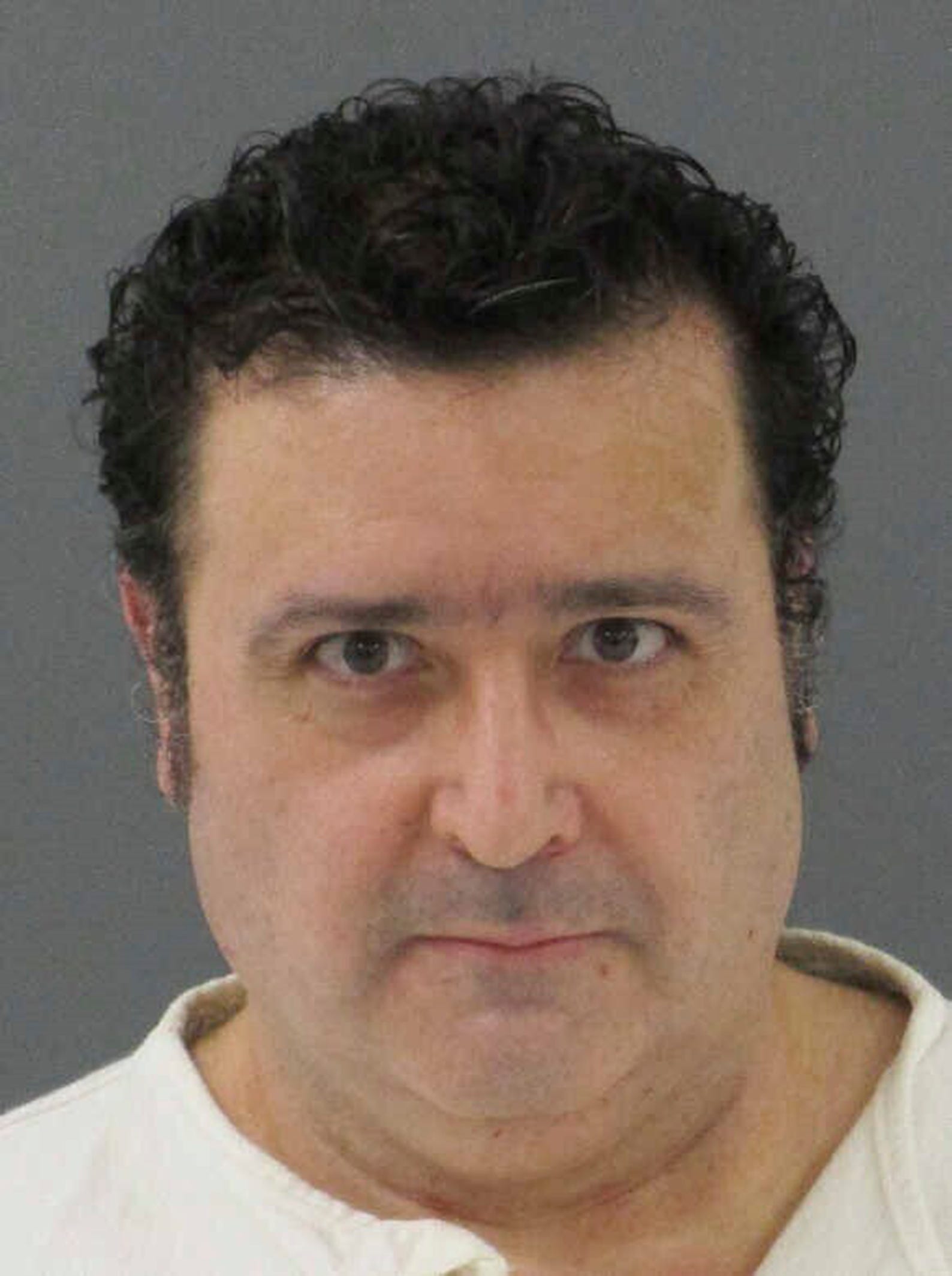
This photo released by the Texas Department of Criminal Justice shows death row inmate David Renteria. Renteria, a Texas inmate convicted of strangling a 5-year-old girl taken from an El Paso store and then burning her body nearly 22 years ago is facing execution. (Texas Department of Criminal Justice)

Alexandra’s sister, Sandra Frausto, and brother, Ignacio Frausto, attended the execution.

Renteria’s sister Cecilia Esparza and a friend also were present.

Esparza collapsed when she walked into the viewing room, and prison officials brought her a chair and she cried. Renteria told his sister through the glass, “I love you.”

Last days on Texas death row for one of El Paso’s most notorious killers

Renteria spent his final days meeting with visitors, laying in bed, watching TV through a cell door and sleeping, a Death Watch report states. The times listed below are in Central time zone.

On his execution day, starting at 12:15 a.m., he sat on his bed and began writing. The report does not state what he wrote.

He began packing up his property about 2:30 a.m., before sitting on the floor and reading a book around 4 a.m., the report states. He then continued packing up his property and cleaning the floor between 5 to 7:30 a.m.

Renteria was allowed to talk to fellow inmates at 7:30 a.m., before meeting with visitors from 8 to 11:30 a.m., the death watch states.

He was then transferred from the Texas Department of Criminal Justice’s Polunsky Unit in Livingston, Texas, to the Huntsville Unit to await his execution.

A victim of Renteria’s from a different criminal incident and her mother also attended the execution. Renteria was previously convicted and sentenced to 20 years in prison for indecency with a child in El Paso.

The execution was also attended by 14 state law enforcement and governmental officials.

Renteria grew up in the Lower Valley and was a tribal member of the Ysleta del Sur Pueblo, according to the Texas Coalition to Abolish the Death Penalty.

While in prison, he rededicated himself to his Roman Catholic faith, the coalition reported.

Renteria’s execution ends a nearly 22-year legal battle waged in what has been described as one of the most heinous crimes committed in El Paso.

“I’ve always been a supporter of the death penalty and from a law enforcement perspective, I just think some people are too dangerous to be in our society and that is certainly one individual who I think that that the death penalty is absolutely appropriate,” El Paso County Sheriff Richard Wiles said. “It’s a long time coming. I think it’s been what? Twenty-one years. I was actually the assistant (El Paso police) chief, (Carlos) Leon was the chief when that horrific crime occurred. It was really tough on everybody. I can’t even imagine what that family went through and what they’re still going through today.

“Hopefully, this will give them a little bit of relief to help them in their recovery that is going to take the rest of their lives, Wiles said. “I can’t even imagine losing my 5-year-old daughter to such a horrific crime.”

Justice served for Alexandra Flores in 2001 abduction nearly 22 years later

Renteria’s execution came two days before the 22nd anniversary of the day he kidnapped 5-year-old Alexandra Flores from an El Paso Walmart, strangled her to death and then burned her body. It also comes six days before his 54th birthday.

Renteria abducted Alexandra Nov. 18, 2001, as she was Christmas shopping with her parents at an El Paso Lower Valley Walmart.

Her parents realized she was missing and searched the store but could not find her. Alexandra was seen on store surveillance video exiting the store about 5:15 p.m. with Renteria.

Alexandra’s body was found about 7:10 a.m. the next day in an alley 16 miles (25km) away.. She was naked and partially burned in a carport near Downtown El Paso.

An autopsy revealed Alexandra was strangled to death and then set ablaze, court documents state. Investigators later revealed there were no signs of sexual assault.

A palm print on a plastic bag found over Alexandra’s head was determined to be from Renteria, court documents state.

El Paso Police Department investigators discovered that a vehicle registered to Renteria was at 9441 Alameda Ave. at the time and date of Alexandra’s disappearance. Renteria also told police he was at the location at the time and date of her disappearance, court documents state.

Renteria went to trial for the death of Alexandra in September 2003. He claimed in his trial that Barrio Azteca gang members forced him to kidnap the girl and someone else was the person who killed her, court records show.

A jury convicted him of capital murder and he was sentenced to death.

Appeals court justices heard the case in 2006 and upheld the conviction. However, the justices ordered a new sentencing phase of the trial.

The resentencing was ordered because of “exclusion of evidence showing the defendant’s remorse violated due process by preventing defendant from rebutting the State’s case when the State left jury with false impression and emphasized it,” the justices wrote in their opinion.

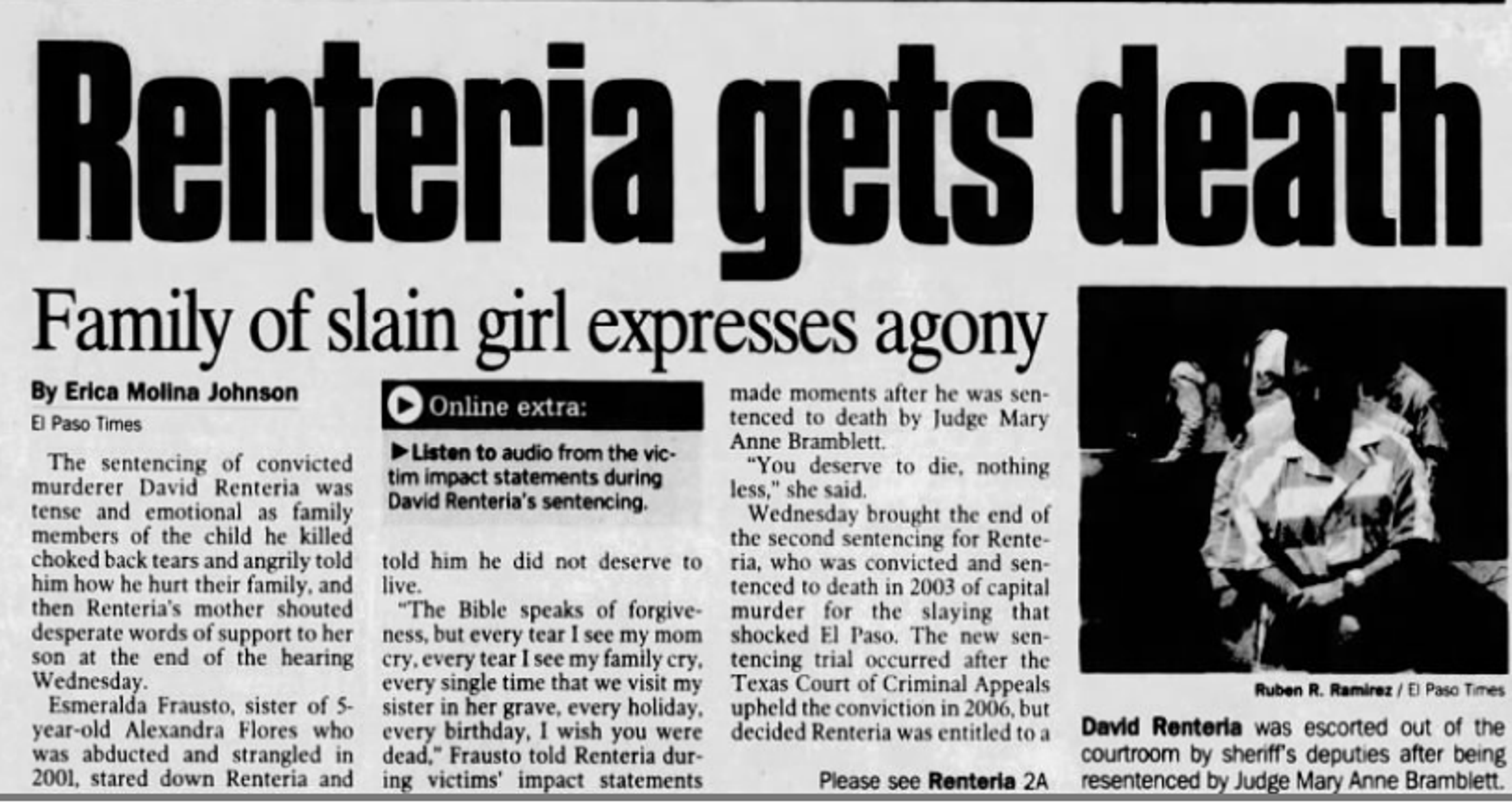
A May 15, 2008, El Paso Times article reporting David Santiago Renteria was given the death penalty during his resentencing hearing.

A May 15, 2008, El Paso Times article reporting David Santiago Renteria was given the death penalty during his resentencing hearing. 

KTSM 9 NEWS

DAVID SANTIAGO RENTERIA v. THE STATE OF TEXAS (Original)

El Paso Sheriff Deputy Peter Herrera’s family speaks after death penalty sentence

Execution carried out 2022- OKLAHOMA Donald Grant – JANV. 27.2022


McALESTER, Okla. — An Oklahoma man who had offered to be executed by firing squad was put to death by lethal injection Thursday morning, officials said.

Donald Anthony Grant, 46, was pronounced dead at 10:16 a.m. CT at the Oklahoma State Penitentiary, a state corrections spokesman announced.

The execution began at 10:03 a.m., and Grant was declared unconscious at 10:08 a.m. before his death at 10:16 a.m., Corrections Department Director Scott Crow said.

There were 18 witnesses, including news reporters, prosecutors, a police chief and loved ones of Grant and his victims.

Grant’s disjointed final words lasted two minutes before a prison staff member in the execution chamber stopped him and cut off the microphone.

“Grant’s last words were “yo God I got this, I got this, it’s nothing” before saying “I’ve got things to handle, no doubt, no doubt.” He also said “Brooklyn for life” among his other chants. Grant reportedly grew up in Brooklyn, New York, and was raised in and out of various foster homes.

Grant kept speaking after the microphone was turned off, looking toward his family members sitting in the front row of the witness room.

At one point, tears appeared to be rolling down his face.

Grant killed Brenda McElyea, 29, and Felicia Suzette Smith, 43, so there would be no witnesses to his robbery at the La Quinta Inn in Del City in July 2001.

LAST MEALGrant, the first person to be given the death penalty in 2022.

After requesting a very large meal, the inmate was given a lethal injection, currently the only approved method in Oklahoma. Grant’s menu included sesame chicken, six egg rolls, shrimp fried rice and a large apple fritter. If there was no dessert, Grant asked for three pints of strawberry ice cream. 

Texas Execution today : John Henry Ramirez EXECUTED 6.41PM


10.05.2022

UPDATE 10.06.2022

In the execution chamber, his spiritual adviser, Dana Moore, placed his right hand on the inmate’s chest, and held it there for the duration. With his back to witnesses, Moore offered a brief prayer.

“Look upon John with your grace,” he prayed. “Grant him peace. Grant all of us peace.” As Moore’s prayer ended, Ramirez responded: “Amen.”

After the prayer, Ramirez addressed five of Castro’s relatives — including four of his children — as they watched through a window a few feet from him. “I have regret and remorse,” he said.” This is such a heinous act. I hope this finds you comfort. If this helps you, then I am glad.

I hope in some shape or form this helps you find closure.”

Ramirez expressed love to his wife, son and friends, concluding with: “Just know that I fought a good fight, and I am ready to go.”

As the lethal dose of pentobarbital took effect, he took several short breaths then began snoring. Within a minute, all movement stopped. Ramirez was pronounced dead 14 minutes later, at 6:41 p.m. CDT.

John Henry Ramirez, 38, was sentenced to death over the 2004 fatal stabbing of 46-year-old convenience store clerk Pablo Castro during a drug-fueled string of robberies.

His execution date was delayed last year after Ramirez claimed his religious freedom was being violated because state prison rules prevented his pastor from touching him and praying aloud during the procedure.

Ramirez’s fight ended up clarifying the role of spiritual advisers in death chambers nationwide after the US Supreme Court sided with the convicted murderer in March.

The court ruled that states must accommodate the wishes of death row inmates who want to have their religious leaders

The Texas Board of Pardons and Paroles declined on Monday to commute Ramirez’s death sentence to a lesser penalty.

Ramirez has exhausted all possible appeals and there is no final request to the Supreme Court planned, his attorney Seth Kretzer said.

Ramirez was convicted of stabbing Castro 29 times in a robbery that cops said was the culmination of a three-day binge fueled by a mix of pot, pills, booze and cocaine — and yielded him just $1.25.

He fled to Mexico immediately after but was arrested 3 1/2 years later.

If Ramirez’s execution goes ahead as planned, he would be the third inmate put to death this year in Texas and the 11th in the country.

EXECUTION LIST 2020


DateNumber Since 1976StateNameAgeRaceVictim RaceMethodDrug ProtocolYears from Sentence to Execution
1/15/201513TXJohn Gardner64W1 White femaleLethal Injection1-drug (Pentobarbital)13
1/29/201514GADonnie Lance65W1 White male, 1 White femaleLethal Injection1-drug (Pentobarbital)21
2/6/201515TXAbel Ochoa47L2 Latinx femalesLethal Injection1-drug (Pentobarbital)17
2/20/201516TNNicholas Todd Sutton58W1 White maleElectrocutionN/A34
3/5/201517ALNathaniel Woods43B3 White malesLethal Injection3-drug (Midazolam)14
5/19/201518MOWalter Barton64W1 White femaleLethal injection1-drug (Pentobarbital)26
7/8/201519TXBilly Joe Wardlow45W1 White maleLethal injection1-drug (Pentobarbital)25
7/14/201520FederalDaniel Lewis Lee47W1 White male, 2 White femaleLethal injection1-drug (Pentobarbital)21
7/16/201521FederalWesley Ira Purkey68W1 White femaleLethal injection1-drug (Pentobarbital)17
7/17/201522FederalDustin Lee Honken52W2 White males, 3 White femalesLethal injection1-drug (Pentobarbital)14
8/26/201523FederalLezmond Mitchell38NA2 Native American femalesLethal injection1-drug (Pentobarbital)17
8/28/201524FederalKeith Dwayne Nelson45W1 White femaleLethal injection1-drug (Pentobarbital)18
9/22/201525FederalWilliam Emmett LeCroy50W1 White femaleLethal injection1-drug (Pentobarbital)16
9/24/201526FederalChristopher Andre Vialva40B1 White male, 1 White femaleLethal injection1-drug (Pentobarbital)20
11/19/201527FederalOrlando Hall49B1 Black femaleLethal injection1-drug (Pentobarbital)25
12/10/201528FederalBrandon Bernard40B1 White male, 1 White femaleLethal injection1-drug (Pentobarbital)20
12/11/201529FederalAlfred Bourgeois56B1 Black femaleLethal injection1-drug (Pentobarbital)18

Supreme Court sides with death row inmate over racist juror claim


JANUARY 8, 2018

WASHINGTON, The U.S. Supreme Court on Monday paved the way for a black Georgia inmate to challenge his 1991 death sentence for killing his sister-in-law after he argued the case was tainted by a racist white juror who questioned whether black people have souls.

The justices, in a 6-3 unsigned decision, threw out a lower court’s decision that had rejected his biased jury assertion. Keith Tharpe was found guilty and sentenced to death by a jury of 10 white people and two black people in Georgia’s Jones County. The allegations of racial bias arose from an interview with one of the jurors years later, not comments made during the trial

Monday’s ruling means the case will return to lower courts and gives Tharpe a chance to avoid execution.

Tharpe had been scheduled to be put to death by lethal injection in a Georgia state prison on Sept. 26 but the Supreme Court granted his last-minute stay application so it could have more time to decide whether to hear his appeal.

Tharpe, 59, kidnapped and raped his estranged wife, Migrisus Tharpe, and used a shotgun to kill Jaquelin Freeman, her sister, in September 1990, according to court records.

Three of the court’s conservatives, Clarence Thomas, Samuel Alito and Neil Gorsuch, dissented from Monday’s decision.

Thomas, the court’s only black justice, is also from Georgia. He pointed out in his dissenting opinion that the court’s decision will “delay justice” for the victim, who was also black.

“The court’s decision is no profile in moral courage,” Thomas said.

In 1998 Tharpe’s lawyers, as they were preparing an appeal in the case, spoke with the trial jurors including a man named Barney Gattie, who has since died.

“After studying the Bible, I have wondered if black people even have souls,” Gattie told Tharpe’s lawyers in an affidavit, according to court papers.

Gattie also told the defense lawyers that there are two kinds of black people, one who he called “regular black folks” and another group he referred to using a racial slur.

“Because I knew the victim and her husband’s family and knew them all to be good black folks, I felt Tharpe, who wasn’t in the good black folks category in my book, should get the electric chair for what he did,” Gattie added.

The 12-person jury, including its two black members, voted unanimously to sentence Tharpe to death.

What Do the Last Words of Death Row Inmates Tell Us?


December 12, 2017

Any last words?

It’s a question prisoners on death row hear before their execution begins. Along with last meals and long cell block walks, the opportunity to give a final statement has become deeply ingrained in the highly ritualized process of executing prisoners.

Most prisoners take the opportunity to pause on the lip of annihilation and utter a final statement, and the content of these messages range from expressions of guilt and sorrow to expletive-laced outbursts. Examining the final thoughts of people who have not only had time to think about their ultimate end, but who must also wrestle with overwhelming feelings of guilt and sorrow (though not in every case), provides a unique opportunity for sociologists and psychologists alike.

It’s Time

There is a growing body of scientific literature centered around the study and analysis of prisoners’ last words, although the subject is far from closed. At the moment, most studies work to identify recurring themes, though work in the future could go beyond this to search for correlations between last words and type of crime, prisoner demographics, personal history and mental health. At the moment, we can break down the final statements of death row inmates into a few broad categories: expressions of guilt and remorse, proclamations of innocence, spiritual statements and communications to their families. Journalist Dan Malone undertook such a content analysis in 2006, and found a few broad categories into which most final statements fall.

For many prisoners, the act seems to be an attempt to reach some sort of peace with their situation. Statements like “I’m ready” and those that express hope for some sort of afterlife are common. Some choose to address their victim’s families directly, and nearly every one that does so expresses remorse for their actions. Many acknowledge that they can never make up for what they did. Most inmates stop short of admitting guilt — instead of focusing on the past, they look to the future.

More rarely, the soon-to-be executed will directly own up to their crimes, most usually along with an expression of sorrow or an apology. In rare cases, the prisoner will choose to go down swinging, lashing out with angry and defiant words in their final minutes.

Still, these cases are rare, and it seems that the finality of death impresses a measure of humility and grace on most people. Most common overall are words of regret and personal statements, usually concerning their family, such as “I love you,” or references to being in a better place. It’s an oddly one-sided view of men who have been convicted of horrible crimes.

What Does It Mean?

Of course, it can be difficult to trust the words of someone who won’t be around to face the consequences of their actions any more. On the other hand, a dying man has very little left to lose, and few among us want to die with regrets. Further work is needed to truly parse out exactly why prisoners choose to say the things they do. As of right now, we have a few hints, though.

Many final statements seemed aimed at lessening psychological pain, something that a 2017 study identified as one of three main themes among prisoners’ last words. Identification with lost or forgotten ideals and rejection and aggression were the other dominant subjects that emerged in their analysis, which aligns roughly with what Malone found in his work.

This makes sense, since both studies used very similar datasets. Because of the nature of the death penalty in the United States, the statements come largely from Texas, which has been responsible for about a third of all executions since the death penalty was re-instated in 1976. While no recording devices are permitted in the execution chamber, a secretary is on hand to transcribe the prisoner’s final words, and, at least up till 2005, when Malone’s study ended, the Associated Press had a reporter on hand to chronicle the event as well.

This means that the final words of Texas death row inmates carry outsized influence in these kinds of studies. Most death row inmates are also men, another limitation. To truly understand the impact that final statements have, and what they say about our relationship with death, a more diverse sample size is necessary. These studies are a start, of course, but looking at how final statements differ across countries, by type of crime, and by demographic could prove illuminating. In addition, the prevalence of mental illness among death row inmates could impact the way they frame their crime, and their lives, just before execution.The last words we say before death are not usually uttered casually. This doesn’t mean they necessarily offer a glimpse of who we truly are, but instead a premonition of who we wish we were, or hope to be someday. It’s a rarified moment in a human being’s life; one that could help us all come to terms with our impending doom.