Death row at the Penitentiary of New Mexico in the early 2000s. New Mexican file photo
Yes, bring back the death penalty63%
No, it should remain abolished38%
I don’t know0%|0 VOTES
New Mexico lawmakers will consider a bill to restore the death penalty, which was made illegal in the state nearly a decade ago. See the story in the Thursday (Jan. 11) edition of The Taos News.
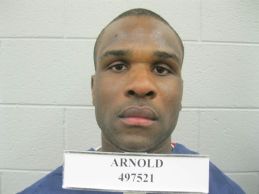
Federal prosecutors filed a rare “Notice of Intent to Seek the Death Penalty” on Monday in Detroit in the case of a gang suspect who is charged with a raft of murderous crimes.
And Billy Arnold, 31, likely won’t be the only member of the Seven Mile Bloods to be fighting for life in U.S. District Court in Detroit, according to court officials.
Arnold is one of several members of the gang facing charges where the death penalty may be applied, officials said Monday. The Department of Justice is reviewing those cases to determine whether the death penalty should be invoked, they said.
Although Michigan was the first state to ban the death penalty in state courts — in 1847 — capital punishment can still be sought in federal cases. Arnold was charged in March 2016, along with six other gang members, with murder in aid of racketeering, attempted murder, RICO conspiracy and other crimes. The Seven Mile Bloods gang has been linked in court pleadings to trafficking in prescription pills and to using violence to protect their sales turf.
Arnold, in particular, “has demonstrated a lack of remorse (and) participated in the killings of more than one victim,” U.S. Attorney Matthew Schneider said in blunt language filed Monday in the case. Prosecutors say Arnold is known by nicknames “B-Man” and “Killa.” He was released in March 2015 from state prison, after serving several years for convictions in state courts on assault and gun charges.
WASHINGTON, The U.S. Supreme Court on Monday paved the way for a black Georgia inmate to challenge his 1991 death sentence for killing his sister-in-law after he argued the case was tainted by a racist white juror who questioned whether black people have souls.
The justices, in a 6-3 unsigned decision, threw out a lower court’s decision that had rejected his biased jury assertion. Keith Tharpe was found guilty and sentenced to death by a jury of 10 white people and two black people in Georgia’s Jones County. The allegations of racial bias arose from an interview with one of the jurors years later, not comments made during the trial
Monday’s ruling means the case will return to lower courts and gives Tharpe a chance to avoid execution.
Tharpe had been scheduled to be put to death by lethal injection in a Georgia state prison on Sept. 26 but the Supreme Court granted his last-minute stay application so it could have more time to decide whether to hear his appeal.
Tharpe, 59, kidnapped and raped his estranged wife, Migrisus Tharpe, and used a shotgun to kill Jaquelin Freeman, her sister, in September 1990, according to court records.
Three of the court’s conservatives, Clarence Thomas, Samuel Alito and Neil Gorsuch, dissented from Monday’s decision.
Thomas, the court’s only black justice, is also from Georgia. He pointed out in his dissenting opinion that the court’s decision will “delay justice” for the victim, who was also black.
“The court’s decision is no profile in moral courage,” Thomas said.
In 1998 Tharpe’s lawyers, as they were preparing an appeal in the case, spoke with the trial jurors including a man named Barney Gattie, who has since died.
“After studying the Bible, I have wondered if black people even have souls,” Gattie told Tharpe’s lawyers in an affidavit, according to court papers.
Gattie also told the defense lawyers that there are two kinds of black people, one who he called “regular black folks” and another group he referred to using a racial slur.
“Because I knew the victim and her husband’s family and knew them all to be good black folks, I felt Tharpe, who wasn’t in the good black folks category in my book, should get the electric chair for what he did,” Gattie added.
The 12-person jury, including its two black members, voted unanimously to sentence Tharpe to death.
A death row inmate convicted of fatally beating an Augusta woman died Tuesday in an Atlanta prison hospital where he was undergoing cancer treatment.
Robert O. Arrington, 70, was convicted of the April 2001 murder of 46-year-old Kathy Hutchens. She and her dog were found dead in her George Road residence 10 days after she called the Richmond County Sheriff’s Office for help in making Arrington leave her home. They had dated and lived together for a short time.
His boot prints and fingerprints were found in Hutchens’ blood. When arrested on April 13, 2001, the day Hutchens’ body was found, he still had her blood on his boots, according to prior reports in The Augusta Chronicle.
Hutchens wasn’t the first woman Arrington beat to death. In 1986 he killed his 53-year-old wife, Elizabeth Arrington, then dumped her body in a ditch in Burke County. The murder charge in that case was reduced to voluntary manslaughter and he was sentenced to 15 years in prison.
A Florida man convicted in the 1993 stabbing death of a pregnant woman will stand trial for the death of the victim’s son 23 years later.
The Sun Sentinel reports the Broward County prosecutor’s office announced Thursday that Ronnie Keith Williams will be charged with first-degree murder in the death of 23-year-old Julius Dyke.
Julius Dyke was born via cesarean section two days after his 18-year-old mother, Lisa Dyke, was stabbed. Lisa died 18 days after he was born.
He had suffered extensive brain damage and his 2016 death was ruled a homicide linked to the attack.
Julius was not able to walk or talk and was only able to eat via a feeding tube.
Hearing of the impending charges, his grandmother and caretaker Margaret Dyke said: ‘Oh my Julius, my love.’
Now I truly miss my daughter because the only part of her has gone on with her.’
Lisa had been babysitting for a friend in Wilton Manors, near Fort Lauderdale, when Williams entered the home and attacked her in 1993. He had apparently been looking for his ex-girlfriend.
TALLAHASSEE, Fla. — The Florida Supreme Court is ordering a new sentence for a man involved in the deadly kidnapping of a young couple from South Beach.
The court on Thursday upheld the conviction of Joel Lebron, but tossed out his death sentence. The 39-year-old man is getting a new hearing because a jury recommended the death penalty by a 9 to 3 vote.
Authorities say 17-year-old Nelson Portobanco and 18-year-old Ana Maria Angel were walking back to their car after a date in 2002 when they were forced into a pickup by Lebron and four other men.
Authorities say Lebron stabbed Portobanco and left him for dead, but the teen survived. Angel was repeatedly raped and taken to a retaining wall beside Interstate 95 where Lebron killed her with a single gunshot.
CALGARY—A lawyer for a Canadian on death row in Montana believes it’s only a matter of time before the death penalty in much of the United States is abolished and his client will be free to return home.
Ronald Smith, 60, is originally from Red Deer, Alta., and has been on death row since 1983 for fatally shooting Harvey Madman Jr. and Thomas Running Rabbit while he was high on LSD and alcohol near East Glacier, Mont.
He originally asked for and was sentenced to death but later changed his mind and has been fighting execution ever since. He has had a number of execution dates set and overturned.
“Last year, I think we’ve only had 20-some executions and those are really isolated to only three or four states, and only three or four counties in those states.
“Most of the United States has moved beyond this and there comes a time where the courts are going to say this is in fact cruel and unusual punishment.”
Lethal injection has been the sole method of execution in Montana since 1997. It is the only state that specifies the death penalty must be accomplished by an “ultra-fast-acting” barbiturate.
Executions in Montana have been on hold since 2008 when the civil liberties union filed legal action that argued that the sedative pentobarbital, which was being proposed by the state as a replacement for the previously used sodium pentothal, could lead to an “excruciating and terrifying” death.
District Court Judge Jeffrey Sherlock sided with the civil liberties group and rejected an appeal by the state of Montana.
Sherlock has now sanctioned the state over its year-long delay in complying with a court order to turn over documents that could reveal if there was manipulation of an expert witness.
The group questioned whether the testimony of Roswell Evans was manipulated at trial to bolster the state’s unsuccessful claim that pentobarbital was suitable for executions.
“We’ve got some emails and we’re now looking at those and trying to ascertain what else is there,” Waterman said. “They’re going to make us unpack this whole thing piece by piece so they’re not going to go easily.
“I don’t know that it’s going to have any direct or immediate impact on the case itself.”
Waterman said it is more a case over legal fees and whether Montana acted in a vexatious manner.
As for Smith’s future, Waterman doesn’t see the current ban on executions in Montana changing any time soon. It would require a new statute being introduced and adopted by both sides of the legislature and would have to be signed by the governor.
“They didn’t change the statute during the last legislative session so the next time up is 2019. I’m not hearing anybody really being that keen about changing (it).”
The Canadian government officially intervened on Smith’s behalf last year when it asked Gov. Steve Bullock to grant him clemency.
“My hope would be ultimately that we can find clemency for Ron so that he can move back to Canada,” Waterman said.
“If the death penalty is abolished he would be eligible to be moved right away.”
COLUMBUS, Ohio – Lawyers for Ohio’s only condemned female killer have asked the U.S. Supreme Court to accept her appeal.
Death row inmate Donna Roberts was convicted of planning her ex-husband’s 2001 killing with a boyfriend in hopes of collecting insurance money.
Roberts’ death sentence was struck down in the past after the state Supreme Court said a prosecutor improperly helped prepare a sentencing motion in her case.
The court also said a judge hadn’t fully considered factors that could argue against a death sentence.
Earlier this year, the Ohio Supreme Court once again upheld the death sentence for the 73-year-old Roberts.
She was sentenced to death for the third time in 2014 but appealed that decision.
Roberts was accused of planning her ex-husband’s murder with her boyfriend Nathaniel Jackson. The killing happened in the couple’s home in Howland.
Jackson was also sentenced to death.
In the past, the court said a prosecutor improperly helped prepare a sentencing motion in Roberts’ case and that a judge hadn’t fully considered factors that could argue against a death sentence.
Justice Terrence O’Donnell, writing for the majority, rejected arguments that allowing a new judge to sentence Roberts after the original judge died was unconstitutional.
Justice O’Donnell explained that Roberts helped Jackson plan Fingerhut’s murder in a series of letters and phone calls while Jackson was in prison on an unrelated charge. She actively participated with Jackson in the killing by purchasing a mask and gloves for him and allowing him into the home, evidencing prior calculation and design, O’Donnell said.
The court ruled 6-1.
The Court also pointed out that although Roberts expressed sadness for Fingerhut’s murder, she never accepted responsibility for it and denied her scheme to kill Fingerhut, “notwithstanding overwhelming evidence to the contrary.”
The Court concluded the death penalty was appropriate and proportionate to the death sentence imposed on Jackson.
The state is expected to oppose Roberts’ latest request.
A Santa Rosa Correctional Institution inmate who viciously beat and killed his cellmate in an apparent racial attack was sentenced to death Monday.
Shawn Rogers, 37, will be placed on death row for the murder and kidnapping of Ricky Dean Martin in 2012.
Rogers, who is a black man, and Martin, a white man, shared a cell in the prison. When word of unarmed black teenager Trayvon Martin’s death made it to the prison, Rogers carried out the racially motivated attack on Ricky Dean Martin that left him tied at the hands and feet, bruised, cut and in a coma that eventually killed him.
The court heard during Rogers’ trial that blood was smeared on the cell’s walls, and Rogers covered Martin’s body with a prayer rug before guards arrived. Martin’s face was covered with a pair of bloody boxer shorts.
A civil lawsuit filed by Martin’s family against the prison further claims Martin had filed grievances in the days before his death, saying he feared for his life and wanted to be moved from Rogers’ cell.
The same suit claims Rogers also raped Martin, though that claim was not presented by the state in Rogers’ criminal case.
Circuit Judge John Simon read a portion of Rogers’ sentencing document during court Monday, finding that the court agrees with the 12-person jury’s unanimous death recommendation.
“Mindful that a human life is at stake … the aggravating factors far outweigh the mitigating factors,” Simon said during sentencing, adding that not only did Rogers murder Martin, but he humiliated him in the process.
Rogers remained stoic as Simon read the document, not making any gestures or saying anything to his attorney, Kenneth Brooks. Rogers will join 349 other Florida prisoners on death row.
Neither Brooks nor prosecutor Jack Schlechter made any motions or arguments before Simon handed down the sentence. Both sides were allowed to present mitigating and aggravating factors in the case at a separate hearing in November, during which Simon heard about Rogers’ troubled past, with one doctor having called his upbringing a “perfect storm” for trouble.
At that same hearing, prosecutors pointed out Rogers had been functional to represent himself at trial, and was capable of premeditation because he voiced to others he would carry out an attack on a white person in the wake of Trayvon Martin’s death.
In addition to the death sentence for the murder charge, Simon sentenced Rogers to life in prison for the kidnapping to inflict terror charge.
Simon told Rogers he is entitled to an appeals process and per state law his death sentence will be automatically reviewed by the Supreme Court.
The civil lawsuit is still ongoing in Federal Court.
Decades into a life prison sentence without the possibility of parole, Craig Coley continued to insist he was innocent.
The former restaurant night manager had fought unsuccessfully for years to overturn a conviction for a grisly double murder that had shocked Simi Valley in 1978.
But when police recently reopened the case, they faced a daunting obstacle. After Coley lost his final appeal years ago, a judge had issued an order permitting the destruction of the crime scene evidence.
A cold-case detective began what some expected to be a fruitless search. He tried to contact the two laboratories that had performed rudimentary tests on the crime scene evidence in the 1970s and found that both had gone out of business. A Northern California lab had acquired their contents.
That’s when the detective discovered that the evidence boxes had not been destroyed but were sitting forgotten, intact and in storage.
New tests found that a key piece of evidence used to convict Coley did not carry any of his DNA, investigators said.
“We had thought it was destroyed,” Michael Schwartz, Ventura County special assistant district attorney, said in an interview Thursday. “Whether we’d reached the same conclusion without that, I don’t know.”
Gov. Jerry Brown pardoned Coley on Wednesday, writing that the DNA evidence and a painstaking re-investigation of the case proved his innocence.
Coley was 31 when he was arrested, and 70 when he was released Wednesday. A former Simi Valley police officer who was convinced of Coley’s innocence plans to help him “get acclimated to freedom” in San Diego, the officer wrote on a GoFundMe page.
It was a relative who came across the bodies of Rhonda Wicht and her son on Nov. 11, 1978. Suspicions had been raised when Wicht, 24, had not arrived for a family get-together.
Police said she had been beaten, raped and strangled with a macrame rope. Her 4-year-old son, Donald, had been smothered in his bed, presumably because he might have identified his mother’s killer.
Wicht had dated Coley for two years, but they were “in the process of breaking up,” officials said this week. Coley was held for questioning the same day.
He was ultimately charged with the two murders.
Defense attorneys criticized Simi Valley police for failing to investigate three other possible suspects, according to news accounts at the time. And the Simi Valley Mirror, a weekly tabloid, published reports asserting that investigators had focused on an innocent man.
At Coley’s first trial, jurors spent four weeks deliberating before announcing they were hopelessly deadlocked 10 to 2 in favor of guilt.
A second jury convicted him of two counts of first-degree murder in 1980, and he was sentenced to life in prison without the possibility of parole.
But last fall, Simi Valley Police Chief David Livingstone was going through old news clippings about his department and came across some from the Wicht murders. He reached out to a retired detective who had expressed concerns in the past about whether Coley was guilty. With his interest piqued, Livingstone decided to reopen the case.
Schwartz, the Ventura County prosecutor, said the recent investigation determined that the original detectives decided too quickly that Coley was their man and did not fully investigate other possible suspects — a phenomenon known in wrongful conviction cases as “tunnel vision.”
Three current and former police officers told Brown’s office that the detective at the time had “mishandled the investigation or framed Mr. Coley,” the pardon said. The district attorney’s office has not decided if the detective committed misconduct, Schwartz said, but the investigation is continuing.
“ ‘Framed’ is a strong word,” Schwartz said. “That implies that someone knowingly blamed the wrong person. I doubt that occurred.”
Still, the re-investigation of the case turned up several inconsistencies.
An upstairs neighbor had reported seeing Coley’s truck parked outside Wicht’s apartment around the time of the murder, and saw it drive away shortly afterward. The witness noted the driver’s medium-length hair and the pinstripes along the side of the truck, which matched the description of Coley’s.
That testimony was key to Coley’s conviction, The Times reported at the time.
Exactly 39 years later, on the anniversary of Wicht’s murder, Simi Valley police returned to the apartment complex in the early morning hours and stared out the same window.
“They could see very little,” Schwartz said. “They could see vehicles, but the idea that someone could identify markings on the side of a vehicle is very unlikely. They couldn’t see inside it at all.”
Another neighbor initially told police the murder had been committed at 4:30 a.m. At that same time, Coley was carpooling home with a coworker from his restaurant job, which Schwartz described as “an airtight alibi.”
The second neighbor later testified that the murder had taken place at 5:30 a.m. and denied saying he thought it had happened an hour earlier. Years later, he began to vacillate again.
“That was an indication that the timing may not have been as firm as we thought,” Schwartz said.
Coley was a model prisoner during his 38 years and 10 months of incarceration, Brown wrote. He avoided gangs and drugs, and earned his bachelor’s degree.
“I understand that he’s not bitter, that he has a positive attitude, which I think is quite remarkable,” Schwartz said. “This whole case is tragic. The murder was tragic, and this is a waste of a person’s life.”




 Claim your Innocence