Ivan Cantu was sentenced to death in 2001 for the murders of his cousin James Mosqueda and his cousin’s fiancée Amy Kitchen, but he has always maintained his innocence and now Kim Kardashian is fighting for his release
Kim Kardashian is fighting to save death row inmate Ivan Cantu after he was convicted for the murders of his cousin and his cousin’s fiancée.
Kim Kardashian has now become involved in the case ( Image: Getty Images)
Cantu has been on death row for more than two decades. He was sentenced to death in 2001 for the fatal shootings of James Mosqueda and Amy Kitchen, but has always maintained his innocence.
Amy and James were killed during a robbery at their home in North Dallas back in November 2000. Cantu has accused police officers of taking “witness statements and testimony at face value” and not properly investigating the claims. He alleges this led to “false and untruthful information” which culminated in his arrest.
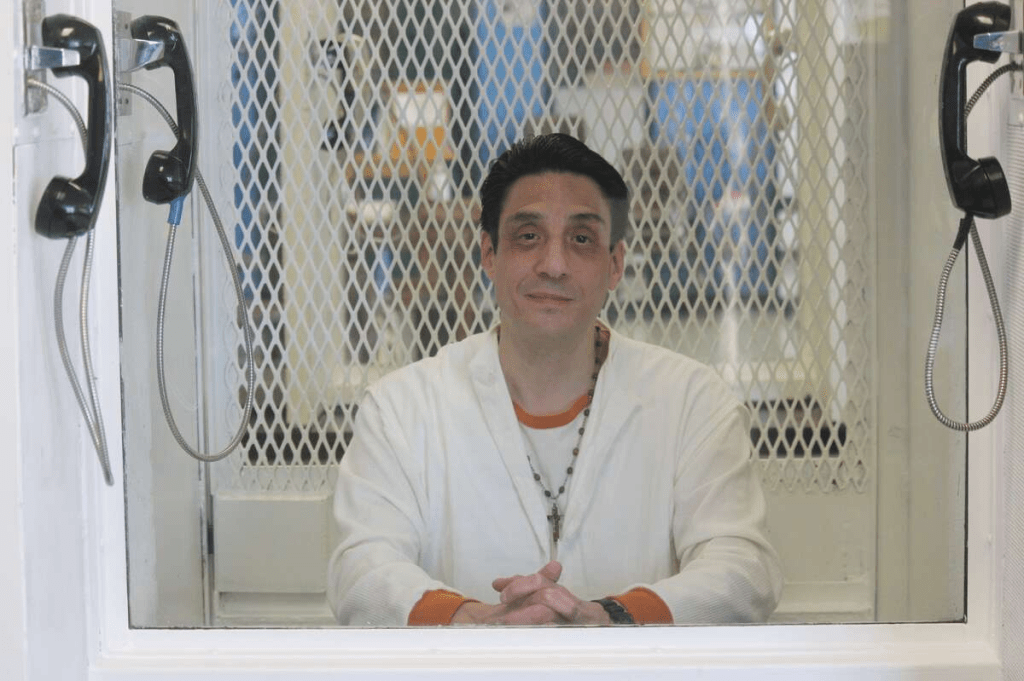
Ivan Cantu was sentenced to death
(Image: Texas Department of Criminal Justice)
Investigators said they believed robbery was the motive for the killings. “Officers believe the crime occurred because robbery was the motive, the murders occurred during a robbery attempt, the car was taken, and some other items were also missing,” police told FOX 4 at the time.
At Cantu’s trial, prosecutors presented evidence of his fingerprints on the gun used in the murders, as well as bloody clothing seized from Cantu which had the victims’ DNA on it. However, true crime podcaster Matt Duff claims Cantu’s fiancée and the state’s star witness Amy Boettcher, who is now deceased, lied on the stand.
“Amy said Ivan had stolen James’s watch and then tossed it out the window,” Matt said during an episode of the Cousins by Blood podcast. The private investigator added: “Early in my investigation I discovered the Rolex. Although it was reported missing, it was later recovered at the house and given back to the family. So the family had that Rolex all along, but no one figured that out until 2019 when I started this case.”
Amy also claimed Cantu proposed to her using a diamond ring she alleges was taken from one of the victims. Witnesses have since come forward and said Amy and Cantu announced their engagement and shown off the ring a week before the murders.
Two jurors who originally voted to find Cantu murder have now come forward and said they don’t want him to be executed until new evidence can be reviewed. The Texas Criminal Court of Appeals could grant an evidentiary hearing, where Cantu’s lawyer could challenge the evidence presented in 2001.
The 50-year-old had been set for execution on April 26, 2023, but state District Judge Benjamin Smith in Collin County, where Cantu was convicted, withdrew the execution date and said more time was needed to review Cantu’s claims. However, his execution has now been rescheduled to February 28, 2024.
Kim Kardashian has now taken to Instagram to speak out about Cantu’s case. Posting on her Story, she wrote: “I heard about Ivan Cantu’s case from Sister Helen Prejean and was really moved by it. In 2001, Ivan was convicted of killing his cousin, James Mosqueda, and his fiancée, Amy Kitchen. Ivan has always maintained his innocence claiming that the rival drug dealer framed him for the murder.”
Explaining how her fans can help, the reality star added: “Texas now has a conviction integrity unity. The prosecutors offices are beginning to recognize that there are a lot of mistakes in convictions. They encourage you to write into their integrity units about specific cases, so I am encouraging everyone to write in about the case of Ivan Cantu. The time to act to save Ivan Cantu is now!”
The spiritual advisor for convicted hitman Kenneth Eugene Smith accompanied him into the chamber, where he witnessed what he called ‘the most horrific thing’ he’d ever seen done to another human
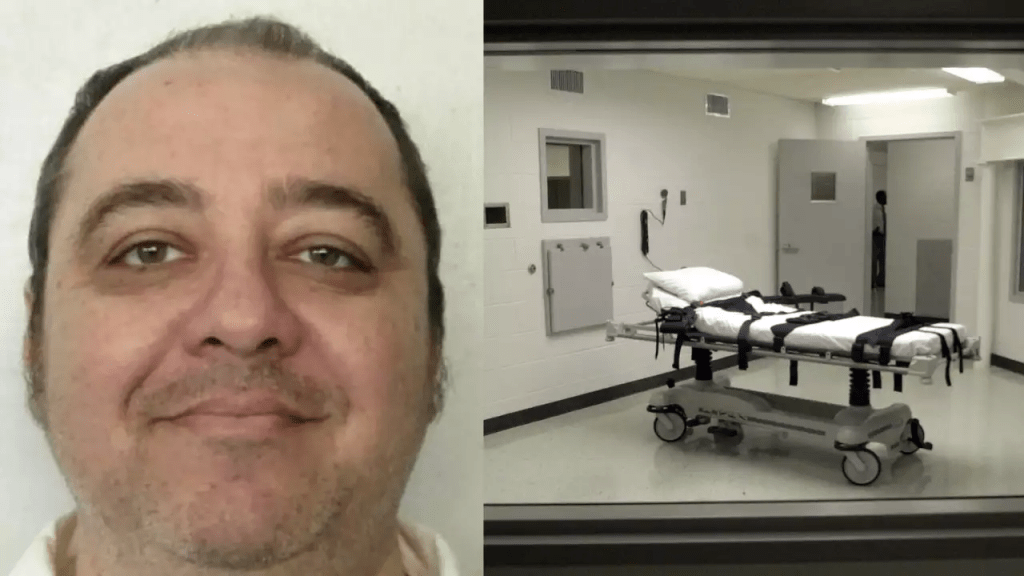
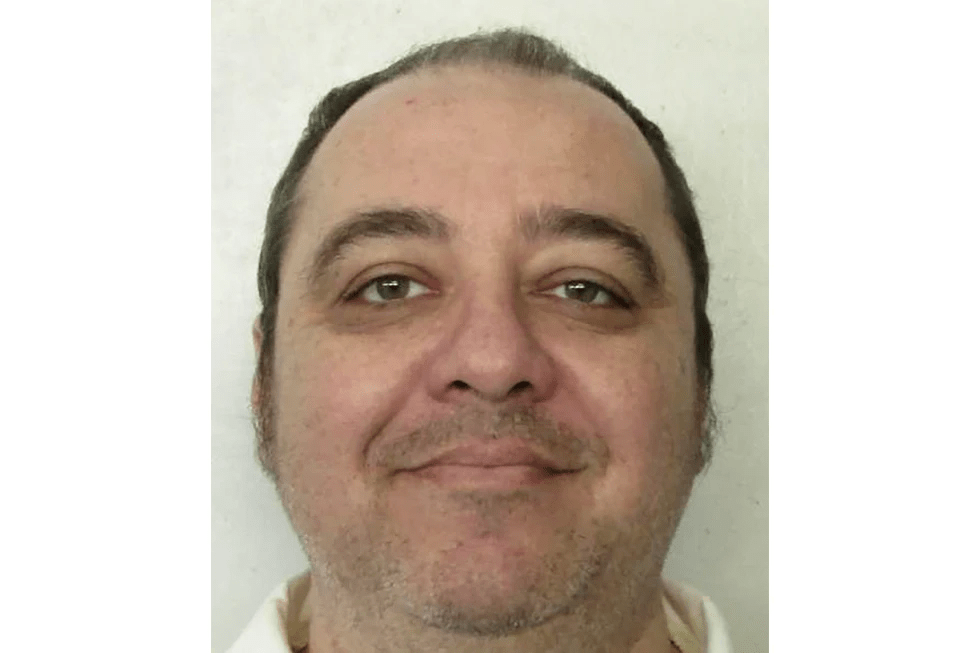
Smith – who survived a botched lethal injection attempt in 2022 – was accompanied to the gas chamber by his spiritual advisor, Reverend Dr Jeff Hood. Rev Hood described how he watched the 58-year-old killer writhe around like a “fish out of water” while his eyes bulged.
Here, in the reverend’s own words, he tells of his haunting, traumatising experience as he watched Smith die after anointing his head with holy oil.
I go into the execution chamber, and one of the first things that I realize was what the oxygen meters were saying. The oxygen meters, when I went in for orientation the other day, were at 22%, which makes sense because air is like 78% nitrogen. When I was going into the chamber, it was 25.4%, which means that they were pumping extra oxygen into the chamber — so that was kind of how they managed that.
“I immediately notice that Kenny has on a mask that extended from the top of his forehead to underneath his chin. It looked like a firefighter’s mask, and it was super tight. There were sorts of straps everywhere. It felt like I was looking at Bane from Batman. That’s what it felt like — it was a super gnarly, intense mask. There were strings going from the mask to the gurney.
“There were two corrections officers and a woman by the name of Cynthia Stewart Reilly, who is in charge of male prisons in Alabama. They were all sort of nonchalant-looking when all of this was happening.
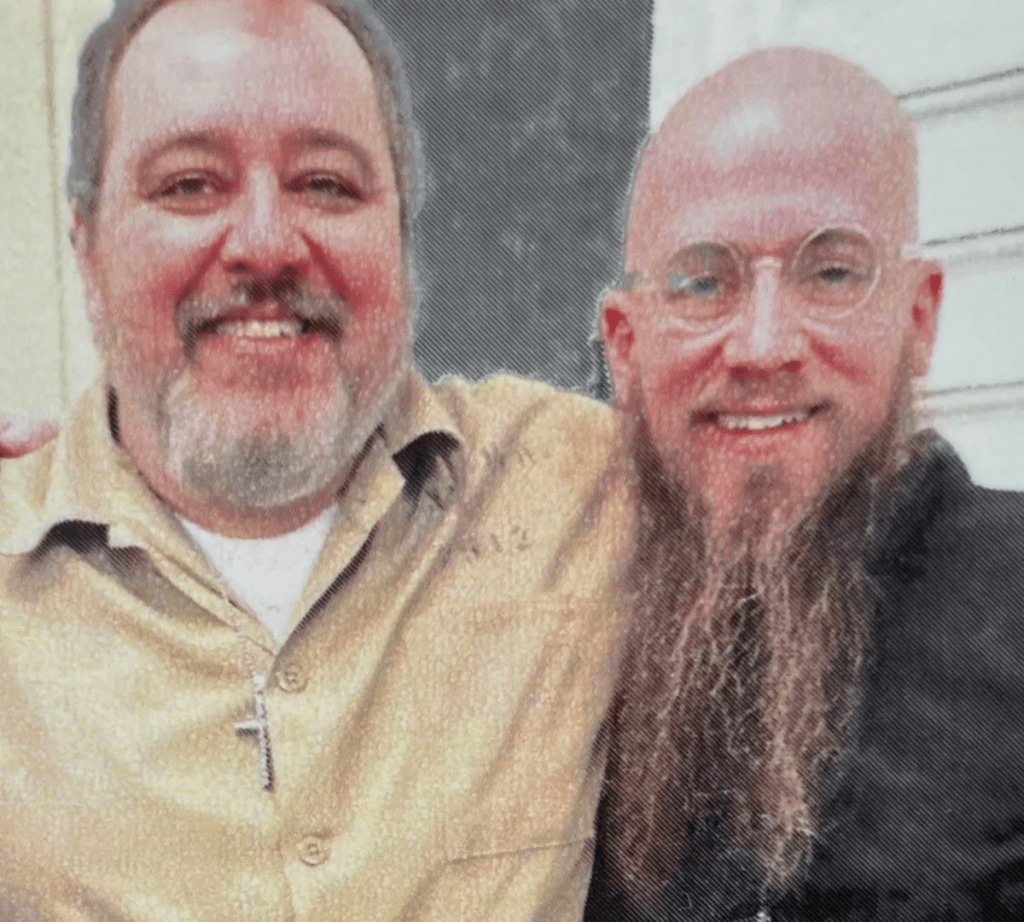
Hood stands with Smith as the two pose for a final picture together before his execution
(Image: Courtesy o Rev. Dr. Jeff Hood)
“Kenny, of course, gave his last words. I was, the whole time, going back and forth with Kenny. I put my hand over my heart to let him know that I loved him. He was talking to me, letting me know that he loved me. It was really powerful. “At this point, the curtains were still shut, so the witnesses can’t see anything. As the curtains were opened, I was allowed to go up and make the sign of the cross on his leg. I did that, and he, again, repeatedly telling me how much he loved me and how thankful he was that I was there. Obviously, that was incredibly touching to me. “Then, he looked at the room where his family was. He kept telling them how much he loved them. He gave his last words, and then the execution started. “When the execution started, based on what the state said, I was expecting him to go unconscious in seconds. Well, as soon as the nitrogen hit, he began to convulse, and he didn’t stop convulsing for minutes. I know that by some accounts, it was two or three minutes.
He said the entire procedure lasted 22 minutes. That’s Lee Hedgepeth, who spoke at the press conference last night.
“It looked like a fish out of water. He kept heaving back and forth, back and forth. And the mask was tied to the gurney, and so every time he heaved forward, his face was hitting the front of the mask and pressing into the mask.
“His eyes started to bulge. He began to turn colors. He was spitting, and mucus was coming out of his mouth and his face. He kept almost hitting his face on the front of the mask.
“The mucus and saliva was hitting the front of the mask, and it was drizzling down the front of the mask. His whole body was seizing. It was absolutely, positively a horror show.
“It was so intense that the expressions of the corrections officers and Ms. Stewart Reilly dramatically changed from the nonchalant facial expressions that they had to real looks of concern.
Hood described the mask as being a tight fit, uncomfortably tight, and then said mucus and saliva from Smith coated the insides as he died
(Image: Getty Images)
“One of the reasons why I feel very comfortable calling Mr. Hamm [Alabama Department of Corrections Commissioner John Hamm] a liar, calling the attorney general [Steve Marshall] a liar, is because they know, based on the reactions in that room, that this was not a success, this was not what they thought it would be, this is not something that happened in seconds. This was something that was torture, cruel and unusual punishment, for minutes and minutes.
“Cynthia Stewart Reilly, she had on women’s dress shoes, and she kept on tapping her feet out of nervousness. It was almost as if she was tap dancing in the execution chamber. It was one of the noises that I kept hearing was her tapping her feet.
“It was just an unbelievably intense situation. I was crying my eyeballs out. I had my hand on the space behind me. The longer it went, I kept thinking in my head, ‘How long is this going to last? How long are we going to have to watch this s**t?’
“On a personal level, I felt an unbelievable sense of guilt that there was nothing I could do to stop it. I felt like I needed to tell Kenny that I was sorry that I couldn’t stop it. I think that comes from a couple of spaces, but … as an activist, I felt guilty that I couldn’t stop it beforehand. In the chamber, I felt just completely powerless.
“Witnessing a murder, a horror show like that, it’s horrible. The tears were running down my face.
“When it finally became apparent that he at least appeared to be deceased, they were waiting on a flatline from the EKG. My face went from just complete sadness and horror to absolute rage that the state of Alabama thought that it was morally appropriate to suffocate someone to death, to torture someone to death, in that manner.
“The tube that was coming out of the control center was a very thin tube. It actually looks like something that would have come out of plastic plumbing that kind of extends, except it was clear. The more he heaved, and the more he looked like a fish out of water, swinging back and forth, the more I was concerned that that tube was going to bust, or at least break, so there was that concern for my safety.
“I kept on wringing my hands. I couldn’t figure out what to do with my hands. You know when you rub your hands so hard you feel like you’re going to rub your hands off when something horrible is happening like you’re going to lose a finger at any moment? All of this happens, and I am eventually escorted out of the chamber.
“The state of Alabama does not send a doctor into the chamber to declare a time of death in front of the witnesses because they’re scared that the doctor will be revealed. In this circumstance, I was taken out of the chamber, and the reason that’s so important is nobody knows the exact time of death. We just have to trust the commissioner to come out and say the time of death.
“This is a state that says, ‘Trust us,’ but they are consistently not being honest and not telling the truth. I think it is very possible — I’m not saying this for certain — I think it is very possible that we could have left that room and Kenny [would] still be alive. We would have never known. We would have no idea.
“All we could tell was it didn’t look like he was breathing. It looked like he was unconscious. But there was no way for us to know that because there was no doctor in the space. There was no doctor who came out and declared a time of death.
Then, what happens is I am escorted down the hallway. On my right, as I was walking down the hallway, I saw the doctor, and he was very shocked and upset that I saw him because he was trying to hide. And the reason he was trying to hide is because he could lose his medical license for participating in that.
“It just shows that there are so many secrets and so many crimes and so many just horrific things that happened last night, and I hope that the state of Alabama is held accountable for the horror that they perpetuated.
“These state officials are obviously chicken hawks. They are all about executions. They’re hawks on executions, making those things happen. But they are too chicken to be present, to take any sort of responsibility, for what’s happening. They’re not in the execution chamber. They are not pushing the mechanisms.
“They’re cowards. They are all about talking about these executions and how they want them to continue and all this kind of fluster, but they are too chicken to participate in them themselves. They sit up in Montgomery, and they talk about how it was successful and this and that, but they’re never there.
They’re forcing the corrections officers to do this stuff, and there’s no doubt from what I saw last night that it has an unbelievable, detrimental effect on them.
“I was a trauma chaplain for a while, so I’ve seen people [who went through] car accidents and burn victims. I’ve seen, unfortunately, all sorts of horrific things — [including] four executions last year. This is the most horrific thing I’ve ever seen done to a human being, by far.
This was, again, a fish out of water. It was someone heaving over and over and over again, and in a viewing chamber where there were state officials, corrections officers, people who could have stopped it. And it just kept going. It wouldn’t stop.
“To say that this was successful… It’s just insane that they keep on saying that. Nobody that saw that would say that was a success, unless you consider a success to just be killing somebody.
“If a success is something that doesn’t violate the Eighth Amendment, if a success is something that’s moral — if this is a success, then they have a very different understanding of morality, any of these things.”
Smith, 58, was executed on Thursday and died from nitrogen hypoxia at 8.25pm CT, the state’s Republican Governor Kay Ivey confirmed.
Final words included, “Tonight Alabama causes humanity to take a step backwards… Thank you for supporting me. Love you all.
“I’m leaving with love, peace and light.” As officials began to administer the gas, Smith turned to his family and signed “I love you.” The witnesses reported seeing Smith thrashing and writhing.
Kenneth Smith Last Moments : From Family and Spiritual Advisors to steak and hash browns
A spokesperson from Alabama Departement of Corrections provided information about the final 48 hours of Smith’s Life.
During Wednesday, Smith received visits from his spiritual advisor, a friend, his brother, two nieces, his son, grandson, wife and attorney. Despite refusing breakfast and only partially eating his dinner, he did consume a lunch tray, accompanied by a Montain Dew, coffee, and a Pepsi. Addionally, he had a conversation with his wife over the phone.
Thursday, he was again visited by his spiritual advisor, his mom, wife, two friends, son, two daughter-in-law, and attorney. Again he spoke on the phone with his wife.
He was seen drinking coffee, sprite, and water. He hate his breakfast, wich consisted of two biscuits, eggs, grape jelly, applesauce and orange juice.
10 A.M Smith ate his final meal of T-bone steak, hash browns, toast and eggs slathered in A1 steak sauce, the Rev. Jeff Hood, Smith’s spiritual adviser, said in a statement.
“He is terrified at the torture that could come. But he’s also at peace. One of the things he told me he is finally getting out,” he added
His witness are set to be his wife, two sons, attorney, and a friend.
Kenneth Smith lawyers continue to push for execution stay
Kenneth Eugene Smith was not provided with a full copy of the protocol for his execution by nitrogen hypoxia until November 2023, his lawyers have said, as they once again petitioned for a stay of execution.
In court documents filed on Thursday, lawyers said that Smith “did not endorse (and could not have endorsed) the procedures in the Protocol before he had seen them”.
“Mr Smith has not walked away from his allegation that nitrogen hypoxia is a feasible and available alternative method of execution to lethal injection. When he made the argument he had not seen ADOC’s Protocol for executing condemned people by nitrogen hypoxia,” the filing stated.
“He was only provided with a heavily redacted copy of the Protocol in late August, at the same time that the State informed him that he would be the first person subject to it and moved in the Alabama Supreme Court for authority to execute him under its procedures.
“Mr Smith did not receive an unredacted copy of the Protocol until late November when the district court ordered Respondents to produce it. Mr Smith did not endorse (and could not have endorsed) the procedures in the Protocol before he had seen them.”
The filing continued: “And, of course, the ‘devil is in the details’ of the Protocol, so his current challenge is to the procedures in the Protocol—specifically to the use of a mask to deliver nitrogen instead of other feasible and available alternatives, including a hood or a closed chamber—not to nitrogen hypoxia per se.
“When the State permitted condemned people in Alabama to elect nitrogen hypoxia as the method of their execution, ADOC adopted an election form that expressly provided that those condemned people so electing did not ‘waive [their] right to challenge the constitutionality of any protocol adopted for carrying out execution by nitrogen hypoxia.’
“Neither did Mr. Smith when he alleged that nitrogen hypoxia was a feasible and available alternative method of execution in the Lethal Injection Action.”
Smith execution method ‘thoroughly vetted’ says Governor
Alabama Governor Kay Ivey said that the method of execution for Kenneth Eugene Smith had been “thoroughly vetted” and she was “confident” that they were ready to proceed.
“Nitrogen hypoxia is the method previously requested by the inmate as an alternative to lethal injection,” Governor Ivey said in a statement.
“This method has been thoroughly vetted, and both the Alabama Department of Corrections and the Attorney General’s Office have indicated it is ready to go. The Legislature passed this law in 2018, and it is our job to implement it. I am confident we are ready to move forward.”
It comes amid ongoing debate about the method – which is previously untested.
Execution timeline
Kenneth Eugene Smith scheduled to be put to death with nitrogen gas on Thursday
Accordingly, Governor Ivey has set a 30-hour time frame for the execution to occur beginning at 12:00 a.m. on Thursday, January 25, 2024, and expiring at 6:00 a.m. on Friday, January 26, 2024. The execution will take place at the William C. Holman Correctional Facility (CF) in Atmore, Alabama.
The tentative start time will be 6:00 p.m. on the 25th. This, of course, may change based on the conclusion of the required legal proceedings.
Alabama death row inmate Kenneth Eugene Smith says he is not prepared to become the first person ever put to death by nitrogen gas.
Smith, 58, told The Guardian he has now been moved to the “death cell” in an Alabama Department of Corrections (ADOC) facility ahead of his Thursday execution, but that he is not ready to be executed using the untested method.
Smith’s attorneys have filed a request with the 11th US Circuit Court of Appeals to stop the execution because the nitrogen gas method carries the risk of prolonged death and suffering.
Additionally, his attorneys have asked the US Supreme Court to review whether the execution will violate the US Constitution. Officials previously tried to execute Smith in 2022 but failed after they were not able to insert IV lines into his system.
Now, his attorneys argue that the state might not have the right to try and put him to death a second time.
“It is uncontroverted that ADOC inflicted actual physical and psychological pain on Smith by repeatedly trying (and failing) to establish IV access through his arms, hands, and by a central line as he was strapped to a gurney for hours,” the filing said.
“Mr Smith’s was the third consecutive execution that ADOC botched or aborted for that same reason. ADOC’s failed attempt to execute Mr Smith caused him severe physical pain and psychological torment, including posttraumatic stress disorder.”
Smith said he’s not ready to be put to death with an untested treatment, given how a botched first execution attempt went.
“I am not ready for that. Not in no kind of way. I’m just not ready, brother,” Smith told the newspaper. He admitted that he’s had a recurring nightmare since the first execution attempt of being escorted back into the death chamber.
“All I had to do was walk into the room in the dream for it to be overwhelming. I was absolutely terrified,” he said. “It kept coming up.”
Discussing his upcoming execution date, he said he has dreams that “they’re coming to get me.” He currently spends most of his days being “sick in his stomach” and frequently suffers from nausea and stress.
“They haven’t given me a chance to heal,” Smith said. “I’m still suffering from the first execution and now we’re doing this again. They won’t let me even have post-traumatic stress disorder — you know, this is ongoing stress disorder.”
The inmate then presented a scenario in which a victim of abuse was forced back into an abusive situation, explaining that that’s how the new execution attempt makes him feel.
“A person who did that would probably be seen as a monster,” he said. “But when the government does it, you know, that’s something else.”
In April 1996, Smith was convicted of capital murder for his role in the death of 45-year-old Elizabeth Sennett, a pastor’s wife in Colbert County. Officials discovered that she’d been stabbed multiple times inside her home.
Smith was part of a two-person murder-for-hire scheme, which appeared to be put together by the woman’s husband. The jury voted 11 to 1 to put Smith away for life. However, the judge presiding over the case overrode the jury’s verdict and sentenced him to death.
Speaking of the crime, he said he wishes he “had done things differently.”
He added: “One second, one moment in a man’s life and that’s been the only incident — I’ve not had any incident with officers, not a single fight with inmates, in 35 years. Violence is not who I am.
“I’ve been in prison for 35 years, how have I not been punished,” he continued. “Thirty-five years. I have not gone unpunished for 35 years. I have suffered doing this. So has my family.”
Supreme court
January 18, 2024 Application (23A664) for stay of execution of sentence of death, submitted to Justice Thomas Stay of Execution
January 22, 2024 Response to application from respondent Alabama filed. Main document
January 23,2024 Reply of Kenneth Eugene Smith in support of application submitted. Reply
January 24, 2024 Application (23A664) referred to the Court. Application (23A664) for stay of execution of sentence of death submitted to Justice Thomas and by him referred to the Court is denied. The petition for a writ of certiorari is denied.
Texas death row inmate Ivan Cantu is now facing his third scheduled execution date after the TexasCriminal Court of Appeals denied him a new trial following his filing of a petition to present new evidence in his case.
Cantu has been on death row for over two decades for murdering his cousin, James Mosqueda, a known drug dealer, and his cousin’s fiance, Amy Kitchen, in 2000.
Since Cantu’s conviction in 2001, new information and holes in the state’s case raise questions of reasonable doubt, according to Matt Duff, a private investigator who has researched the case since 2019. The new developments in Cantu’s case included a trial witness recanting his testimony and a pair of jurors in his trial coming forward to express concerns about the conviction.
Duff documented his private investigation and created a lengthy, in-depth podcast titled “Cousins by Blood.” His work dives into Cantu’s case with first-hand interviews, including Cantu’s early jail tapes in 2000 and an interview with the state’s star witness that helped put him on death row.
Ivan Cantu has been given two prior execution dates, but both have been halted.
In 2022, after the DNA hearing concluded, Cantu received an execution date for April 2023. But Collin County District Judge Benjamin Smith withdrew that death warrant after Bunn filed her appeal outlining the new evidence.
Then, on August 23, a judge dismissed the new evidence for procedural reasons without considering the merit of her arguments.
This month, Bunn filed a new request with the court to reexamine the ballistic evidence in the case since Duff and other investigators have conducted their own ballistics experiments that cast more doubt on some of the police’s original conclusions.
To this day, Bunn doesn’t know if she has received everything related to Cantu’s case from the Collin County District Attorney’s Office and from the Dallas Police Department. Part of the issue is that 20 years have passed since the original trial, and many people currently working in those departments weren’t around then. Another issue was jurisdiction—Dallas police, then and now, don’t usually work with Collin County prosecutors—but the murders happened in a portion of North Dallas that extends into Collin County.
Winning post-conviction relief is extremely difficult in Texas, though not impossible: 464 people have been exonerated of various crimes here since 1989, according to the National Registry of Exonerations. About a third of those cases were overturned due to perjury or false accusations, according to the registry. Nearly one in five was due to inadequate legal defense.
Almost 70 exonerations were from Dallas County. But Cantu’s case was tried in Collin County, even though it was investigated by the Dallas Police Department. Since 1989, only four people sent to prison from Collin County have been exonerated.
The judge who presided over Cantu’s trial, Charles Sandoval, has since been heralded “the worst judge in Collin County”. Known as “Hang Them All Sandoval,” he lost his seat in 2008 after developing a reputation for cruelty and for making decisions based not on law but on courtroom favorites. One of the four recent Collin County exonerations was of former Judge Suzanne Wooten, who was convicted of bribery after successfully challenging Sandoval in a judicial campaign. That accusation came directly from Sandoval, but the charges were later overturned and discredited as a baseless vendetta.
On Valentine’s Day, Cantu will submit his paperwork to tell the prison system who he wants there on his execution day and what he wants the state to do with his body afterward. He’ll explain where he wants his few belongings and any money left in his account to go.
Sister Helen Prejean, author of the book Dead Man Walking, is acting as Cantu’s spiritual adviser. She’ll be there with Cantu during his execution if his date holds. But in the meantime, she is a fierce advocate for the date to be withdrawn.
“There’s no way I’m simply going to acquiesce, hold his hand, and pray him into eternity without doing every single thing I can to get the truth out so that Texas does not execute this man who very possibly might be innocent,” Prejean told
Prejean, along with Cantu’s other supporters, are calling on Collin County to again withdraw his death warrant. It’s one of many ongoing efforts to spare Cantu’s life—and to give him another day in court. Officials from the county did not respond to requests for comment for this story.
“If you want to execute me, that’s fine,” Cantu said over the closed-circuit phone in the Polunsky Unit. “Just give me a fair trial.”
“The criminal court of appeals deemed the claims in Ivan’s application were procedural barred, meaning it should have been included in Ivan’s 2004 habeas filing,” Duff said. “If the claims raised were based on a 2009 law (ex. Parte Chabot) and 2022 recant of a state’s star witness, that information was clearly unavailable in 2004.”
“The court’s ruling is unjust and needs to be overturned,” Duff added.
Cantu responded to the court’s decision on death row through the Texas Department of Criminal Justice email system.
“I’m disappointed with the Texas Court of Criminal Appeals for not reviewing my case on the merits,” Cantu writes. “I’m entitled to a new trial according to state law precedent and the constitution of the United States.”
“Where is State Rep. Jeff Leach?” Cantu added. “Leach advocates for other death row inmates such as Melissa Lucio and Jeffery Wood, who are not even from Collin County. Why isn’t he advocating for the injustice occurring in his own backyard?”
Texas State Rep. Jeff Leach was contacted for comment by phone and via email on Friday, Sept. 1, and again on Monday, Sept. 5, and has yet to reply as of noon on Wednesday, Sept. 6.
Cantu’s execution date is scheduled for Feb. 28, 2024.
Alabama will be allowed to put an inmate to death with nitrogen gas later this month, a federal judge ruled Wednesday, clearing the way for what would be the nation’s first execution using a new method the inmate’s lawyers criticize as cruel and experimental.
U.S. District Judge R. Austin Huffaker rejected inmate Kenneth Eugene Smith’s request for a preliminary injunction to stop his scheduled Jan. 25 execution by nitrogen hypoxia. Smith’s attorneys have said Alabama is trying to make Smith the “test subject” for an untried execution method after he survived the state’s previous attempt to put him to death by lethal injection.
Why it matters: This untested hypoxia execution method, the first of its kind in the U.S., could prove to be “painful and humiliating,” human rights experts said.
“Hypoxia is a state in which oxygen is not available in sufficient amounts at the tissue level to maintain adequate homeostasis,” per research in the National Institutes of Health.
Smith’s attorney, Robert Grass, said he will appeal the decision but declined further comment. The question of whether the execution can ultimately proceed could end up before the U.S. Supreme Court.
Smith, now 58, was one of two men convicted of the murder-for-hire of a preacher’s wife that rocked Alabama in 1988. Prosecutors said Smith and the other man were each paid $1,000 to kill ElizabethSennett on behalf of her husband, who was deeply in debt and wanted to collect on insurance.
Alabama Attorney General Steve Marshall praised Wednesday’s decision, saying it moves the state closer to “holding Kenneth Smith accountable for the heinous murder-for-hire slaying” he was convicted of committing.
“Smith has avoided his lawful death sentence for over 35 years, but the court’s rejection today of Smith’s speculative claims removes an obstacle to finally seeing justice done,” his statement added.
The state’s plans call for placing a respirator-type face mask over Smith’s nose and mouth to replace breathable air with nitrogen, causing him to die from lack of oxygen. Three states — Alabama, Mississippi and Oklahoma — have authorized nitrogen hypoxia as an execution method, but none has used it so far.
Smith’s attorneys argued the new protocol is riddled with unknowns and potential problems and violates a constitutional ban on cruel and unusual punishment.
Huffaker acknowledged that execution by nitrogen hypoxia is a new method but noted that lethal injection — now the most common execution method in the country — once was also new. He said while Smith had shown the theoretical risks of pain and suffering under Alabama’s protocol, those risks don’t rise to an unconstitutional violation.
“Smith is not guaranteed a painless death. On this record, Smith has not shown, and the court cannot conclude, the Protocol inflicts both cruel and unusual punishment rendering it constitutionally infirm under the prevailing legal framework,” Huffaker wrote in the 48-page ruling.
Huffaker also wrote that there wasn’t enough evidence to find the method “is substantially likely to cause Smith superadded pain short of death or a prolonged death.”
Smith survived a prior attempt to execute him. The Alabama Department of Corrections tried to give Smith a lethal injection in 2022 but called it off when authorities couldn’t connect two intravenous lines.
The Rev. Dr. Jeff Hood, Smith’s spiritual adviser who plans to be with Smith during the execution, said he was troubled by the ruling. “Horror is an understatement. The State of Alabama now has the permission of a federal court to suffocate its citizens,” Hood said.
Experts appointed by the United Nations Human Rights Council earlier this month cautioned that, in their view, the execution method would violate the prohibition on torture and other cruel, inhuman or degrading punishment.
Wednesday’s ruling followed a December court hearing and legal filings in which attorneys for Smith and Alabama gave diverging descriptions of the risks and humaneness of death from nitrogen gas exposure.
The state attorney general’s office had argued that the deprivation of oxygen would “cause unconsciousness within seconds, and cause death within minutes.” Its court filings compared the new execution method to industrial accidents in which people passed out quickly and died after exposure to nitrogen gas.
But Smith’s attorneys noted in court filings that the American Veterinary Medical Association wrote in 2020 euthanasia guidelines that nitrogen hypoxia is an acceptable method of euthanasia for pigs but not for other mammals because it could create an “anoxic environment that is distressing for some species.”
Smith’s attorneys also argued that the gas mask, which sits over the nose and mouth, would interfere with Smith’s ability to pray aloud or make a final death chamber statement.
The attorney general’s office called those concerns speculative.
Alabama’s prison system agreed to minor changes to settle concerns that Smith’s spiritual adviser would be unable to minister to him before the execution. The state wrote in a court filing that the adviser could enter the execution chamber before the mask was placed on Smith’s face to pray with him and anoint him with oil.
The murder victim Sennett was found dead on March 18, 1988, in the home she shared with her husband Charles Sennett Sr. in Alabama’s northern Colbert County. The coroner testified the 45-year-old woman had been stabbed repeatedly. Her husband, then the pastor of the Westside Church of Christ, killed himself when the murder investigation focused on him as a suspect, according to court documents.
Smith’s initial 1989 conviction was overturned on appeal. He was retried and convicted again in 1996. The jury recommended a life sentence by a vote of 11-1, but a judge overrode the recommendation and sentenced Smith to death. Alabama no longer allows a judge to override a jury’s decision on death penalty decisions.
John Forrest Parker, the other man convicted in the case, was executed in 2010.











 Claim your Innocence