Day: September 2, 2015

Supremacist convicted of killing 3 at Kansas Jewish sites


The man who admitted killing 3 people at 2 suburban Kansas City Jewish sites gave jurors a Nazi salute Monday after they convicted him of murder and other charges for the shootings, which he said would allow him to “die a martyr.”
It took the jury of 7 men and 5 women just over 2 hours to find Frazier Glenn Miller Jr. guilty of 1 count of capital murder, 3 counts of attempted murder and assault and weapons charges.
After the verdict was announced, Miller, 74, of Aurora, Missouri, said: “The fat lady just sang” and he raised his right arm in the Nazi salute. As jurors were filing out of the courtroom later, he told them: “You probably won’t sleep tonight.”
The judge reminded Miller that the same jury will decide his sentence. He could get the death penalty. The sentencing proceedings were expected to begin Tuesday.
During the prosecution’s closing, District Attorney Steve Howe cited a “mountain of evidence” against Miller, who is charged with capital murder in the April 2014 shootings at 2 Jewish sites in Overland Park, Kansas. Although he has admitted to killing the three people, he has pleaded not guilty, saying it was his duty to stop genocide against the white race. None of the victims was Jewish.
“He wants to be the one who decides who lives and dies,” Howe said of Miller.
The Passover eve shootings killed William Corporon, 69, and Corporon’s 14-year-old grandson, Reat Griffin Underwood, at the Jewish Community Center in Overland Park, and Terri LaManno, 53, at the nearby Village Shalom retirement center.
During his closing, Miller said he had been “floating on a cloud” since the killings. Earlier, he objected when Howe alleged he wanted to kill as many people as possible. Miller interjected: “I wanted to kill Jews, not people.”
Miller, who also was known as Frazier Glenn Cross Jr., urged jurors to “show great courage” and find him not guilty.
“You have the power in your hands to inspire the world,” he said. “You can become a man or woman your forefathers will be proud of for your bravery.”
The proceedings were marked with frequent outbursts from Miller, who objected repeatedly while jurors were out of the courtroom during discussions about what instructions should guide deliberations. At one point, he said, “I object to everything on the grounds of George Washington, our founding father.”
The objections became so heated that Judge Thomas Kelly Ryan temporarily ejected Miller from the courtroom when Miller said he didn’t respect the process and used an anti-Semitic comment to criticize the court system. Ryan told Miller that if there were further outbursts, he would permanently eject him or declare a mistrial.
Miller groused before finally agreeing, “I will take it under advisement and try to improve.”
Miller is a Vietnam War veteran who founded the Carolina Knights of the Ku Klux Klan in his native North Carolina and later the White Patriot Party. He also ran for the U.S. House in 2006 and the U.S. Senate in 2010 in Missouri, each time espousing a white-power platform.
Source: Associated Press, Sept. 1, 2015

Prosecutors Say Shannon Miles Shot Texas Deputy 15 Times


August 31, 2015 (nyt)

HOUSTON — The man charged with killing a sheriff’s deputy at a suburban gas station Friday emptied his 15-round handgun into the back and the back of the head of the deputy, as witnesses watched in horror and surveillance cameras captured the shooting, prosecutors said Monday.

The man, Shannon Jaruay Miles, 30, walked into a courtroom crowded with sheriff’s deputies and police officers for his first court appearance here Monday morning. Mr. Miles said nothing as the Harris County district attorney, Devon Anderson, described to a judge what the authorities have called an unprovoked attack. The deputy, Darren H. Goforth, 47, had pulled into a Chevron gas station about 8:30 p.m. Friday when Mr. Miles approached him from behind and opened fire, the authorities said.

After the hearing, Ms. Anderson said Mr. Miles was cooperating with investigators but said they were still trying to establish a motive, even though prosecutors do not have to prove one under Texas law. Law enforcement officials have said it appeared Deputy Goforth was targeted because he was wearing a uniform.

After a weekend of denouncing a “dangerous national rhetoric” aimed at the police, officials have been hesitant to comment further and to explain how it might have influenced Mr. Miles. The Harris County sheriff, Ron Hickman, said Saturday, referring to the “Black Lives Matter” slogan, “Well, cops’ lives matter, too.”

Asked Monday whether anti-police sentiment had anything to do with the case, Ms. Anderson replied: “I have no idea whether it does or not. But you know what — I want to accentuate the positive here.” She spoke of a Saturday vigil and a Sunday prayer walk that drew over 1,000 people to the gas station each day.

“This crime is not going to divide us,” Ms. Anderson said. “This crime is going to unite us. People of all races were out there. That’s what’s important here.”

Mr. Miles, who graduated in 2003 from a high school near the gas station, Cypress Falls, and played on the football team there, did not have to enter a plea at the probable-cause hearing. His arraignment was set for Oct. 5.

Anthony Osso, one of Mr. Miles’s court-appointed lawyers, said: “I just ask people to keep an open mind. It’s really easy to pass judgment and rush to judgment on it.”

In 2012, Mr. Miles was arrested in Austin on allegations of assaulting and seriously injuring a man at the Salvation Army shelter where he had been staying, the authorities said. He was accused of punching and kicking the man in a dispute over which television program to watch, and he was charged with aggravated assault with a deadly weapon, officials said.

Mr. Miles was sent to a state mental hospital after an evaluation found him mentally incompetent to stand trial, said Joe Frederick, the Travis County assistant district attorney in the case. After a six-month stay, Mr. Miles was found competent to face prosecution, but the case was dismissed in 2013 when officials were unable to find the victim.

Ms. Anderson said investigators had found 15 .40-caliber Aguila shell casings near Deputy Goforth’s body. A witness said he had pulled up to the gas station with his children, and he heard gunshots, Ms. Anderson said. The witness saw a black man with a bald head standing over the deputy and shooting, and he saw the man flee in a red Ford truck with an extended cab.

The gas station’s surveillance camera video showed the truck had a trailer hitch on the back and a white cooler in the bed. A search for the vehicle led investigators to Mr. Miles’s home.

In Mr. Miles’s garage, investigators found a .40-caliber Smith & Wesson pistol, Aguila cartridges and a white cooler, Ms. Anderson said. Tests on the pistol showed it matched the gun that fired the shell casings left at the scene, she said.

In the Execution Business, Missouri Is Surging


Defense lawyers call it a crisis; the state says it’s just doing its job.
Since Texas carried out the country’s 1st lethal injection in 1982, the state has performed far more executions than any other state. To date, 528 men and women have been put to death in Texas, more than the total in the next 8 states combined.
But viewed from a slightly different angle, Texas has lost its place as the epicenter of the American death penalty, at least for the moment.
Since November 2013, when Missouri began performing executions at a rate of almost 1 per month, the state has outstripped Texas in terms of the execution rate per capita. In 2014, both states executed 10 people, but Texas has more than 4 times the population of Missouri. This year, the difference is not quite as stark (Texas: 10, Missouri: 5) but Missouri still ranks number 1. The state that has become the center of so many conversations about criminal justice through the courts and cops of Ferguson is now the center of one more.
Why?
The politicians, judges and prosecutors who keep the system running at full steam simply say the death penalty is a good thing and the pace of executions is a sign that nothing is gumming up the pipes of justice. Defense attorneys are more eager to talk about the reasons for the current situation. They tend to use the word “crisis.”
The Drugs
The most important reason for the rise in Missouri’s rate of execution is also the most mysterious. As other states have dealt with a nationwide shortage in lethal-injection drugs by turning to new and experimental combinations – leading to grisly botched executions (Dennis McGuire in Ohio, Clayton Lockett in Oklahoma, and Joseph Wood in Arizona) and lawsuits that have slowed down the pace of executions – Missouri has managed to get a steady supply of pentobarbital, a common execution drug.
Like their counterparts in all death-penalty states, Missouri officials are pushing in court to keep the source of their pentobarbital a secret. Texas has also exclusively used pentobarbital for executions in recent years, but has struggled to find a compounding pharmacy that will produce it. In Missouri, corrections officials had also struggled, but now have managed to stockpile the drug.
“We’re the only state in the union with no trouble getting pentobarbital,” says Cheryl Pilate, a Kansas City attorney who has represented death-row inmates. The pentobarbital made by small, generally unregulated compounding pharmacies – the choice in Texas – does not have a long shelf-life, leading Pilate and her colleagues to wonder whether Missouri officials are getting the drug from a veterinary supplier (the drug is often used to euthanize animals) or a manufacturer from overseas. Attorney General Chris Koster recently said in a court filing, quoted by BuzzFeed, that “Missouri uses pentobarbital as the lethal chemical in its execution process, but does not admit nor deny the chemical now used is compounded as opposed to manufactured.”
The Governor and the Attorney General
Attorney General Koster, as well as Missouri Governor Jay Nixon, are both Democrats and both outspoken supporters of the death penalty. Nixon himself was the attorney general before Koster, so both have overseen the state’s side in fighting the appeals of death-row inmates, pushing them along toward execution. Koster has suggested that the state set up a laboratory to make its own supply of lethal-injection drugs.
Nixon has the power to commute death sentences to life in prison, but he has done so once in his 6 1/2 years as governor, and he provided no explanation for why. Many political commentators have speculated that Nixon and Koster, as Democrats in a primarily conservative state – where the electoral votes went to Mitt Romney in the 2012 presidential election – use executions to establish their tough-on-crime bonafides. “As a Democrat in public office, you would lose a lot of votes by not being enthusiastically in support of the death penalty,” says Joseph Luby, an attorney with the Death Penalty Litigation Clinic in Kansas City.
Nixon and Koster’s support for the death penalty fits a historical pattern of death-penalty support among blue governors in red states. In the 1990s, Texas Governor Ann Richards never commuted a death sentence and Arkansas Governor Bill Clinton famously flew home from the presidential campaign trail to preside over an execution of a man missing part of his brain. (Nixon had his own similar case earlier this year.) At the same time, Republicans in states near Missouri – Governor John Kasich in Ohio and former Governor Mike Huckabee in Arkansas – have regularly granted clemency to death-row inmates.
Nixon’s office did not respond to a request for comment on the politics of the death penalty, while Koster’s press secretary, Nanci Gonder, replied that he “has consistently supported the death penalty for the most serious murder convictions” and “1 of the duties of the Attorney General is to ensure that legal punishments for violating Missouri’s criminal laws are carried out.”
The Courts
Sean O’Brien, a professor at University of Missouri-Kansas City School of Law, spent much of his career defending death-row inmates and recalled a case in which the judges at the Missouri Supreme Court ruled against the prosecution. In 2003, the court ruled in favor of a man who committed a murder before turning 18, a decision that was later ratified by the U.S. Supreme Court and became the basis for a nationwide ban on the execution of juveniles.
Missouri Supreme Court judges are appointed by the governor, and in 2013 Governor Nixon selected Judge Mary Russell to be chief justice, overseeing the setting of execution dates. Her court set up the 1-a-month schedule in November of that year. When she stepped down in July this year, she told several reporters that the pace of executions picked up because they had been on hold during the lethal-injection drug shortage. Once the state had the drugs, she said, “there were a number of people who had been backlogged whose appeals were exhausted.”
“It’s required by law that the Supreme Court shall set execution dates,” she added. “It’s not that we agree or disagree with the death penalty.”
The Eighth Circuit U.S. Court of Appeals, which has final say over death cases in Missouri, rarely stops executions, according to O’Brien, the law professor. “We’ve got a situation where all 3” – the governor, attorney general, and supreme court – “are lickety-split gung-ho on this, and the federal courts aren’t stopping them.”
The Defense Bar
During a short phone interview last week, the Missouri capital-defense attorneys Cheryl Pilate and Lindsay Runnels used the words “crisis,” “disaster,” “horrific” and “overwhelming” as they described their “extremely small and embattled defense bar.” They see their cohort’s rushed work and missed deadlines and paltry resources as signs of broader problems with public defense in the state. Missouri was ranked 49th by the National Legal Aid & Defender Association in per-capita spending on indigent defense in 2009.
My colleague Ken Armstrong has chronicled the experience of one overburdened defense lawyer who dealt with the executions of 2 clients over 2 months at the end of 2013. In a March 2015 letter to the Missouri Supreme Court, members of the American Bar Association Death Penalty Assessment Team wrote, “The current pace of executions is preventing counsel for the condemned from performing competently.”
“You live in a perpetual state of tension,” Pilate said, “thinking your client could be next.”
This state of affairs may not last. A pending lawsuit over the secrecy of the lethal injection drugs might force the state to divulge its source, allowing for more litigation that could lead to a slow-down. The Missouri Supreme Court will soon have a new chief justice. A future Republican governor or attorney general could follow the lead of Kasich or Huckabee. The defense bar may get more help from national anti-death penalty groups now that the state is ground zero. For now, though, as the death penalty declines nationally, Missouri is headed in the other direction.
Source: themarshallproject.org, August 31, 2015

Largest Dutch pension fund exits Mylan over death penalty concerns


The Dutch public employees’ pension fund, the world’s third largest, has sold all its shares in pharmaceuticals maker Mylan after it emerged that one of the company’s products is in stock at a U.S. prison where death sentences are carried out.
The move comes amid increasing pressure from European countries over continuing use of capital punishment in the United States.
European companies are barred from selling drugs for use in executions, forcing states that still impose the death penalty to scrabble for alternative substances, some of which have led to widely publicized and gruesome botched executions.
The move by ABP, which had $416 billion in assets in 2014 according to consultancy Towers Watson, is thought to have been followed by other Dutch pension funds. The Netherlands has the world’s largest pool of pension assets per capita, worth $1.2 trillion in 2012.
Harmen Geers, a spokesman for ABP, said the decision came after a nine-month dialog with the company failed to achieve a satisfactory result.
“As the Dutch government and Dutch society as a whole renounced the death penalty a long time ago, we do not want Dutch pension money to be involved in that,” he said.
The U.S.-based but Dutch-registered company has a declaration on its website saying its products are not designed or intended for use in executions, but Geers said Mylan could do more to police their use.
The U.S. state of Virginia confirmed in response to a freedom of information request in July that it held stocks of Rocuronium Bromide, a Mylan-made drug that can be used to kill people.
Geers said it was this information that led to the decision to sell its Mylan holdings in full. “We thought we have only one step left to show our disapproval,” he said.
ABP, the largest Dutch pension fund, held 9 million euros ($10 million) in the company before the divestment, down from 25 million euros last year when it first approached Mylan with its concerns.
Calls to Mylan were not immediately returned.
– Contact Mylan
Source: Reuters, August 31, 2015

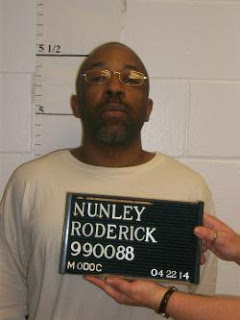
Missouri executes Roderick Nunley 9:09 p.m


BONNE TERRE, Mo. (AP) – Missouri executed Tuesday evening Roderick Nunley for the kidnapping, rape and fatal stabbing of 15-year-old Ann Harrison in 1989.

Nunley was pronounced dead at 9:09 p.m., according to the Missouri Department of Corrections.

Roderick Nunley

9:09 p.m.

A man who spent nearly 25 years on Missouri’s death row has been executed for the kidnapping, rape and stabbing death of a 15-year-old Kansas City girl.

Fifty-year-old Roderick Nunley died by injection Tuesday night. Of 20 executions nationally in 2015, 10 have been in Texas and six in Missouri.

Ann Harrison was waiting for a school bus on her driveway, 20 yards from her front door, on March 22, 1989. Nunley and Michael Taylor drove by in a stolen car and abducted her. They took her to the home of Nunley’s mother where she was raped, sodomized and then fatally stabbed.

The girl’s body was found in the trunk of the abandoned car three days later.

Both men were sentenced to death in 1991. Taylor was executed last year.

___

5:30 p.m.

The U.S. Supreme Court says it won’t stop the scheduled execution of a man convicted in the 1989 kidnapping, rape and stabbing death of a 15-year-old girl in Kansas City.

The justices issued orders Tuesday evening denying a stay of execution for 50-year-old Roderick Nunley. He’s set to be executed at 6 p.m. Tuesday for the death of Ann Harrison.

Investigators say the girl was randomly targeted as she waited outside her home for the school bus. She was taken to a home, raped and fatally stabbed.

Nunley’s attorney had three appeals pending before the Supreme Court. One questioned the constitutionality of the death penalty Another argued Nunley should’ve been sentenced by a jury, not a judge.

A third took issue with Missouri’s process of secretly acquiring its execution drug.

___

1 a.m.

Missouri prison officials are preparing to execute a man convicted of killing a 15-year-old girl more than two decades ago in Kansas City.

Fifty-year-old Roderick Nunley is scheduled to be executed at 6 p.m. Tuesday for the kidnapping, rape and stabbing death of Ann Harrison. Investigators say the girl was randomly targeted while waiting in her driveway for the school bus on the morning of March 22, 1989.

Nunley’s co-defendant, Michael Taylor, also was convicted of first-degree murder. He was executed last year.

Nunley’s attorney has three appeals pending before the U.S. Supreme Court. One questions the constitutionality of the death penalty, while another argues that Nunley should’ve been sentenced by a jury, not a judge. An appeal filed Monday takes issues with Missouri’s process of secretly acquiring its execution drug.

Gov. Jay Nixon is also weighing a clemency petition.

___